What Is SOFR? Understanding the New Benchmark Rate Behind U.S. Financial Markets


Hello, this is MasterMind.
When the Federal Reserve changes interest rates, investors usually focus on the Fed Funds Rate. However, professional investors and financial institutions pay close attention to another important indicator: SOFR (Secured Overnight Financing Rate).
Why?
Because the Fed Funds Rate represents the central bank's policy direction, while SOFR shows what is actually happening in the financial system.
SOFR reflects the real cost of borrowing dollars using U.S. Treasury securities as collateral. It has become one of the most important indicators for understanding liquidity conditions, funding stress, and the movement of money across global financial markets.
For investors, understanding SOFR means understanding how money actually flows beneath the surface of the market.
Key Takeaway
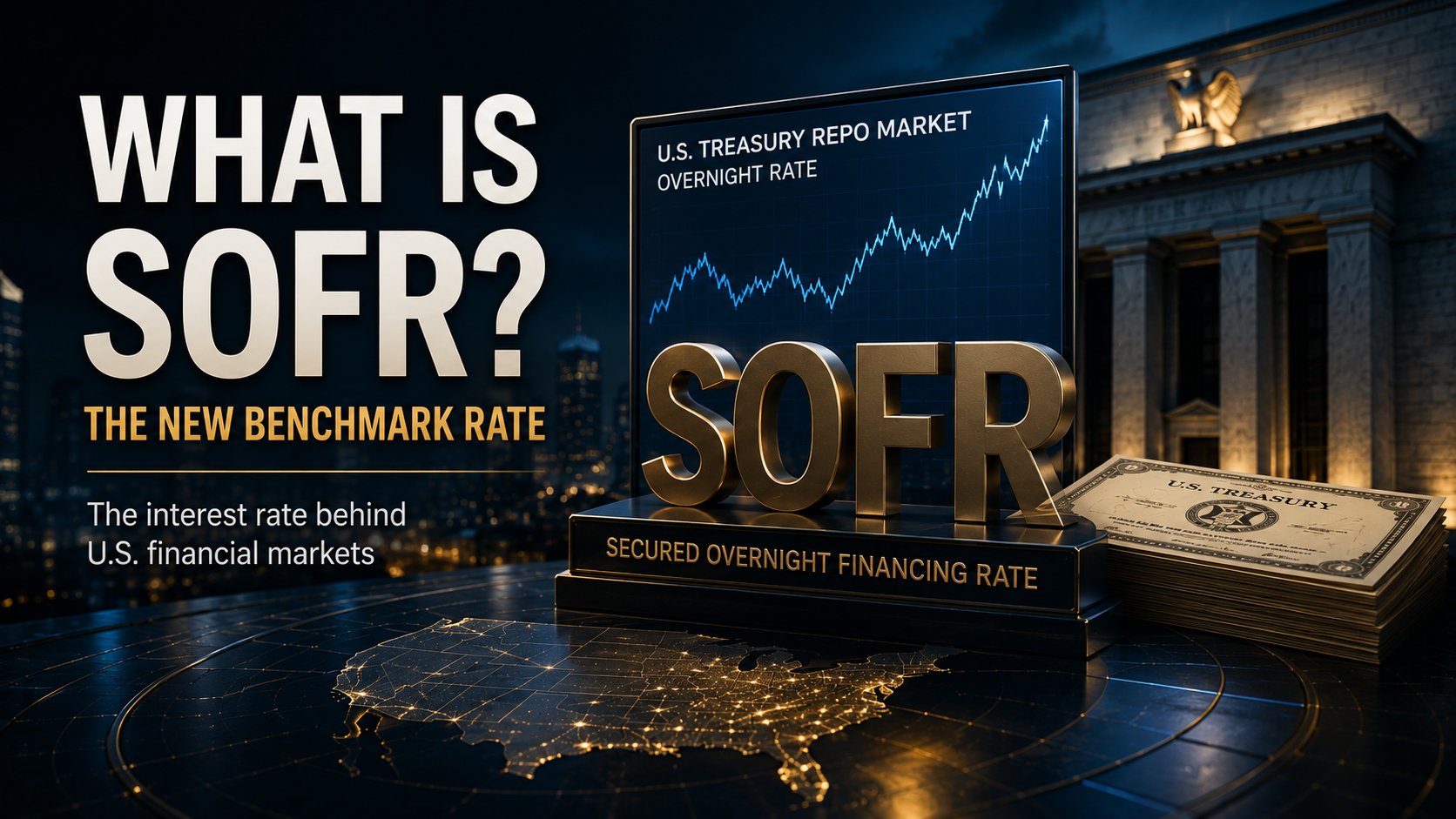
SOFR is the benchmark overnight interest rate based on real transactions in the U.S. Treasury repo market, providing investors with a clearer view of dollar liquidity and financial market conditions.
What Is SOFR?
SOFR stands for Secured Overnight Financing Rate.
It represents the average interest rate paid by financial institutions when they borrow cash overnight while using U.S. Treasury securities as collateral.
In simple terms
A financial institution needs cash.
It provides U.S. Treasury securities as collateral.
Another institution provides dollars.
The interest rate charged in that transaction becomes part of the SOFR calculation.
Unlike many traditional interest rates, SOFR is based on actual market transactions, not estimates or surveys.
This makes SOFR one of the most transparent indicators of short-term funding conditions in the U.S. financial system.
Why Did SOFR Replace LIBOR?
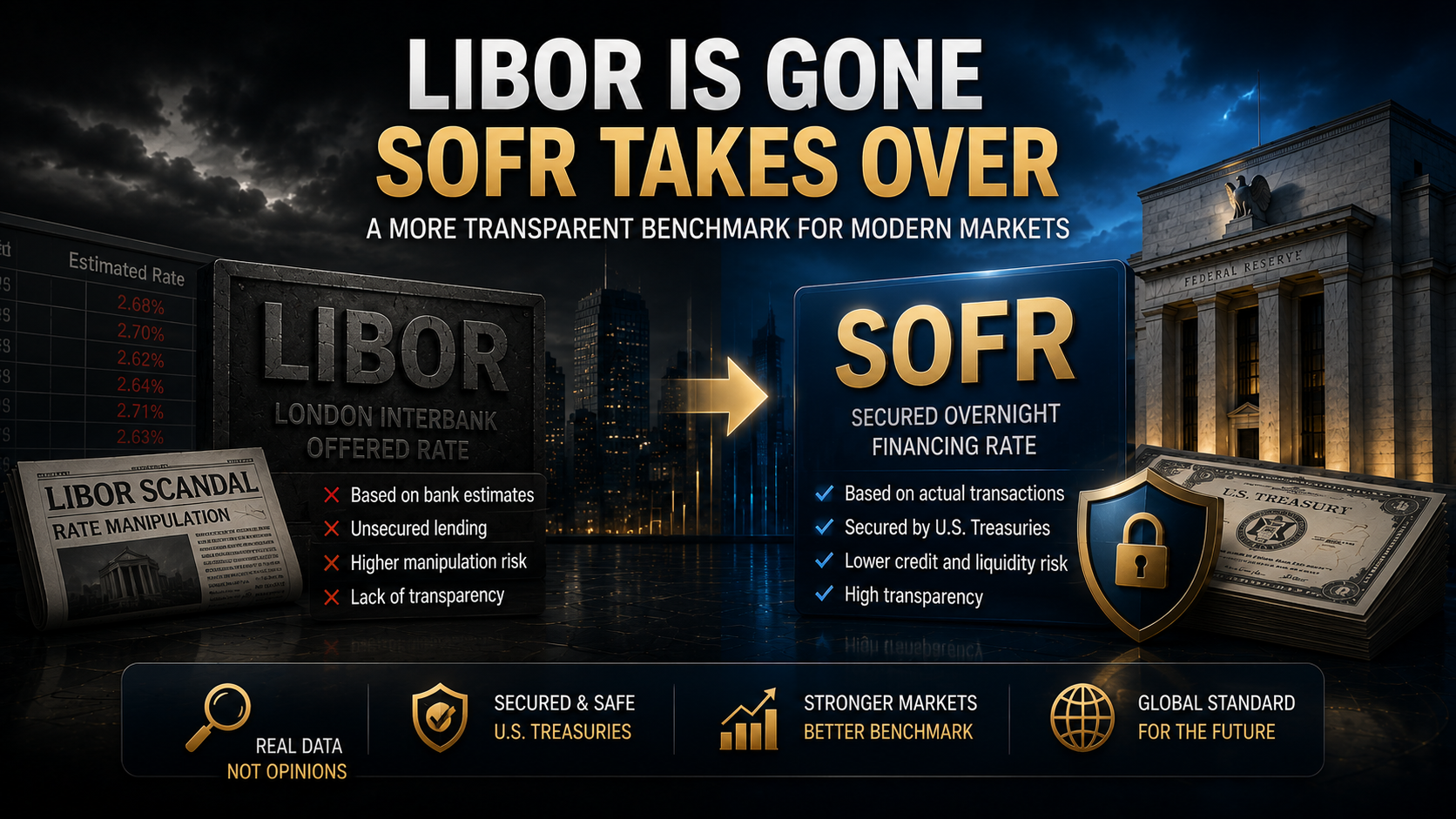
For decades, LIBOR (London Interbank Offered Rate) was the dominant benchmark interest rate used around the world.
However, LIBOR had a major weakness.
It was based on banks reporting the rates at which they believed they could borrow money, rather than being directly calculated from actual transactions.
After the LIBOR manipulation scandal, financial markets began searching for a more reliable benchmark.
That led to the adoption of SOFR.
| LIBOR | SOFR | |
| Calculation method | Bank estimates | Actual transactions |
| Collateral | Unsecured | U.S. Treasury securities |
| Market risk | Higher | Lower |
| Transparency | Limited | High |
| Current status | Discontinued | Major benchmark |
The transition from LIBOR to SOFR was not simply a technical adjustment.
It represented a major change toward a more transparent and market-based financial system.
How Does SOFR Work? Understanding the Repo Market

To understand SOFR, investors need to understand the repo market.
The repo market is one of the most important parts of the global financial system because it provides short-term liquidity to financial institutions.
The basic process
1. A financial institution needs cash
Banks, hedge funds, and securities firms may need short-term funding.
2. They provide Treasury securities as collateral
Because U.S. Treasury securities are considered highly liquid and safe assets, they can be used as collateral.
3. Another institution provides dollars
Money market funds and banks with excess cash provide funding.
4. The borrower repays the cash with interest
The interest rate generated through these transactions becomes part of SOFR.
This means SOFR is not just an interest rate.
It is a measurement of how easily dollars move through the financial system.
Why Is SOFR Important for Investors?
SOFR Shows Real Market Liquidity
The Federal Reserve controls monetary policy, but markets determine actual financial conditions.
The Fed can announce a policy change, but investors need to know
"Is liquidity actually improving or tightening?"
SOFR provides that answer.
When SOFR remains stable, it usually indicates that short-term funding markets are functioning normally.
When SOFR rises sharply, it can signal stress in the financial system.
SOFR Influences Financial Products
SOFR is now widely used as a reference rate for
- Corporate loans
- Floating-rate bonds
- Interest rate swaps
- Derivatives
- Financial contracts
Changes in SOFR can affect borrowing costs for companies and financial institutions.
Higher funding costs can eventually influence corporate earnings and asset valuations.
How SOFR Affects Financial Markets
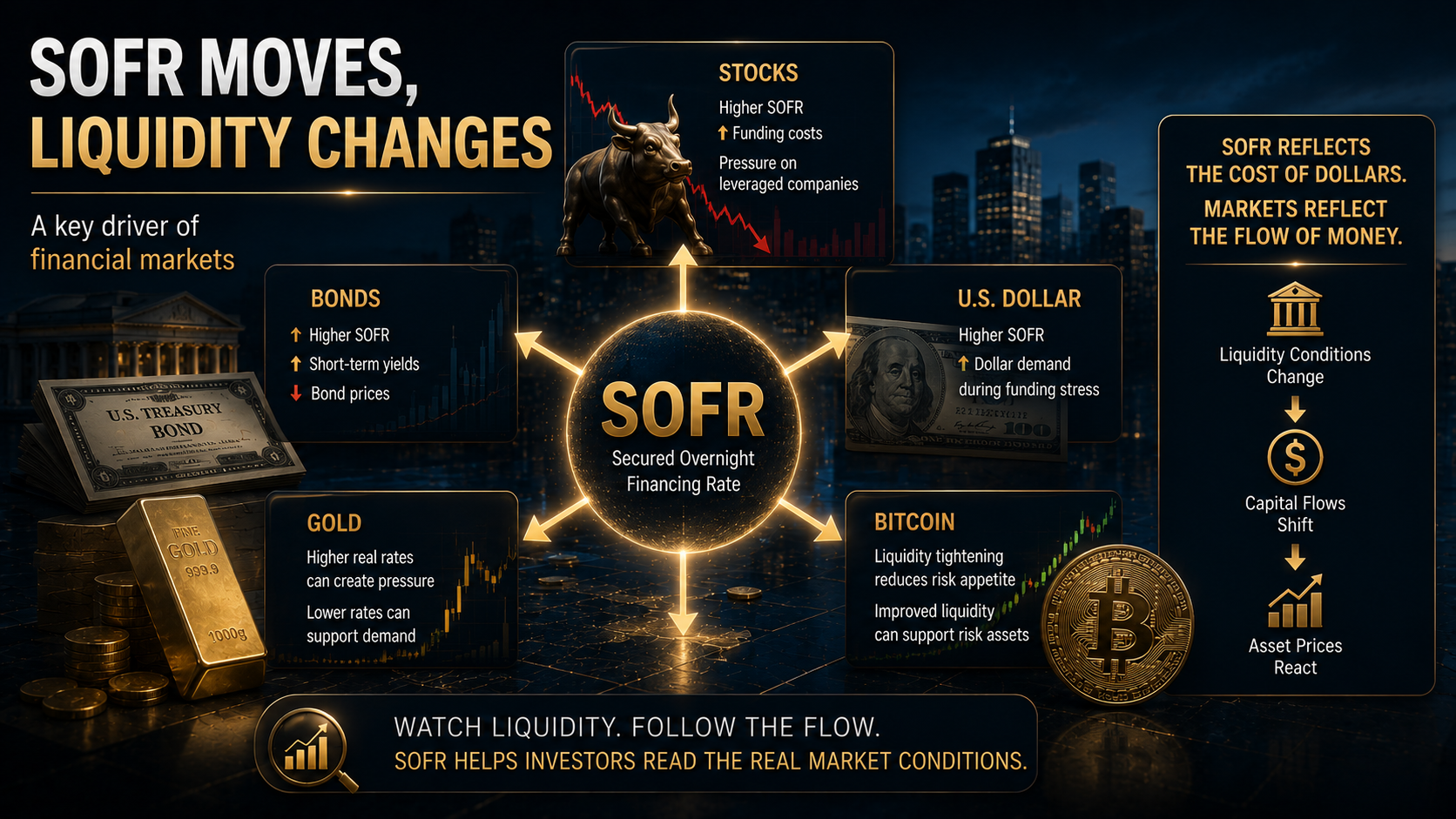
SOFR movements can influence multiple asset classes.
| Asset | When SOFR Rises | When SOFR Falls |
| Stocks | Higher funding costs, pressure on leveraged companies | Improved liquidity conditions |
| Bonds | Short-term yields may rise, bond prices may decline | Lower yields support bond prices |
| U.S. Dollar | Dollar demand may increase during funding stress | Dollar pressure may ease |
| Gold | Higher real rates can create pressure | Lower rates can support demand |
| Bitcoin | Liquidity tightening can reduce risk appetite | Improved liquidity can support risk assets |
Financial markets may appear disconnected, but they are ultimately connected through one thing
The movement of money.
SOFR and Quantitative Tightening (QT)
One of the most important relationships investors should understand is the connection between SOFR and the Federal Reserve's quantitative tightening policy.
During QT, the Fed reduces the size of its balance sheet and removes liquidity from the financial system.
Initially, markets can absorb this change because excess liquidity remains available.
However, as liquidity becomes tighter, short-term funding markets may begin to show stress.
This is where SOFR becomes important.
A rising SOFR can indicate that obtaining short-term dollar funding is becoming more expensive.
Historically, sudden stress in repo markets has forced the Federal Reserve to respond by providing additional liquidity.
For investors, SOFR can serve as an early warning signal of changing financial conditions.
What Should Investors Watch?
Investors should focus on several key points.
1. The direction matters more than the level
A sudden increase in SOFR can be more important than the absolute number itself.
2. Compare SOFR with Fed policy rates
The relationship between SOFR and the Fed Funds Rate can reveal whether market conditions are aligned with Federal Reserve policy.
3. Watch liquidity before price movements
Markets often react to changes in liquidity before those changes appear in stock prices.
Money moves first.
Asset prices follow.
What Do Long-Term Investors See in SOFR?
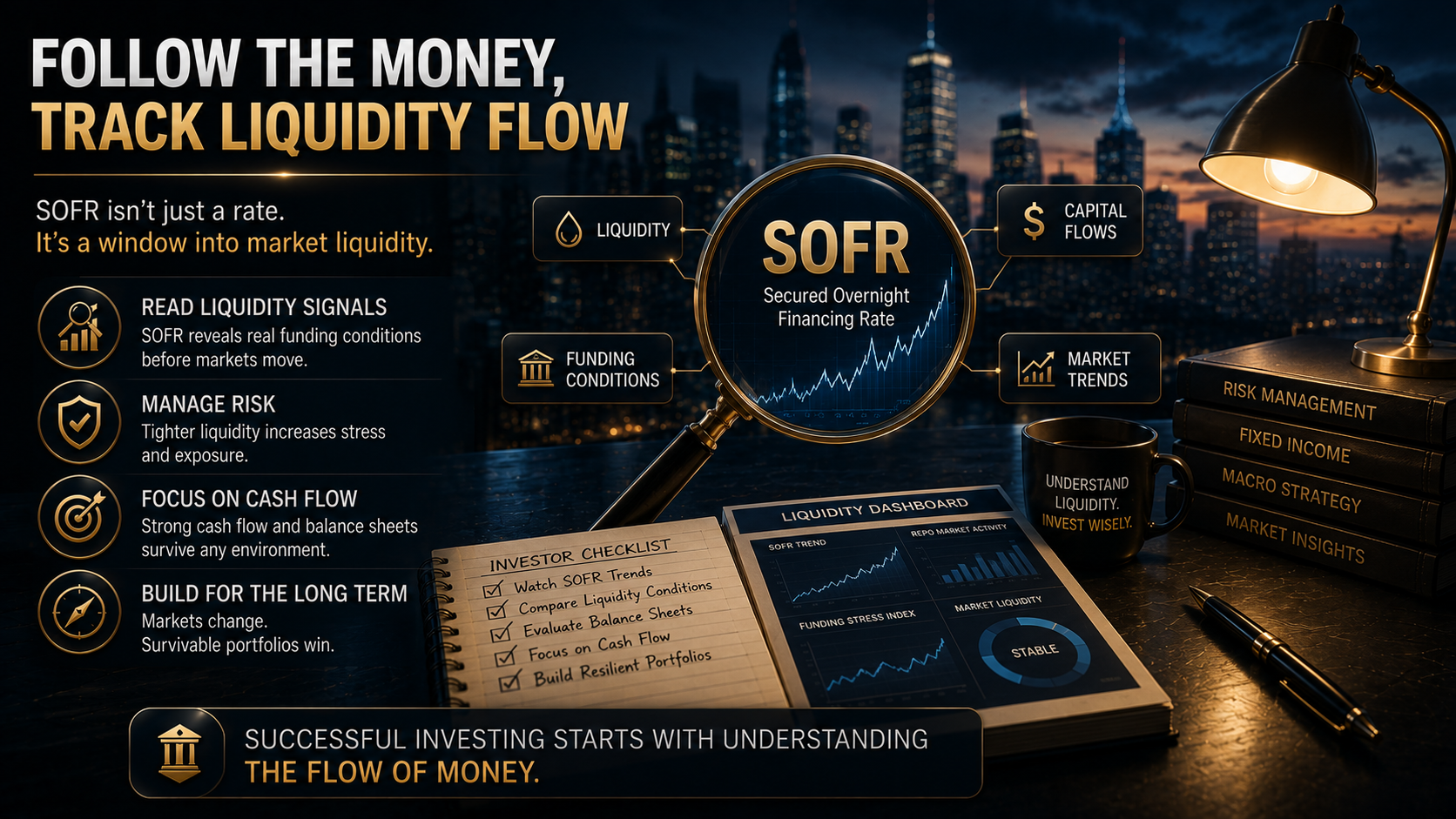
Money Flow
Professional investors do not view SOFR as just another interest rate.
They use it to understand where capital is moving.
Is money flowing toward risk assets?
Or is it moving into safer short-term instruments?
Cash Flow and Asset Survival
Higher funding costs can expose companies with weak balance sheets.
Investors pay attention to
- Debt levels
- Refinancing risks
- Free cash flow
- Business durability
A company that depends heavily on cheap financing may struggle when liquidity conditions tighten.
Long-Term Investment Perspective
Investors should ask
- Can my portfolio survive a period of tighter dollar liquidity?
- Are the companies I own generating strong cash flow?
- Am I focusing only on prices, or also on financial conditions?
- Do I understand where capital is moving?
Successful investing is not about predicting every market move.
It is about building a structure that can survive different economic environments.
Final Thoughts
SOFR is more than a short-term interest rate.
It is a window into the real condition of the U.S. financial system.
As the replacement for LIBOR, SOFR has become a critical benchmark for understanding funding costs, liquidity conditions, and the movement of capital across global markets.
For investors, the most important lesson is this
Markets move because money moves. Understanding SOFR means understanding the foundation of that movement.
Master Mind was here.
'[Global] Success Blueprints' 카테고리의 다른 글