What Are Investment-Grade Bonds? How They Work and Why They Matter


Hello, this is MasterMind.
When financial markets become volatile, where does institutional money go?
During periods of uncertainty, pension funds, insurance companies, endowments, and large asset managers often reduce exposure to risky assets and increase allocations to high-quality bonds. Among those, investment-grade bonds play a central role.
But what exactly makes a bond "investment grade"? Why do professional investors closely monitor this market? And what can individual investors learn from the way institutional capital flows?
In this article, we'll break down how investment-grade bonds work, why they matter to the broader economy, and how they influence stocks, Treasury yields, gold, and other major asset classes.
Key Takeaway
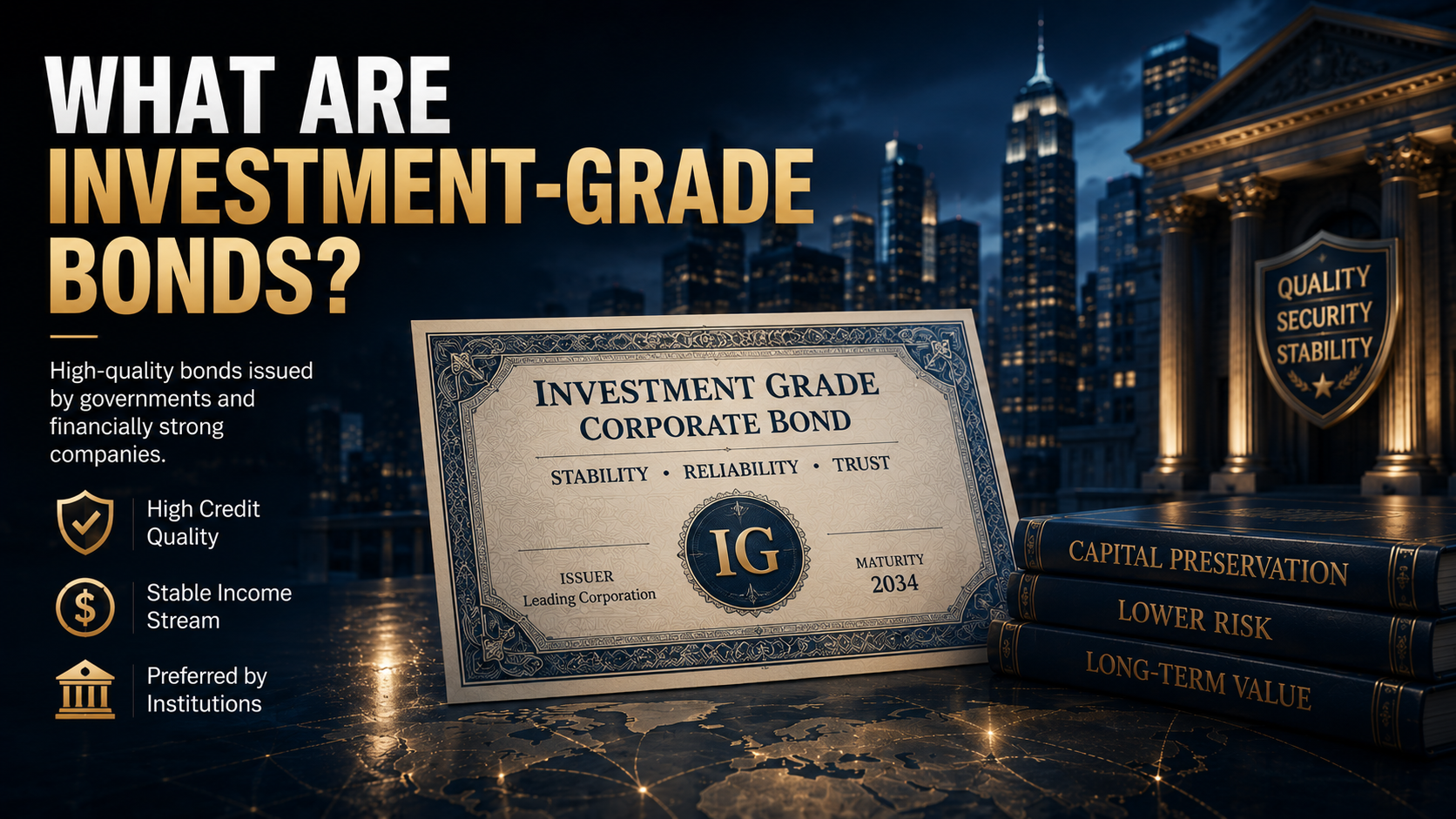
Investment-grade bonds are high-credit-quality debt securities that provide relatively stable income while serving as one of the most important defensive assets in global financial markets.
What Are Investment-Grade Bonds?
Investment-grade bonds are debt securities issued by governments, corporations, or agencies that have received high credit ratings from major rating agencies such as S&P Global Ratings, Moody's, and Fitch Ratings.
In simple terms, they are bonds issued by borrowers that are considered highly likely to repay both principal and interest on time.
Unlike stocks, which represent ownership, bonds represent loans. When you buy a bond, you are lending money to the issuer in exchange for regular interest payments and the return of your principal at maturity.
However, not all borrowers carry the same level of financial strength.
Some companies have strong balance sheets, consistent cash flow, and manageable debt levels, while others face greater financial uncertainty. Credit ratings help investors distinguish between those differences.
Investment Grade vs. High Yield
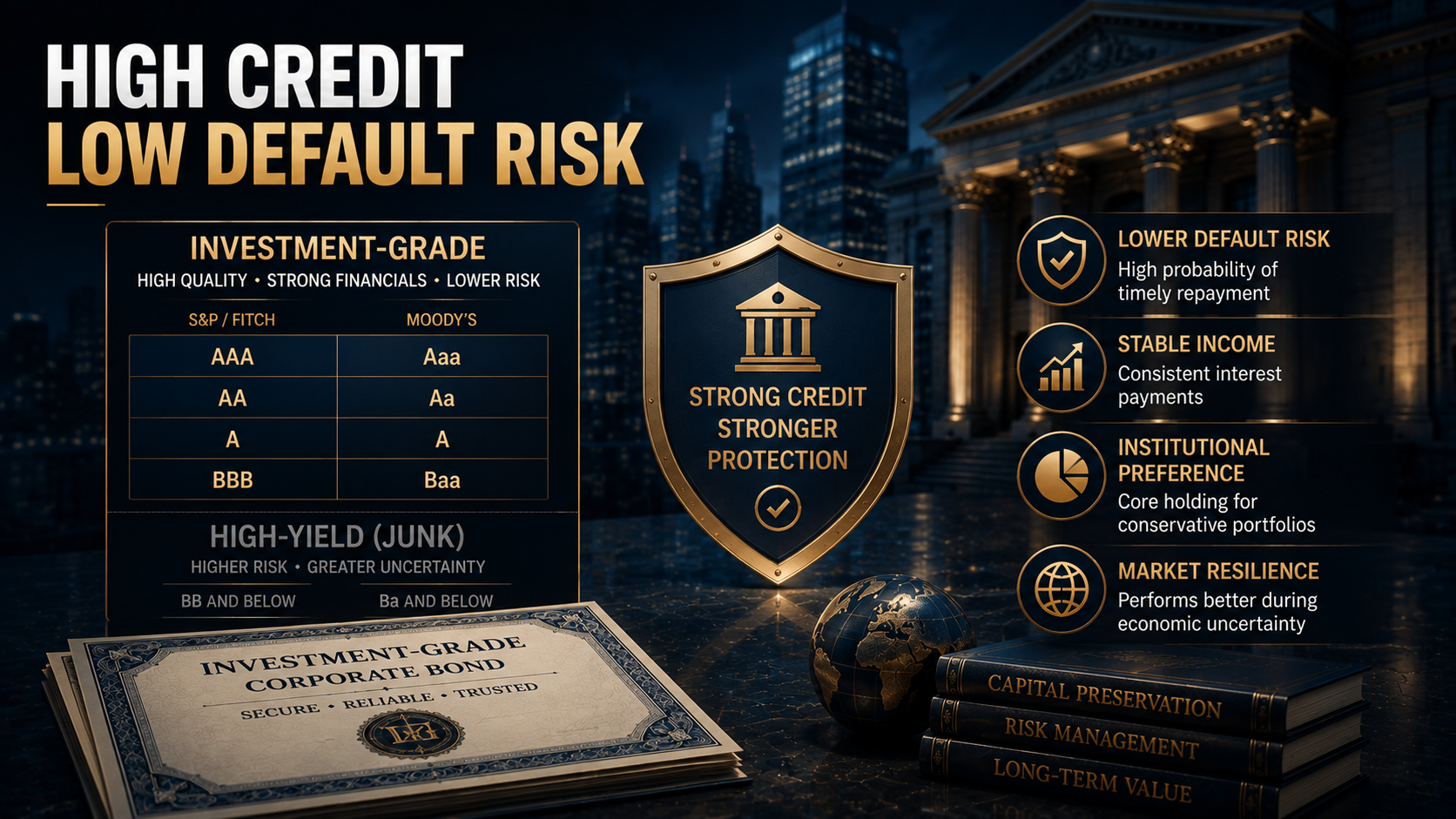
Investment-grade bonds generally include ratings of
| S&P / Fitch | Moody's | Classification |
| AAA | Aaa | Highest quality |
| AA | Aa | Very high quality |
| A | A | Strong credit quality |
| BBB | Baa | Lowest investment-grade level |
Anything below BBB- (or Baa3) is considered high-yield, sometimes called junk bonds.
One of the biggest misconceptions among new investors is assuming that a higher yield automatically means a better investment.
In reality, higher yields usually compensate investors for taking on greater credit risk.
How Investment-Grade Bonds Work
At their core, bonds generate returns through two primary sources
- Regular coupon payments
- Price appreciation or depreciation as market interest rates change
Unlike savings accounts, bond prices fluctuate daily in the secondary market.
Understanding these price movements is essential.
Interest Rates and Bond Prices
Bond prices move in the opposite direction of interest rates.
When market interest rates rise, newly issued bonds offer higher yields, making older bonds with lower coupons less attractive.
As a result, existing bond prices fall.
Conversely, when interest rates decline, older bonds with higher coupon rates become more valuable, pushing their market prices higher.
This relationship explains why bonds can generate capital gains in addition to interest income.
Credit Spreads
Another key concept is the credit spread.
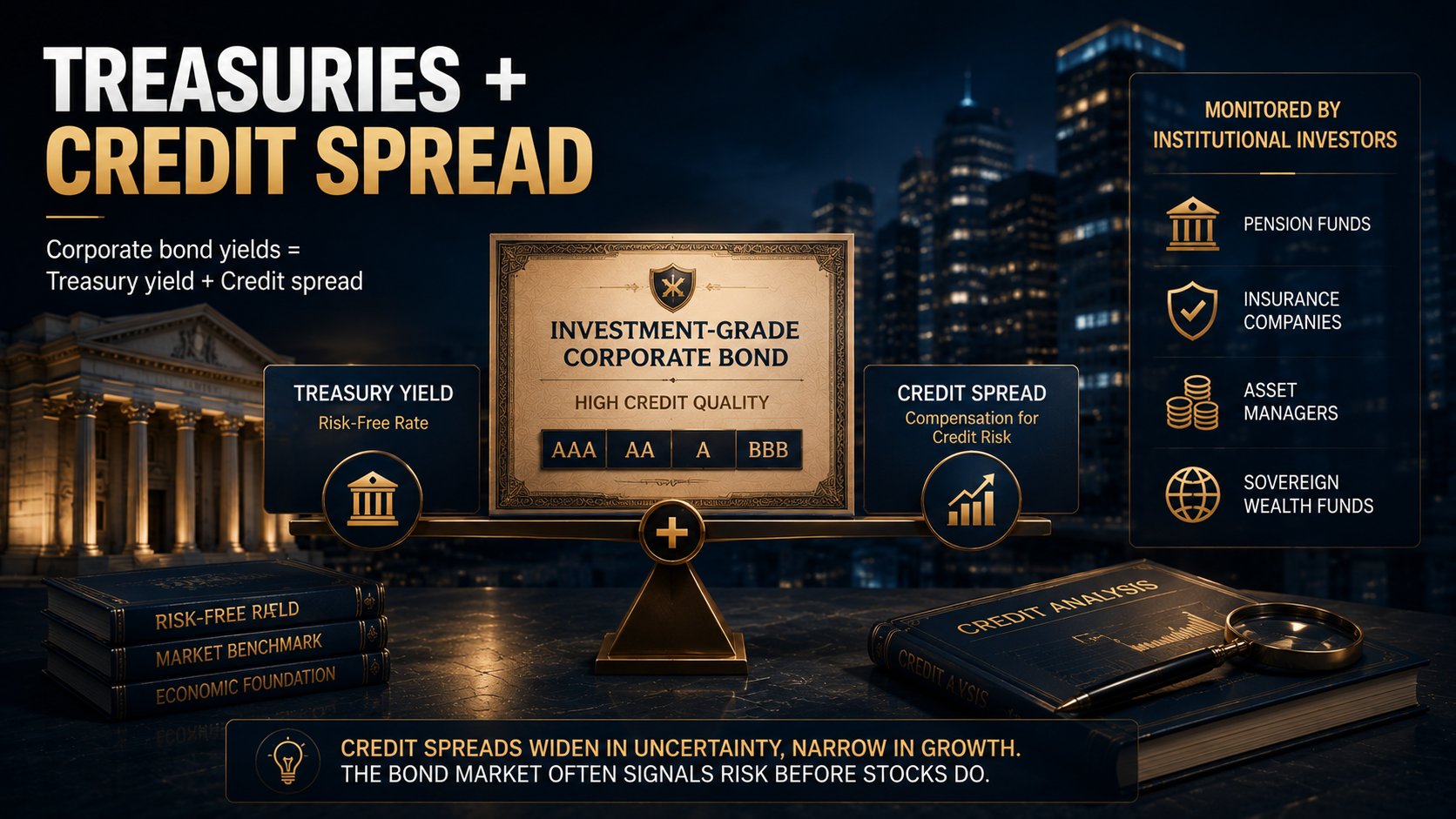
An investment-grade corporate bond typically yields more than a U.S. Treasury bond because investors require additional compensation for taking on corporate credit risk.
The relationship can be summarized as
Corporate Bond Yield = Treasury Yield + Credit Spread
When economic conditions improve, default risk declines, and credit spreads generally narrow.
During recessions or periods of financial stress, investors demand greater compensation for risk, causing credit spreads to widen.
Many professional investors closely monitor credit spreads because they often reveal changes in market sentiment before stock prices fully react.
Stocks often reflect optimism first. Bond markets frequently recognize risk first.
Why Investment-Grade Bonds Matter
Investment-grade bonds are much more than conservative income investments.
They represent one of the largest pools of institutional capital in the world.
Major investors including
- Pension funds
- Insurance companies
- Sovereign wealth funds
- University endowments
- Central banks
- Asset management firms
allocate substantial portions of their portfolios to investment-grade fixed income.
Many institutions are also required by regulation or investment policy to maintain minimum allocations to high-quality bonds.
As a result, changes in demand for investment-grade bonds often signal shifts in overall market confidence.
The Importance of Fallen Angels
One area closely watched by professional investors involves Fallen Angels.
A Fallen Angel refers to a company whose credit rating falls from investment grade to high yield.
This downgrade can trigger forced selling because many institutional investors are prohibited from holding below-investment-grade securities.
Large waves of Fallen Angel downgrades can tighten financial conditions and reduce market liquidity, making them an important indicator during economic downturns.
Impact on Financial Markets
Investment-grade bonds influence far more than just the bond market.
| Asset Class | Typical Market Impact |
| Stocks | Wider credit spreads can reduce investor appetite for equities and pressure corporate valuations. |
| Treasuries | Treasury yields serve as the benchmark for pricing investment-grade corporate debt. |
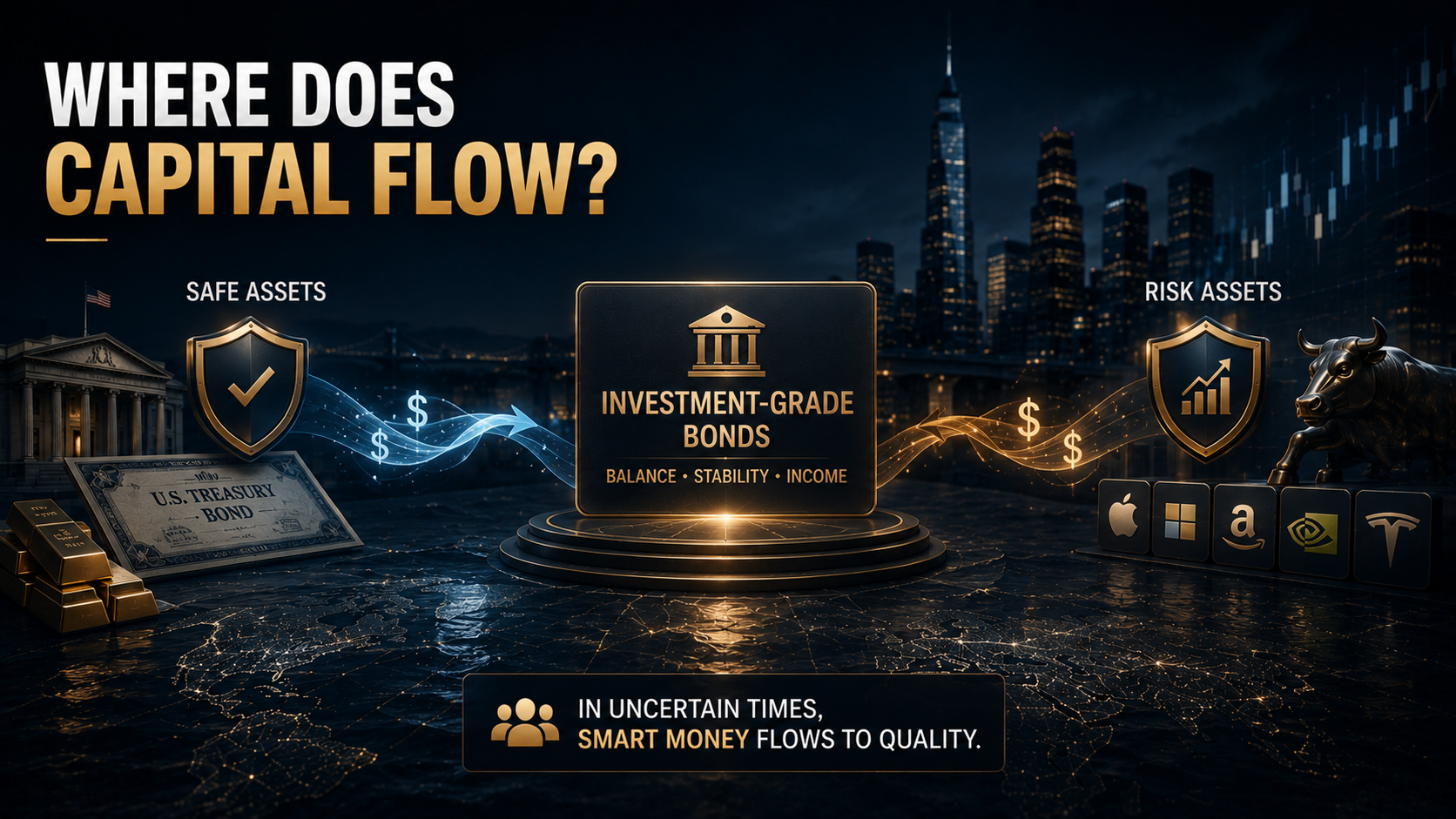
| U.S. Dollar | During periods of global uncertainty, international capital often flows into dollar-denominated investment-grade bonds, supporting the U.S. dollar. |
| Gold | Falling real yields and declining bond attractiveness may increase demand for gold. |
| Bitcoin & Risk Assets | During periods of abundant liquidity, investors may rotate from defensive assets toward higher-risk investments. |
No single asset moves in isolation.
Capital constantly reallocates based on changing expectations for growth, inflation, interest rates, and credit conditions.
What Investors Should Watch
Duration
Duration measures how sensitive a bond's price is to changes in interest rates.
Long-duration bonds generally benefit more when rates decline but experience larger price declines when rates rise.
Credit Quality
Not all investment-grade bonds offer the same level of safety.
Many bond funds hold significant allocations to BBB-rated issuers, which carry greater downgrade risk than higher-rated securities.
Reviewing the overall credit quality of a portfolio is just as important as evaluating yield.
Credit Outlook
Credit ratings tell investors where a company stands today.
Credit outlooks indicate where those ratings may be headed.
A Negative Outlook may signal increased downgrade risk well before an official rating change occurs.
Professional investors often react to outlook revisions before rating agencies announce formal downgrades.
What Wealthy Investors Really Watch
Experienced investors rarely focus only on the coupon rate.
Instead, they study the broader flow of capital.
When uncertainty rises, preserving capital becomes more important than maximizing returns.
Investment-grade bonds provide predictable cash flow, relatively low default risk, and portfolio stability during periods of market stress.
Professional investors also recognize that purchasing high-quality bonds near the peak of an interest-rate cycle can create two potential sources of return
- Consistent income through coupon payments
- Capital appreciation if interest rates decline later
Rather than trying to predict every market move, successful long-term investors focus on building portfolios that can withstand changing economic environments.
Ask yourself
- Is capital currently moving toward defensive assets or risk assets?
- Does my portfolio generate reliable cash flow during market downturns?
- Am I reaching for yield without fully understanding the credit risk involved?
- Can my portfolio remain resilient through an entire economic cycle?
Markets often reveal their biggest signals through capital flows—not headlines.
Conclusion
Investment-grade bonds are much more than "safe corporate bonds."
They are one of the foundational building blocks of the global financial system, reflecting credit quality, investor confidence, and the movement of institutional capital.
While equities often dominate financial headlines, investment-grade bonds quietly influence borrowing costs, corporate financing, portfolio construction, and overall market stability.
For long-term investors, understanding investment-grade bonds isn't simply about fixed income. It's about understanding how money moves through financial markets and why preserving capital is often just as important as growing it.
The most successful investors don't chase the highest yields. They build portfolios capable of generating durable cash flow while remaining resilient across changing market conditions.
This has been MasterMind.
'[Global] Success Blueprints' 카테고리의 다른 글