What Is the High-Yield Bond Spread? A Key Recession Signal


Hello, this is MasterMind.
What part of the financial market tends to detect trouble before stock prices fully react?
Many investors immediately think of the S&P 500, the Nasdaq, or the VIX. However, some of the earliest signs of financial stress often appear in the credit market, particularly in the high-yield bond spread.
High-yield bonds are issued by companies with weaker credit ratings. Because these businesses are more vulnerable to rising interest costs, slowing revenue, and tighter liquidity, their bond prices often react quickly when investors begin to question the health of the economy.
That is why experienced investors do not view the high-yield market merely as a place to earn additional income. They use it as a gauge of corporate stress, liquidity conditions, and overall risk appetite.
So, what exactly is a high-yield bond spread, why does it widen during periods of market stress, and what can it tell investors about stocks, bonds, the U.S. dollar, gold, and Bitcoin?
One-Sentence Summary
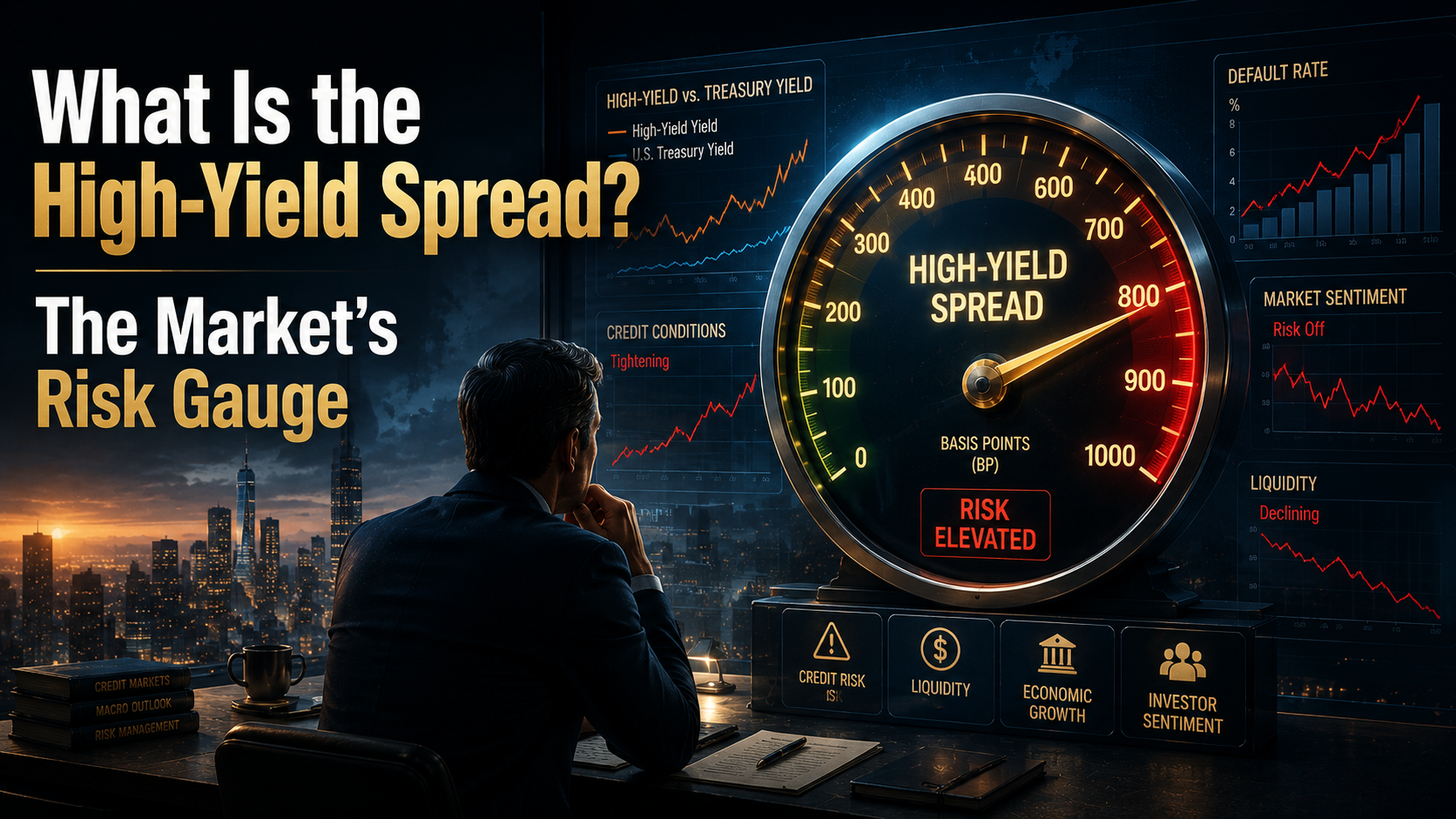
The high-yield bond spread measures the extra return investors demand for holding lower-quality corporate debt instead of U.S. Treasuries, making it one of the clearest indicators of credit risk, liquidity stress, and changing market sentiment.
What Is a High-Yield Bond?
A high-yield bond is a corporate bond issued by a company with a below-investment-grade credit rating.
These bonds are also known as
- Speculative-grade bonds
- Non-investment-grade bonds
- Junk bonds
The term “junk bond” can sound dismissive, but it simply refers to debt issued by companies with a higher probability of financial distress or default.
Credit rating agencies such as S&P Global Ratings, Moody’s, and Fitch evaluate a company’s ability to repay its debt.
Under the S&P and Fitch scale, the broad distinction is generally
| Bond category | Credit rating | General meaning |
| Investment grade | BBB- or higher | Lower expected default risk |
| High yield | BB+ or lower | Higher expected default risk |
A company with a strong balance sheet can usually borrow at a relatively low interest rate. A financially weaker company must offer a higher yield to persuade investors to accept greater uncertainty.
In simple terms
High-yield bonds offer more income because investors are being paid to bear more credit risk.
The higher yield is not free money. It is compensation for the possibility that the issuer may struggle to make interest payments, refinance its debt, or repay principal at maturity.

What Is the High-Yield Bond Spread?
The high-yield bond spread is the difference between the yield on high-yield corporate bonds and the yield on comparable U.S. Treasury securities.
The basic relationship can be expressed as
High-Yield Spread = High-Yield Bond Yield − U.S. Treasury Yield
For example
- High-yield corporate bond yield: 8%
- Comparable U.S. Treasury yield: 4%
- High-yield spread: 4 percentage points, or 400 basis points
One percentage point equals 100 basis points, so a 4% spread is usually described as a 400-basis-point spread.
The spread represents the additional compensation investors demand for taking corporate credit risk rather than holding U.S. government debt.
That additional return is known as the credit risk premium.
Why Are High-Yield Bonds Compared with U.S. Treasuries?
U.S. Treasuries are commonly used as the benchmark for the risk-free rate in global financial markets.
They are not entirely free of every possible risk. Treasury prices still move with inflation expectations, interest rates, and duration. However, they are generally treated as the reference point for default-free U.S. dollar borrowing.
A corporate bond yield can therefore be viewed as two major components
Corporate bond yield = Treasury yield + credit spread
The Treasury portion reflects the broader level of interest rates.
The credit spread reflects the extra risk associated with the company itself.
This distinction is important because a corporate bond yield can rise for different reasons.
It may rise because Treasury yields are increasing across the entire market. It may also rise because investors believe the issuing company has become more likely to default.
The high-yield spread helps separate those two forces.
A widening spread suggests that investors are demanding more compensation for credit risk. A narrowing spread suggests that investors feel more comfortable holding lower-quality corporate debt.
How Does the High-Yield Spread Work?
The high-yield spread changes with the economic cycle, corporate profitability, financial conditions, and investor sentiment.
During Economic Expansion
When the economy is growing
- Corporate revenue tends to improve
- Cash flow becomes more stable
- Default expectations decline
- Banks and capital markets remain open
- Investors become more willing to take risk
Demand for high-yield bonds increases.
When bond demand rises, bond prices move higher and yields move lower. As the yield on high-yield bonds falls relative to Treasury yields, the spread narrows.
A narrowing spread usually reflects confidence in corporate balance sheets and a willingness to hold riskier assets.
During Economic Slowdown or Financial Stress
When growth weakens
- Corporate earnings may decline
- Interest coverage ratios deteriorate
- Refinancing becomes more expensive
- Default risk increases
- Investors begin moving toward safer assets
Investors sell high-yield bonds and buy Treasuries.
High-yield bond prices fall, pushing their yields higher. Treasury prices may rise as safe-haven demand increases, pushing Treasury yields lower.
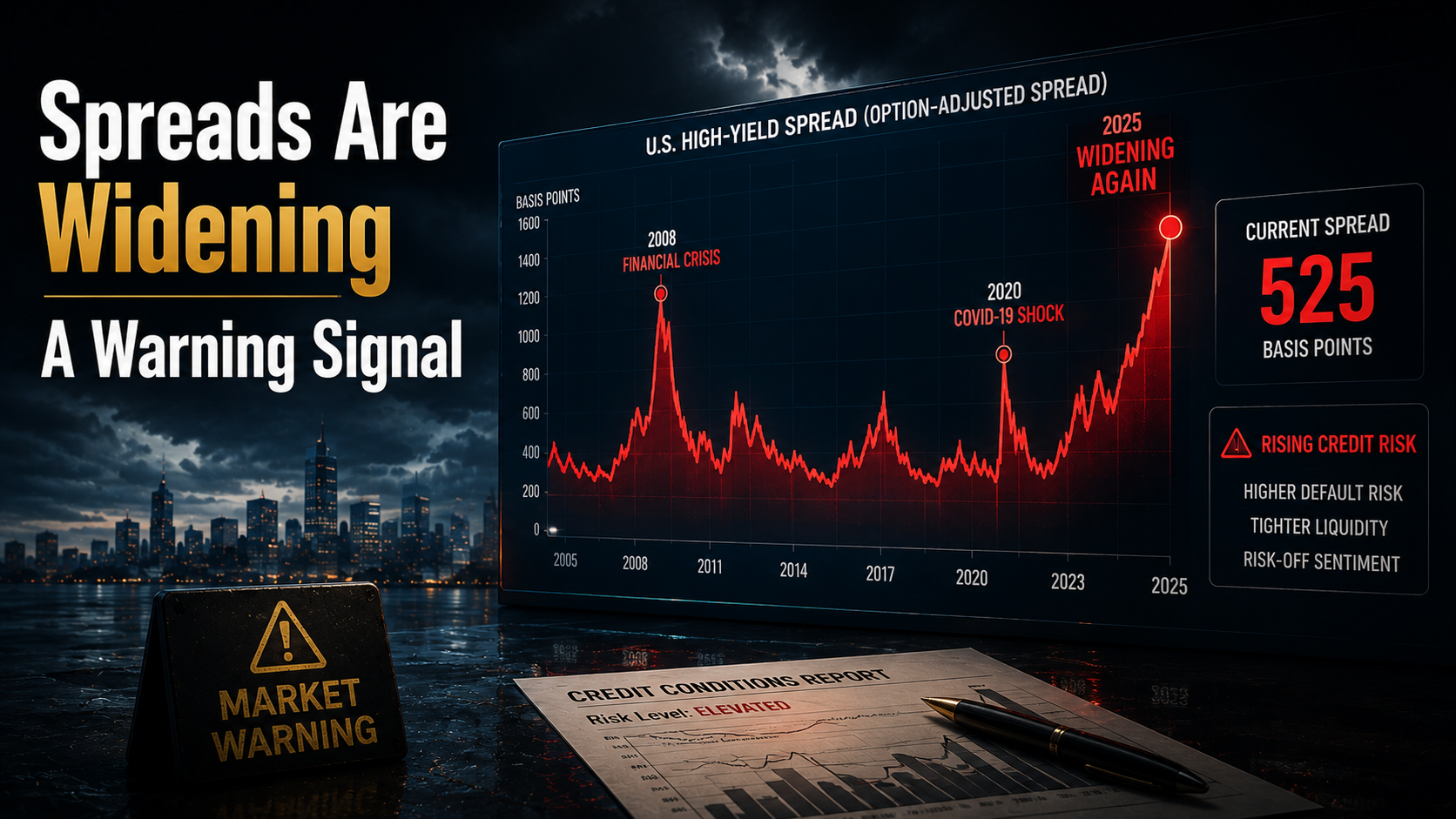
This combination causes the high-yield spread to widen, sometimes very quickly.
The key point is that the spread does not widen simply because interest rates are high. It widens because the market is reassessing the probability of corporate losses.
Why Is the High-Yield Bond Spread Important?
The high-yield spread matters because it acts as a real-time measure of financial stress.
It provides insight into three major areas
- Corporate default risk
- Market liquidity
- Investor risk appetite
A Canary in the Credit Market
High-yield issuers are often among the weakest borrowers in the financial system.
They may have
- Heavy debt burdens
- Cyclical revenue
- Low profit margins
- Weak interest coverage
- Significant refinancing needs
When liquidity is abundant, even weak companies can often refinance existing debt and continue operating.
When liquidity tightens, these companies are usually among the first to feel pressure.
For that reason, the high-yield market is often compared with a canary in a coal mine. It may begin showing signs of stress before problems become obvious in the broader economy.
A Signal of Financial Conditions
Financial conditions describe how easy or difficult it is for households and businesses to access capital.
When high-yield spreads are narrow, financing is usually easier. Companies can issue debt at manageable rates, refinance obligations, and invest in expansion.
When spreads widen, borrowing costs increase even if the Federal Reserve has not changed policy rates.
This is why credit spreads can tighten financial conditions independently of the Fed.
A company may face a much higher effective borrowing cost because investors demand more compensation for risk, even if Treasury yields remain unchanged.
A Measure of Risk Appetite
High-yield bonds sit between traditional bonds and equities.
They have contractual interest payments like bonds, but their market behavior often resembles stocks because their performance depends heavily on corporate survival and economic growth.
When investors are confident, money tends to move into high yield, small-cap stocks, emerging markets, and other risk assets.
When fear rises, capital often moves toward Treasuries, cash, and defensive assets.
The high-yield spread therefore reveals how much risk the market is willing to absorb.
Why High-Yield Bonds Often Behave More Like Stocks
High-yield bonds are legally debt instruments, but their economic sensitivity is often closer to equities than to government bonds.
An investment-grade bond investor is mostly concerned with
- Interest rates
- Inflation
- Duration
- Moderate changes in credit quality
A high-yield investor must also focus on
- Default probability
- Recovery value after default
- Business-cycle sensitivity
- Access to refinancing
- Corporate cash flow
- Bankruptcy risk
If a company becomes financially distressed, its bond price may fall sharply even if Treasury yields decline.
That is why high-yield bonds may perform poorly during recessions at the same time that U.S. Treasuries perform well.
The label “bond” does not automatically make an asset defensive.
What Does a Widening High-Yield Spread Mean?
A widening spread generally indicates that investors are becoming more concerned about credit risk.
Possible reasons include
- Slowing economic growth
- Falling corporate profits
- Rising default expectations
- Tighter bank lending standards
- Higher refinancing costs
- Declining market liquidity
- Geopolitical or financial shocks
- Forced selling by leveraged investors
A gradual widening may simply reflect a normal increase in caution.
A rapid and broad-based widening is more serious because it may indicate that stress is spreading across the credit system.
The speed of the move often matters as much as the absolute level.
What Does a Narrowing High-Yield Spread Mean?
A narrowing spread usually indicates improving confidence.
Possible reasons include
- Stronger economic growth
- Better corporate earnings
- Falling default expectations
- Easier financial conditions
- Increased demand for income
- Greater investor risk tolerance
- Supportive monetary policy
- Improved access to refinancing
However, extremely narrow spreads can also become a warning sign.
When investors accept very little compensation for owning weak credit, the market may be underpricing risk.
In other words, narrow spreads can reflect healthy conditions, but they can also reflect complacency.
The most dangerous part of a credit cycle often occurs when investors believe default risk has nearly disappeared.
High-Yield Spreads and the Business Cycle
High-yield spreads usually move inversely with economic confidence.
| Economic environment | Typical spread behavior | Market interpretation |
| Strong expansion | Narrowing | Default risk perceived as low |
| Late-cycle optimism | Very narrow | Risk may be underpriced |
| Growth slowdown | Gradual widening | Caution is increasing |
| Recession or crisis | Sharp widening | Credit stress and default fears |
| Early recovery | Rapid narrowing | Liquidity and confidence return |
This framework is useful, but the high-yield spread should not be treated as a perfect recession timer.
Spreads may widen temporarily because of a market shock that does not lead to a recession. They may also stay narrow longer than expected when liquidity remains abundant.
The indicator is most valuable when combined with other economic and financial data.
How High-Yield Spreads Affect Major Asset Classes
Changes in high-yield spreads can influence the entire financial system because they reflect shifts in liquidity and risk appetite.
| Asset class | When spreads narrow | When spreads widen |
| U.S. stocks | Supportive for risk-taking and valuations | Greater downside pressure |
| High-yield bonds | Prices generally rise | Prices generally fall |
| U.S. Treasuries | Safe-haven demand may weaken | Safe-haven demand may strengthen |
| U.S. dollar | May stabilize or weaken in risk-on markets | Often benefits from demand for liquidity |
| Gold | May lag in strong risk-on periods | Can benefit from fear and policy uncertainty |
| Emerging markets | Capital inflows often improve | Capital outflows and currency stress may increase |
| Bitcoin | Often benefits from liquidity expansion | Often pressured by liquidity withdrawal |
These relationships are not automatic. Inflation, Federal Reserve policy, positioning, and geopolitical events can produce different outcomes.
Still, the broad pattern is clear
When credit risk rises, capital tends to move away from fragile assets and toward liquidity, quality, and safety.

High-Yield Spreads and the Stock Market
High-yield spreads and stocks often move in opposite directions.
When spreads narrow, investors are usually more confident in corporate earnings and balance sheets. That environment often supports higher equity valuations.
When spreads widen, investors begin questioning whether companies can sustain profits, refinance debt, and avoid default. Equity risk premiums may rise, and stock prices may face pressure.
This relationship is especially important for
- Small-cap companies
- Highly leveraged businesses
- Unprofitable growth stocks
- Cyclical industries
- Private equity-backed companies
- Firms with large near-term debt maturities
Large companies with strong balance sheets may initially appear resilient. However, if credit stress persists, tighter financing conditions can eventually affect hiring, capital expenditure, mergers, and consumer demand across the economy.
High-Yield Spreads and U.S. Treasuries
During periods of stress, investors often sell high-yield debt and buy U.S. Treasuries.
This creates two simultaneous movements
- High-yield bond yields rise
- Treasury yields fall
As a result, the spread widens rapidly.
However, inflationary shocks can complicate this relationship.
If inflation remains high, Treasury yields may rise even while credit spreads widen. In that case, high-yield borrowers face pressure from both directions
- A higher risk-free rate
- A larger credit risk premium
This combination can make refinancing especially difficult.
High-Yield Spreads and the U.S. Dollar
The U.S. dollar often strengthens during severe credit stress because global investors demand liquidity and safety.
Many companies and financial institutions around the world borrow in dollars. When risk rises, the need for dollar funding can increase.
A widening high-yield spread may therefore coincide with
- Stronger demand for cash
- Tighter global dollar liquidity
- Weakness in emerging-market currencies
- Pressure on commodities and speculative assets
However, the dollar’s response also depends on Federal Reserve policy and relative growth expectations.
High-Yield Spreads, Gold, and Bitcoin
Gold and Bitcoin are both sometimes described as alternatives to the traditional financial system, but they respond differently to credit stress.
Gold can benefit from
- Safe-haven demand
- Falling real yields
- Monetary easing expectations
- Concern about financial stability
Bitcoin is often more sensitive to
- Global liquidity
- Leverage
- Speculative risk appetite
- Institutional flows
- Dollar funding conditions
During an initial liquidity shock, both assets can fall as investors raise cash.
Over a longer period, their performance may diverge depending on the policy response.
If central banks respond to credit stress with aggressive liquidity support, both gold and Bitcoin may eventually benefit, but not necessarily at the same time or for the same reason.
Historical Lessons from Credit Spread Shocks
The 2008 Global Financial Crisis
During the financial crisis, high-yield spreads widened dramatically as investors reassessed mortgage exposure, bank solvency, and corporate default risk.
The credit market signaled severe stress well before the economic damage was fully reflected in employment and corporate earnings.
The important lesson was not simply that spreads widened. It was that funding markets stopped trusting weaker borrowers.
Once trust disappeared, refinancing became extremely difficult, creating a feedback loop between falling asset prices, reduced lending, and corporate distress.
The 2020 Pandemic Shock
In early 2020, economic activity stopped suddenly, and high-yield spreads surged.
Investors feared that companies in energy, travel, retail, and other vulnerable sectors would lose access to financing.
The Federal Reserve responded with extraordinary liquidity measures and credit-market support. Once investors believed the market would remain functional, spreads narrowed rapidly.
This episode demonstrated that high-yield spreads reflect not only economic fundamentals but also confidence in the financial system’s ability to provide liquidity.
The 2022 Tightening Cycle
During the 2022 rate-hiking cycle, both Treasury yields and corporate borrowing costs increased.
High-yield spreads widened as investors considered the impact of higher rates on leveraged companies and future refinancing needs.
The move was less severe than in 2008 or 2020, but it highlighted an important risk: a company does not need to default immediately for its bond price to decline.
The expectation of future refinancing stress can be enough to reprice the entire market.
The Importance of Default Rates
The high-yield market cannot be evaluated by yield alone.
Investors must consider the default rate, which measures the percentage of issuers that fail to meet their debt obligations.
A bond yielding 9% may appear attractive, but the return can be quickly reduced by
- Defaults
- Missed interest payments
- Restructuring
- Forced exchanges
- Low recovery values
- Price declines before maturity
The key question is not simply how much income the bond offers.
The more important question is
Is the additional yield sufficient to compensate for expected credit losses?
Refinancing Risk and the Maturity Wall
Many high-yield companies rely on refinancing rather than repaying debt entirely from operating cash flow.
They issue new debt to replace bonds that are approaching maturity.
This strategy works when
- Credit markets are open
- Investor demand is strong
- Interest rates are manageable
- The company’s business outlook remains credible
Problems arise when older low-rate debt matures in a high-rate environment.
A company that previously borrowed at 4% may be forced to refinance at 8%, 10%, or more.
That increase in interest expense can weaken cash flow and reduce the company’s ability to invest, hire, or survive a downturn.
A large concentration of upcoming maturities is often described as a maturity wall.
Investors should pay close attention to how much debt must be refinanced over the next several years.
Fallen Angels and Forced Selling
A fallen angel is a company whose bonds are downgraded from investment grade to high yield.
For example, a bond may fall from BBB- to BB+.
This downgrade can trigger forced selling because some pension funds, insurance companies, and investment-grade bond funds are not permitted to hold below-investment-grade debt.
When a large issuer becomes a fallen angel
- Investment-grade funds may sell
- High-yield funds must absorb the supply
- Bond prices may fall sharply
- Market liquidity may weaken
- Spreads across the sector may widen
This is one reason credit rating changes can create market disruption even before an actual default occurs.
How U.S. Investors Can Track the High-Yield Market
Individual investors can follow several widely used indicators.
ICE BofA U.S. High Yield Index Option-Adjusted Spread
This is one of the most commonly watched measures of U.S. high-yield credit risk.
It estimates the spread of high-yield corporate bonds over comparable Treasury securities while adjusting for embedded options.
The abbreviation OAS, or option-adjusted spread, is frequently used in professional fixed-income markets.
HYG
The iShares iBoxx $ High Yield Corporate Bond ETF, commonly known by its ticker HYG, is one of the largest high-yield bond ETFs.
Its price can provide a quick view of market sentiment, though it is not identical to the spread itself.
JNK
The SPDR Bloomberg High Yield Bond ETF, known as JNK, is another widely followed high-yield ETF.
When both HYG and JNK weaken while credit spreads widen, risk aversion may be increasing.
CDX High Yield Index
Professional investors also monitor credit default swap indexes such as CDX High Yield.
These instruments can respond quickly to changes in perceived default risk.
Indicators to Watch Alongside High-Yield Spreads
The high-yield spread is most useful when combined with other indicators.
Important measures include
- U.S. Treasury yield curve
- Federal Reserve policy expectations
- Bank lending standards
- Corporate default rates
- Interest coverage ratios
- VIX volatility index
- Credit default swap premiums
- Financial conditions indexes
- Small-cap stock performance
- Unemployment claims
- Purchasing managers’ indexes
If several indicators weaken simultaneously, the signal becomes more meaningful.
For example, a widening spread combined with tighter lending standards, rising unemployment claims, and weaker corporate earnings may indicate a deeper deterioration in financial conditions.
Common Mistakes Investors Make
Chasing Yield Without Understanding Risk
A high yield can attract investors who focus only on income.
However, the yield is high for a reason.
Investors should examine
- Balance-sheet leverage
- Free cash flow
- Debt maturity schedule
- Interest coverage
- Industry cyclicality
- Asset quality
- Management credibility
Treating High Yield Like a Safe Bond Allocation
High-yield bonds can fall sharply during recessions.
They should not automatically be treated as a substitute for Treasuries or high-quality bonds.
Looking Only at the Absolute Spread Level
A specific spread level may not have the same meaning in every market environment.
Investors should also consider
- The speed of change
- Sector composition
- Default expectations
- Treasury yield levels
- Market liquidity
- Federal Reserve policy
Assuming Narrow Spreads Mean No Risk
Very narrow spreads may reflect strong fundamentals, but they may also indicate that investors are accepting too little compensation for risk.
Complacency is often strongest near the later stages of a credit cycle.
What Should Long-Term Investors Focus On?
Long-term investors do not need to predict every short-term move in the high-yield market.
Instead, they can use the spread to understand the broader environment.
Key questions include
- Are financial conditions becoming easier or tighter?
- Are companies generating enough cash to service their debt?
- Are upcoming maturities manageable?
- Are investors being adequately compensated for default risk?
- Is spread widening limited to one sector or spreading across the market?
- Are weak companies still able to refinance?
- Is market liquidity improving or deteriorating?
These questions are more useful than trying to identify a single perfect buy or sell signal.
What Do Wealthy Investors Look for in This Market?

Experienced investors do not focus only on the headline yield.
They study the movement of capital.
They Watch Where Money Is Moving
When high-yield spreads narrow, money is usually moving toward risk.
Investors are willing to finance weaker companies because they expect economic growth, stable liquidity, and manageable defaults.
When spreads widen, capital moves toward
- Cash
- U.S. Treasuries
- Higher-quality corporate bonds
- Defensive equities
- Assets with stronger balance sheets
The most important signal is often not the price of one asset, but the direction of liquidity across the system.
They Focus on Cash Flow
A company does not survive because its stock price is popular.
It survives because it generates enough cash to
- Pay employees
- Fund operations
- Service debt
- Refinance maturities
- Continue investing through a downturn
In a tightening credit environment, reliable cash flow becomes more valuable than optimistic projections.
They Evaluate Asset Survival
High returns matter only if the asset survives long enough to deliver them.
A bond with a high coupon is not attractive if the issuer cannot repay principal.
A stock with a compelling story is not durable if the company depends on constant access to cheap capital.
The central question is
Can this asset survive if liquidity becomes scarce, refinancing costs remain high, and economic growth slows?
They Think in Cycles, Not Headlines
Professional investors understand that credit conditions move in cycles.
Periods of easy money encourage leverage and risk-taking. Eventually, the quality of new borrowing declines.
When liquidity tightens, the weakest balance sheets are exposed first.
Long-term investors therefore focus less on predicting the exact date of a recession and more on maintaining exposure to assets that can survive multiple scenarios.
Investment success is not only about maximizing returns during good markets.
It is also about avoiding permanent loss when the financial cycle turns.
Questions Investors Should Ask Themselves
Before increasing exposure to high-yield bonds or other risk assets, investors may want to ask
- Is the current yield high because the asset is undervalued, or because default risk is rising?
- Is the company producing consistent free cash flow?
- How much debt matures within the next two to three years?
- Can the company refinance at current interest rates?
- Is the credit spread compensating me for the risk?
- Is liquidity improving or deteriorating?
- Would this investment remain viable during a recession?
- Am I buying income, or unknowingly taking equity-like risk?
These questions help shift attention away from headline yield and toward financial resilience.
Final Thoughts
The high-yield bond spread is much more than a difference between two interest rates.
It reflects how investors perceive corporate default risk, how easily weaker companies can access financing, and whether capital is moving toward risk or safety.
When spreads narrow, markets are usually confident, liquidity is available, and investors are willing to accept lower compensation for credit risk.
When spreads widen, the market is demanding protection. That may indicate slower growth, tighter lending, refinancing stress, rising default expectations, or broader financial instability.
The indicator is not perfect, and it should never be used in isolation. However, it provides a valuable perspective that stock prices alone may not reveal.
The main lesson to remember is this
Financial markets often begin questioning credit quality before the damage becomes fully visible in economic data, and the high-yield bond spread is one of the clearest ways to observe that shift.
Investing is not about finding the asset with the highest advertised return. It is about understanding the risk behind that return and owning assets capable of surviving when liquidity becomes scarce.
This was MasterMind.
'[Global] Success Blueprints' 카테고리의 다른 글