What Is Stagflation? Causes, Market Impact, and Investment Strategies


Hello, this is MasterMind.
Can prices continue rising even while economic growth slows and financial markets struggle?
Most people assume inflation is a sign of a strong economy. When growth is healthy, demand rises, businesses charge higher prices, and consumers keep spending.
Likewise, many investors expect inflation to cool when economic activity weakens.
But history has shown that this relationship does not always hold.
There have been periods when economic growth slowed, unemployment increased, corporate profits weakened, and yet prices continued rising.
This unusual and dangerous environment is known as stagflation.
Stagflation is often considered one of the most difficult economic conditions for governments, central banks, businesses, and investors to navigate.
Today, we'll explore what stagflation is, why it happens, how it affects financial markets, and what investors should pay attention to when it appears.
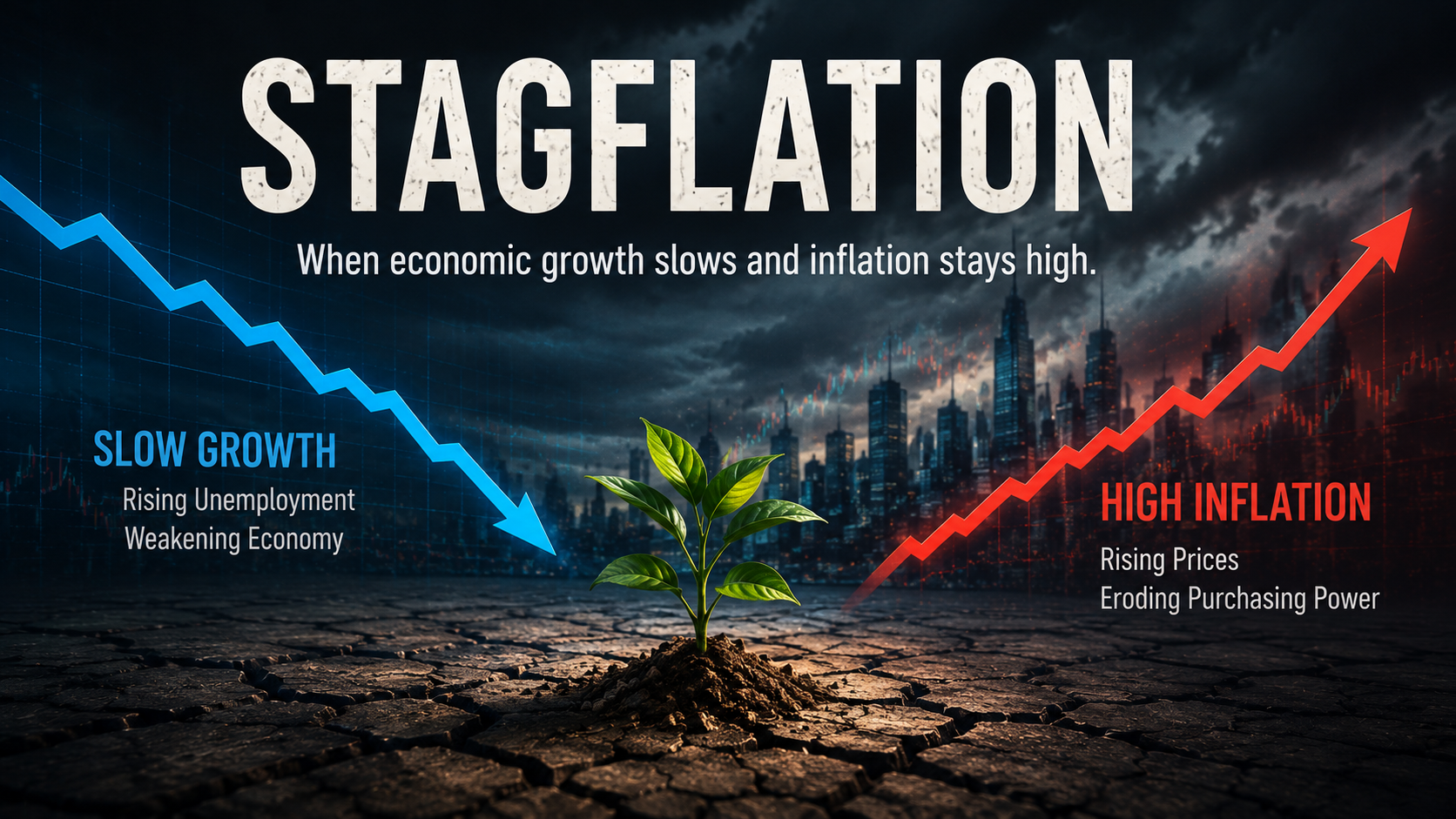
Key Takeaway
Stagflation occurs when economic growth slows while inflation remains elevated. It creates a difficult environment where policymakers have fewer options and investors face greater uncertainty across nearly every asset class.
What Is Stagflation?
The term stagflation combines two economic concepts
- Stagnation
- Inflation
In simple terms, stagflation describes a situation where economic growth slows or stalls while prices continue rising.
Under normal circumstances, economic growth and inflation often move in a similar direction.
| Economic Environment | Inflation Trend |
| Economic Expansion | Rising |
| Recession | Stable or Falling |
Stagflation breaks this relationship.
Growth slows.
Unemployment rises.
Consumer demand weakens.
Yet prices continue moving higher.
As a result, households face a higher cost of living while businesses struggle with weaker demand and rising operating costs.
Why Does Stagflation Happen?

Supply Shocks
The most common cause of stagflation is a supply shock.
When essential resources such as oil, natural gas, food commodities, semiconductors, or industrial materials become scarce or significantly more expensive, production costs rise throughout the economy.
Oil is the classic example.
When energy prices rise, businesses face
- Higher transportation costs
- Higher manufacturing costs
- Higher utility expenses
- Higher logistics costs
Companies often pass those costs on to consumers through higher prices.
At the same time, consumers lose purchasing power.
As spending slows, economic growth weakens.
The result is a dangerous combination of
- Rising prices
- Slower consumption
- Lower corporate profitability
- Slower economic growth
This is how a stagflationary cycle can begin.
Excess Liquidity and Weak Productivity
Stagflation can also emerge when money supply grows faster than the economy's ability to produce goods and services.
If more money enters the system while productivity and output fail to keep pace, inflationary pressure builds.
When supply chain disruptions occur simultaneously, inflation can become even more persistent.
More money alone does not create more economic growth.
Without productivity improvements, excess liquidity can push prices higher while real growth remains weak.
Rising Labor Costs
Wage growth is generally positive for workers.
However, when wages rise significantly faster than productivity, businesses often respond by increasing prices to protect profit margins.
Over time, this can contribute to ongoing inflationary pressure even while economic growth slows.
Why Stagflation Is So Dangerous for Investors
Many investors fear recessions.
Financial markets often fear stagflation even more.
During a normal recession, the Federal Reserve can lower interest rates and inject liquidity into the economy.
During a typical inflationary period, policymakers can raise rates to cool demand.
Stagflation creates a policy dilemma.
If the Fed raises rates to fight inflation
- Consumer spending slows
- Business investment declines
- Corporate earnings weaken
- Economic growth deteriorates
If the Fed lowers rates to support growth
- Inflation can accelerate
- Purchasing power can decline
- Price pressures may become even harder to control
Every option comes with consequences.
That is why stagflation is often viewed as one of the most challenging economic environments in modern macroeconomics.
The Most Famous Example of Stagflation
The 1970s Oil Crisis
The most frequently cited example of stagflation occurred during the 1970s.
Following geopolitical tensions in the Middle East, OPEC restricted oil production, causing energy prices to surge.
The United States experienced
- Rapid inflation
- Slowing economic growth
- Rising unemployment
At the time, policymakers faced an extremely difficult challenge as they attempted to balance economic stability with inflation control.
The experience remains one of the most important lessons in modern economic history and continues to influence how investors analyze inflation risks today.
How Stagflation Affects Financial Markets
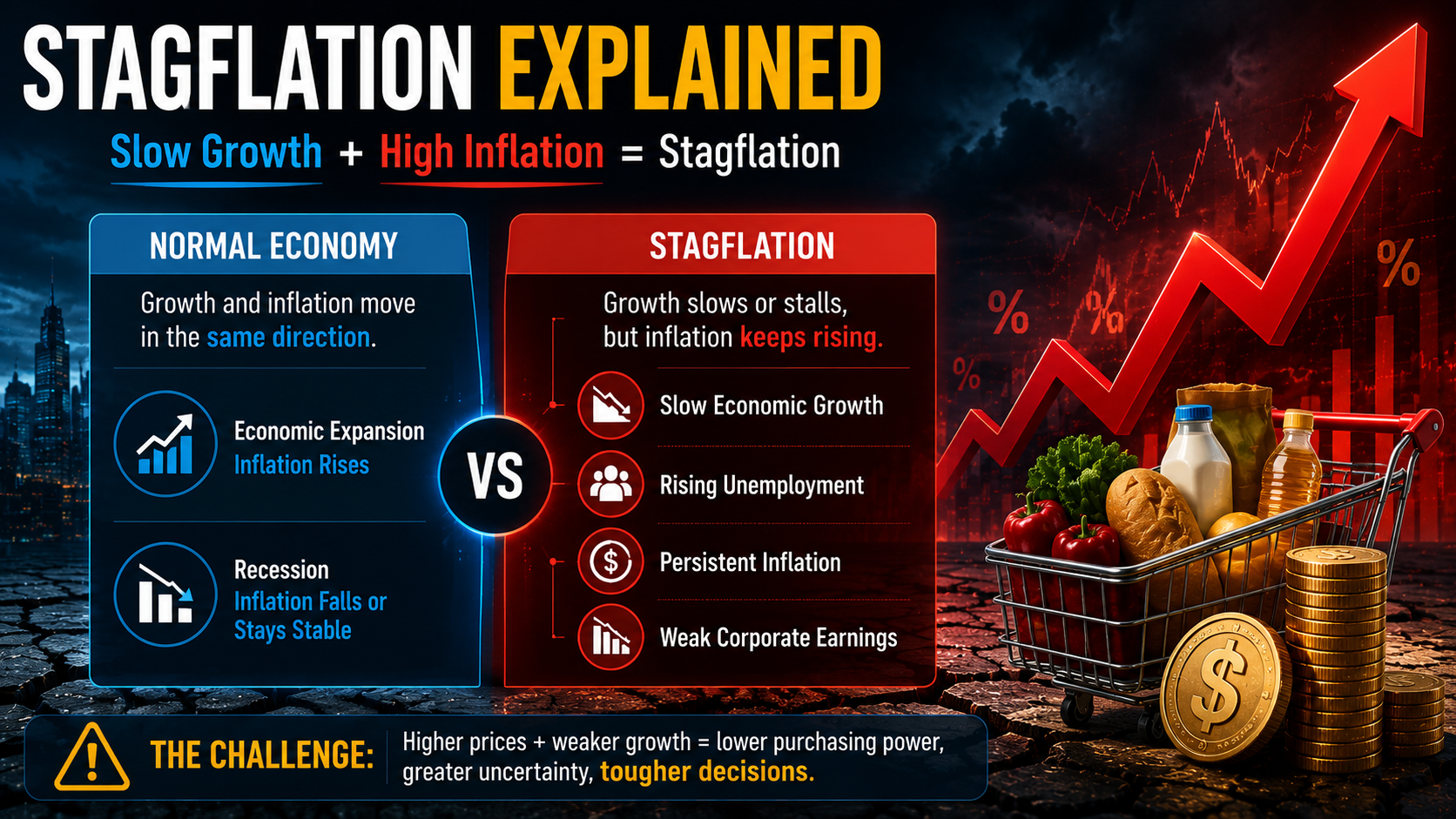
Stagflation can influence nearly every major asset class.
| Asset Class | Typical Impact | Primary Reason |
| Stocks | Negative | Slower growth and weaker earnings |
| Bonds | Negative | Inflation reduces real returns |
| U.S. Dollar | Mixed | Safe-haven demand and policy uncertainty |
| Gold | Potentially Positive | Inflation hedge characteristics |
| Commodities | Potentially Positive | Supply shortages and rising costs |
| Bitcoin | High Volatility | Sensitive to liquidity conditions |
Stocks
Companies often face rising costs while consumers reduce spending.
Growth-oriented companies may face additional pressure because higher interest rates reduce the value of future earnings.
Bonds
Inflation reduces the purchasing power of fixed-income payments.
As inflation expectations rise, bond prices can come under pressure and real returns may decline.
Gold and Commodities
Gold and certain commodities often attract attention during inflationary periods.
Investors frequently view them as tools for preserving purchasing power.
However, interest rates, real yields, and dollar strength remain important factors.
Bitcoin
Bitcoin is sometimes referred to as digital gold.
In reality, it remains highly sensitive to liquidity conditions and investor sentiment.
As a result, stagflation does not automatically guarantee stronger Bitcoin performance.
Key Takeaways for Investors
Watch Growth, Not Just Inflation
Inflation alone does not create stagflation.
The real concern is the combination of rising prices and slowing economic activity.
Investors should monitor
- GDP growth
- Employment trends
- Consumer spending
- Corporate earnings
Alongside inflation data.
Focus on Companies With Pricing Power
Businesses that can pass rising costs on to customers often have a significant advantage during inflationary periods.
Companies with strong brands, essential products, and loyal customer bases may be better positioned to maintain profitability.
Follow Liquidity
The most powerful force in financial markets is often the flow of money.
Investors should pay attention to
- Federal Reserve policy
- Credit conditions
- Money supply trends
- Liquidity cycles
These factors often determine where capital moves during uncertain periods.
What Wealthy Investors Watch During Stagflation
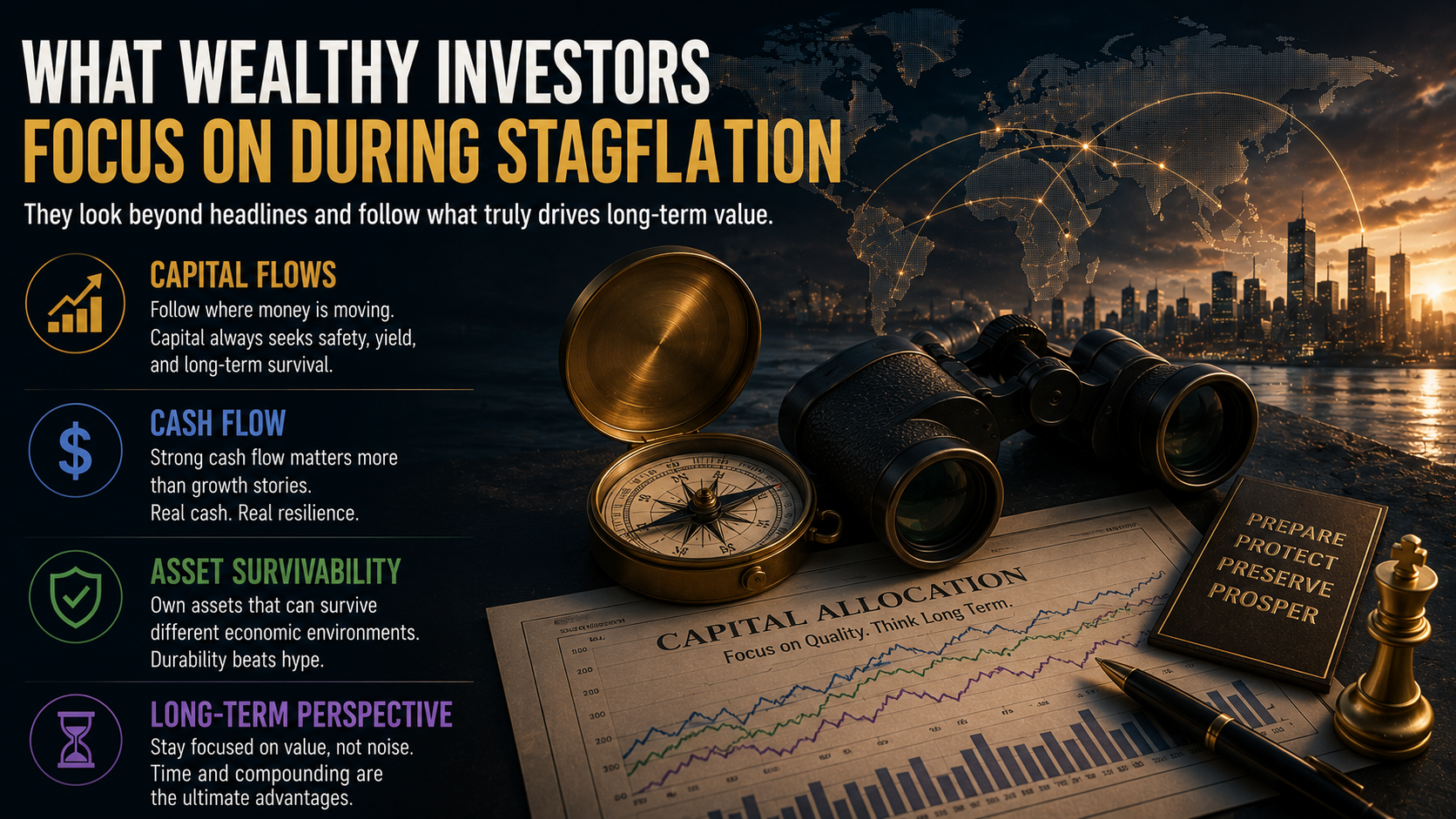
Most people focus on inflation.
Wealthy investors focus on where capital is moving.
Capital Flows
Money constantly searches for assets that are most likely to preserve value and survive uncertainty.
During periods of economic stress, markets often prioritize stability over growth expectations.
Understanding where capital is flowing can provide valuable insight into investor behavior.
Cash Flow
During stagflation, strong cash flow often becomes more important than exciting growth stories.
Investors frequently place greater value on businesses that generate consistent earnings and free cash flow.
The ability to produce cash today often matters more than promises of growth tomorrow.
Asset Survivability
The best assets are not necessarily those that perform well during ideal conditions.
The most valuable assets are often those capable of surviving difficult economic environments.
Businesses with strong balance sheets, manageable debt levels, and durable competitive advantages may be better positioned to weather uncertainty.
A Long-Term Investing Perspective
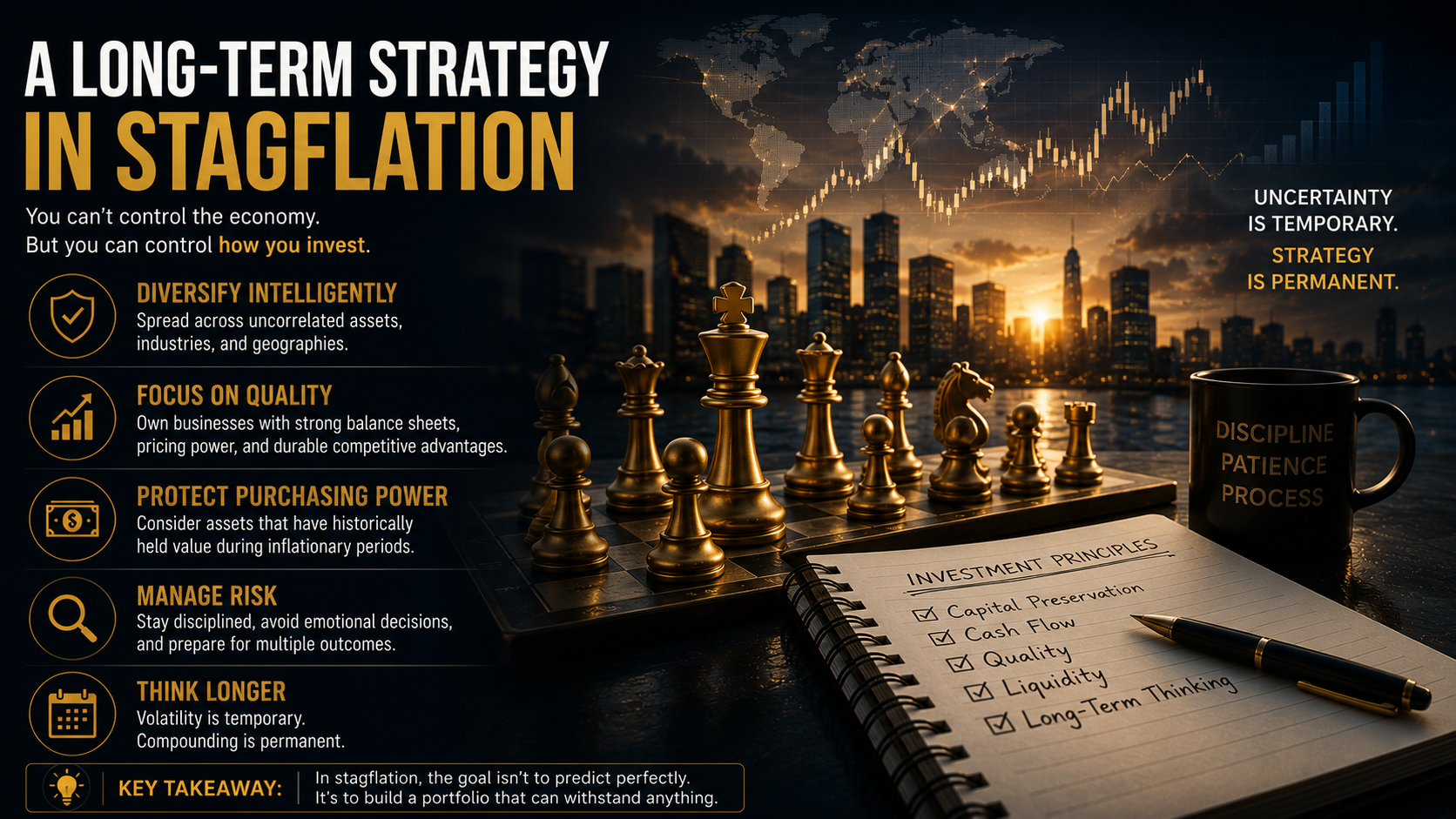
Successful investing is not about perfectly predicting the future.
It is about preparing for multiple possible outcomes.
Ask yourself
- Can my portfolio withstand inflation?
- Will my investments continue generating cash flow during a slowdown?
- Can my assets survive tighter liquidity conditions?
- Do I own businesses with long-term durability?
Markets ultimately reward assets that can preserve value through changing economic cycles.
During stagflation, protecting purchasing power may become more important than maximizing short-term returns.
Final Thoughts
Stagflation is far more than a period of high inflation.
It is a complex economic environment where slowing growth and rising prices occur simultaneously.
Policy options become limited.
Market volatility often increases.
Capital flows can shift dramatically.
For investors, understanding stagflation means looking beyond inflation headlines and paying attention to growth, corporate profitability, liquidity, monetary policy, and capital allocation.
The most important lesson is this
Stagflation is not simply an inflation problem. It is a structural challenge that affects growth, liquidity, and investor behavior simultaneously. In such environments, survivability often matters more than chasing returns.
This was MasterMind.
Designing success.
'[Global] Success Blueprints' 카테고리의 다른 글