What Is the S&P 500? How It Works, Why It Matters, and How to Invest


Hello, this is MasterMind.
If you follow the stock market, you've probably heard one phrase countless times:
"The S&P 500 hit a new high."
"The S&P 500 fell sharply today."
But have you ever stopped to ask why this single index receives so much attention?
Why do pension funds, institutional investors, financial advisors, and even Warren Buffett consistently point investors toward the S&P 500?
Many people think it's simply a stock market benchmark.
In reality, the S&P 500 is much more than that.
It represents the collective strength of America's largest businesses, the flow of global capital, and the long-term growth engine of the U.S. economy.
Understanding the S&P 500 is one of the most important steps an investor can take toward understanding how wealth is created in modern financial markets.
Key Takeaway
The S&P 500 is a market-cap-weighted index of America's leading companies and serves as one of the most powerful long-term vehicles for preserving purchasing power and participating in economic growth.
What Is the S&P 500?
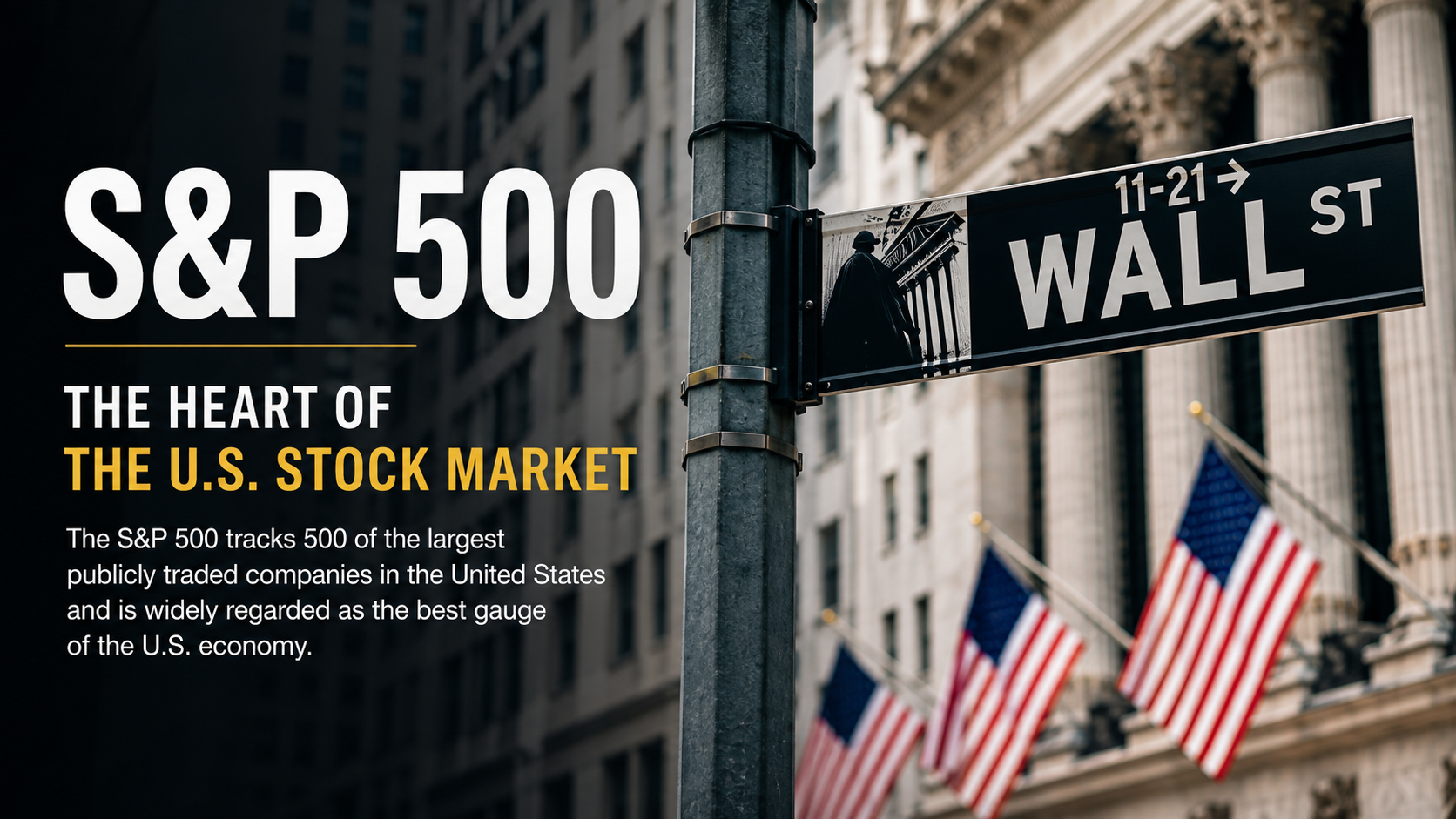
The S&P 500, short for Standard & Poor's 500 Index, tracks 500 of the largest publicly traded companies in the United States.
These companies span multiple sectors, including:
- Technology
- Healthcare
- Financial Services
- Consumer Goods
- Energy
- Industrials
The index includes many of the world's most influential businesses, such as Apple, Microsoft, Nvidia, Amazon, and Alphabet.
However, inclusion is not automatic.
Companies must meet specific requirements related to market capitalization, liquidity, profitability, and financial stability.
As a result, the S&P 500 is widely viewed as the best representation of the overall U.S. stock market and the American economy.
Today, the index accounts for roughly 80% of the total value of the U.S. equity market.
How the S&P 500 Works
To understand why the S&P 500 has been such a successful long-term investment vehicle, investors need to understand two important concepts.
Market Capitalization Weighting

The S&P 500 is weighted by market capitalization.
This means larger companies have a greater influence on the index than smaller companies.
For example, a company worth several trillion dollars contributes much more to the index's movement than a company worth only a few billion dollars.
This approach allows the index to reflect the true economic importance of its constituents rather than treating every company equally.
The Built-In Evolution Mechanism
One of the most overlooked strengths of the S&P 500 is its ability to adapt.
Companies that lose relevance, struggle financially, or fail to compete are eventually removed.
Growing businesses with stronger fundamentals are added.
This process creates a powerful self-renewing system.
The companies that dominated the index decades ago are very different from the leaders today.
Yet the index itself continues to evolve alongside the economy.
MasterMind Insight
Most investors spend years trying to identify tomorrow's winners.
The S&P 500 automatically does this over time.
Declining businesses gradually lose influence, while successful companies gain larger weights and drive future returns.
In many ways, the S&P 500 is capitalism's built-in selection process at work.
Why Is the S&P 500 Important?
It Reflects the Strength of the U.S. Economy
The United States remains the world's largest economy and home to many of the most innovative companies on the planet.
Economic growth, consumer spending, productivity improvements, and technological innovation ultimately show up in corporate earnings.
Because of this relationship, the S&P 500 serves as a real-time reflection of America's economic health.
It Has a Long History of Wealth Creation
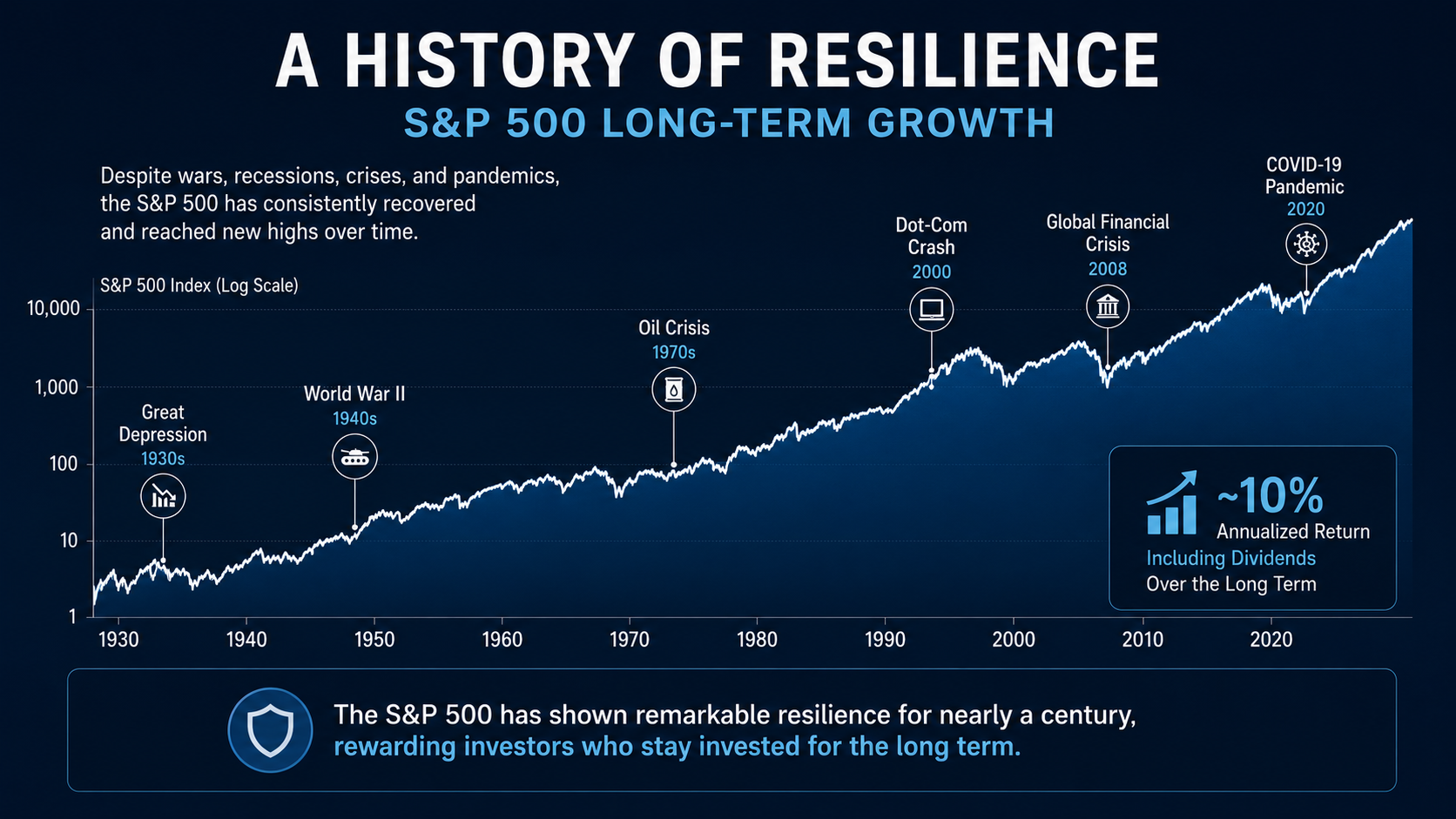
Over the past century, investors have faced:
- The Great Depression
- World War II
- The Oil Crisis
- The Dot-Com Crash
- The Global Financial Crisis
- The COVID Pandemic
Despite these challenges, the S&P 500 has consistently recovered and reached new highs over time.
Historically, the index has delivered roughly 10% annualized returns, including dividends.
While future performance is never guaranteed, the long-term trend highlights the resilience of productive businesses and economic growth.
Global Capital Flows Into the S&P 500
The S&P 500 is one of the most heavily invested financial assets in the world.
Pension funds, insurance companies, sovereign wealth funds, ETFs, and individual investors all allocate capital to the index.
Markets are ultimately driven by capital flows.
And few destinations attract more global capital than the S&P 500.
Why Are S&P 500 ETFs So Popular?

Many investors choose S&P 500 ETFs instead of trying to pick individual stocks.
There are several reasons why.
Instant Diversification
Buying an S&P 500 ETF provides exposure to hundreds of companies across multiple industries.
This reduces the risk associated with any single company.
Exposure to Economic Growth
Instead of betting on one business, investors gain exposure to the broader growth of the American economy.
Low Costs
Most S&P 500 ETFs have extremely low expense ratios.
Over decades, lower costs can significantly improve long-term investment outcomes.
How to Invest in the S&P 500
For most investors, the easiest way to invest in the S&P 500 is through an index fund or ETF that tracks the index.
Some of the most popular S&P 500 ETFs include:
- SPY (SPDR S&P 500 ETF Trust)
- VOO (Vanguard S&P 500 ETF)
- IVV (iShares Core S&P 500 ETF)
These funds provide exposure to hundreds of America's largest companies through a single investment.
Rather than trying to identify individual winners, investors can participate in the long-term growth of the broader U.S. economy while benefiting from diversification and low costs.
MasterMind Insight
Most investors try to find the next winning company.
The S&P 500 takes a different approach.
It allows investors to own the companies that survive, adapt, and lead over time.
In many ways, the index is a reflection of capitalism's natural selection process.
How the S&P 500 Influences Other Markets
The S&P 500 does not exist in isolation.
Its performance often affects sentiment and capital flows across multiple asset classes.
| Asset Class | When S&P 500 Rises | When S&P 500 Falls |
| Stocks | Risk appetite increases | Risk aversion increases |
| Bonds | Investors rotate away from safety | Demand for bonds rises |
| U.S. Dollar | Can weaken during risk-on periods | Often strengthens during stress |
| Gold | May see lower demand | Often benefits from safe-haven flows |
| Bitcoin | Can benefit from liquidity expansion | Often experiences higher volatility |
This is why professional investors closely monitor the S&P 500 even when investing in other markets.
Key Things Investors Should Know
Market Concentration Matters
A significant portion of the index's performance comes from a relatively small group of mega-cap companies.
As a result, the index can appear strong even if many individual stocks are struggling.
Investors should pay attention to market breadth in addition to index performance.
Volatility Is Normal
Even the S&P 500 experiences major drawdowns.
Temporary declines of 20% or more have occurred multiple times throughout history.
Short-term volatility is a feature of investing, not a flaw.
Time Is Often More Important Than Timing
Many investors focus on predicting market moves.
History suggests that staying invested through economic cycles has often been more effective than trying to perfectly time entries and exits.
What Do Wealthy Investors See That Others Often Miss?
Most successful investors don't simply look at whether the S&P 500 is up or down.
They focus on deeper signals.
Capital Flows
Where is money moving?
Is capital flowing into productive assets, or is it hiding in defensive positions?
Corporate Earnings
Are businesses generating sustainable profits?
Long-term stock prices ultimately follow earnings growth.
Asset Survival
Which companies will still dominate their industries ten years from now?
The strength of the S&P 500 comes from its ability to continually replace weaker businesses with stronger ones.
Long-Term Purchasing Power
Inflation steadily reduces the value of cash.
The companies inside the S&P 500 often possess pricing power, innovation, and global reach that help investors preserve purchasing power over time.
Ask yourself:
- Am I focused on short-term market noise?
- Or am I investing in long-term economic growth?
- Is my portfolio positioned to outpace inflation?
- Am I trying to predict markets, or participate in them?
Successful investing is often less about forecasting the future and more about owning assets that can survive and grow through uncertainty.
Final Thoughts

The S&P 500 is far more than a stock market index.
It is a collection of America's most successful businesses, a reflection of economic productivity, and one of the largest destinations for global capital.
Markets will always experience cycles of fear and optimism.
But over long periods, corporate earnings, innovation, and productivity tend to drive wealth creation.
The most important lesson is not how to beat the market.
It is how to stay invested in productive assets long enough to benefit from their growth.
Remember this:
The S&P 500 is not simply a way to track the U.S. economy. It is one of the most effective ways to participate in the long-term growth of capitalism itself.
This was MasterMind.
Designing success.
'[Global] Success Blueprints' 카테고리의 다른 글