What Is M2 Money Supply? Why It Matters for Inflation, Asset Prices, and Investors


Hello, this is MasterMind.
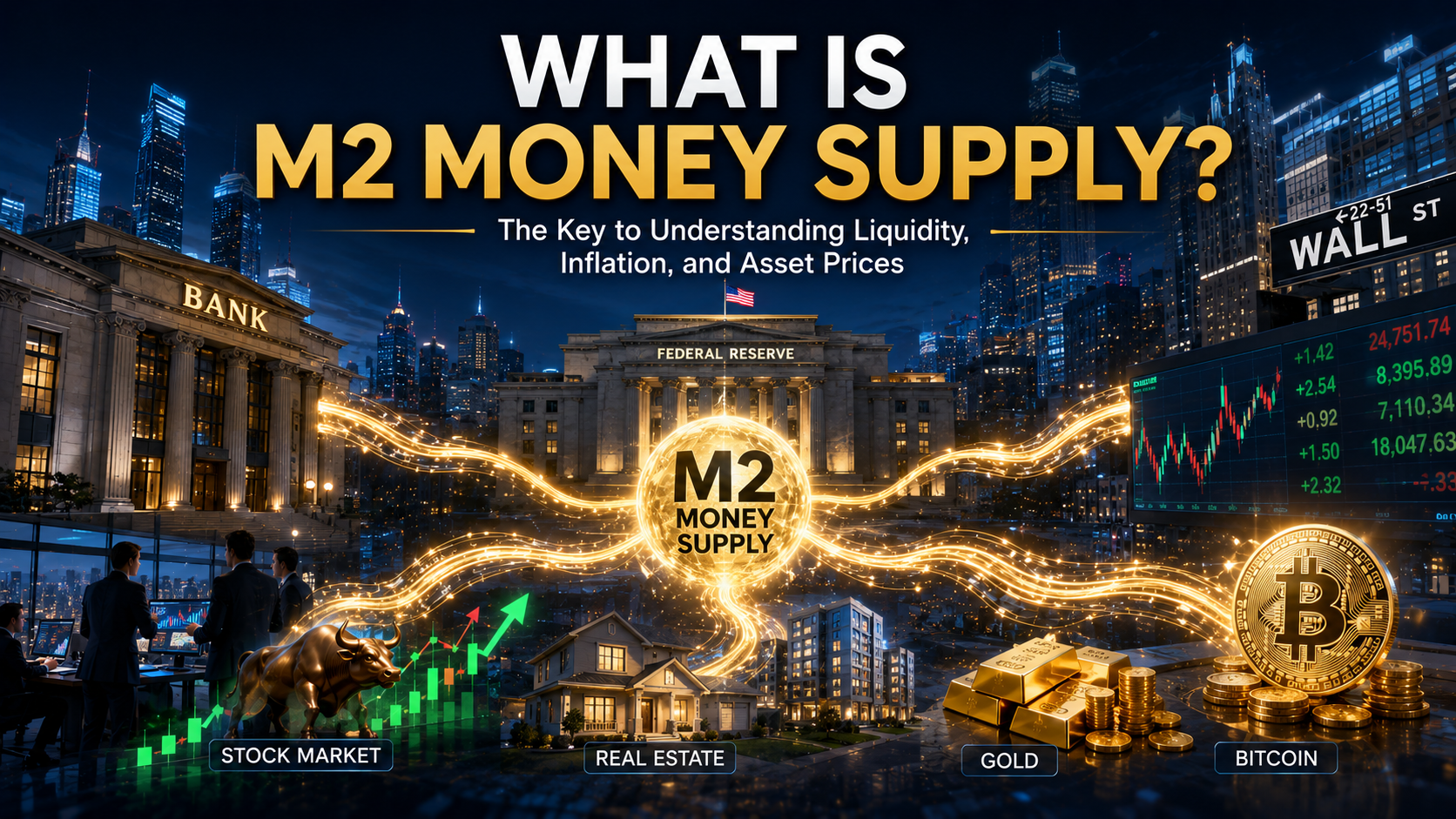
Have you ever wondered why stocks, real estate, gold, and Bitcoin seem to rise over the long run, even when economic conditions are far from perfect?
Why does cash sitting in a bank account often feel like it's losing purchasing power while asset prices continue climbing?
The answer often comes down to one of the most important yet overlooked economic indicators: M2 Money Supply.
While investors spend countless hours analyzing earnings reports, inflation data, and interest rates, many fail to recognize the deeper force driving financial markets—liquidity.
Understanding M2 is not just about economics. It's about understanding how money moves through the system and why certain assets benefit from that movement.
Key Takeaway
M2 Money Supply measures the amount of liquid money available in the economy, and its long-term growth is one of the most powerful drivers of inflation, asset prices, and investment returns.
What Is M2 Money Supply?
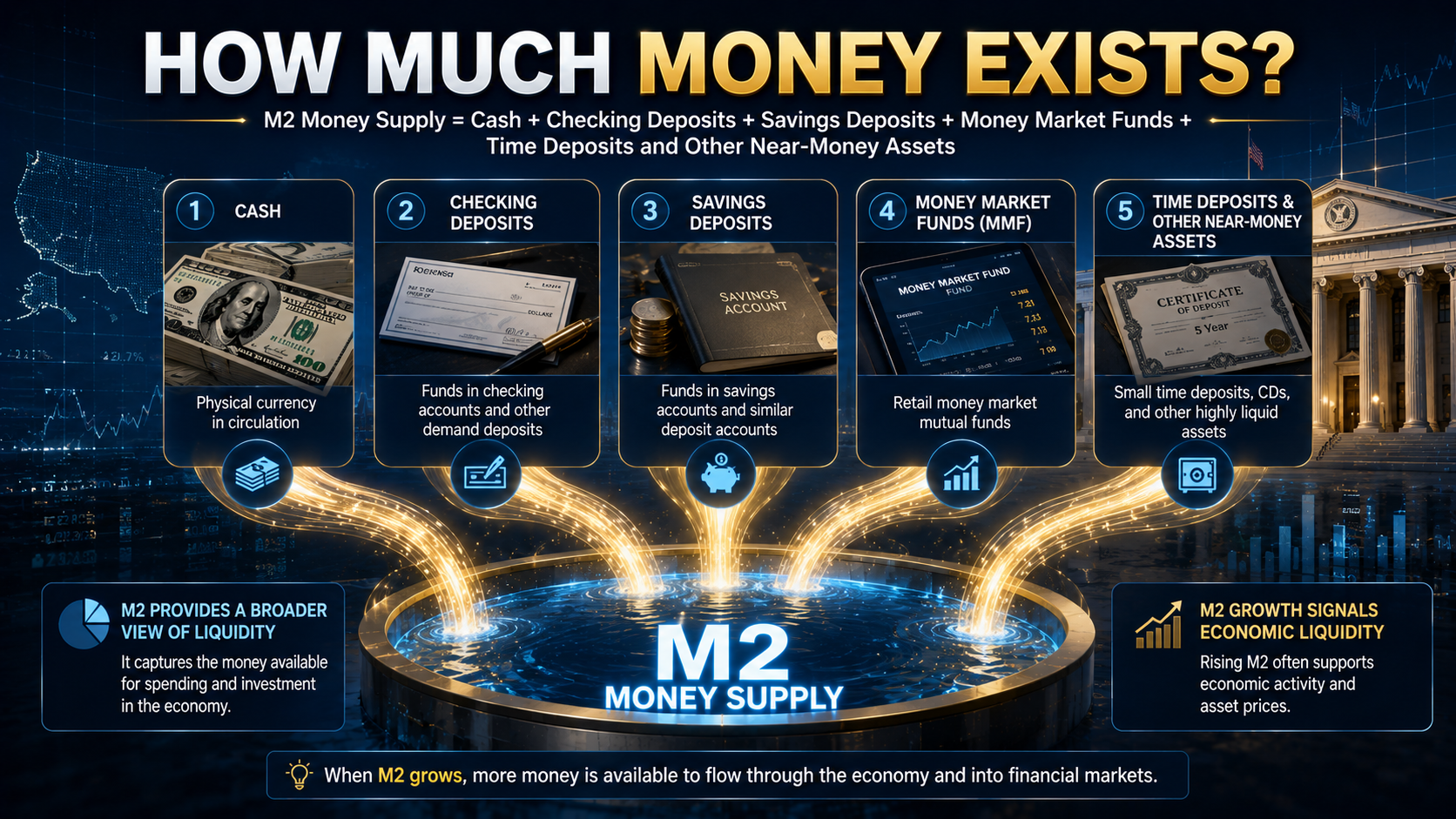
M2 is a broad measure of the money circulating throughout the economy.
It includes not only physical cash but also highly liquid financial assets that can quickly be converted into spending power.
Economists use M2 because it provides a clearer picture of the purchasing power available to consumers, businesses, and investors.
M1 vs. M2
| Measure | Includes |
| M1 | Physical cash, checking accounts, demand deposits |
| M2 | M1 plus savings accounts, money market funds, small time deposits, and other near-cash assets |
Think of M1 as money you can spend immediately.
M2 includes money that can easily become spendable within a short period of time.
Because M2 captures a broader view of liquidity, it is often considered one of the most useful indicators for understanding economic activity and financial markets.
How Does M2 Increase?

Many people assume that money supply grows only when the government prints more currency.
In reality, most money creation occurs through the banking system.
1. Federal Reserve Monetary Policy
The Federal Reserve influences liquidity through interest rate policy and balance sheet operations.
When the Fed lowers interest rates or conducts quantitative easing (QE), liquidity tends to increase throughout the financial system.
2. Bank Lending and Credit Creation
This is where most money is actually created.
When a bank issues a loan, new deposits are created within the banking system.
In other words, lending itself expands the money supply.
Every mortgage, business loan, or line of credit increases the amount of money circulating throughout the economy.
Modern economies are fundamentally built on credit expansion.
3. Government Spending
Fiscal stimulus programs can inject significant amounts of money into the economy.
The massive stimulus packages introduced during the COVID-19 pandemic are a clear example of how government spending can rapidly increase liquidity.
Why Investors Pay Attention to M2
The reason is simple.
Asset prices are heavily influenced by the amount of money available to buy them.
When liquidity increases, investors have more capital available for stocks, real estate, private investments, commodities, and cryptocurrencies.
When liquidity contracts, asset prices often face significant pressure.
This is why M2 has become a key indicator for macro investors.
Markets Follow Liquidity
Most investors focus on headlines.
Wealthy investors focus on capital flows.
Markets often appear to move because of news, but over the long term they tend to move in the direction of liquidity.
Strong liquidity can support higher valuations even when economic data is mixed.
Conversely, shrinking liquidity can pressure markets despite positive news.
One of the most important lessons in investing is this
Markets react to headlines in the short run, but they follow liquidity over the long run.
M2 and Inflation
The relationship between money supply and inflation has been debated for decades.
While supply chain disruptions and commodity prices can influence inflation in the short term, long-term inflation is closely tied to money supply growth.
Economist Milton Friedman famously stated
"Inflation is always and everywhere a monetary phenomenon."
If the amount of money in the economy grows faster than the production of goods and services, the purchasing power of that money tends to decline.
This is one reason why investors monitor M2 growth alongside inflation indicators such as CPI and PCE.
How M2 Affects Different Asset Classes

Impact of Rising M2 on Major Assets
| Asset | Impact of Rising M2 |
| Stocks | Higher liquidity often supports valuations and investor demand |
| Bonds | Lower rates and greater liquidity can boost bond prices |
| U.S. Dollar | Increased supply may weaken the dollar over time |
| Gold | Often benefits from concerns about currency debasement |
| Bitcoin | Frequently responds positively to expanding global liquidity |
| Real Estate | Increased borrowing and liquidity can support housing demand |
While asset performance depends on many factors, liquidity remains one of the most powerful long-term drivers.
Why Bitcoin Investors Watch M2
Bitcoin has become increasingly connected to global liquidity conditions.
Unlike traditional businesses, Bitcoin does not generate earnings or cash flow.
As a result, it often behaves like a liquidity-sensitive asset.
Periods of rapid global M2 growth have frequently coincided with strong Bitcoin bull markets.
Although short-term price movements can be driven by sentiment, regulation, or speculation, long-term liquidity trends remain an important factor.
Key Lessons for Investors
Focus on Growth Rates, Not Just Levels
The direction and rate of change in M2 often matter more than the absolute number itself.
Investors frequently monitor year-over-year growth rates to identify turning points in liquidity conditions.
Watch the Federal Reserve
Interest rates, quantitative easing, and quantitative tightening all influence money supply growth.
Understanding Federal Reserve policy is essential for understanding M2.
Liquidity Works With a Lag
Changes in money supply do not immediately affect markets.
There is often a delay between liquidity expansion and asset price appreciation.
Patience is required.
Separate Real Growth From Monetary Growth
Not every increase in asset prices reflects stronger fundamentals.
Sometimes rising prices simply reflect a larger supply of money competing for the same assets.
Understanding this distinction helps investors avoid common valuation mistakes.
What Do Wealthy Investors See in This Trend?

Sophisticated investors often focus less on prices and more on capital flows.
They ask questions such as
- Where is money moving?
- Which assets are attracting liquidity?
- Which investments generate durable cash flow?
- Can this asset survive during a liquidity contraction?
- Does this asset maintain long-term scarcity?
The goal is not to predict every market move.
The goal is to understand the environment in which capital is flowing.
Because in investing, survival is often more important than prediction.
Final Thoughts
M2 Money Supply is far more than an economic statistic.
It represents the amount of liquidity available within the financial system and provides valuable insight into inflation, market cycles, and asset prices.
Stocks, real estate, gold, bonds, and Bitcoin all respond to liquidity conditions over time.
That is why many experienced investors watch M2 as closely as they watch earnings reports, inflation data, and Federal Reserve decisions.
Remember this
Most investors watch prices. The best investors watch the flow of money behind those prices.
This was MasterMind.
Designing success.
'[Global] Success Blueprints' 카테고리의 다른 글