What Is M1 Money Supply? Definition, M2 Differences, and Market Impact


Hello, this is MasterMind.
Why do stocks surge during some periods while struggling in others, even when corporate earnings remain strong?
Why do assets like Bitcoin, gold, and real estate often rise after central banks inject liquidity into the financial system?
The answer often comes down to one critical factor: money.
More specifically, it comes down to how much money is immediately available to be spent, invested, or deployed into financial markets.
That is where M1 money supply becomes important.
While most investors focus on interest rates, inflation, or GDP growth, M1 provides a direct look at the most liquid money circulating through the economy.
Understanding M1 can help investors better understand market liquidity, risk appetite, and potential capital flows across asset classes.

Key Takeaway
M1 money supply represents the most liquid money in the economy—capital that can be spent, invested, or moved immediately—and often serves as a leading indicator of liquidity conditions in financial markets.
What Is M1 Money Supply?
M1 money supply is one of the narrowest measures of money in an economy.
It consists of funds that are immediately available for transactions.
In the United States, M1 generally includes:
- Physical currency in circulation
- Demand deposits
- Checking accounts
- Other highly liquid deposits
In simple terms, M1 represents money that can be used right now.
If money is sitting in your checking account and can be used to buy stocks, pay bills, or make purchases today, it is generally part of M1.
Unlike longer-term savings vehicles, M1 focuses on liquidity rather than wealth.
Why Do Economists Track M1?
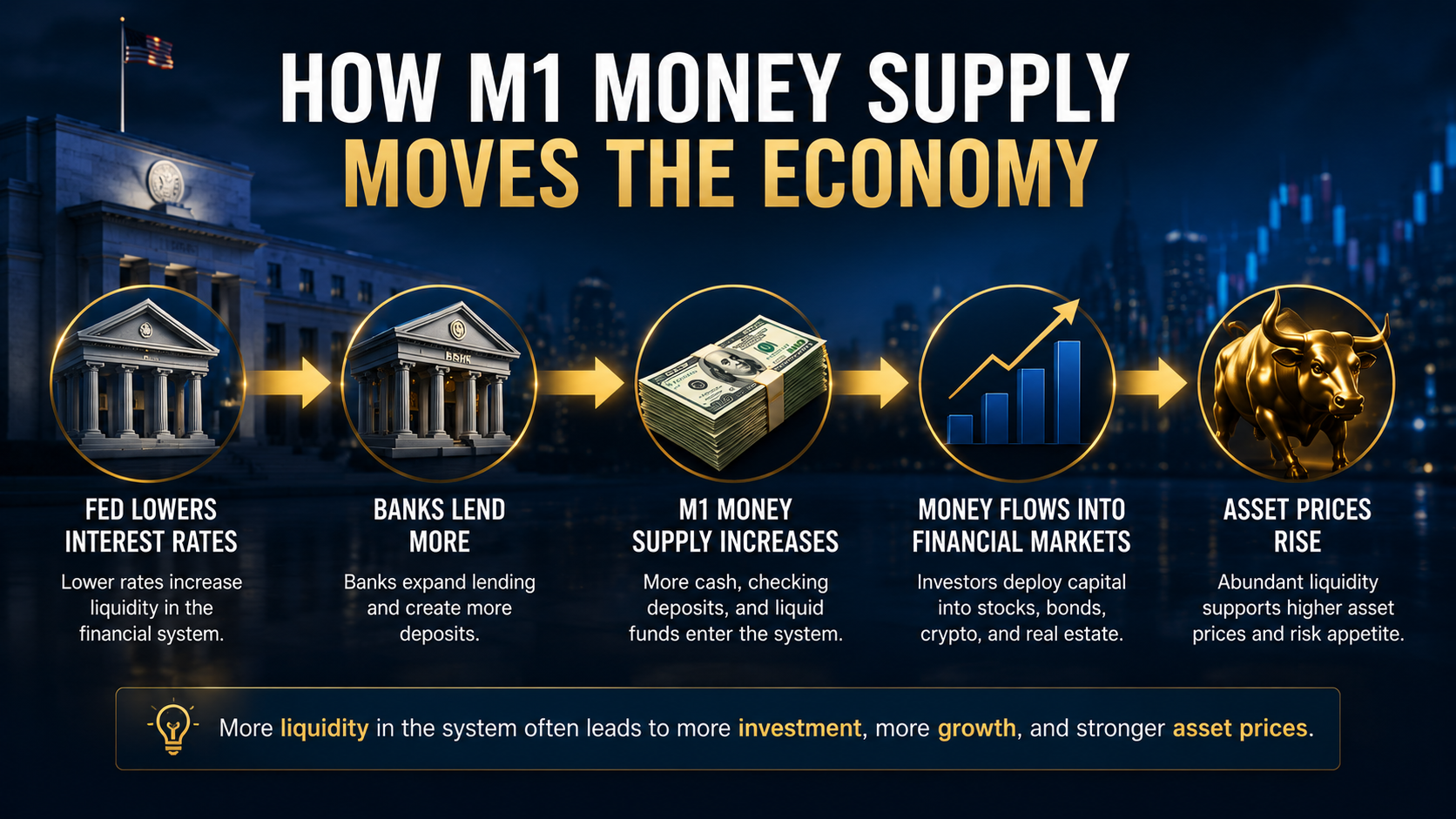
Think of M1 as the fuel readily available inside the financial system.
When M1 grows rapidly, more money becomes available for consumption, investment, and speculation.
When M1 contracts or grows slowly, liquidity conditions often become tighter.
This makes M1 a useful tool for understanding economic activity and market behavior.
A simplified version of the process looks like this:
Federal Reserve Policy
↓
Bank Lending Expands
↓
Deposits Increase
↓
M1 Money Supply Grows
↓
Spending and Investment Rise
↓
Financial Markets Benefit From Liquidity
Because money creation and lending are closely linked, M1 often reflects broader changes in economic momentum.
M1 vs. M2: What Is the Difference?

Many investors hear about M2 more frequently than M1.
While both measure money supply, they serve different purposes.
| Measure | Includes |
| M1 | Cash, checking accounts, demand deposits, highly liquid funds |
| M2 | M1 plus savings accounts, money market funds, small time deposits, and other near-cash assets |
A simple way to think about it is:
- M1 = Money ready to move today
- M2 = Money that could move relatively soon
For investors, M1 often provides a clearer picture of immediate liquidity conditions, while M2 gives a broader view of total money available within the economy.
Why M1 Matters for Investors
Asset prices are influenced by two major forces:
- Expectations
- Liquidity
Most investors spend their time analyzing expectations.
However, even the strongest investment narrative can struggle if liquidity dries up.
Markets need buyers.
Buyers need money.
M1 helps investors understand whether capital is readily available to support risk assets.
A rising M1 environment often signals that financial conditions are becoming more supportive.
A declining M1 environment may indicate that investors are becoming more defensive.
This is why liquidity is often described as the lifeblood of financial markets.
Does Rising M1 Always Mean Higher Stock Prices?
Not necessarily.
This is one of the most common misconceptions among investors.
There are situations where M1 increases while asset prices remain weak.
For example, during periods of economic uncertainty, investors may hold large amounts of cash instead of deploying capital into stocks or real estate.
In that scenario:
- M1 rises
- Risk appetite falls
- Asset prices may remain under pressure
This is why M1 should never be viewed in isolation.
Investors should also monitor:
- Federal Reserve policy
- Interest rates
- Credit growth
- Consumer spending
- Corporate earnings
- Investor sentiment
The amount of money matters.
But the direction of money matters even more.
How M1 Money Supply Affects Financial Markets

| Asset Class | Potential Impact of Rising M1 |
| Stocks | Increased liquidity may support higher valuations |
| Bonds | Often associated with accommodative monetary conditions |
| U.S. Dollar | Greater money supply may weaken purchasing power over time |
| Gold | Can benefit from concerns about currency dilution |
| Bitcoin | Often attracts liquidity during risk-on environments |
| Real Estate | Lower financing costs and abundant liquidity may support prices |
Of course, no single indicator determines market direction.
M1 should be viewed as one piece of a larger macroeconomic puzzle.
Key Things Investors Should Watch

M1 Growth Rate
The rate of change often matters more than the absolute level.
Markets react to accelerating or decelerating liquidity.
M1 Relative to M2
Understanding the share of money that is immediately available can provide insight into investor behavior.
Federal Reserve Policy
Liquidity conditions are heavily influenced by monetary policy decisions.
Capital Flows
Investors should focus on where money is moving, not simply how much money exists.
What Do Wealthy Investors Look For?
Successful long-term investors rarely focus on headlines alone.
Instead, they focus on liquidity and capital flows.
Money Movement
Where is new liquidity flowing?
Stocks?
Real estate?
Bonds?
Alternative assets?
Cash Flow Strength
Which assets can continue generating cash flow during economic slowdowns?
Asset Resilience
Which investments are most likely to survive periods of tightening liquidity?
Long-Term Positioning
The goal is not to predict every market move.
The goal is to remain positioned to benefit from long-term trends while surviving short-term volatility.
Ask yourself:
- How much capital do I have available to take advantage of future opportunities?
- Can my portfolio withstand tighter liquidity conditions?
- Am I following prices, or am I following money flows?
These questions often matter more than trying to predict the next market headline.
Final Thoughts
M1 money supply is far more than a technical economic statistic.
It represents the most liquid capital available within the financial system and offers valuable insight into spending, investing, and market behavior.
Many investors focus exclusively on stock prices, inflation reports, or interest rates.
However, beneath all of those indicators lies a simpler question:
Where is the money going?
Understanding M1 can help investors better understand liquidity cycles, risk appetite, and long-term market trends.
Because in investing, success is often less about predicting the future and more about understanding the flow of money.
This was MasterMind.
Designing success.
'[Global] Success Blueprints' 카테고리의 다른 글