How Oil Prices Affect the Nasdaq: The Link Between Crude Oil, Interest Rates, and Stocks


Hello, this is MasterMind.
When investors think about the Nasdaq, they usually focus on companies like Apple, Microsoft, Nvidia, Amazon, and Meta.
When they think about oil, they picture gasoline prices, OPEC meetings, or geopolitical tensions in the Middle East.
At first glance, these two worlds seem completely unrelated.
So why do financial markets react so strongly when oil prices move?
Why do technology stocks often rally when oil prices fall?
And why can a spike in crude oil prices trigger selloffs across the stock market?
The answer lies in one of the most important chains of cause and effect in global finance
Oil → Inflation → Interest Rates → Liquidity → Asset Prices
Understanding this relationship helps investors move beyond daily headlines and focus on the forces that truly drive markets over the long term.
One-Sentence Summary
Oil prices influence inflation, inflation influences interest rates, and interest rates influence the valuation of growth stocks. That is why changes in crude oil prices often have a significant impact on the Nasdaq and broader financial markets.
What Are Oil Prices?
Crude oil is one of the most important commodities in the global economy.
The most widely followed benchmarks include
Global Crude Oil Benchmarks
| Benchmark | Primary Region & Market |
| WTI (West Texas Intermediate) | United States (Americas) |
| Brent Crude | Europe and Global Markets |
| Dubai Crude | Asia & Middle East Markets |
Oil is far more than a fuel source.
It affects
- Manufacturing
- Transportation
- Aviation
- Shipping
- Petrochemicals
- Electricity generation
Because oil is embedded in almost every part of economic activity, changes in oil prices ripple through the entire economy.
This is why many economists refer to oil as the lifeblood of the global economy.
What Is the Nasdaq?
The Nasdaq is one of the major U.S. stock market indexes and is heavily weighted toward technology and growth companies.
Some of its largest components include
- Apple
- Microsoft
- Nvidia
- Amazon
- Meta
Unlike traditional industrial companies, many Nasdaq firms derive a large portion of their value from future growth expectations.
As a result, the Nasdaq tends to be highly sensitive to interest rates and liquidity conditions.
Why Do Oil Prices Affect the Stock Market?
Many investors assume oil and stocks are directly connected.
In reality, oil influences markets through a broader economic transmission mechanism.
Crude Oil Prices
↓
Inflation
↓
Central Bank Policy
↓
Interest Rates
↓
Liquidity
↓
Asset Prices
This chain helps explain why a movement in oil prices can eventually impact stocks, bonds, currencies, gold, and cryptocurrencies.
How Oil Price Changes Influence Financial Markets

1. Oil Prices and Inflation
When oil prices rise, businesses face higher costs.
Examples include
- Higher transportation expenses
- Rising manufacturing costs
- Increased shipping costs
- Higher energy bills
Companies often pass these costs on to consumers through higher prices.
This process contributes to inflation.
Conversely, falling oil prices can reduce cost pressures across the economy and help inflation moderate.
2. Inflation and Central Bank Policy

Central banks, including the Federal Reserve, closely monitor inflation.
If inflation rises too quickly, policymakers may keep interest rates elevated or raise them further.
If inflation cools, the Federal Reserve gains more flexibility to lower rates or adopt a less restrictive stance.
Markets often react to these expectations long before official policy decisions are made.
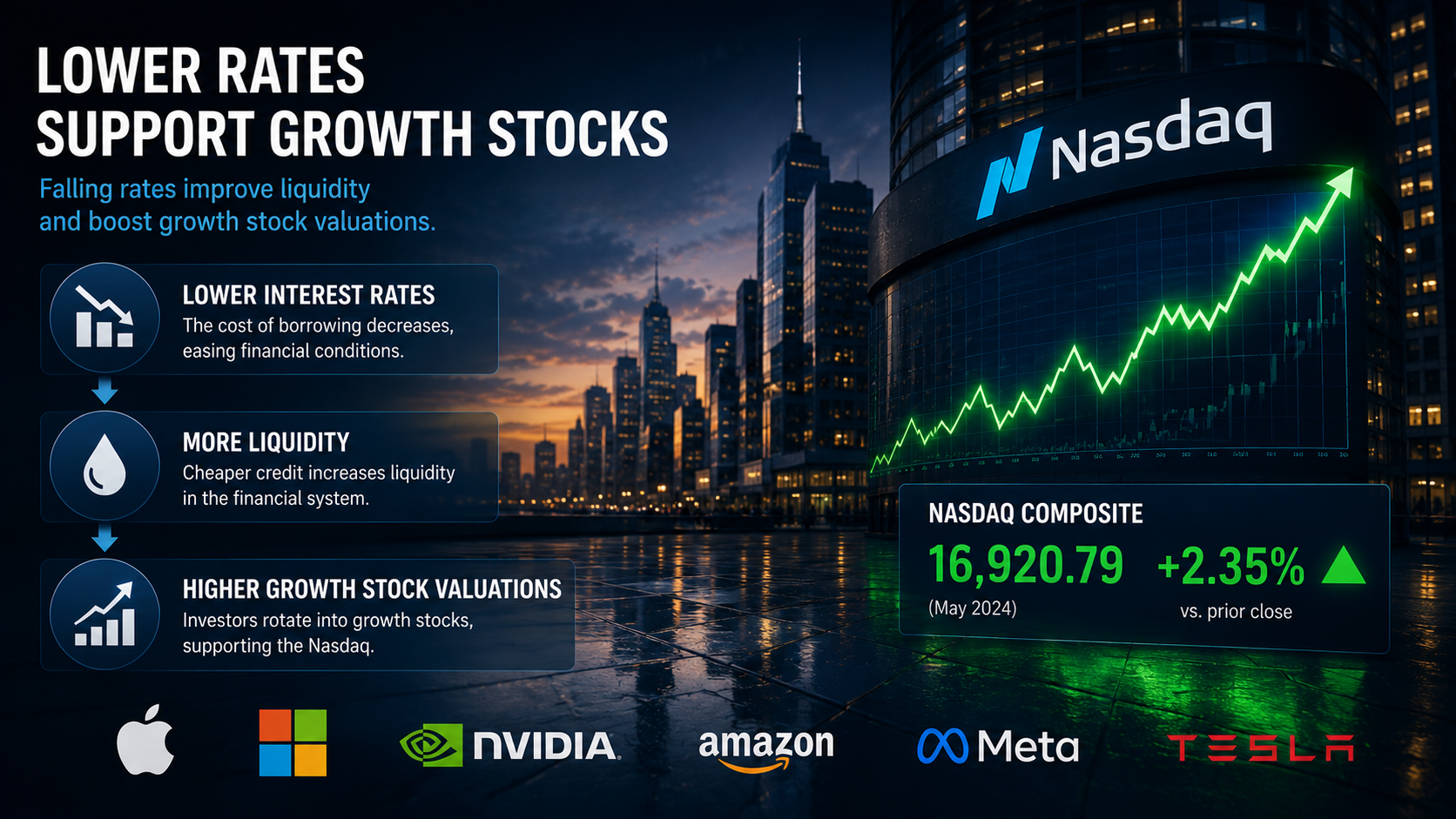
3. Interest Rates and Growth Stock Valuations
This is where the Nasdaq becomes especially important.
Growth companies generate much of their value from earnings expected years into the future.
Higher interest rates reduce the present value of those future cash flows.
Lower interest rates increase the present value of future earnings.
As a result
- Rising rates generally create headwinds for the Nasdaq.
- Falling rates often support higher Nasdaq valuations.
This explains why investors frequently celebrate falling oil prices and lower inflation expectations.
Markets Price the Future, Not the Present
One of the biggest mistakes new investors make is assuming markets react only to current conditions.
In reality, markets are constantly pricing future expectations.
Stocks often rise before economic data improves.
Stocks can also fall while economic conditions still appear strong.
Investors are always asking
- Where is inflation heading?
- What will the Federal Reserve do next?
- Will liquidity improve or tighten?
- How will corporate earnings look six to twelve months from now?
Oil prices matter because they influence the answers to these questions.
In many ways, markets are not pricing today's oil price—they are pricing tomorrow's economic environment.
Why Investors Pay Close Attention to Oil Prices
The relationship between oil and markets is not always straightforward.
A rising oil price can sometimes be bullish.
A falling oil price can sometimes be bearish.
The key question is
Why are oil prices moving?
A Healthy Oil Price Increase
Oil may rise because
- Economic growth is accelerating
- Consumer demand is strong
- Industrial activity is expanding
In this scenario, higher oil prices may reflect a healthy economy.
A Dangerous Oil Price Increase
Oil may rise because
- Geopolitical conflicts
- Supply disruptions
- Production cuts
In this case, higher oil prices can increase inflation without improving economic growth.
This creates a much more challenging environment for investors.
Oil Prices and Major Asset Classes
How Changes in Oil Prices Can Influence Financial Markets
| Asset Class | When Oil Prices Rise | When Oil Prices Fall |
| Inflation | Inflationary pressure increases | Inflation pressure may ease |
| Federal Reserve | Restrictive policy becomes more likely | Policy easing becomes more likely |
| Interest Rates | Upward pressure on rates | Downward pressure on rates |
| Liquidity | Liquidity may tighten | Liquidity conditions may improve |
| Nasdaq | Valuation pressure may increase | Valuation environment may improve |
| S&P 500 | Profit margins may face pressure | Corporate earnings environment may improve |
| U.S. Treasuries | Bond prices may decline | Bond prices may rise |
| U.S. Dollar | Strength may increase | Weakness may increase |
| Gold | Inflation hedge demand may rise | Mixed, depending on real yields |
| Bitcoin | Risk-off pressure may increase | Risk-on sentiment may improve |
Key Takeaways for Investors
There are several important lessons investors should remember.
First, focus on the reason oil prices are moving, not simply the direction.
Second, markets often care more about interest rates than oil itself.
Third, liquidity remains one of the most powerful forces in asset pricing.
Fourth, the Nasdaq is particularly sensitive to changes in rates and future growth expectations.
Finally, understanding capital flows is often more valuable than reacting to daily headlines.
What Do Wealthy Investors See in This Trend?

Large institutional investors rarely focus on short-term oil price fluctuations alone.
Instead, they study how capital moves through the financial system.
Capital Flows
When inflation fears decline, money often shifts toward growth assets and risk assets.
When inflation fears rise, investors frequently move toward defensive assets and safe havens.
Cash Flow Matters
The strongest companies are often those with the ability to maintain profitability regardless of energy costs.
Businesses with pricing power can pass higher costs on to customers and protect margins even during difficult environments.
Asset Survivability
During periods of uncertainty, investors prioritize companies with
- Strong balance sheets
- Consistent cash flow generation
- Sustainable competitive advantages
These businesses are more likely to survive changing economic cycles.
Long-Term Thinking
Successful investors do not try to predict every oil price movement.
Instead, they focus on understanding the broader structure of the market.
Ask yourself
- Why are oil prices moving?
- What is the market expecting next?
- Where is capital flowing?
- Can my portfolio withstand changes in inflation and interest rates?
- Am I reacting to headlines or understanding the underlying trend?
In investing, survival matters more than prediction.
Final Thoughts
Oil prices and the Nasdaq may appear unrelated on the surface, but they are deeply connected through inflation, interest rates, liquidity, and investor expectations.
Oil influences inflation.
Inflation influences monetary policy.
Monetary policy influences liquidity.
And liquidity influences asset prices.
That is why understanding oil prices is not simply about understanding energy markets.
It is about understanding how money moves throughout the global financial system.
The most important lesson is this
Investors who understand the relationship between oil, inflation, interest rates, and liquidity are often better prepared to navigate market cycles than those who focus only on headlines.
This was MasterMind.
Designing success.
'[Global] Success Blueprints' 카테고리의 다른 글