What Is the ISM Manufacturing Index? Why Investors Watch It as a Leading Recession Indicator


Hello, this is MasterMind.
How can investors tell whether the economy is slowing down before a recession officially begins?
By the time GDP contracts or unemployment starts rising, financial markets have often already moved. Investors who wait for confirmation are usually reacting to old information rather than preparing for what's ahead.
This is why Wall Street closely watches a relatively simple survey released every month: the ISM Manufacturing Index.
At first glance, it may seem odd that investors still care so much about manufacturing data in a service-driven economy like the United States. However, the ISM Manufacturing Index is not really about factories. It is about business demand, corporate confidence, hiring intentions, and future economic activity.
In many cases, it provides one of the earliest signals that the economy is accelerating, slowing down, or potentially heading toward recession.
In this article, we'll break down what the ISM Manufacturing Index is, how it works, why investors pay attention to it, and what it can tell us about future market conditions.
Key Takeaway
The ISM Manufacturing Index is one of the most widely followed leading economic indicators because it captures changes in business activity before they appear in GDP, employment, or corporate earnings data.
What Is the ISM Manufacturing Index?

The ISM Manufacturing Index, often referred to as the ISM Manufacturing PMI (Purchasing Managers' Index), is a monthly survey published by the Institute for Supply Management.
The survey collects responses from purchasing managers at manufacturing companies across the United States.
Participants are asked whether conditions have improved, deteriorated, or remained unchanged compared to the previous month in areas such as
- New Orders
- Production
- Employment
- Inventories
- Supplier Deliveries
The responses are then combined into a diffusion index that ranges from 0 to 100.
Rather than measuring actual production output, the ISM Manufacturing Index measures business sentiment and activity trends.
Because purchasing managers sit at the beginning of the supply chain, they often notice changes in demand before those changes show up in government economic reports.
Why Purchasing Managers Matter
Think about who sees economic changes first.
Consumers may reduce spending.
Retailers may notice weaker sales.
But manufacturers often see declining orders even earlier.
When demand slows, purchasing managers immediately reduce orders for raw materials and components.
When demand improves, they increase purchases to prepare for higher production.
As a result, purchasing managers are often among the first people to detect changes in economic momentum.
That is why PMI surveys are considered leading indicators.
How Is the ISM Manufacturing Index Calculated?
The ISM Manufacturing Index combines several key categories.
| Component | What It Measures & Macro Significance |
| New Orders | Future demand (The most critical leading indicator for corporate earnings) |
| Production | Current manufacturing activity and output levels |
| Employment | Hiring trends within the industrial and manufacturing sectors |
| Inventories | Inventory levels (Helps gauge whether supply is matching demand) |
| Supplier Deliveries | Supply chain conditions (Slower deliveries often signal high demand or supply bottlenecks) |
Among these categories, investors often focus most closely on New Orders because it provides insight into future business activity.
If new orders begin falling consistently, production, employment, and earnings often follow.
The Most Important Number: 50
When interpreting the ISM Manufacturing Index, one number matters more than any other
50
| PMI Reading | Macroeconomic Interpretation |
| Above 50 | Manufacturing Expansion (Economic growth/Health) |
| Below 50 | Manufacturing Contraction (Economic slowdown) |
| Around 45 | Elevated Recession Risk (Historical danger zone) |
| Near 40 | Significant Economic Weakness (Deep economic crisis) |
For example, a reading of 55 suggests that manufacturing activity is expanding.
A reading of 45 indicates that more companies are reporting worsening conditions than improving conditions.
However, investors rarely focus on the number alone.
The direction of the trend often matters more than the level itself.
A decline from 58 to 52 may signal a slowing economy even though the index remains above 50.
Why Is It Considered a Leading Recession Indicator?
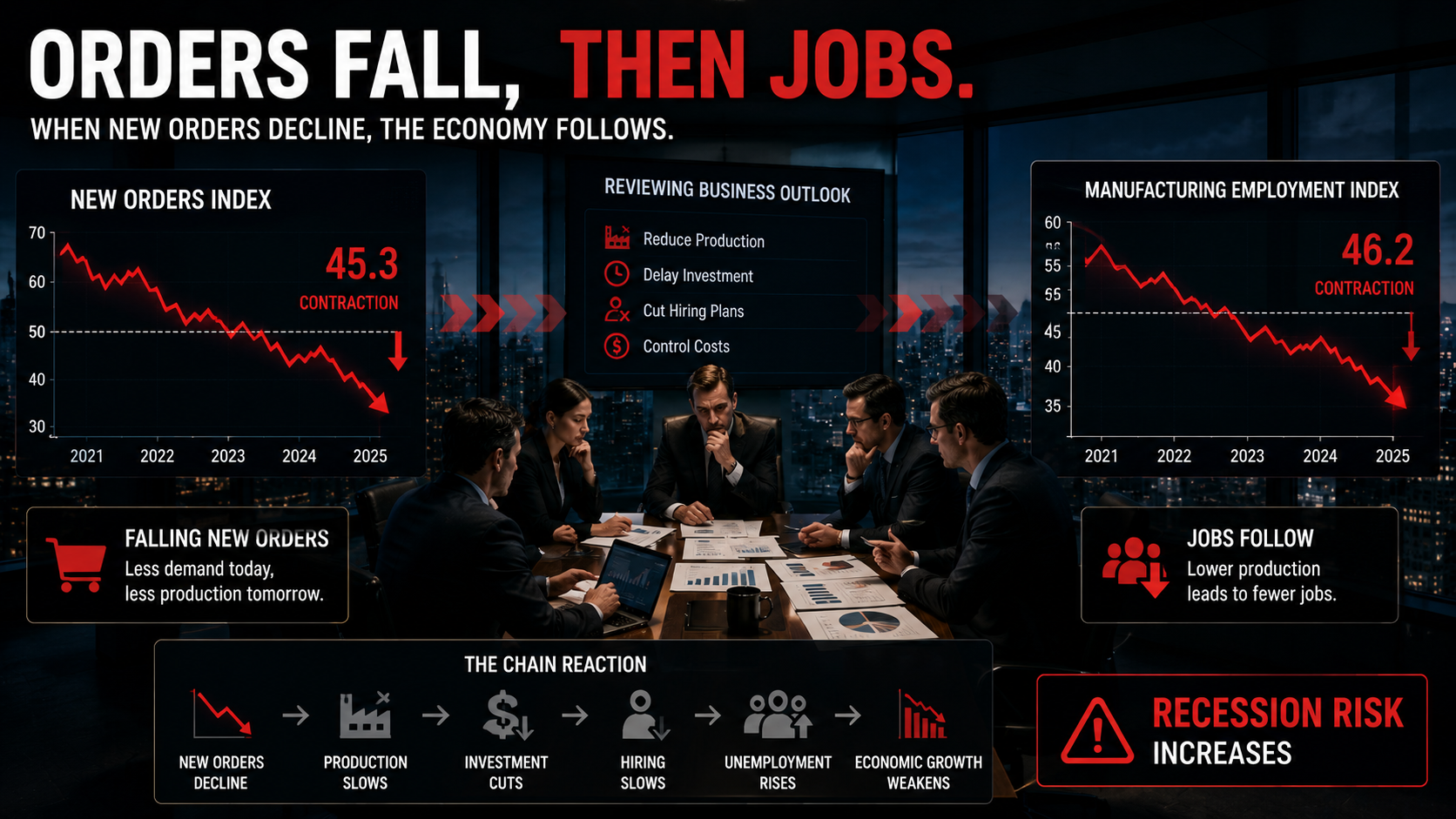
Economic slowdowns tend to follow a predictable sequence.
Consumer spending weakens.
New orders decline.
Production slows.
Business investment falls.
Hiring slows.
Unemployment rises.
Economic growth weakens.
The ISM Manufacturing Index often captures the beginning of this process.
While GDP and employment reports tell investors what has already happened, the ISM survey provides insight into what businesses are seeing right now.
That is why investors often view it as an economic early-warning system.
Historical Track Record
The ISM Manufacturing Index has developed a strong reputation because it has frequently signaled economic weakness before major downturns.
Examples include
- The 2001 Dot-Com Recession
- The 2008 Global Financial Crisis
- The 2020 Pandemic Recession
In each case, manufacturing activity weakened before the broader economy entered recession.
Of course, no indicator is perfect.
Not every decline below 50 leads to a recession.
However, sustained readings below 50—especially near 45—have historically been warning signs that investors take seriously.
Why Investors Pay Attention to the ISM Manufacturing Index

Markets are forward-looking.
Stock prices do not reflect today's economy.
They reflect expectations about future earnings, future growth, and future liquidity.
When the ISM Manufacturing Index rises, investors often interpret it as
- Stronger economic growth ahead
- Improving corporate earnings
- Higher business confidence
When the index falls, investors may begin pricing in
- Slower growth
- Lower earnings expectations
- Increased recession risk
As a result, ISM data can influence market sentiment well beyond the manufacturing sector itself.
How the ISM Manufacturing Index Affects Financial Markets
Changes in the ISM Manufacturing Index can influence the flow of capital across multiple asset classes.
| Asset Class | Strong ISM (Expansion) | Weak ISM (Contraction) |
| Stocks | Generally positive | Often negative |
| Bonds | Yields may rise | Yields may fall |
| U.S. Dollar | Potentially stronger | Potentially weaker |
| Gold | Often weaker | Often stronger |
| Bitcoin | Risk appetite improves | Volatility increases |
Stocks
A rising ISM reading often supports cyclical sectors such as
- Industrials
- Financials
- Semiconductors
- Consumer discretionary companies
A weakening ISM reading can pressure earnings expectations and reduce risk appetite.
Bonds
Strong economic activity may lead investors to expect higher interest rates, which can push bond prices lower.
Weak economic data often increases expectations for future Federal Reserve rate cuts, supporting bond prices.
The U.S. Dollar and Gold
A strong ISM reading can reinforce confidence in the U.S. economy and support the dollar.
Conversely, signs of economic weakness often increase demand for defensive assets such as gold.
Bitcoin
Bitcoin is generally viewed as a risk-sensitive asset.
During economic slowdowns, investors may initially reduce exposure.
However, if weakening economic conditions eventually lead to easier monetary policy and increased liquidity, Bitcoin can benefit significantly from that environment.
This is why liquidity often matters more than economic growth alone.
Key Takeaways for Investors
When analyzing ISM data, investors should look beyond the headline number.
Pay particular attention to
New Orders
This is often the most important forward-looking component.
Employment
Provides insight into future labor market conditions.
Inventories
Can reveal whether businesses are building excess stock or preparing for stronger demand.
Trend Direction
Momentum often matters more than the absolute reading.
Economic turning points usually appear in the trend before they appear in the headlines.
What Do Wealthy Investors See in This Data?

Most investors focus on whether the economy is improving or deteriorating.
Wealthy investors often focus on something else
the flow of money.
Where Is Capital Moving?
When manufacturing activity weakens, capital often rotates away from speculative assets and toward more defensive areas.
Investors may increase exposure to
- U.S. Treasuries
- Cash
- Defensive equities
- Gold
The goal is not necessarily to predict a recession.
The goal is to understand where capital is moving before everyone else notices.
Which Assets Can Survive?
Economic slowdowns expose weak business models.
Companies with strong balance sheets and stable cash flows often outperform those dependent on aggressive growth assumptions.
This is why experienced investors pay close attention to financial resilience rather than simply chasing returns.
Long-Term Investors Look Beyond the Slowdown
Markets spend a great deal of time worrying about recessions.
Long-term investors focus on what comes after them.
When manufacturing activity weakens, many investors become obsessed with predicting the next downturn.
But capital allocators often ask different questions
- Where is money leaving?
- Where is money accumulating?
- Which assets can survive a difficult environment?
- Which sectors could benefit when liquidity eventually returns?
The biggest opportunities often emerge after periods of fear, not during periods of optimism.
Ultimately, successful investing is less about predicting every economic cycle and more about surviving long enough to benefit from the next one.
Final Thoughts
The ISM Manufacturing Index is far more than a manufacturing statistic.
It is one of the earliest windows into business activity, corporate confidence, and economic momentum in the United States.
Because financial markets are forward-looking, investors pay close attention to indicators that reveal future trends rather than past conditions.
Understanding the ISM Manufacturing Index can help investors better interpret economic cycles, market sentiment, and capital flows.
The most important lesson is this
The ISM Manufacturing Index does not tell us where the economy has been. It helps us understand where it may be heading next.
This was MasterMind.
Designing success.
'[Global] Success Blueprints' 카테고리의 다른 글