What Is a Recession? Warning Signs, Causes, and Market Impact Explained


Hello, this is MasterMind.
Every market cycle eventually raises the same question
"Is a recession coming?"
Investors ask it when stocks become volatile, layoffs begin appearing in headlines, or the Federal Reserve keeps interest rates higher for longer.
But recessions rarely arrive overnight.
By the time economists officially declare a recession, markets have often spent months repricing risk, moving capital, and preparing for a different economic environment.
So how does a recession actually begin?
More importantly, what signals should investors watch before the headlines start screaming about economic trouble?
Let's break down the mechanics behind recessions, the warning signs that often appear beforehand, and what long-term investors can learn from them.
Key Takeaway
Recessions typically begin when higher interest rates and tighter credit slow the flow of money through the economy, leading to weaker spending, lower corporate profits, softer hiring, and eventually economic contraction.
What Is a Recession?
A recession is a broad decline in economic activity that affects consumers, businesses, and financial markets.
Many people define a recession as two consecutive quarters of negative GDP growth. While that rule of thumb is widely used, economists often look at a broader set of indicators including
- Employment
- Consumer spending
- Industrial production
- Personal income
- Business investment
From an investor's perspective, a recession is not simply an economic statistic.
It is a period when money becomes harder to access, risk appetite declines, and economic participants shift from growth mode into survival mode.
In other words, the engine of the economy starts losing momentum.
How Does a Recession Start?
Most recessions follow a similar pattern.
The details may differ from cycle to cycle, but the underlying mechanism is usually the same: credit becomes more expensive and economic activity slows.
Step 1: Interest Rates Rise
The process often begins when the Federal Reserve raises interest rates to fight inflation.
Higher rates increase borrowing costs across the economy.
Mortgages become more expensive.
Credit card balances become more costly.
Businesses face higher financing expenses.
As borrowing slows, spending and investment begin to cool.
Step 2: Credit Tightens
Modern economies are built on credit.
When banks become more cautious and lending standards tighten, money flows less freely through the financial system.
Businesses delay expansion plans.
Consumers become more conservative.
The most leveraged parts of the economy usually feel pressure first.
Step 3: Consumer Spending Slows
Consumer spending accounts for roughly two-thirds of U.S. economic activity.
When households reduce discretionary spending, businesses begin to feel the impact.
Large purchases such as homes, vehicles, and durable goods often weaken first.
Lower demand eventually translates into slower revenue growth.
Step 4: Corporate Investment Declines
When executives see weaker demand ahead, they often reduce spending.
Expansion projects are delayed.
Capital expenditures shrink.
Hiring plans are scaled back.
This creates another layer of economic slowdown.
Step 5: Employment Weakens
The labor market is often the final pillar to crack.
As growth slows, companies focus on preserving cash flow.
Hiring freezes become more common.
Layoffs begin to increase.
As unemployment rises, consumer spending weakens further.
The cycle feeds on itself.
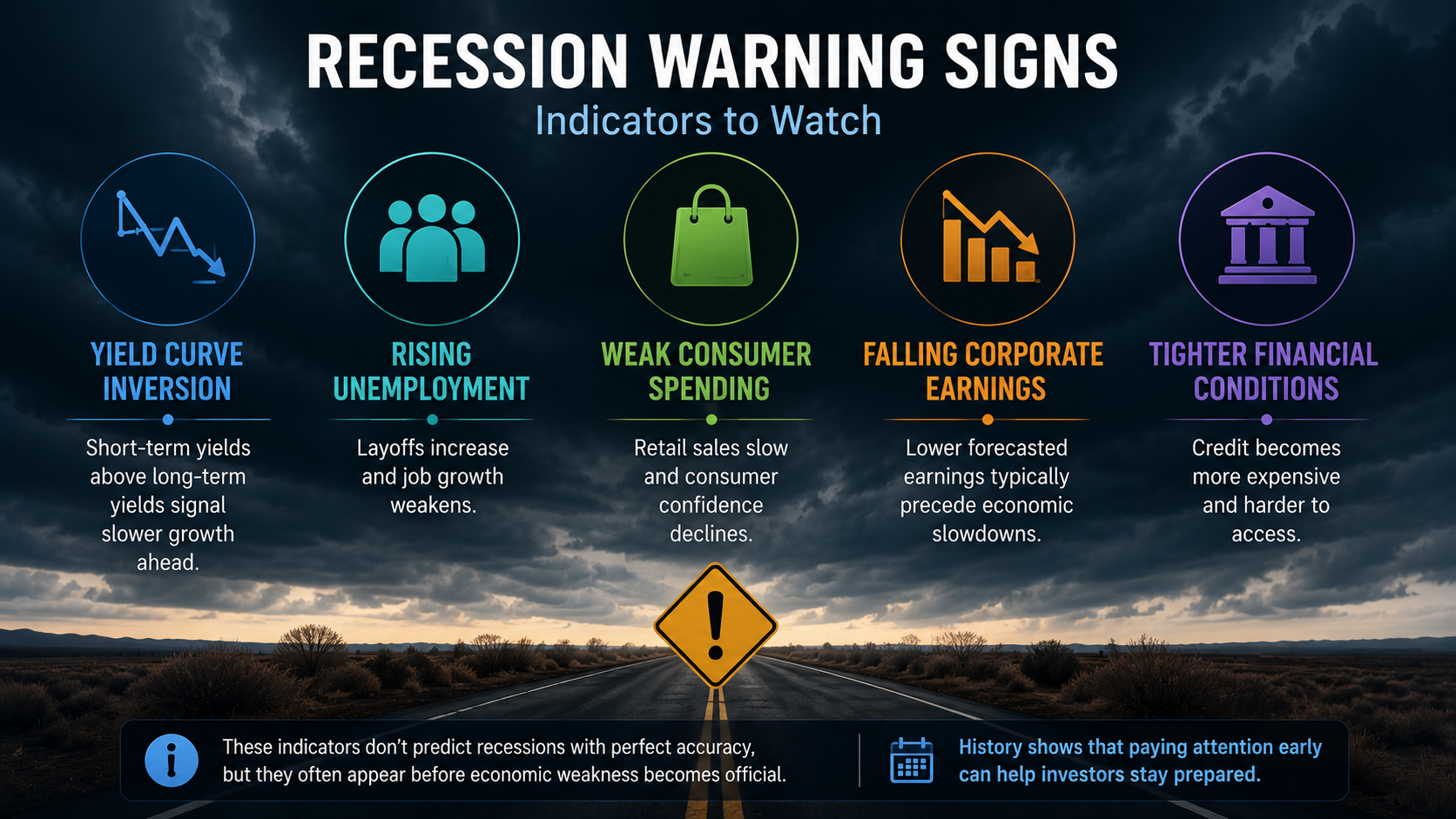
Recession Warning Signs Investors Should Watch

No one can predict recessions with perfect accuracy.
However, markets often provide clues long before an official recession begins.
Yield Curve Inversion
One of the most widely followed recession indicators is an inverted yield curve.
Normally, long-term Treasury yields are higher than short-term yields because investors demand additional compensation for lending money over longer periods.
When short-term yields rise above long-term yields, the bond market is signaling expectations for slower growth ahead.
Historically, many U.S. recessions have been preceded by yield curve inversions.

Rising Unemployment
Employment is one of the strongest indicators of economic health.
When businesses begin reducing payrolls, consumer confidence and spending often weaken soon afterward.
A sustained rise in unemployment can be a warning sign that economic momentum is fading.
Weak Consumer Spending
Consumers drive the U.S. economy.
Slowing retail sales, declining consumer confidence, and weaker discretionary spending often indicate that households are becoming more cautious.
When consumers pull back, economic growth typically follows.
Falling Corporate Earnings
Stock markets care about future earnings, not past performance.
When companies begin lowering revenue forecasts and profit expectations, investors often reassess valuations before economic data fully reflects the slowdown.
This is why markets frequently move ahead of the economy.
Why Recessions Matter to Investors
Markets are forward-looking.
By the time a recession officially begins, asset prices may have already adjusted.
This is why investors should focus less on predicting recession dates and more on understanding changing liquidity conditions.
A recession changes the flow of capital throughout the financial system.
Money moves.
Risk is repriced.
Valuations reset.
The key question is not whether a recession will occur.
The key question is where capital is moving as economic conditions evolve.
How Different Assets Typically React During a Recession
Asset Performance Dynamics During Recessions
| Asset Class | Typical Recession Behavior & Market Drivers |
| Stocks | Faces severe corporate earnings pressure, multiple compressions, and higher market volatility. |
| Bonds | Often benefits significantly as yields drop due to falling federal rate expectations. |
| U.S. Dollar | May strengthen sharply during periods of global uncertainty, driven by cash hoarding. |
| Gold | Actively attracts defensive capital and safe-haven demand amidst economic turmoil. |
| Real Estate | Highly non-linear; heavily influenced by mortgage rates, financing conditions, and local demand. |
| Bitcoin | Highly sensitive; often reacts negatively to initial liquidity shocks, then recovers based on risk appetite. |
It is important to remember that markets do not always behave exactly the same way.
What matters most is whether investors have already priced in the expected slowdown.
Key Lessons for Investors
Focus on Survival Before Prediction
The exact timing of a recession is nearly impossible to forecast consistently.
Investors who survive difficult periods are often better positioned than those who try to predict every turning point.
Cash Flow Matters More During Slowdowns
In bull markets, investors often chase growth.
During economic contractions, durable cash flow becomes far more valuable.
Companies with strong balance sheets and reliable earnings typically attract greater attention.
Liquidity Is the Hidden Driver
At its core, every market cycle is a liquidity cycle.
When money flows freely, risk assets tend to perform well.
When liquidity contracts, asset prices often face pressure.
Understanding liquidity is often more important than following headlines.
Markets Recover Before the Economy
One of the most counterintuitive lessons in investing is that markets often begin recovering while economic news still looks terrible.
The stock market is not a reflection of today's economy.
It is a discounting mechanism for future expectations.
What Wealthy Investors Look For During a Recession

Experienced investors rarely focus solely on falling asset prices.
Instead, they focus on capital flows.
Where Is Money Moving?
Capital tends to move from speculative assets toward quality assets.
Investors seek stronger balance sheets, reliable earnings, and defensive sectors.
Which Assets Generate Cash Flow?
Assets that continue producing income during economic stress become increasingly valuable.
Cash flow often determines survival.
Which Businesses Can Survive the Cycle?
The strongest companies are not necessarily those that grow fastest during booms.
They are the businesses that remain resilient during downturns.
What Opportunities Are Being Created?
Every recession creates winners and losers.
Periods of fear often produce the most attractive long-term opportunities for patient investors.
Ask yourself
- Can my portfolio withstand an economic downturn?
- Am I relying too heavily on debt-driven growth?
- Do my investments generate durable cash flow?
- Am I reacting to headlines or following the data?
Investing is not about predicting every storm.
It is about building a portfolio that can survive them.
Final Thoughts
Recessions are not random events.
They are the result of slowing credit growth, tightening financial conditions, weakening demand, and changing investor behavior.
Most recessions begin with higher borrowing costs and tighter credit, eventually leading to slower spending, weaker business activity, and softer labor markets.
For investors, the goal should not be to predict every recession.
The goal should be to understand how money moves through the economy and how market expectations evolve over time.
Because in investing, survival is often more important than prediction.
And those who survive the cycle are usually the ones best positioned for the next opportunity.
MasterMind.
'[Global] Success Blueprints' 카테고리의 다른 글