What Is the Sahm Rule? A Key Recession Indicator Based on Unemployment Trends


Hello, this is MasterMind.
How do investors know when the economy is actually slipping into a recession?
Why does Wall Street pay such close attention to a seemingly small increase in the unemployment rate?
While most investors focus on GDP, inflation, or Federal Reserve policy, one of the most respected recession indicators in modern economics is surprisingly simple: the Sahm Rule.
Developed by economist Claudia Sahm, this indicator uses changes in unemployment to identify when the U.S. economy may already be entering a recession.
Understanding the Sahm Rule can help investors better interpret economic cycles, market sentiment, and shifts in liquidity before they become obvious headlines.

Key Takeaway
The Sahm Rule is a recession indicator that measures how quickly unemployment is rising and has historically provided one of the most reliable signals that the U.S. economy is entering a downturn.
What Is the Sahm Rule?
The Sahm Rule is an economic indicator designed to identify the early stages of a recession using unemployment data.
It compares the current three-month average unemployment rate with the lowest three-month average unemployment rate observed during the previous twelve months.
A recession signal occurs when that difference reaches 0.5 percentage points or more.
In simple terms, the rule suggests that when unemployment starts rising rapidly, economic weakness is likely spreading throughout the broader economy.
For example
| Data Point | Value |
| Lowest 3-month average unemployment rate in past 12 months | 3.5% |
| Current 3-month average unemployment rate | 4.1% |
| Difference | +0.6% |
Since the increase exceeds 0.5 percentage points, the Sahm Rule would be triggered.
How Is the Sahm Rule Calculated?
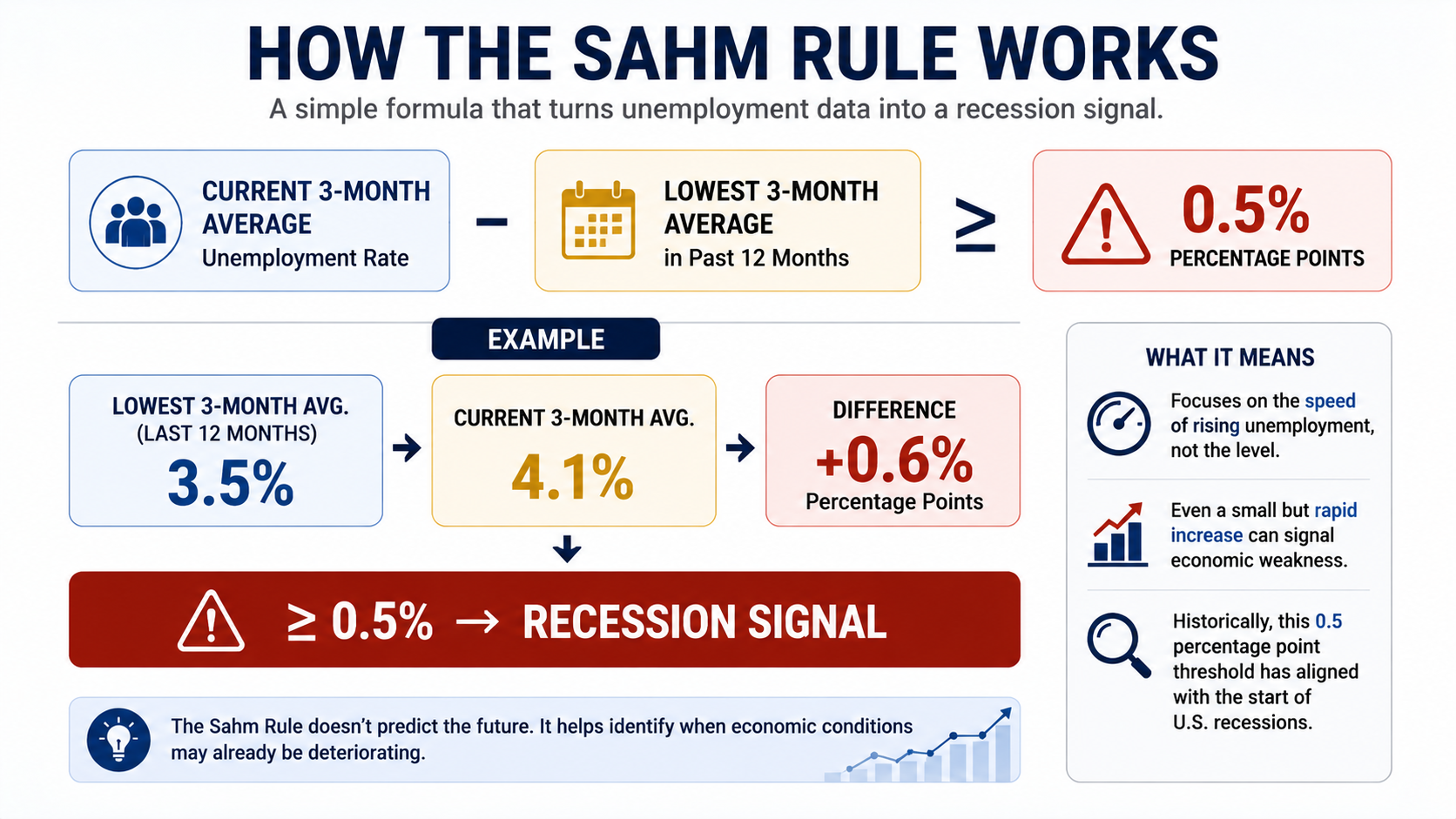
The formula is straightforward
Current 3-Month Average Unemployment Rate
−
Lowest 3-Month Average Unemployment Rate During the Previous 12 Months
≥ 0.5%
What matters is not the absolute unemployment rate itself but the speed at which unemployment is increasing.
Even if unemployment remains historically low, a rapid increase can signal that economic conditions are deteriorating faster than expected.
Why Was the Sahm Rule Created?
Official recession declarations often arrive too late to be useful for investors.
In the United States, recessions are officially determined by the National Bureau of Economic Research (NBER). However, those announcements frequently occur months after a recession has already begun.
Financial markets do not wait for official confirmation.
Stocks, bonds, and currencies continuously price future expectations.
By the time a recession is officially declared, markets may have already sold off—or even started recovering.
The Sahm Rule was developed to provide a faster and more practical way to detect economic weakness using real-time labor market data.
How the Sahm Rule Works
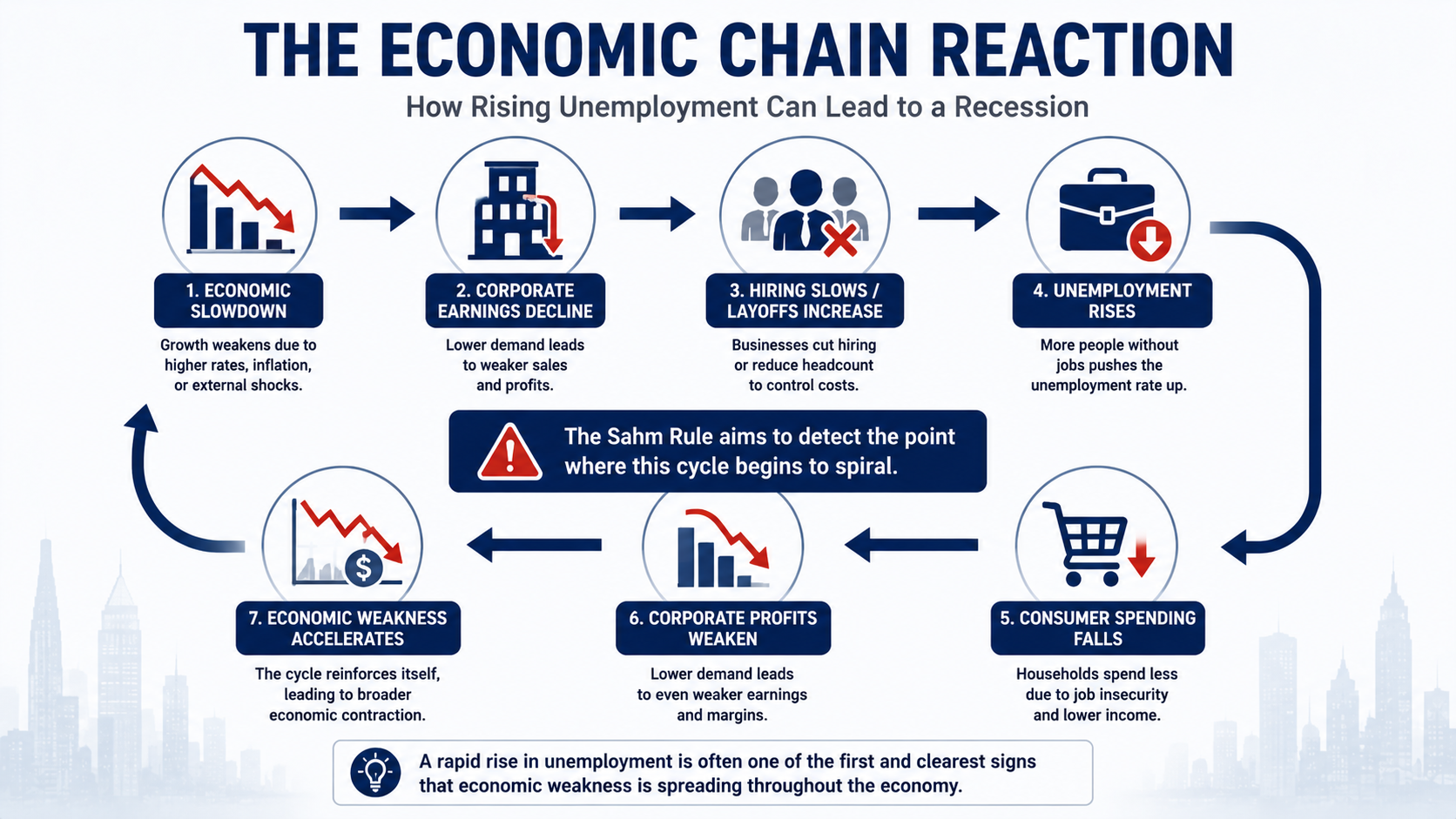
The labor market is often one of the clearest reflections of economic health.
When economic growth slows
Economic Demand Weakens
↓
Corporate Revenue Declines
↓
Hiring Slows
↓
Layoffs Increase
↓
Unemployment Rises
↓
Consumer Spending Falls
↓
Corporate Earnings Deteriorate
↓
Economic Weakness Accelerates
The Sahm Rule attempts to identify the point at which this cycle begins feeding on itself.
Historically, the 0.5 percentage point threshold has closely aligned with the start of recessionary conditions.
Why Investors Pay Attention to the Sahm Rule
1. Strong Historical Track Record
The Sahm Rule gained credibility because it successfully identified every U.S. recession over several decades with remarkable consistency.
Few economic indicators have demonstrated such reliability.
2. It Can Signal a Federal Reserve Pivot
The Federal Reserve has a dual mandate
- Price stability
- Maximum employment
If unemployment rises rapidly, policymakers may shift their focus from fighting inflation to supporting economic growth.
This can increase expectations for
- Interest rate cuts
- Monetary easing
- Liquidity expansion
As a result, markets closely monitor labor market deterioration.
3. Money Flows Begin to Change
The most important question for investors is not whether a recession is coming.
It is where capital is moving.
When recession risks rise, money often flows
- From growth stocks to defensive sectors
- From risk assets to government bonds
- From speculation toward stability
- From leverage toward liquidity
Understanding these shifts can be more valuable than predicting the recession itself.
Limitations of the Sahm Rule
Despite its strong track record, the Sahm Rule is not perfect.
Recent labor market dynamics have raised questions about potential distortions.
For example, unemployment can rise because labor supply increases rather than because companies are aggressively laying off workers.
This can happen when
- Labor force participation rises
- Immigration increases
- More workers enter the job market
In these cases, unemployment may increase without a severe economic contraction.
For that reason, investors should also monitor
- JOLTS Job Openings
- Nonfarm Payrolls (NFP)
- Initial Jobless Claims
- ISM Manufacturing Index
- Consumer Spending Data
No single indicator should be viewed in isolation.
How the Sahm Rule Can Affect Financial Markets
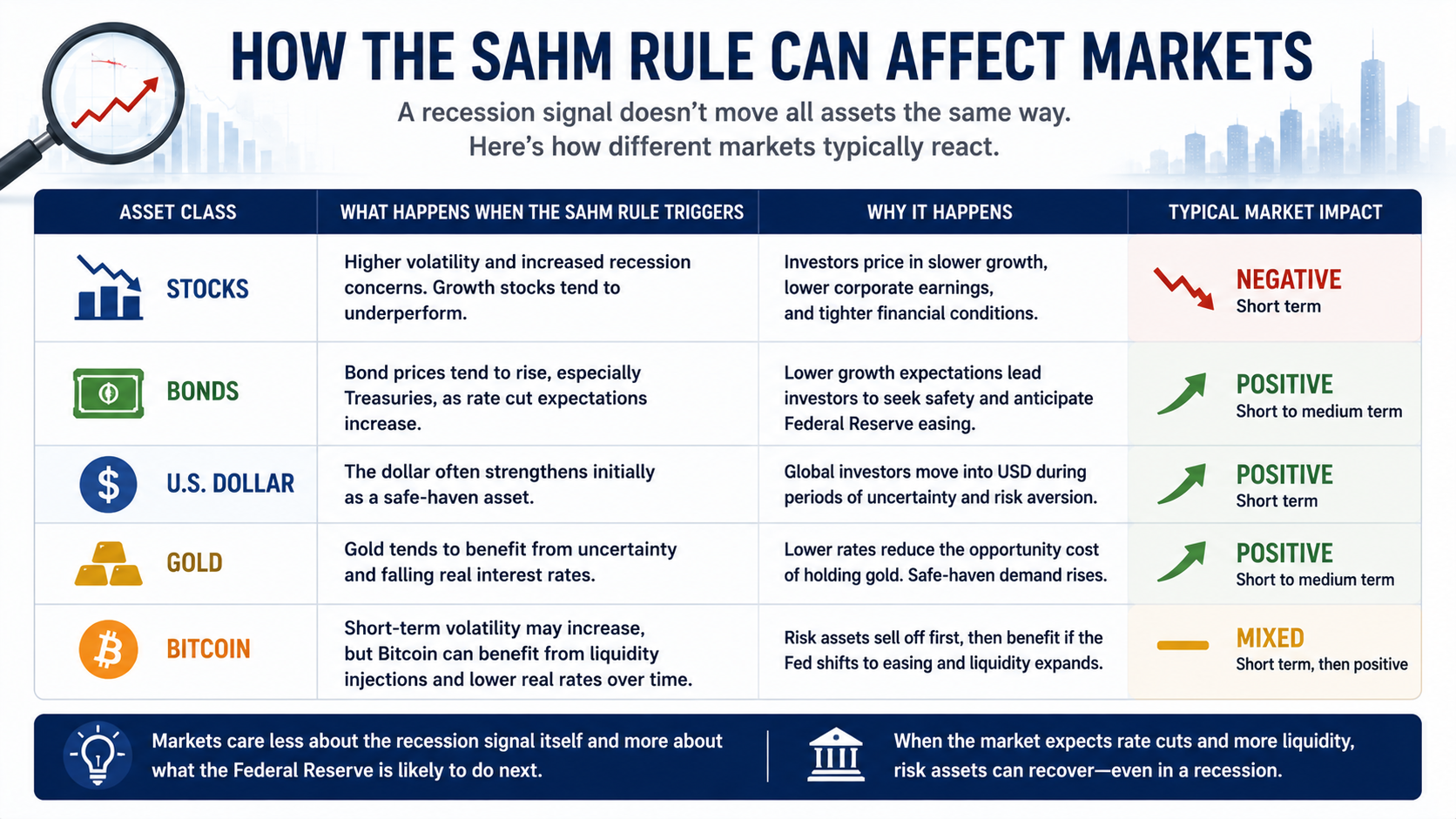
Market Impact of Recession Signals (Sahm Rule Trigger)
| Asset Class | Typical Market Impact & Dynamics |
| Stocks | Faces severe headwinds with increased volatility and corporate earnings recession concerns. |
| Bonds | Experiences a strong bull run (higher prices) as monetary easing and rate-cut expectations surge. |
| U.S. Dollar | Sees sharp initial strength driven by global safe-haven liquidity demand. |
| Gold | Benefits significantly from macro uncertainty, market fear, and rapidly falling real interest rates. |
| Bitcoin | Endures short-term liquidity shocks and volatility, followed by growth opportunities as central banks inject liquidity. |
One important point is that markets often react more to expected Federal Reserve actions than to the recession signal itself.
A recession signal can sometimes become bullish if investors anticipate aggressive monetary easing.
What Investors Should Remember
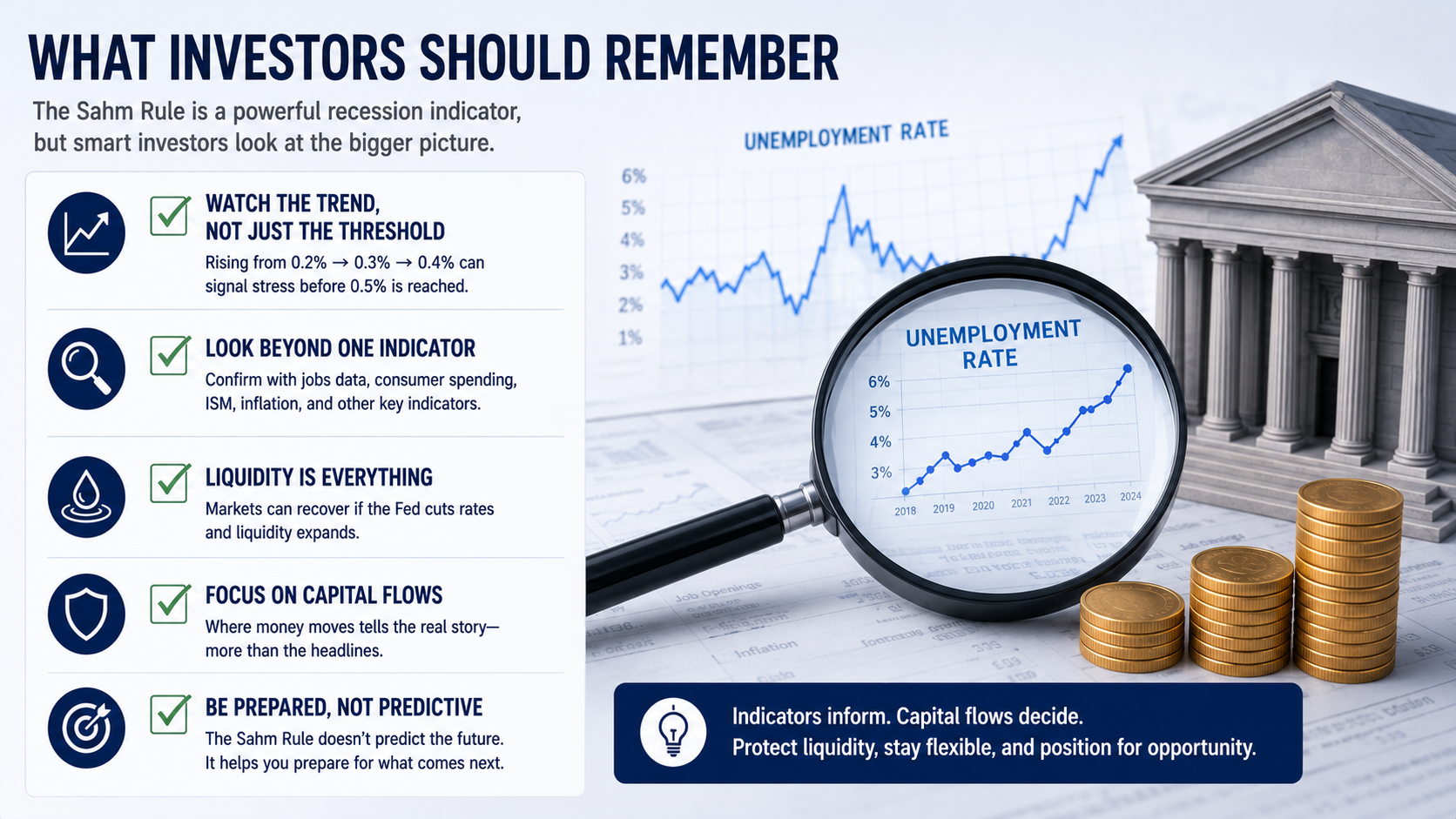
The Sahm Rule Is Not a Crystal Ball
The indicator does not predict recessions years in advance.
Instead, it helps confirm that economic weakness may already be developing.
Watch the Trend, Not Just the Threshold
Markets frequently react before the indicator officially reaches 0.5%.
A progression such as
0.2%
↓
0.3%
↓
0.4%
can already signal growing economic stress.
Liquidity Still Matters Most
Even when recession risks rise, markets can recover quickly if
- Interest rates fall
- Liquidity expands
- Financial conditions ease
Economic weakness and market performance are not always the same thing.
What Do Wealthy Investors Look For?
Most people focus on unemployment numbers.
Sophisticated investors focus on capital flows.
Where Is Money Moving?
Are investors moving into government bonds?
Are they increasing cash allocations?
Are defensive sectors outperforming?
These shifts often reveal more than economic headlines.
Which Assets Can Survive?
During economic slowdowns, asset durability becomes critical.
Strong balance sheets.
Reliable cash flow.
Low debt burdens.
These characteristics often matter more than growth projections.
Is Liquidity Being Preserved?
The largest investment opportunities often emerge during periods of economic stress.
Investors who maintain liquidity during downturns are usually in a stronger position when attractive opportunities appear.
As always, successful investing is less about prediction and more about survival.
Final Thoughts
The Sahm Rule is one of the most respected recession indicators because it captures a critical shift in the labor market.
Rising unemployment often reflects deeper economic weakness that may already be spreading throughout the economy.
However, investors should remember that markets do not move based solely on recession signals.
They move based on expectations, liquidity, and capital flows.
Understanding where money is moving is often more important than predicting exactly when a recession will begin.
The Sahm Rule is not simply a warning signal.
For long-term investors, it can serve as a valuable framework for understanding changing economic conditions and preparing for the opportunities that follow.
This was MasterMind.
Designing success.
'[Global] Success Blueprints' 카테고리의 다른 글