What Is an ETF? A Beginner's Guide to Investing and Diversification


Hello, this is MasterMind.
Imagine opening a brokerage account for the first time.
You want to invest in the stock market, but you're immediately faced with thousands of choices. Should you buy Apple? Microsoft? Nvidia? Amazon?
What if you choose the wrong company?
What if a business that looks unstoppable today struggles a decade from now?
This is exactly why millions of investors eventually discover ETFs.
Today, ETFs have become one of the most popular investment vehicles in the world, attracting trillions of dollars from individual investors, pension funds, and institutional money managers.
But what exactly is an ETF?
And why do so many long-term investors use ETFs as the foundation of their portfolios?
Let's break down the concept, how it works, and why ETFs have transformed modern investing.

Key Takeaway
An ETF allows investors to buy an entire basket of stocks or assets with a single purchase, making diversification simpler, cheaper, and more accessible than ever before.
What Is an ETF?
ETF stands for Exchange-Traded Fund.
At its core, an ETF is a fund that holds a collection of assets and trades on a stock exchange just like an individual stock.
Think of it as a basket.
Instead of buying one company, you're buying a basket containing dozens, hundreds, or even thousands of investments.
For example
- An S&P 500 ETF gives you exposure to approximately 500 of America's largest companies.
- A Nasdaq-100 ETF provides access to leading technology and growth companies.
- A Treasury Bond ETF offers exposure to government debt.
- A Gold ETF tracks the price of gold.
- A Bitcoin ETF tracks the price of Bitcoin.
With a single purchase, investors can gain broad market exposure without having to select every individual asset themselves.
How Do ETFs Work?
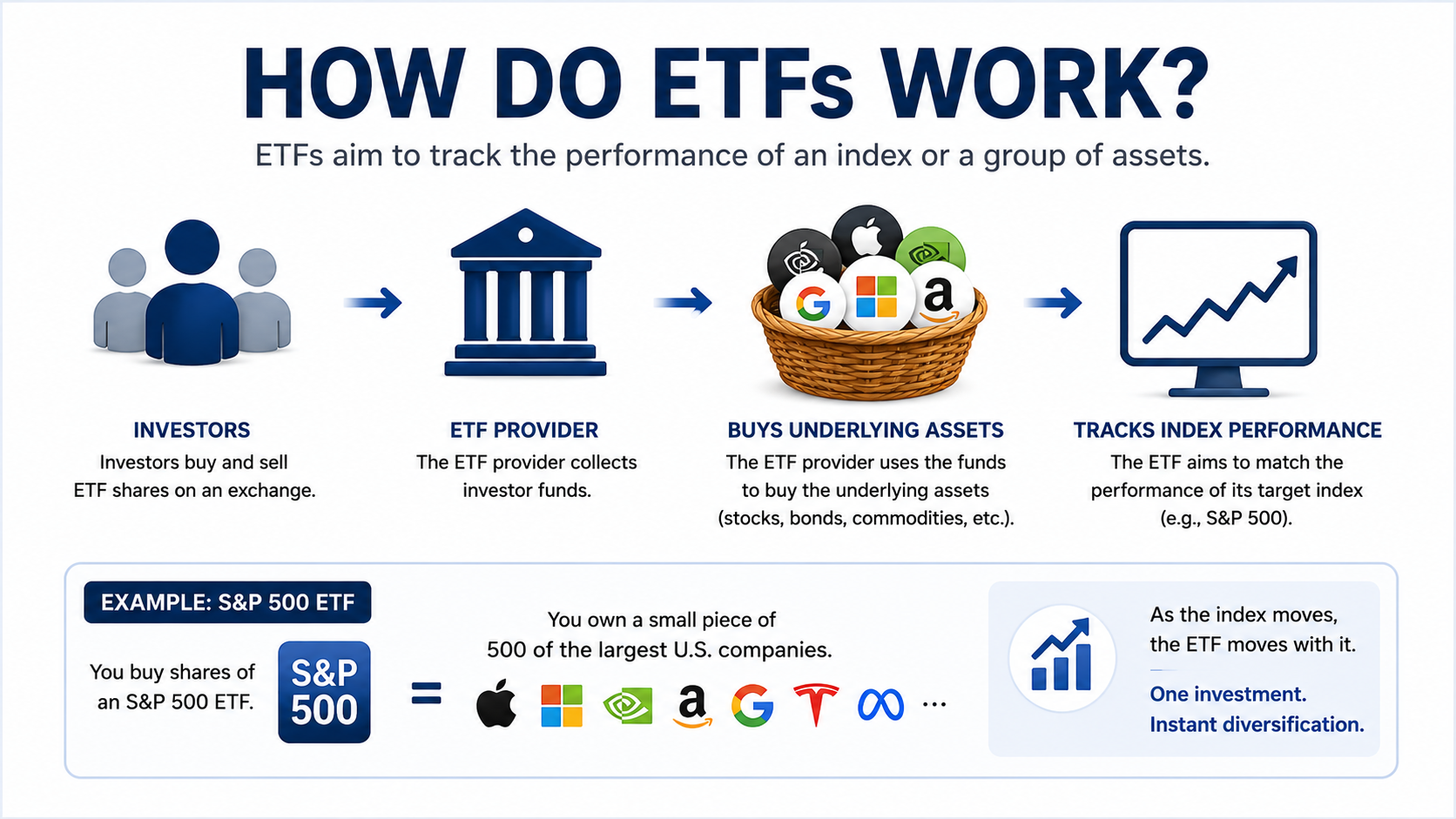
Most ETFs are designed to track a specific index or asset.
For example, an S&P 500 ETF attempts to mirror the performance of the S&P 500 Index.
If the index rises by 10%, the ETF should rise by roughly the same amount.
If the index falls by 10%, the ETF will generally decline as well.
Behind the scenes, the ETF provider owns the underlying assets and adjusts the holdings as necessary to keep the fund aligned with its benchmark.
This means that when investors buy shares of an ETF, they are indirectly buying small pieces of all the assets inside that fund.
Instead of betting on a single company, they are investing in an entire segment of the market.
ETF vs Individual Stocks
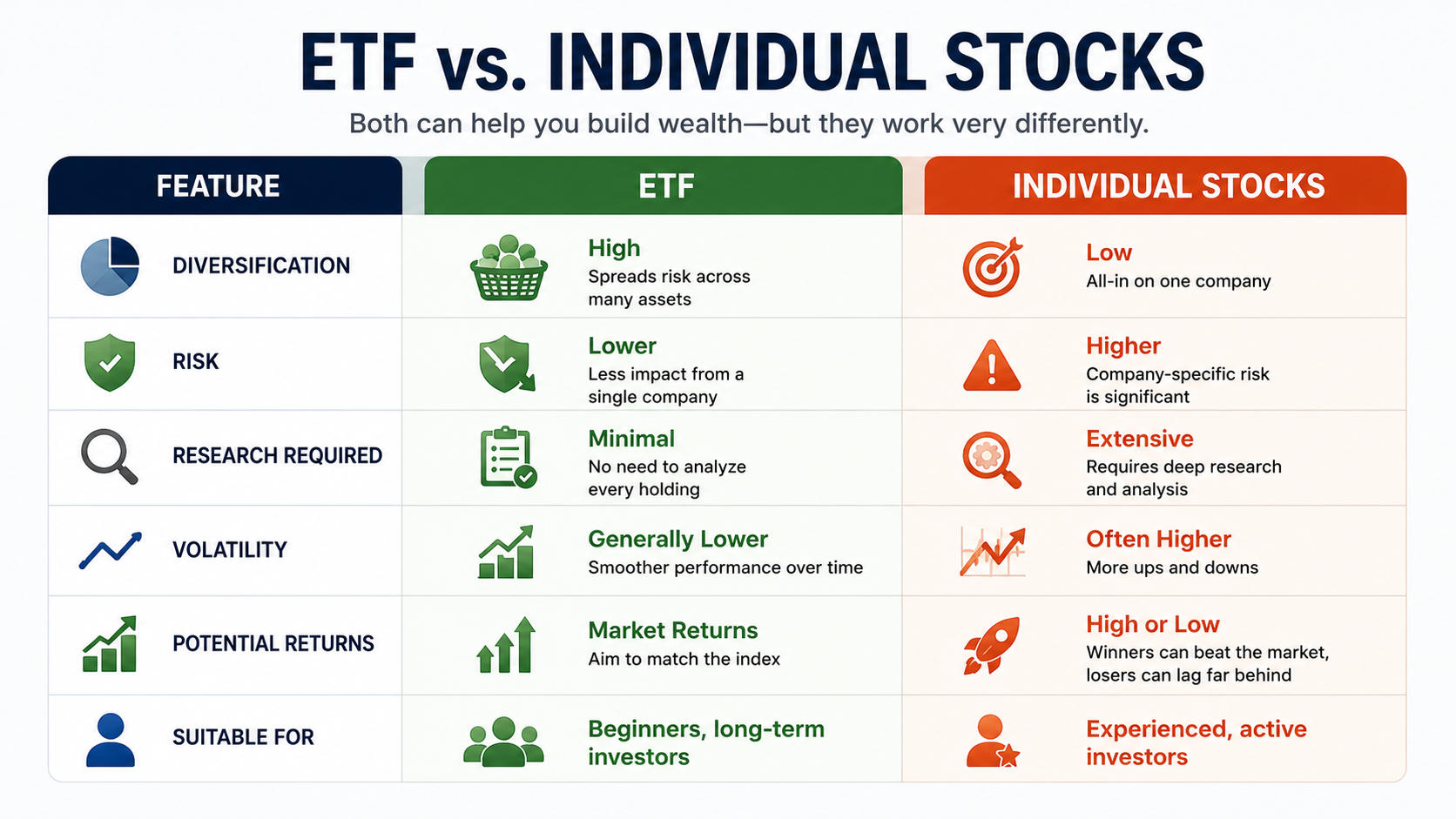
One of the most common questions among beginner investors is whether they should buy ETFs or individual stocks.
The answer depends on their goals.
Investment Strategy - ETF vs. Individual Stocks
| Category | ETF (Exchange-Traded Fund) | Individual Stocks |
| Diversification | 🟢 High (Instant basket of assets) | 🔴 Low (Single company exposure) |
| Risk | Lower (Smoothed out by basket) | Higher (Subject to sharp moves) |
| Research Required | Minimal (Broad sectors/indices) | Significant (Financials, earnings) |
| Volatility | Generally Lower | Often Higher |
| Potential to Beat the Market | Limited | Possible |
| Beginner Friendly | Excellent | Moderate |
Individual stocks can generate extraordinary returns.
However, they also carry company-specific risks.
A single earnings miss, management failure, or industry disruption can significantly impact a stock's performance.
ETFs reduce that risk by spreading investments across many companies.
This is one reason why many financial advisors recommend ETFs as a starting point for long-term investors.
Why Are ETFs So Popular?
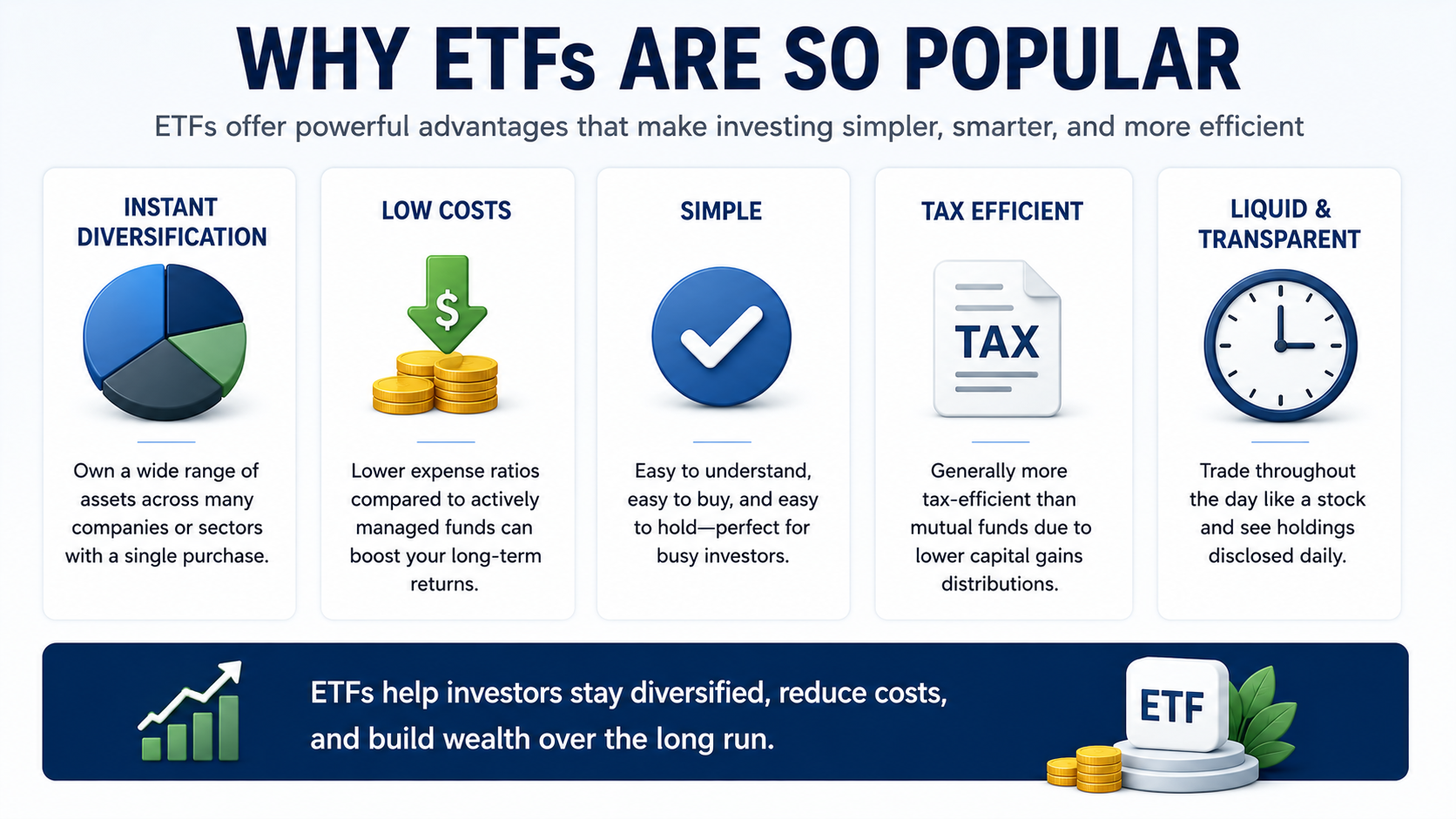
Instant Diversification
Diversification is one of the most powerful tools in investing.
By owning an ETF, investors can instantly spread their money across many businesses, sectors, or asset classes.
This reduces the impact of any single investment performing poorly.
Low Costs
Most index ETFs are extremely inexpensive.
Because they simply track an index rather than actively selecting stocks, management fees are often only a fraction of traditional mutual fund costs.
Over decades, even small fee differences can have a significant impact on long-term returns.
Simplicity
Investing does not have to be complicated.
Rather than constantly researching earnings reports, management teams, and industry trends, investors can gain exposure to the broader economy through a single investment.
Transparency and Liquidity
ETFs trade throughout the day like stocks.
Investors can see market prices in real time and easily buy or sell shares whenever markets are open.
Why Investors Pay Attention to ETF Flows
ETFs are no longer just investment products.
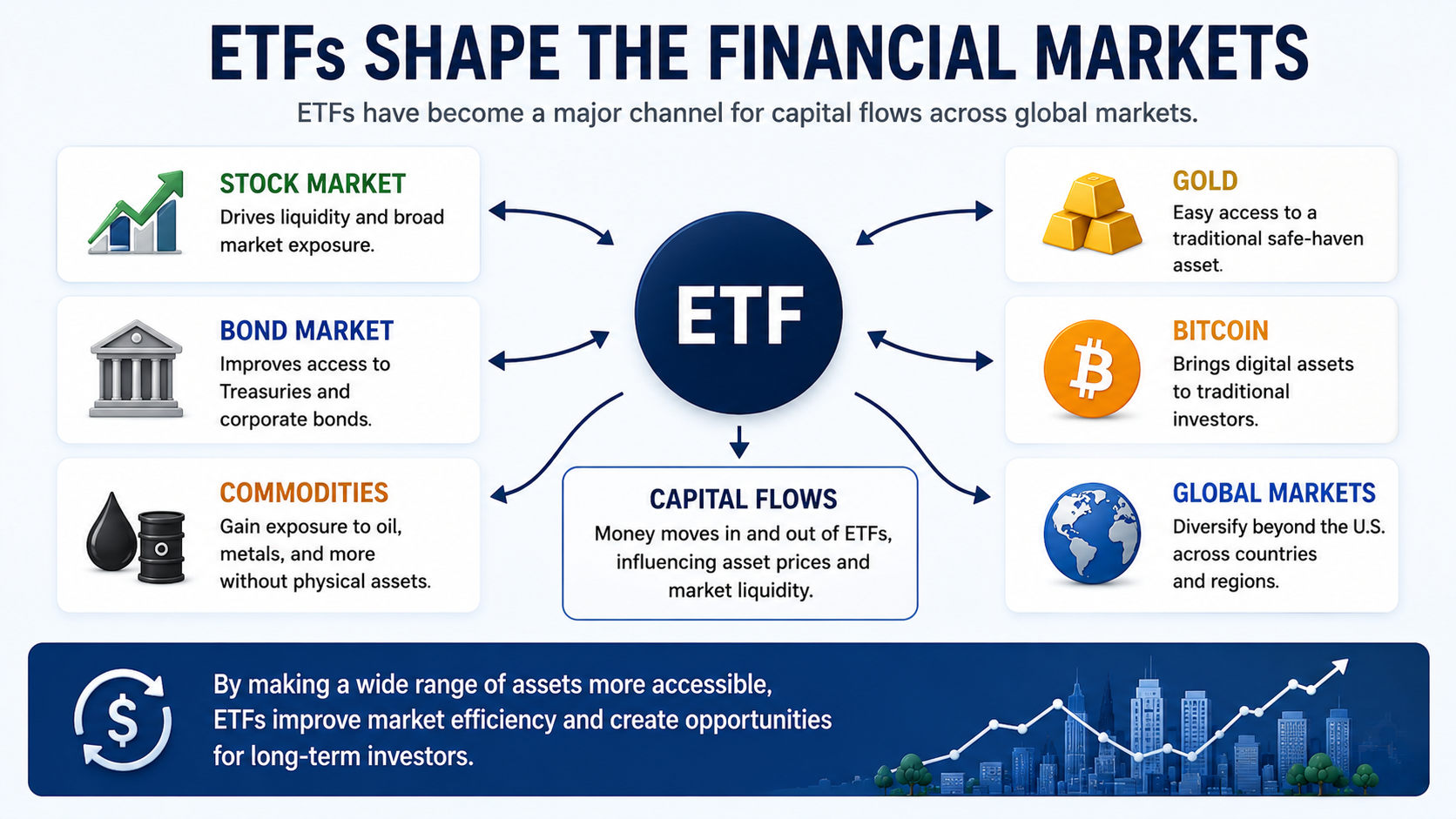
They have become major channels through which capital moves across global markets.
When investors pour money into an ETF, the fund provider often needs to purchase more of the underlying assets.
When investors withdraw money, those assets may need to be sold.
As a result, ETF flows can influence market liquidity and asset prices.
Today, understanding markets is not just about understanding information.
It is about understanding where money is flowing.
And ETFs have become one of the largest highways for capital movement in modern finance.
How ETFs Impact Different Markets
How ETFs Revolutionized Asset Classes
| Asset Class | Market Impact & Transformation |
| Stocks | Dramatically increased retail access and liquidity for broad market investing. |
| Bonds | Provided easier, instant access to complex Treasury and corporate bond markets. |
| Gold | Simplified ownership of a traditional safe-haven asset without physical storage. |
| Commodities | Allowed seamless institutional exposure without raw physical storage challenges. |
| Bitcoin | Opened the floodgates for institutional access through regulated investment products. |
| International Markets | Created frictionless, global diversification opportunities for everyday investors. |
The introduction of spot Bitcoin ETFs is a recent example of how ETFs can reshape an asset class.
By making Bitcoin accessible through traditional brokerage accounts, ETFs opened the door for a much larger pool of institutional capital.
Three Things Investors Should Check Before Buying an ETF
Assets Under Management (AUM)
Larger ETFs generally have stronger liquidity and tighter trading spreads.
Expense Ratio
Even small differences in fees can compound into meaningful differences over decades.
Tracking Error
Investors should examine how closely an ETF follows its intended benchmark.
A lower tracking error generally indicates a more efficient fund.
Can You Build Wealth With ETFs Alone?
Many investors wonder whether ETFs are enough.
Interestingly, legendary investor Warren Buffett has repeatedly suggested that most investors would be better off owning a low-cost S&P 500 index fund rather than attempting to pick individual stocks.
His reasoning is simple.
Most investors struggle to consistently outperform the market.
Owning a broad market ETF allows them to participate in the long-term growth of the economy without having to predict which company will become the next winner.
This approach may not be exciting.
But investing is not supposed to be exciting.
Successful investing is often about consistency rather than prediction.
What Are Wealthy Investors Really Watching?
Experienced investors often look beyond the ETF itself.
They pay attention to the movement of capital.
Is money flowing into stocks or bonds?
Are investors becoming more aggressive or more defensive?
Are institutions increasing exposure to growth sectors or moving toward safer assets?
These capital flows often provide valuable clues about market sentiment and economic expectations.
The goal is not to perfectly predict the future.
The goal is to understand the direction of money.
Because money tends to move before headlines fully explain why.
What Are You Really Buying When You Buy an ETF?
Many people think they are simply buying a financial product.
In reality, they may be buying something much larger.
When investors purchase an S&P 500 ETF, they are not just buying shares of 500 companies.
They are investing in innovation.
They are investing in productivity.
They are investing in entrepreneurship.
And ultimately, they are investing in the long-term growth of the American economy.
Markets will experience recessions.
Bear markets will happen.
Financial crises will return.
But throughout history, economic growth and corporate innovation have continued to create value over time.
ETFs provide one of the simplest ways to participate in that process.
Final Thoughts
ETFs have transformed investing by making diversification accessible, affordable, and efficient.
They allow investors to own broad sections of the market with a single purchase while reducing many of the risks associated with concentrated stock picking.
The most important lesson is this
Successful investing is not about making perfect predictions.
It is about building a portfolio that can survive uncertainty and benefit from long-term economic growth.
In the end, investing is less about finding the next hot stock and more about staying invested long enough for compounding to work.
This was MasterMind.
Designing success.
'[Global] Success Blueprints' 카테고리의 다른 글