What Is the Federal Reserve? How the Fed Controls Money, Interest Rates, and Market Liquidity


Hello, this is MasterMind.
Few institutions have as much influence over financial markets as the Federal Reserve.
Whether stocks are rallying to new highs, bonds are surging, or Bitcoin is experiencing extreme volatility, investors often find themselves asking the same question
What will the Fed do next?
A single statement from the Federal Reserve Chair can move trillions of dollars across global markets. But why does a central bank in Washington, D.C., have such an enormous impact on stocks, bonds, real estate, commodities, and even international economies?
To understand investing at a deeper level, you first need to understand the institution that controls the price and supply of money.
That institution is the Federal Reserve.
Key Takeaway
The Federal Reserve controls interest rates and the supply of U.S. dollars, making it one of the most powerful forces behind global liquidity, asset prices, and capital flows.
What Is the Federal Reserve?
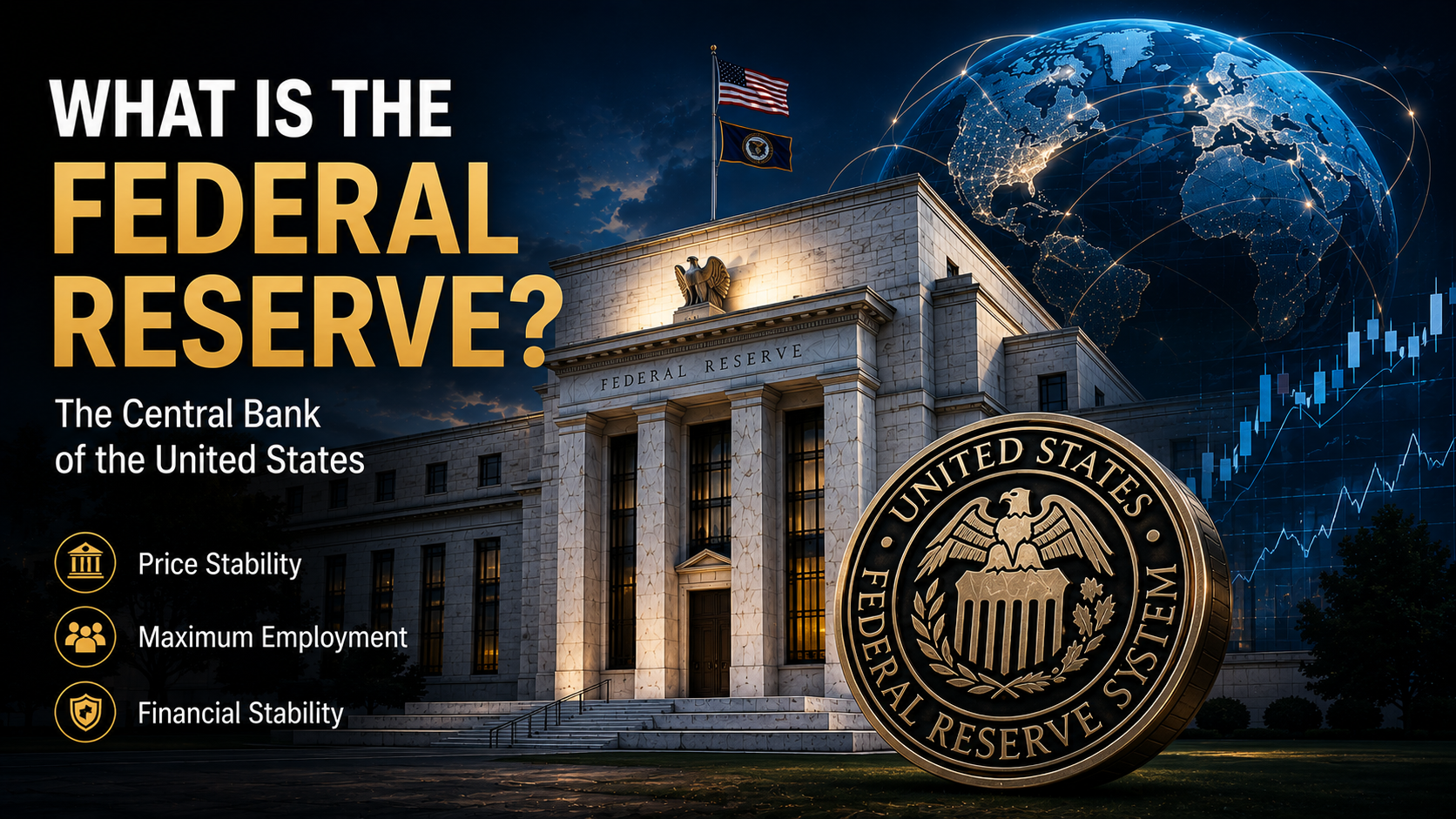
The Federal Reserve, commonly known as the Fed, is the central banking system of the United States.
Created in 1913, the Fed serves as the nation's monetary authority and is responsible for maintaining economic and financial stability.
Its primary objectives are often referred to as the "dual mandate"
Price Stability
The Fed seeks to keep inflation under control while maintaining confidence in the purchasing power of the U.S. dollar.
Maximum Employment
The Fed aims to support a strong labor market and sustainable economic growth.
Financial System Stability
The Fed also acts as a lender of last resort during financial crises and helps maintain confidence in the banking system.
The institution most investors pay attention to is the Federal Open Market Committee (FOMC), which meets regularly to determine the direction of monetary policy and interest rates.
How Does the Federal Reserve Influence the Economy?

The Fed's most powerful tool is the federal funds rate.
Simply put, interest rates represent the price of money.
When rates are lowered
- Borrowing becomes cheaper
- Consumer spending tends to increase
- Business investment often accelerates
- Liquidity expands throughout the economy
When rates are raised
- Borrowing becomes more expensive
- Spending and investment typically slow
- Financial conditions tighten
- Liquidity is reduced
Think of the economy as a vehicle.
Rate cuts press the accelerator.
Rate hikes apply the brakes.
The Fed's job is to manage the speed of economic activity without allowing inflation or financial instability to spiral out of control.
Why Does the Fed Matter to the Entire World?

This is where many investors underestimate the Fed's importance.
The answer comes down to one word
The Dollar
The U.S. dollar remains the world's primary reserve currency.
Global trade, energy markets, commodities, international lending, and cross-border investments are overwhelmingly denominated in dollars.
Oil is priced in dollars.
Gold is priced in dollars.
A significant portion of global debt is issued in dollars.
Because of this, the Fed doesn't just influence the American economy.
It influences global liquidity.
When the Fed changes monetary policy, capital flows often shift across continents.
What happens in Washington can affect investment portfolios in New York, London, Tokyo, Singapore, and beyond.
Markets React to Liquidity More Than Headlines
Many new investors focus exclusively on interest rate announcements.
Professional investors often focus on something deeper
Liquidity.
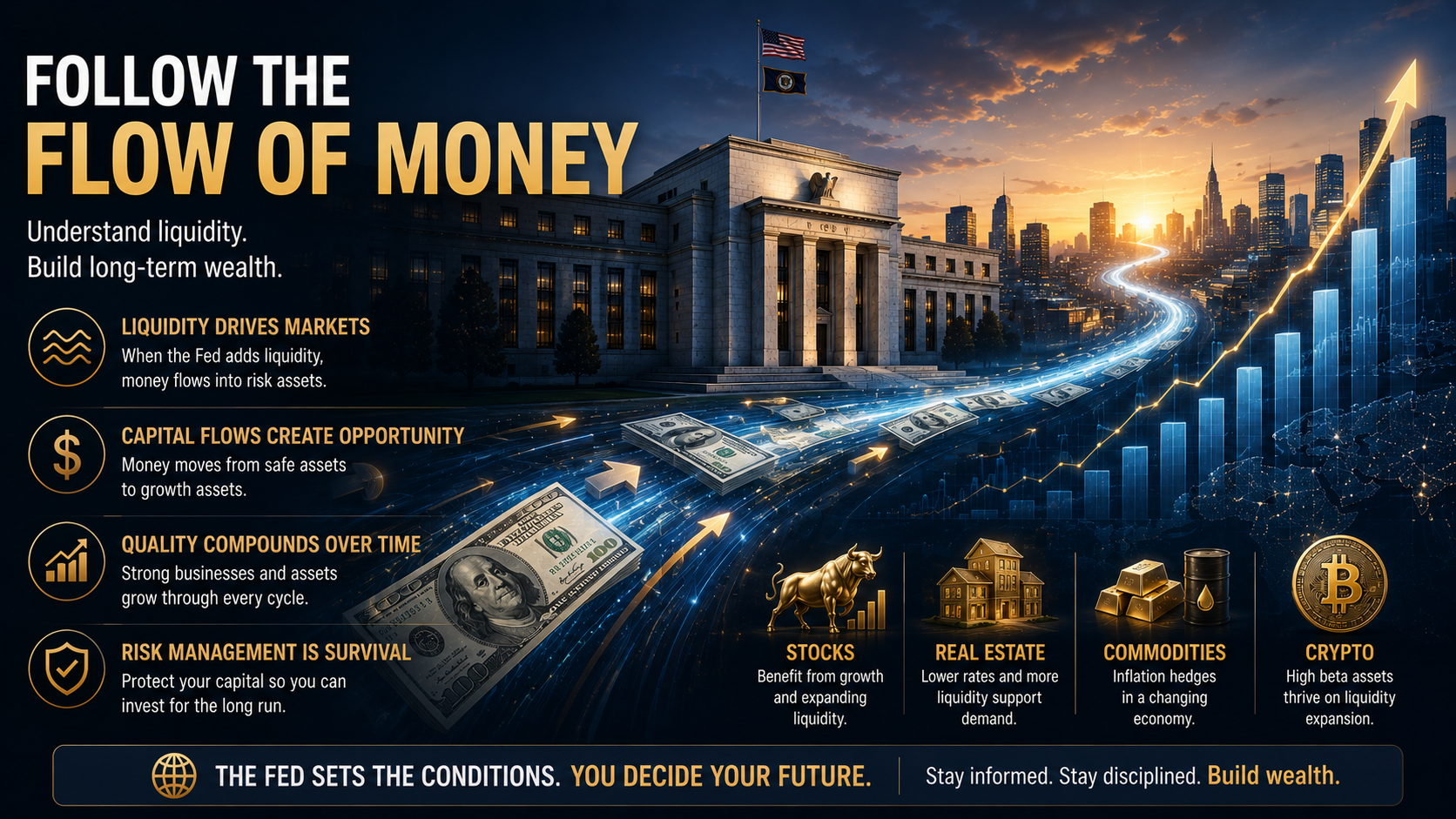
Liquidity represents how much money is available within the financial system.
When liquidity expands, capital tends to flow into
- Stocks
- Real estate
- Venture capital
- Growth assets
- Cryptocurrencies
When liquidity contracts, risk assets often face significant pressure.
This is one of the most important concepts in investing.
Markets frequently appear to move because of news headlines.
In reality, they often move because money is flowing toward or away from risk.
The Fed plays a major role in determining that flow.
Why Investors Closely Watch the Fed

Markets are forward-looking.
Investors are not simply reacting to today's interest rate.
They are trying to anticipate tomorrow's.
For example, stocks may rally months before the Fed actually cuts rates if investors believe easier monetary policy is approaching.
Likewise, markets can decline even before rate hikes occur if participants expect tighter conditions ahead.
This explains why every FOMC meeting, economic projection, and Fed Chair press conference receives enormous attention.
Markets trade expectations far more than they trade current conditions.
How Fed Policy Affects Major Asset Classes
Fed Policy Transmission: Interest Rate Sensitivity Matrix
| Asset Class | Higher Interest Rates (Tightening) 🇺🇸 | Lower Interest Rates (Easing) 🇺🇸 |
| Stocks | Valuations face pressure due to higher discount rates | Typically benefit from increased liquidity |
| Bonds | Existing bond prices generally fall | Existing bond prices generally rise |
| U.S. Dollar | Often strengthens | Often weakens |
| Gold | May face pressure from higher yields and a stronger dollar | Often benefits from lower real yields |
| Real Estate | Financing costs rise, reducing demand | Lower borrowing costs can support demand |
| Bitcoin & Crypto | Liquidity-sensitive assets often face pressure | Increased liquidity may provide support |
It's important to remember that markets often price in expectations long before policy changes actually occur.
Key Things Investors Should Understand About the Fed
1. Watch the Dot Plot
The Fed's dot plot shows where policymakers expect interest rates to be in the future.
Differences between market expectations and Fed expectations often create volatility.
2. Follow Economic Data
The Fed is highly data-dependent.
Important reports include
- CPI Inflation
- PCE Inflation
- Nonfarm Payrolls
- Unemployment Rate
- GDP Growth
These indicators heavily influence future policy decisions.
3. Don't Fight the Fed
One of Wall Street's most famous investing principles is
"Don't Fight the Fed."
When monetary policy is tightening, risk assets often face headwinds.
When policy is becoming more accommodative, market conditions can become more supportive.
4. Focus on Adaptation, Not Prediction
No investor consistently predicts every Fed decision.
Successful investors build portfolios that can adapt across different economic environments.
Survival is often more important than forecasting.
What Wealthy Investors See That Others Often Miss
Large asset allocators and institutional investors rarely focus on a single Fed meeting.
Instead, they focus on broader trends.
Capital Flows
Where is money moving?
Toward risk assets?
Toward cash and Treasury bonds?
Toward international markets?
Understanding capital flows often provides more insight than following daily headlines.
Cash Flow
In higher-rate environments, investors frequently prioritize assets that generate reliable cash flow.
Businesses with strong earnings and pricing power tend to be more resilient.
Asset Durability
Can an investment survive economic slowdowns, inflation, and tighter financial conditions?
The strongest assets often demonstrate resilience across multiple market cycles.
Long-Term Thinking
Fed policy cycles may last several years.
Great businesses can compound value for decades.
Long-term investors understand the difference between temporary market noise and structural economic trends.
Questions Every Investor Should Ask
- Where is capital flowing today?
- Can my investments generate cash flow?
- Will my portfolio survive a higher-rate environment?
- Am I reacting to headlines or understanding the bigger picture?
Final Thoughts
The Federal Reserve is far more than America's central bank.
It sits at the center of the global financial system because it controls the world's most important currency.
Its decisions influence liquidity, borrowing costs, investment behavior, and ultimately the valuation of nearly every major asset class.
For investors, understanding the Fed isn't about predicting the next meeting.
It's about understanding how money moves through the financial system.
Markets ultimately follow liquidity.
And liquidity begins with the institutions that control the supply and cost of money.
The most successful investors are rarely those who predict every market move.
They are the ones who understand the flow of capital and position themselves to survive and thrive across changing economic cycles.
This was MasterMind.
'[Global] Success Blueprints' 카테고리의 다른 글