What Is Deflation? Causes, Risks, and Its Impact on the Economy and Financial Markets


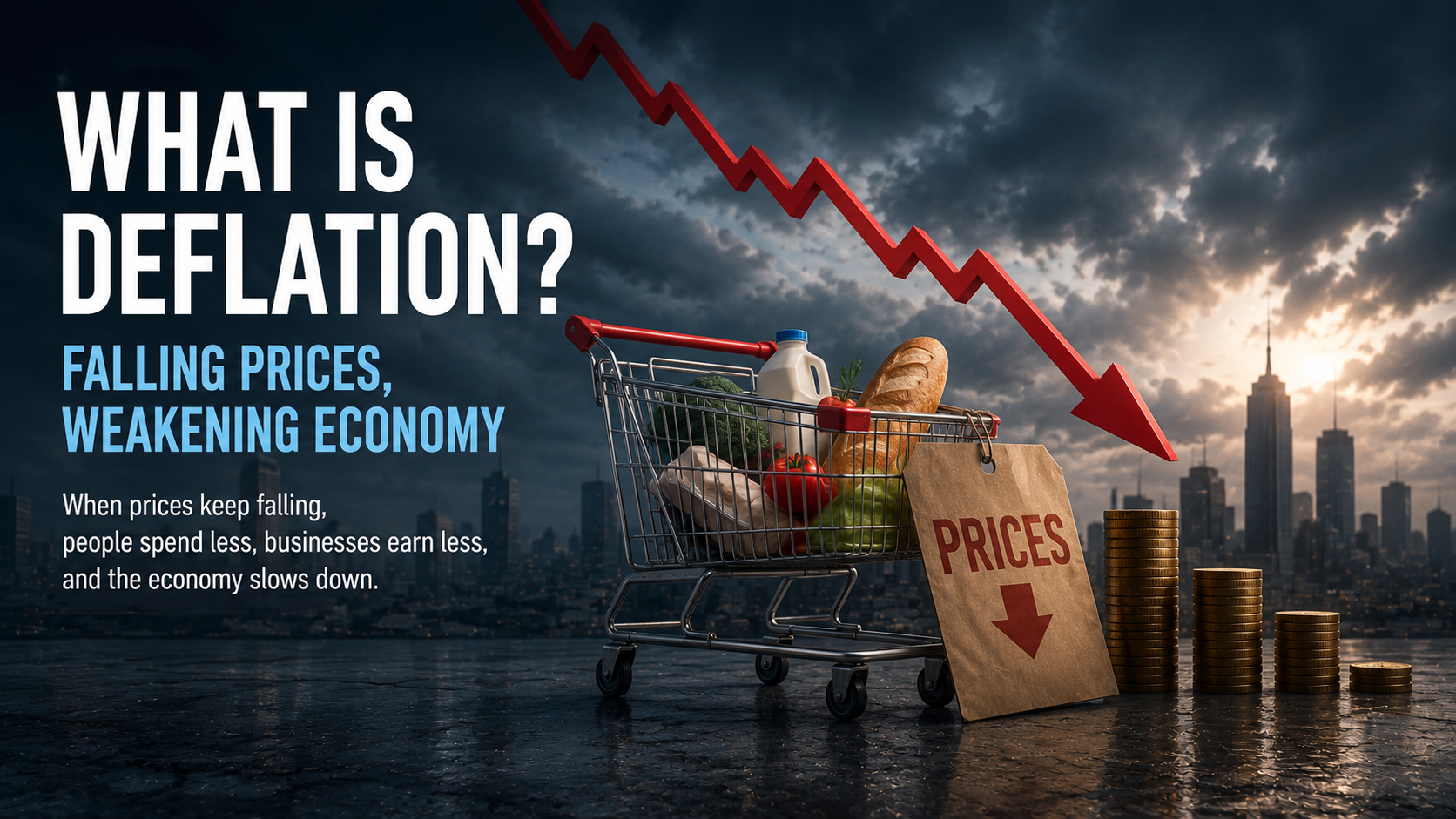
When most people hear that prices are falling, their first reaction is usually positive.
Lower grocery bills, cheaper cars, and more affordable goods sound like good news for consumers.
So why do economists, central banks, and professional investors often view deflation as one of the most dangerous economic forces?
The answer is simple - deflation is not merely about lower prices. It is often a sign that economic activity is slowing, demand is weakening, and money is becoming harder to circulate throughout the economy.
Understanding deflation is essential for investors because it can dramatically change the behavior of stocks, bonds, real estate, and even alternative assets like Bitcoin.
Key Takeaway
Deflation is a sustained decline in the general price level that often reflects weakening demand, slower economic growth, and rising debt burdens, making it one of the most challenging environments for businesses, consumers, and investors.
What Is Deflation?
Deflation occurs when the overall price level of goods and services declines over time.
It is the opposite of inflation.
While inflation reduces the purchasing power of money, deflation increases it.
At first glance, that sounds beneficial.
If prices continue to fall, consumers can buy more with the same amount of money.
However, the problem begins when people expect prices to keep falling.
Instead of spending today, consumers delay purchases until tomorrow.
Businesses respond by cutting production, reducing investment, and slowing hiring.
As spending declines across the economy, growth begins to weaken.
This is why economists view deflation differently from a temporary drop in the price of specific goods.
A decline in smartphone prices due to technological improvements is not necessarily deflation.
True deflation occurs when falling prices become widespread throughout the economy.
What Causes Deflation?
Several economic forces can contribute to deflation.
Weak Consumer Demand
Deflation often begins when households reduce spending.
When businesses struggle to sell products, they lower prices to attract buyers.
If this happens across multiple industries, overall price levels begin to fall.
Declining Money Supply
Modern economies rely heavily on credit creation.
When banks reduce lending or consumers become reluctant to borrow, the money supply can contract.
Less money circulating through the economy means less spending and investment.
Debt Deleveraging
After periods of excessive borrowing, households and businesses may focus on paying down debt instead of spending.
This process, known as deleveraging, can significantly reduce economic activity.
Financial Crises
Banking crises and credit contractions often create powerful deflationary pressures because access to capital becomes limited.
The Danger of the Deflationary Spiral

The greatest risk of deflation is that it can become self-reinforcing.
Economists refer to this process as a deflationary spiral.
The cycle often unfolds like this
- Consumers delay spending.
- Business revenues decline.
- Companies cut costs and reduce hiring.
- Unemployment rises.
- Household income falls.
- Consumer spending declines even further.
As this cycle repeats, economic growth slows and confidence deteriorates.
Historical examples include the Great Depression of the 1930s and Japan's prolonged period of economic stagnation following the collapse of its asset bubble in the 1990s.
Why Deflation Is More Dangerous Than It Appears
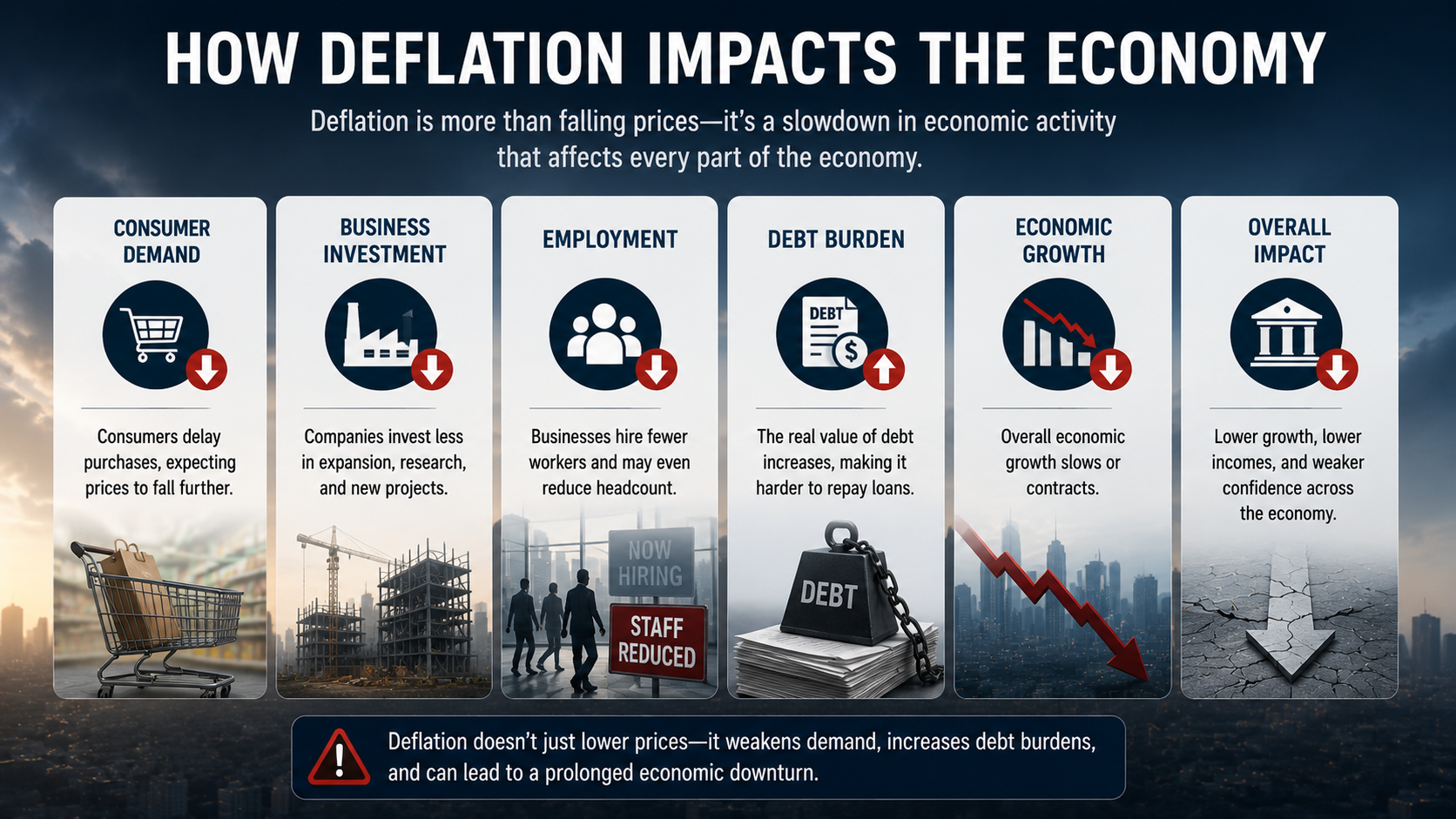
The real danger of deflation lies in debt.
Most debts are fixed in nominal terms.
A mortgage, business loan, or corporate bond obligation does not automatically shrink when prices fall.
Imagine owing $300,000 on a mortgage.
If wages, asset prices, and business revenues are falling while debt remains unchanged, the real burden of that debt increases.
In effect, deflation makes existing debt more expensive.
This dynamic can create widespread financial stress for households, corporations, and even governments.
Many economists describe deflation as a hidden amplifier of debt problems.
Why Investors Closely Watch Deflation
Investors pay close attention to deflation because financial markets are heavily influenced by expectations for future growth.
Asset prices ultimately depend on future cash flows.
When economic activity weakens, corporate earnings often come under pressure.
Businesses sell fewer products, invest less, and generate lower profits.
As a result, investors frequently shift capital away from risk assets and toward assets perceived as safer.
The market is not simply reacting to falling prices.
It is reacting to the possibility of slower growth and weaker future earnings.
How Deflation Impacts Financial Markets

Different asset classes respond differently to deflationary environments.
| Asset Class | Typical Impact |
| Stocks | Negative |
| Bonds | Positive |
| Cash | Positive |
| Real Estate | Negative |
| Gold | Mixed |
| Bitcoin | Often Negative |
Stocks
Corporate earnings growth typically slows during deflationary periods.
Lower revenues and weaker demand can reduce profitability and pressure stock valuations.
Bonds
Government bonds often perform well during deflation because interest rates tend to fall.
Existing bonds with higher yields become more attractive.
Cash
In deflationary environments, cash gains purchasing power.
This is why investors often say "cash is king" during periods of economic stress.
Real Estate
Property values may struggle as economic activity weakens and credit conditions tighten.
Gold
Gold's performance can vary.
It may benefit from uncertainty, but it can also face pressure when liquidity contracts.
Bitcoin
Because Bitcoin is often treated as a risk asset, deflationary environments can reduce investor appetite for speculative investments.
What Investors Should Focus On

Deflation changes investment priorities.
During inflationary periods, investors often focus on growth.
During deflationary periods, survival becomes more important than expansion.
Key areas to monitor include
Cash Flow Quality
Companies with strong and consistent cash flow are generally better positioned to withstand economic slowdowns.
Balance Sheet Strength
Low debt levels become increasingly valuable when borrowing conditions tighten.
Central Bank Policy
Federal Reserve decisions often play a major role in determining how long deflationary pressures persist.
Liquidity Conditions
The flow of money throughout the financial system often matters more than headline inflation numbers.
What Wealthy Investors Look For During Deflation
While most investors focus on falling prices, experienced investors focus on capital flows.
They ask different questions
- Where is money moving?
- Which businesses can survive prolonged economic weakness?
- Which assets generate reliable cash flow regardless of market conditions?
- Which opportunities may emerge once panic reaches its peak?
The most successful investors understand that every market cycle eventually ends.
Periods of fear often create opportunities for those with strong balance sheets, patience, and liquidity.
History repeatedly shows that investors who survive difficult environments are the ones positioned to benefit when growth eventually returns.
In investing, survival is often more important than prediction.
Final Thoughts
Deflation is far more than a decline in prices.
It represents a slowdown in the circulation of money throughout the economy and can create a powerful cycle of weaker demand, lower business activity, and rising debt burdens.
For investors, understanding deflation is not about predicting the future.
It is about recognizing how money flows through the financial system and preparing for different economic scenarios.
The most important lesson is simple
Markets ultimately follow the movement of capital, and deflation is one of the clearest signals that capital is becoming more cautious.
MasterMind
'[Global] Success Blueprints' 카테고리의 다른 글