What Is the Real Interest Rate? Why It Matters for Gold, Bitcoin, and Investors


Hello, this is MasterMind.
If your savings account pays 5% interest, are you actually getting richer?
At first glance, the answer seems obvious. But what if inflation is running at 6%?
In that case, your bank balance may be growing, yet your purchasing power is shrinking.
This simple concept explains why investors closely watch not only Federal Reserve policy and Treasury yields, but also a less-discussed metric that often drives major asset classes behind the scenes: the real interest rate.
Whether you're investing in stocks, bonds, gold, or Bitcoin, understanding real interest rates can provide valuable insight into where capital is flowing and why certain assets outperform during different economic environments.
Key Takeaway
The real interest rate measures the true return on money after inflation. When real rates fall, assets such as gold and Bitcoin often become more attractive because holding cash becomes less rewarding.
What Is the Real Interest Rate?
Most investors are familiar with nominal interest rates.
These are the rates quoted by banks, Treasury securities, and the Federal Reserve.
The real interest rate goes one step further by adjusting for inflation.
In simple terms
Real Interest Rate = Nominal Interest Rate − Expected Inflation
For example
- Savings account yield: 5%
- Inflation rate: 3%
Your real return is approximately 2%.
However, if inflation rises to 6% while your savings account still pays 5%, your real return becomes negative.
Even though the number in your account increases, your purchasing power declines.
This is why professional investors pay close attention to real rates rather than nominal rates alone.
How Real Interest Rates Influence Financial Markets
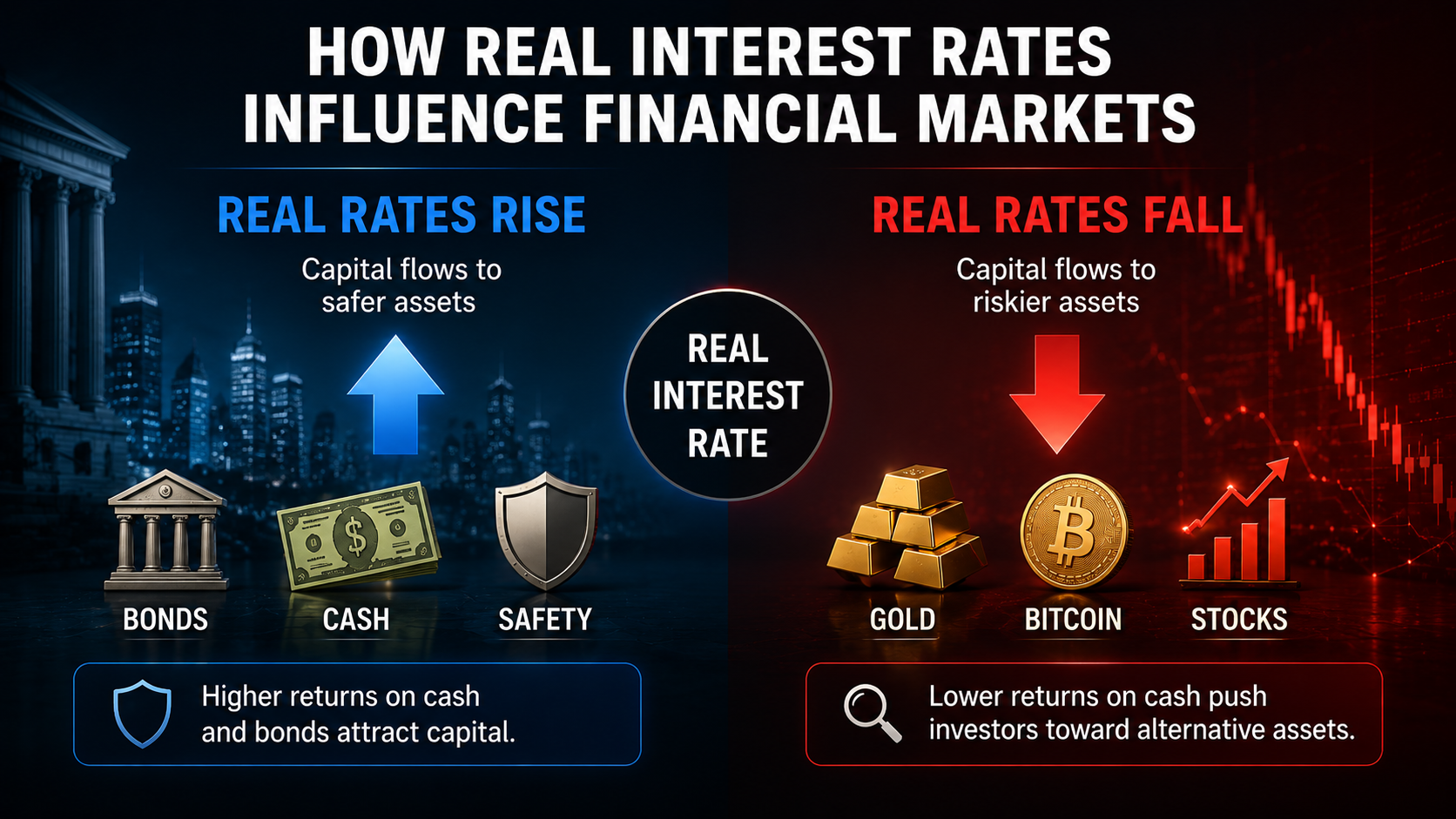
Capital is constantly searching for the highest risk-adjusted return.
Real interest rates help determine where that capital flows.
When Real Interest Rates Rise
Higher real rates increase the attractiveness of cash, money market funds, and government bonds.
Investors can preserve purchasing power while earning a positive return with relatively low risk.
As a result, capital may flow away from speculative assets and toward safer investments.
When Real Interest Rates Fall
Lower real rates reduce the reward for holding cash.
If inflation is eroding purchasing power faster than interest income can replace it, investors often seek alternative stores of value.
This environment can benefit
- Gold
- Bitcoin
- Real estate
- Growth stocks
- Other risk assets
Markets often appear to react to Federal Reserve decisions, but in many cases, the underlying driver is how those decisions affect real interest rates.
Why Real Interest Rates Matter to Investors
Successful investing is not just about increasing wealth.
It is about increasing purchasing power.
Inflation acts like a hidden tax on savings, gradually reducing the value of cash over time.
Real interest rates help investors measure whether their capital is actually growing after accounting for inflation.
This concept becomes especially important when evaluating assets that do not generate income.
Gold pays no interest.
Bitcoin produces no cash flow.
Their attractiveness often depends on the opportunity cost of holding them.
When real rates are high, investors can earn meaningful returns from Treasury bonds and cash equivalents.
When real rates are low or negative, the opportunity cost of holding gold or Bitcoin decreases significantly.
How to Track Real Interest Rates
One of the most widely followed market-based measures of real interest rates is the yield on U.S. Treasury Inflation-Protected Securities (TIPS).
TIPS are government bonds designed to adjust for inflation.
Because of this feature, their yields provide a useful estimate of the market's real interest rate expectations.
Many macro investors monitor the 10-year TIPS yield as a leading indicator for asset allocation decisions.
Generally
- Rising TIPS yields suggest rising real rates
- Falling TIPS yields suggest declining real rates
Changes in these yields often influence the direction of gold, Bitcoin, and growth-oriented equities.
The Relationship Between Real Interest Rates and the Federal Reserve
Many investors assume that Fed rate hikes automatically lead to higher real interest rates.
In reality, the relationship is more complex.
Consider the following example
- Federal Funds Rate increases by 1%
- Inflation expectations increase by 2%
Even though nominal rates have risen, real rates may actually decline.
The opposite can also occur.
If inflation falls faster than interest rates, real rates may increase despite a dovish Federal Reserve stance.
This is why markets pay attention to both
- Federal Reserve policy
- Inflation expectations
The interaction between these two forces ultimately determines the direction of real interest rates.
How Real Interest Rates Affect Major Asset Classes
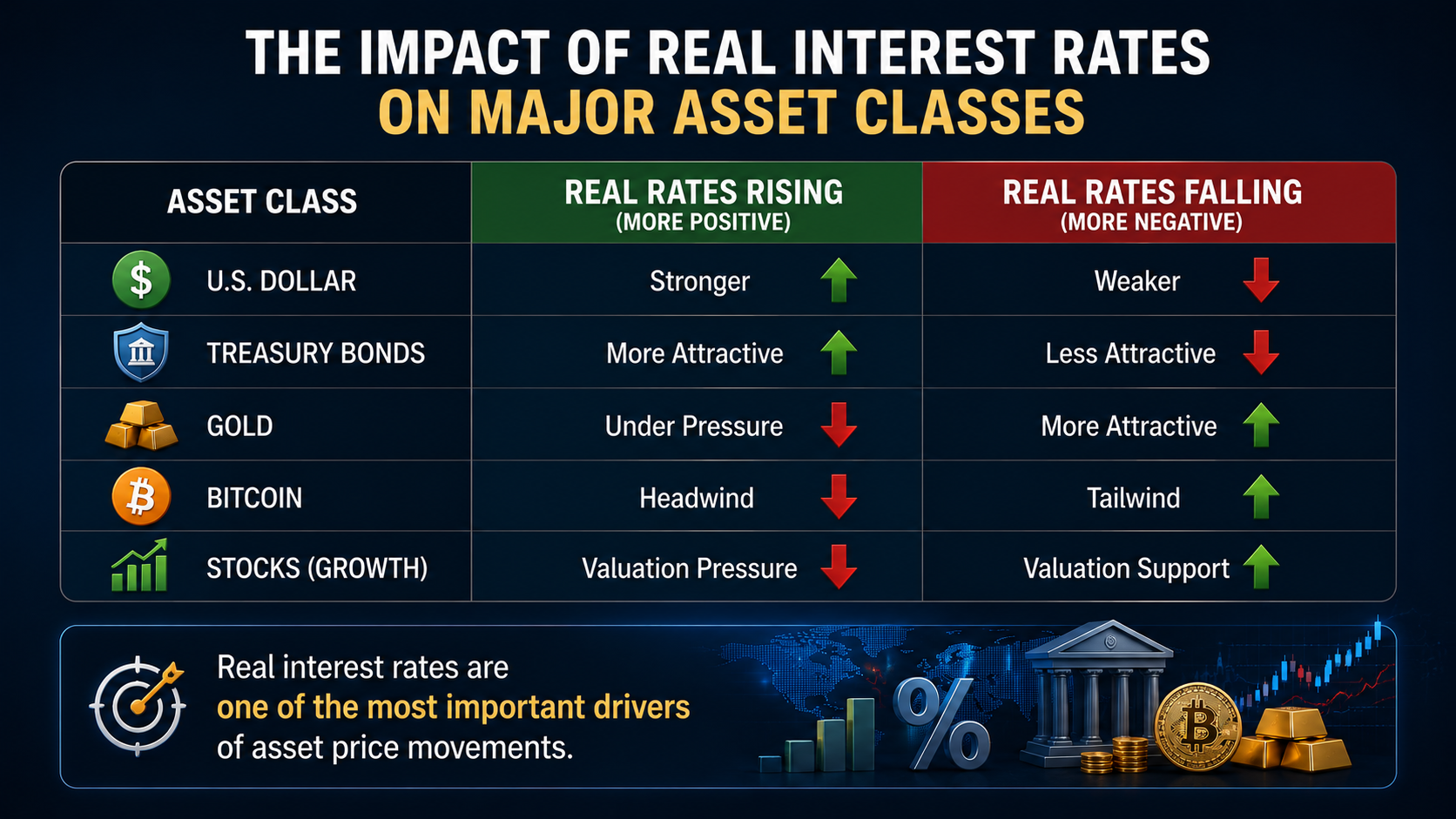
| Asset Class | Rising Real Rates | Falling Real Rates |
| U.S. Dollar | Typically Bullish | Typically Bearish |
| Treasury Bonds | More Attractive | Less Attractive |
| Gold | Often Faces Pressure | Often Benefits |
| Bitcoin | Liquidity Headwind | Liquidity Tailwind |
| Growth Stocks | Valuation Pressure | Valuation Support |
While many variables influence markets, real interest rates remain one of the most important macroeconomic indicators for understanding long-term asset performance.
Why Gold and Bitcoin Are Sensitive to Real Rates
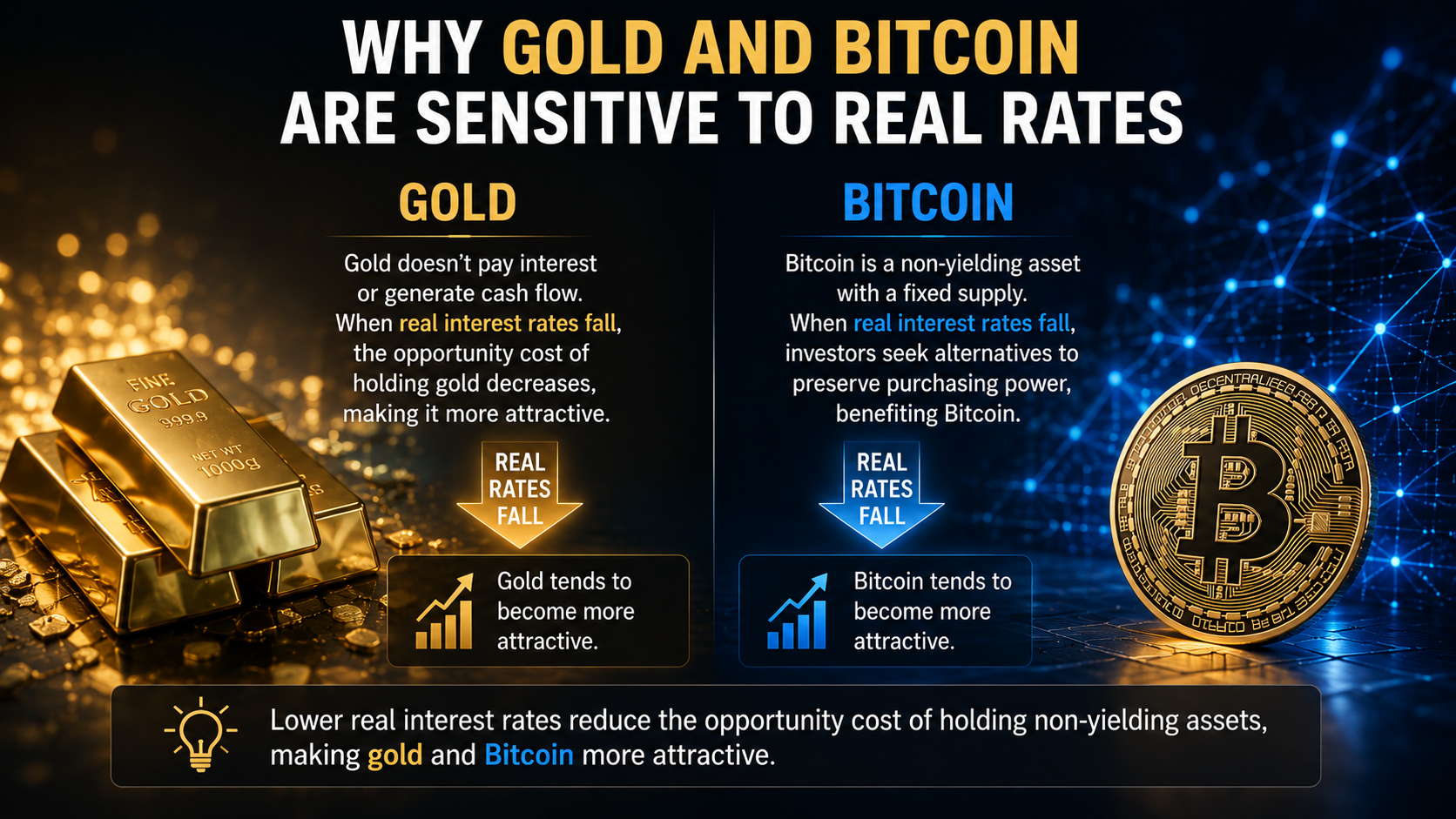
Gold
Gold has served as a store of value for thousands of years.
However, it does not generate income.
When real interest rates rise, investors can earn attractive returns through Treasury bonds and other fixed-income investments.
This increases the opportunity cost of holding gold.
Conversely, when real rates decline, gold often becomes more appealing as a hedge against inflation and currency debasement.
Bitcoin
Bitcoin is frequently referred to as digital gold.
Although it differs significantly from gold in terms of volatility and adoption, both assets tend to attract attention when investors become concerned about the future purchasing power of fiat currencies.
Periods of falling real rates often coincide with increased liquidity and stronger investor appetite for alternative assets, creating a favorable environment for Bitcoin.
Key Lessons for Investors
Real Rates Are the Price of Liquidity
Higher real rates reward saving.
Lower real rates encourage investment and risk-taking.
Direction Matters More Than Level
Markets are forward-looking.
Investors often focus more on where real rates are heading than where they currently stand.
Follow Purchasing Power, Not Just Interest Rates
The most important question is not how much interest you earn.
The real question is whether your wealth is growing faster than inflation.
Money tends to flow toward assets that offer the highest real return over time.
What Do Wealthy Investors See in This Trend?

Experienced investors rarely focus on headlines alone.
Instead, they analyze how capital flows through the financial system.
When real rates rise, capital often moves toward cash and fixed income.
When real rates fall, capital tends to seek opportunities in productive assets, hard assets, and growth-oriented investments.
The goal is not to predict every market move.
The goal is to build a portfolio capable of surviving multiple economic scenarios.
Ask yourself
- Is my portfolio generating positive real returns?
- How would my investments perform if inflation unexpectedly accelerated?
- Am I relying too heavily on assets that depend on low interest rates?
- Do I own assets capable of protecting purchasing power over the long run?
The most successful investors understand a simple truth
Capital ultimately flows toward assets that preserve and grow real value.
Final Thoughts
Real interest rates are one of the most important yet overlooked drivers of financial markets.
They influence the attractiveness of cash, bonds, stocks, gold, and Bitcoin by determining the true value of money after inflation.
Many investors focus exclusively on Federal Reserve policy or nominal interest rates.
However, understanding the direction of real interest rates often provides a clearer picture of where liquidity is moving and which assets may benefit in the future.
If you want to understand why gold and Bitcoin rise or fall, start by looking beyond the headlines and paying attention to real interest rates.
That is where the deeper story of capital flows begins.
MasterMind.
'[Global] Success Blueprints' 카테고리의 다른 글