What Is Quantitative Easing (QE)? Why Does the Stock Market Often Rise When the Fed Prints Money?


Hello, this is MasterMind.
If you follow the financial markets, you've probably heard headlines like
"The Federal Reserve is injecting liquidity into the economy."
"The Fed is expanding its balance sheet."
"Quantitative Easing is back."
But what exactly does that mean?
More importantly, why do stocks, real estate, gold, and even Bitcoin often rally when the Federal Reserve launches a new round of Quantitative Easing?
Is it simply because more money exists in the system, or is there a deeper mechanism driving asset prices higher?
In this article, we'll explore what Quantitative Easing (QE) is, how it works, and why investors pay such close attention to liquidity when evaluating financial markets.
Key Takeaway
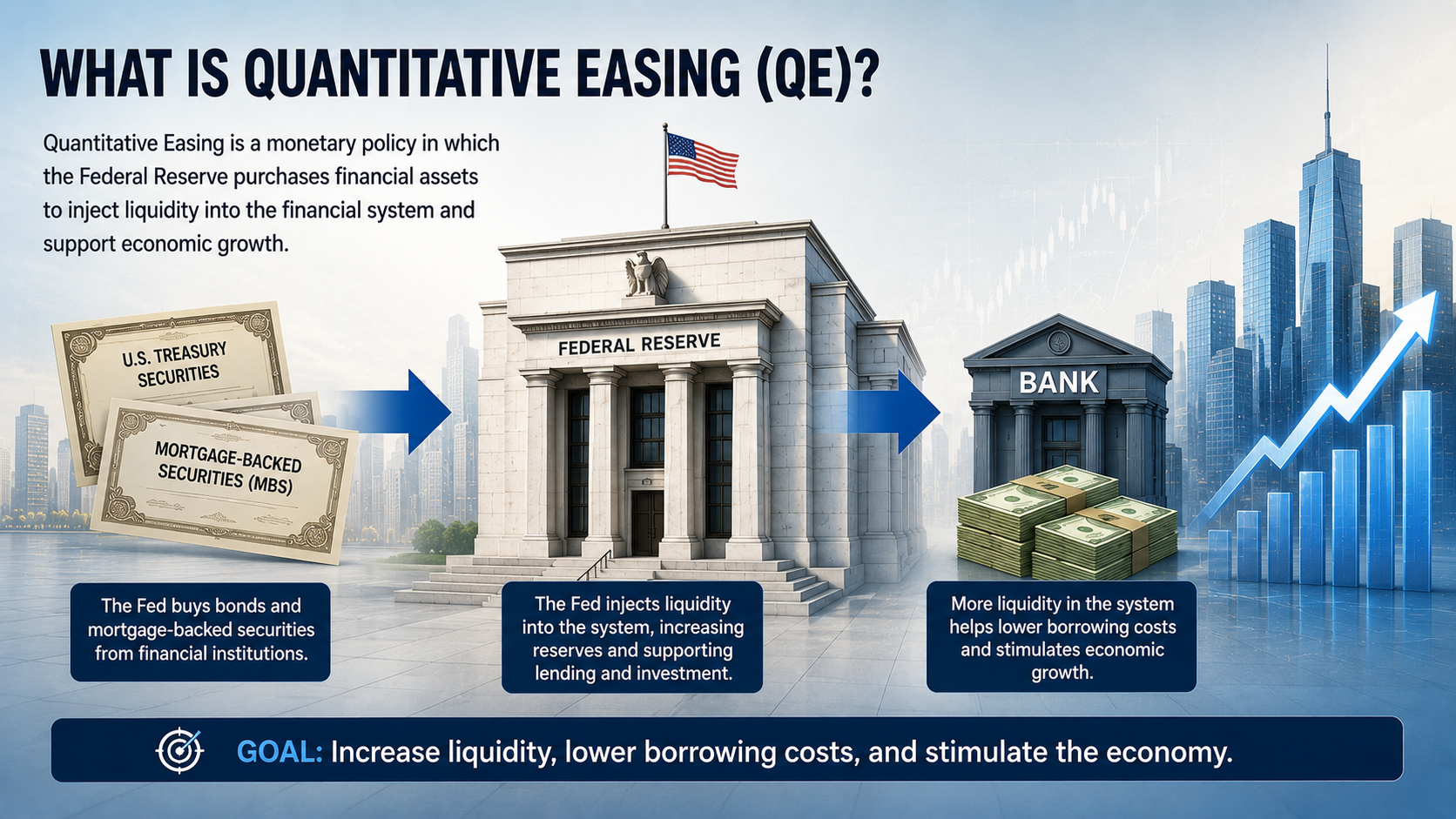
Quantitative Easing (QE) is a monetary policy in which the Federal Reserve purchases financial assets to inject liquidity into the financial system. By lowering interest rates and increasing available capital, QE often encourages money to flow from safe assets into stocks and other risk assets.
What Is Quantitative Easing (QE)?
Quantitative Easing, commonly known as QE, is an unconventional monetary policy used by central banks when traditional interest rate cuts are no longer effective.
Under normal circumstances, the Federal Reserve stimulates economic growth by lowering the federal funds rate.
However, during severe economic downturns, interest rates can approach zero, leaving little room for additional cuts.
When that happens, the Fed may begin purchasing large amounts of government bonds and mortgage-backed securities (MBS) from financial institutions.
By doing so, the Fed injects fresh liquidity into the financial system and attempts to support lending, investment, and economic activity.
In simple terms
Quantitative Easing is the process of creating liquidity and using it to purchase financial assets in order to stimulate the economy.
The most notable examples occurred during the 2008 Global Financial Crisis and the 2020 COVID-19 pandemic.
How Does Quantitative Easing Work?
QE does not involve helicopters dropping cash from the sky.
Instead, it operates through the financial system.
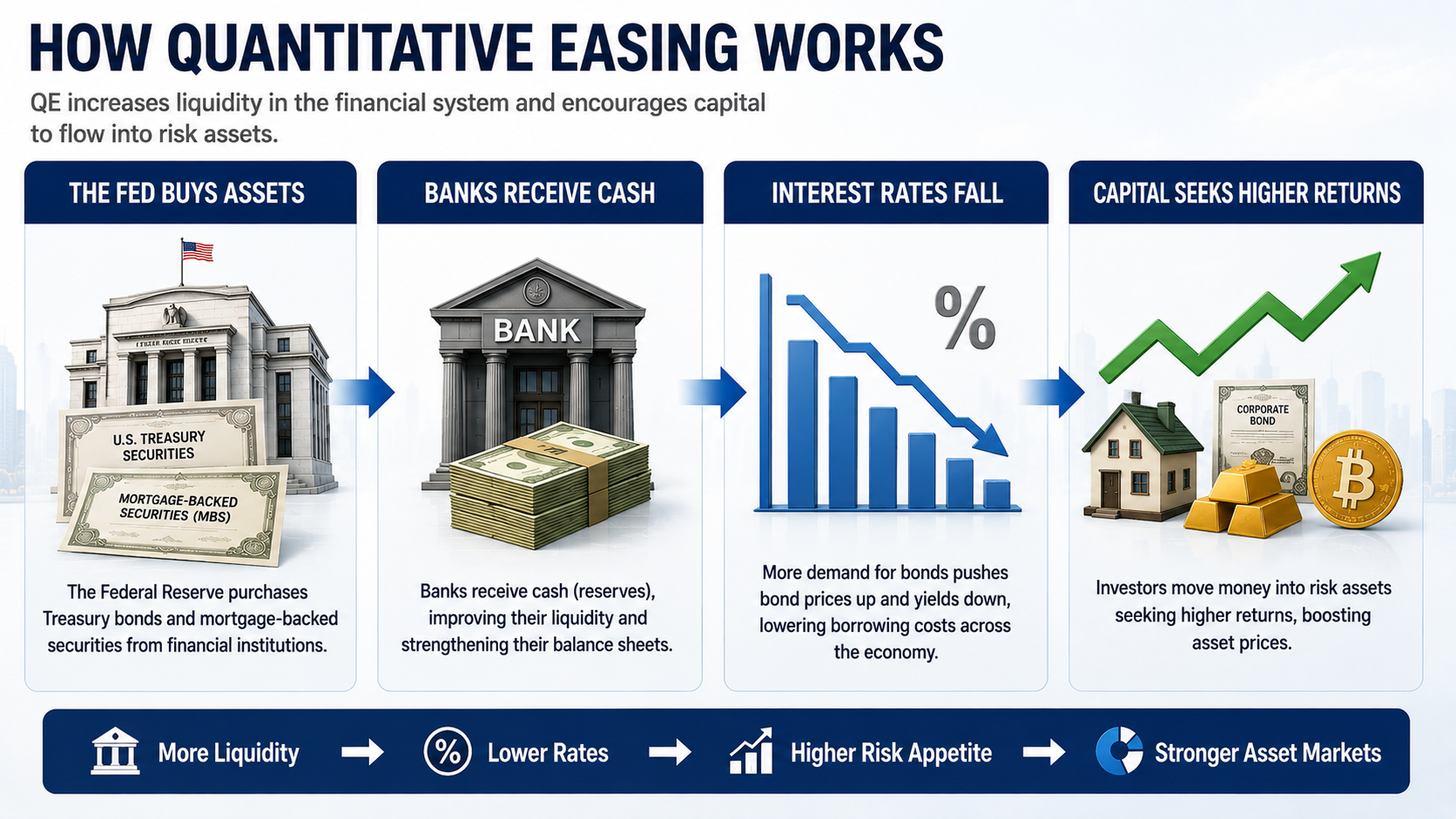
Step 1: The Federal Reserve Buys Assets
The Fed purchases U.S. Treasury securities and mortgage-backed securities from banks and financial institutions.
Step 2: Banks Receive Cash
In exchange for those assets, banks receive reserves and additional liquidity.
Their balance sheets become more liquid and flexible.
Step 3: Interest Rates Fall
As bond demand increases, bond prices rise and yields decline.
Lower yields often translate into lower borrowing costs throughout the economy.
Step 4: Capital Seeks Higher Returns
With savings accounts and bonds offering lower returns, investors begin searching for alternative opportunities.
This often pushes capital toward
- Stocks
- Real Estate
- Corporate Bonds
- Private Equity
- Gold
- Bitcoin and other alternative assets
The result is a significant shift in capital allocation across financial markets.
Why Does QE Often Push Financial Markets Higher?

Many people assume asset prices rise simply because "more money exists."
The reality is more nuanced.
QE changes the relative attractiveness of different asset classes.
Imagine an investor who can earn 5% risk-free from Treasury bonds.
In that environment, taking additional risk in stocks may not seem necessary.
Now imagine Treasury yields fall to 1% or lower.
Suddenly, investors must take more risk to achieve the same return objectives.
This creates a chain reaction
Cash → Bonds → Stocks → Growth Stocks → Alternative Assets
As safer investments become less attractive, capital naturally migrates toward assets with higher return potential.
This is one of the primary reasons QE has historically supported equity markets.
Why Investors Closely Watch Quantitative Easing
Corporate earnings matter.
Economic growth matters.
But liquidity also matters.
Financial markets are not driven solely by fundamentals.
They are heavily influenced by the amount of capital available in the system.
Many of the strongest bull markets in modern history occurred during periods of abundant liquidity and accommodative monetary policy.
This is especially true for growth-oriented sectors such as technology, where valuations are highly sensitive to interest rates and investor expectations.
One of the most important lessons investors eventually learn is this
Markets often move not only because earnings improve, but because liquidity expands.
How QE Affects Different Asset Classes

| Asset Class | Typical Impact of QE | Primary Reason |
| Stocks | Bullish | Increased liquidity and lower discount rates |
| Bonds | Prices rise | Central bank purchases increase demand |
| Bond Yields | Fall | Bond prices move higher |
| U.S. Dollar | Potential weakness | Expansion of money supply |
| Gold | Potential strength | Hedge against currency debasement |
| Real Estate | Potential strength | Lower financing costs |
| Bitcoin | Potential strength | Increased appetite for risk assets |
Of course, market outcomes are never guaranteed.
Inflation, economic conditions, investor sentiment, and policy expectations all play important roles.
However, historically, large-scale liquidity injections have often supported risk assets.
Quantitative Easing and Inflation
One of the most common criticisms of QE is its potential impact on inflation.
When large amounts of liquidity enter the economy, spending and investment may increase.
If demand grows faster than supply, inflationary pressures can emerge.
This became a major topic of debate following the extraordinary stimulus measures introduced during the pandemic era.
As a result, central banks constantly face a balancing act
- Support economic growth
- Maintain price stability
Too little liquidity can slow growth.
Too much liquidity can fuel inflation.
The Difference Between QE and QT
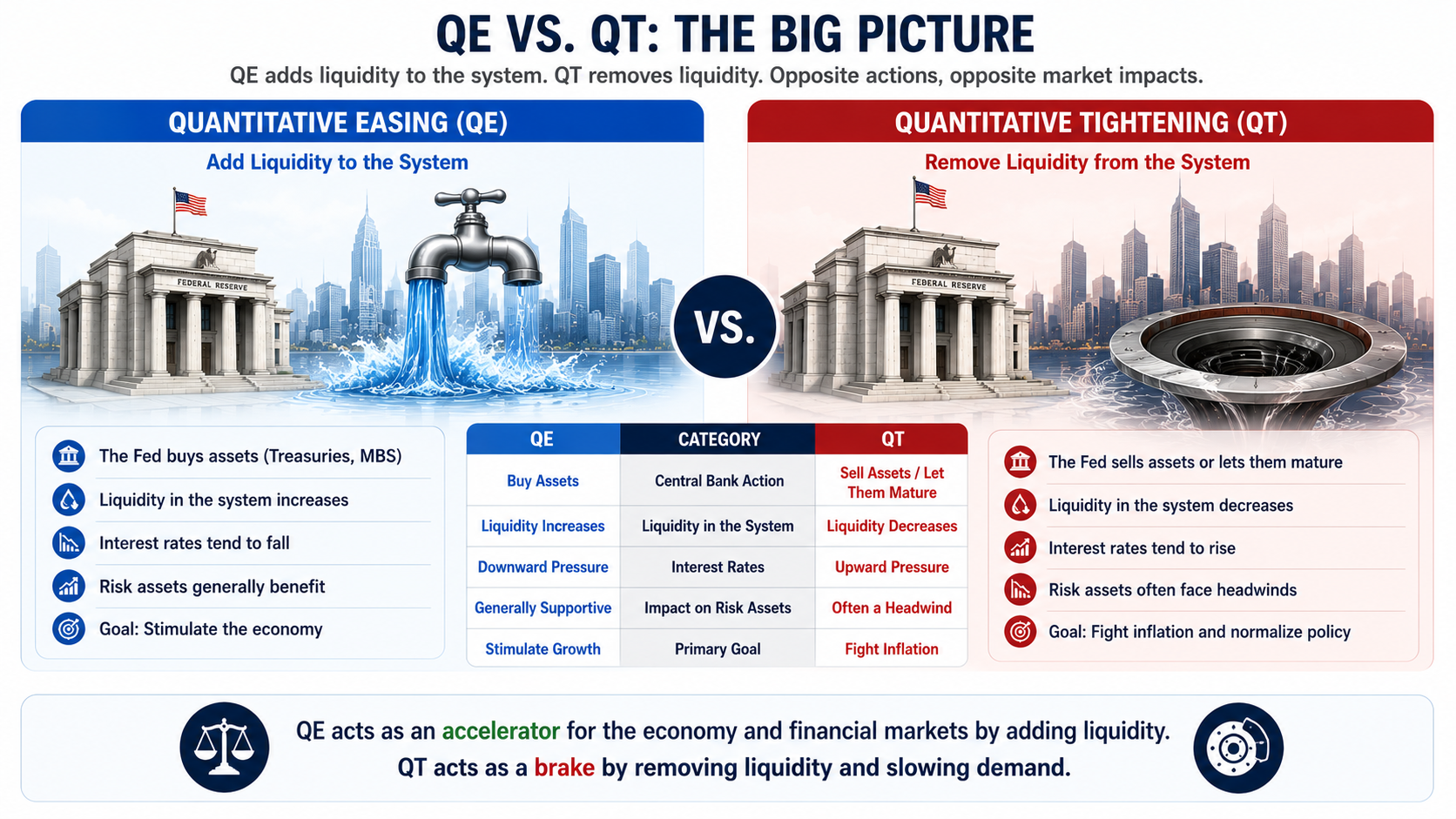
To fully understand Quantitative Easing, investors should also understand its opposite policy: Quantitative Tightening (QT).
| Category | Quantitative Easing (QE) | Quantitative Tightening (QT) |
| Objective | Stimulate growth | Fight inflation |
| Central Bank Action | Buy assets | Reduce asset holdings |
| Liquidity | Increases | Decreases |
| Risk Assets | Generally supportive | Often creates headwinds |
| Interest Rates | Downward pressure | Upward pressure |
If QE acts as an accelerator for financial markets, QT often functions as a brake.
That is why investors closely monitor changes in the Federal Reserve's balance sheet.
What Smart Investors Focus On During QE
Successful investors rarely focus only on whether stocks are rising.
Instead, they study where money is flowing.
Some of the most important questions include
- Is market strength being driven by earnings or liquidity?
- Which sectors are attracting the most capital?
- Can current asset prices remain resilient if liquidity conditions change?
- Are valuations supported by fundamentals or easy money?
The answers to these questions often determine long-term investment outcomes.
What Wealthy Investors See in These Cycles
Experienced investors understand that liquidity creates opportunities, but it can also create distortions.
They pay close attention to
Capital Flows
Where is newly created liquidity actually going?
Into productive economic activity, or into financial speculation?
Cash Flow Strength
Can a business generate sustainable cash flow even when monetary conditions tighten?
Asset Durability
Will an asset survive the next economic downturn, or is it dependent on cheap money?
The biggest fortunes are often built not by predicting every market move, but by understanding the underlying forces driving those moves.
And few forces are more powerful than liquidity.
Final Thoughts
Quantitative Easing is one of the most influential monetary policies in modern financial markets.
By injecting liquidity into the system and lowering borrowing costs, QE can significantly alter investor behavior and capital allocation.
The reason investors pay so much attention to QE is not simply because more money enters the economy.
It is because QE changes the flow of money.
And in financial markets, understanding where money is moving is often more important than understanding where prices have already gone.
The key lesson is simple
Quantitative Easing is not merely about printing money. It is about changing the direction of capital flows throughout the financial system.
MasterMind.
'[Global] Success Blueprints' 카테고리의 다른 글