What Is Quantitative Tightening (QT)? Why Liquidity Reduction Matters for Investors


Hello, this is MasterMind.
Most investors pay close attention to Federal Reserve interest rate decisions.
But have you ever wondered why markets sometimes struggle even when rate hikes have stopped—or why risk assets can remain under pressure despite improving economic data?
The answer often comes down to one critical factor: liquidity.
And one of the most important tools affecting liquidity today is Quantitative Tightening (QT).
Understanding QT is essential because financial markets are driven not only by earnings, growth, and interest rates, but also by the amount of money flowing through the system.
Let's take a closer look at what Quantitative Tightening is, how it works, and why investors should pay attention to it.
Key Takeaway
Quantitative Tightening (QT) is the Federal Reserve's process of reducing liquidity in the financial system, which can create headwinds for stocks, bonds, cryptocurrencies, and other risk assets.
What Is Quantitative Tightening (QT)?
Quantitative Tightening (QT) is a monetary policy tool used by the Federal Reserve to reduce the size of its balance sheet and withdraw liquidity from the economy.
Think of QT as the opposite of Quantitative Easing (QE).
During QE, the Fed purchases Treasury securities and mortgage-backed securities (MBS), injecting money into the financial system.
During QT, the Fed allows those assets to roll off its balance sheet, effectively reducing the amount of liquidity available in financial markets.
While interest rate hikes increase the price of money, QT reduces the supply of money.
That is why many investors refer to QT as a form of "hidden tightening."
| Policy | Federal Reserve Action | Liquidity Impact |
| Quantitative Easing (QE) | Asset Purchases | Liquidity Increases |
| Quantitative Tightening (QT) | Balance Sheet Reduction | Liquidity Decreases |
How Does Quantitative Tightening Work?
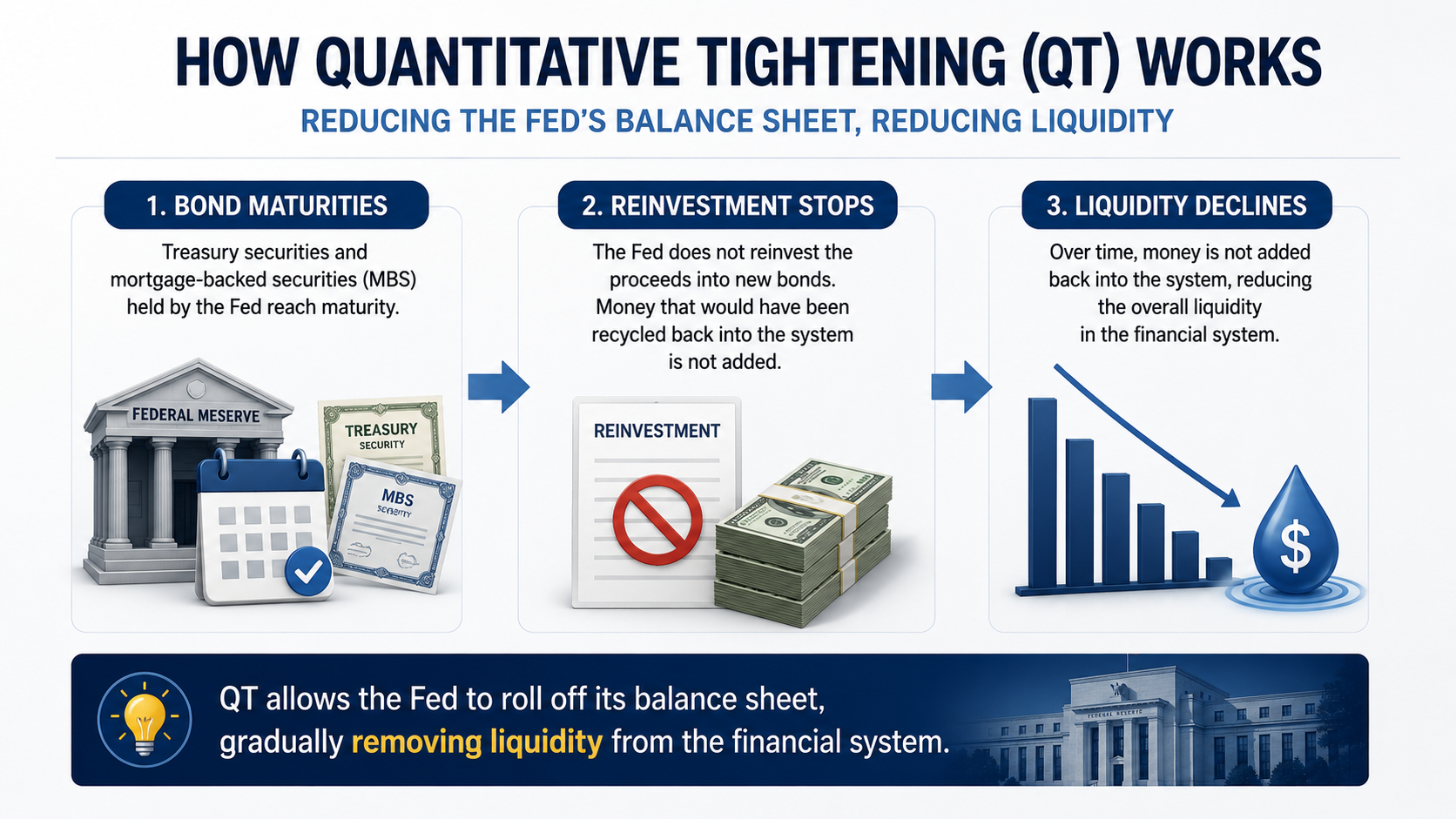
QT does not involve the Fed physically collecting cash from banks.
Instead, it works through the central bank's balance sheet.
Bond Maturities
Over the years, the Federal Reserve accumulated trillions of dollars worth of Treasury securities and mortgage-backed securities.
These assets eventually mature.
Reinvestment Stops
During QE, the Fed typically reinvests proceeds from maturing securities into new bonds.
Under QT, the Fed stops reinvesting part or all of those proceeds.
As a result, money that would have been recycled back into financial markets is removed from circulation.
Liquidity Gradually Declines
This process doesn't create an immediate shock.
Instead, liquidity is drained slowly over months or years.
However, even gradual liquidity reductions can have significant effects on asset prices and investor behavior.
Why Is QT So Important?

Many investors focus exclusively on interest rates.
However, market history shows that liquidity often plays an equally important role.
Asset prices don't rise simply because companies generate profits.
They also rise when abundant capital is available to purchase those assets.
When liquidity is expanding, investors tend to move further out on the risk spectrum, allocating capital to growth stocks, venture investments, cryptocurrencies, and other speculative assets.
When liquidity contracts, the opposite often happens.
Capital becomes more selective.
Risk appetite declines.
Cash becomes more valuable.
A useful way to think about markets is this:
Interest rates are the price of money, but liquidity is the fuel that powers financial markets.
Even a strong economy can struggle to support elevated asset valuations if liquidity conditions continue tightening.
How QT Impacts Financial Markets

Stocks
QT generally creates a more challenging environment for equities.
Growth stocks and technology companies are often more sensitive because their valuations rely heavily on future earnings expectations.
When liquidity declines, investors may become less willing to pay premium valuations.
Bonds
The Federal Reserve is one of the largest participants in the Treasury market.
When the Fed steps back from bond purchases, bond prices can face downward pressure while yields move higher.
U.S. Dollar
QT is often viewed as supportive for the U.S. dollar.
As liquidity declines, dollars become relatively scarcer, which can contribute to dollar strength.
Gold
Gold does not generate income or interest.
As real yields rise during tightening cycles, gold can face headwinds.
However, if financial stress increases, gold may still benefit from safe-haven demand.
Bitcoin and Cryptocurrencies
Few asset classes are as sensitive to liquidity conditions as cryptocurrencies.
The massive liquidity expansion during 2020 and 2021 coincided with a historic rally in Bitcoin and other digital assets.
Likewise, tighter liquidity conditions have often been associated with increased volatility across crypto markets.
While QT is not the only factor driving crypto prices, it remains an important macroeconomic variable.
What Investors Should Watch During QT

Monitor Liquidity, Not Just Interest Rates
Many investors track Fed rate decisions but ignore balance sheet changes.
Both matter.
A market with stable rates but declining liquidity can behave very differently from a market where liquidity is expanding.
Be Cautious With Leverage
Liquidity tightening can increase market volatility.
Investors using excessive leverage may find it difficult to withstand sharp price swings.
Focus on Adaptability Over Predictions
Trying to perfectly time market tops and bottoms is rarely successful.
Instead, investors should focus on building portfolios that can adapt to changing liquidity environments.
What Wealthy Investors Look For During QT
Experienced investors rarely focus solely on headlines.
They follow the flow of capital.
During periods of Quantitative Tightening, they often ask questions such as:
- Which businesses generate reliable cash flow regardless of economic conditions?
- Which companies can thrive even if borrowing costs remain elevated?
- Which assets have strong balance sheets and long-term competitive advantages?
- Where is capital moving as liquidity leaves the system?
When liquidity is abundant, many assets can perform well.
When liquidity contracts, the true quality of an asset often becomes more visible.
This is why professional investors place greater emphasis on cash flow, financial strength, and resilience during tightening cycles.
Questions Every Investor Should Ask
- Can my portfolio withstand a prolonged period of tighter liquidity?
- Do I have enough cash available to take advantage of market opportunities?
- Am I paying attention to capital flows, or only watching prices?
Final Thoughts
Quantitative Tightening is one of the most important yet misunderstood forces in modern financial markets.
By reducing the Federal Reserve's balance sheet, QT gradually removes liquidity from the system and influences everything from stocks and bonds to gold and cryptocurrencies.
Investors who focus only on interest rates often miss a major part of the bigger picture.
Markets are driven not just by economic growth, but also by the availability of capital and the flow of money throughout the financial system.
The key lesson is simple:
Liquidity matters.
Understanding where money is flowing—and where it is leaving—can provide valuable insight into market behavior long before headlines catch up.
This was MasterMind.
'[Global] Success Blueprints' 카테고리의 다른 글