What Is GDP? Why Gross Domestic Product Matters for Economic Growth and the Stock Market


Hello, this is MasterMind.
If you follow financial news, you've probably heard headlines like "GDP growth exceeded expectations" or "The economy is slowing down."
But what exactly is GDP, and why do investors pay so much attention to it?
More importantly, how can a single economic number influence stocks, bonds, interest rates, the U.S. dollar, and even Bitcoin?
Understanding GDP is not just about learning an economic term. It is about understanding how money moves through the economy and why financial markets react the way they do.
Key Takeaway
GDP is the most widely used measure of economic activity, and it plays a critical role in shaping corporate earnings, Federal Reserve policy, and long-term investment trends.
What Is GDP?
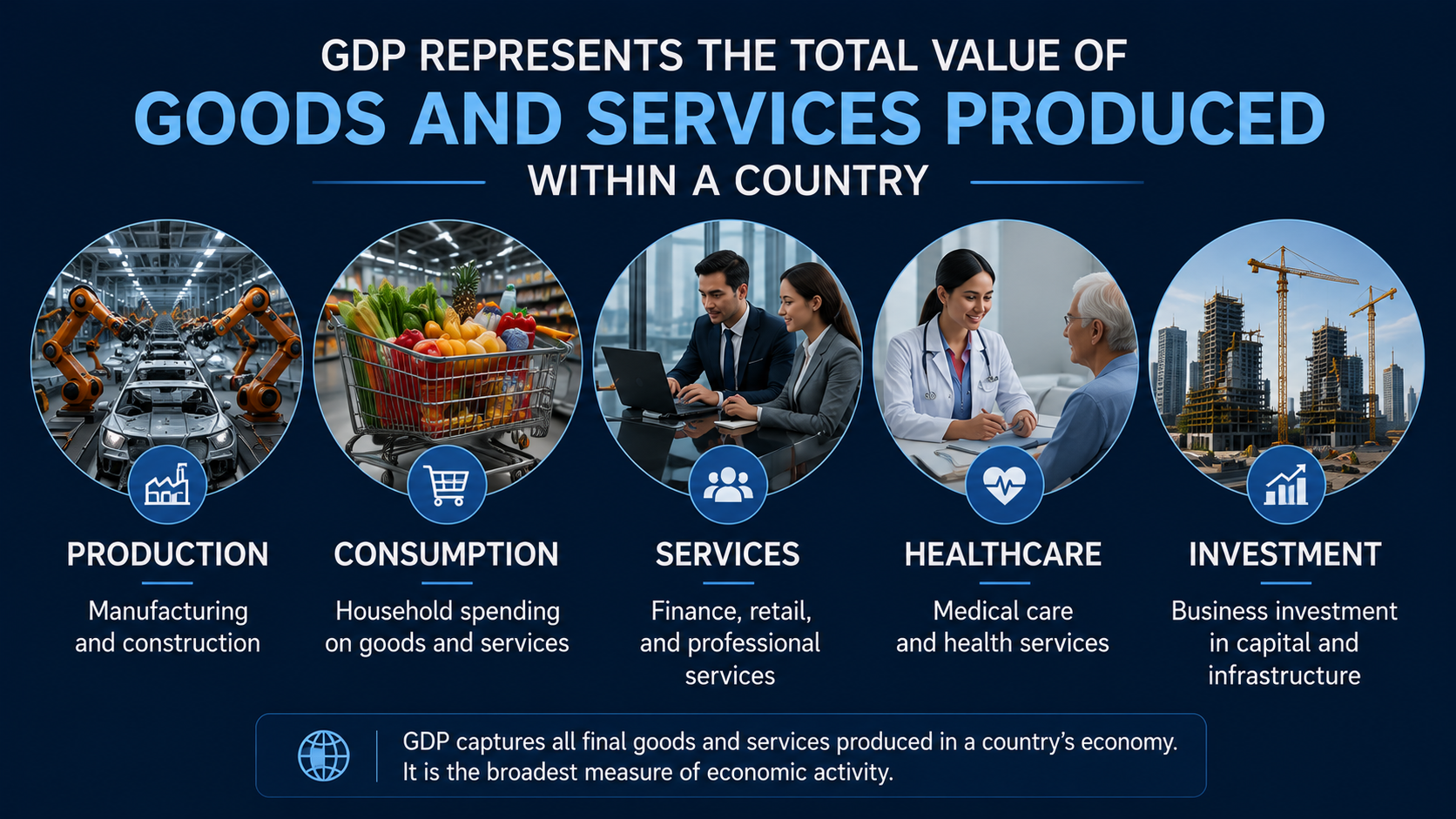
GDP, or Gross Domestic Product, measures the total market value of all final goods and services produced within a country's borders during a specific period.
In the United States, GDP includes economic activity such as
- Manufacturing automobiles and technology products
- Retail spending by consumers
- Healthcare services
- Financial services
- Construction projects
- Business investments
When GDP grows, it generally signals that economic activity is expanding.
When GDP slows or contracts, it may indicate weakening demand, lower business activity, and increased recession risks.
Because of this, GDP is often considered the broadest measure of a nation's economic health.
A Simple Way to Think About GDP
Think of GDP as the economy's revenue.
Just as investors analyze a company's revenue growth to evaluate its future potential, economists and investors analyze GDP growth to understand the direction of the overall economy.
A growing economy typically creates
- More jobs
- Higher consumer spending
- Stronger corporate profits
- Greater investment activity
These factors ultimately influence financial markets and asset prices.
How Is GDP Calculated?
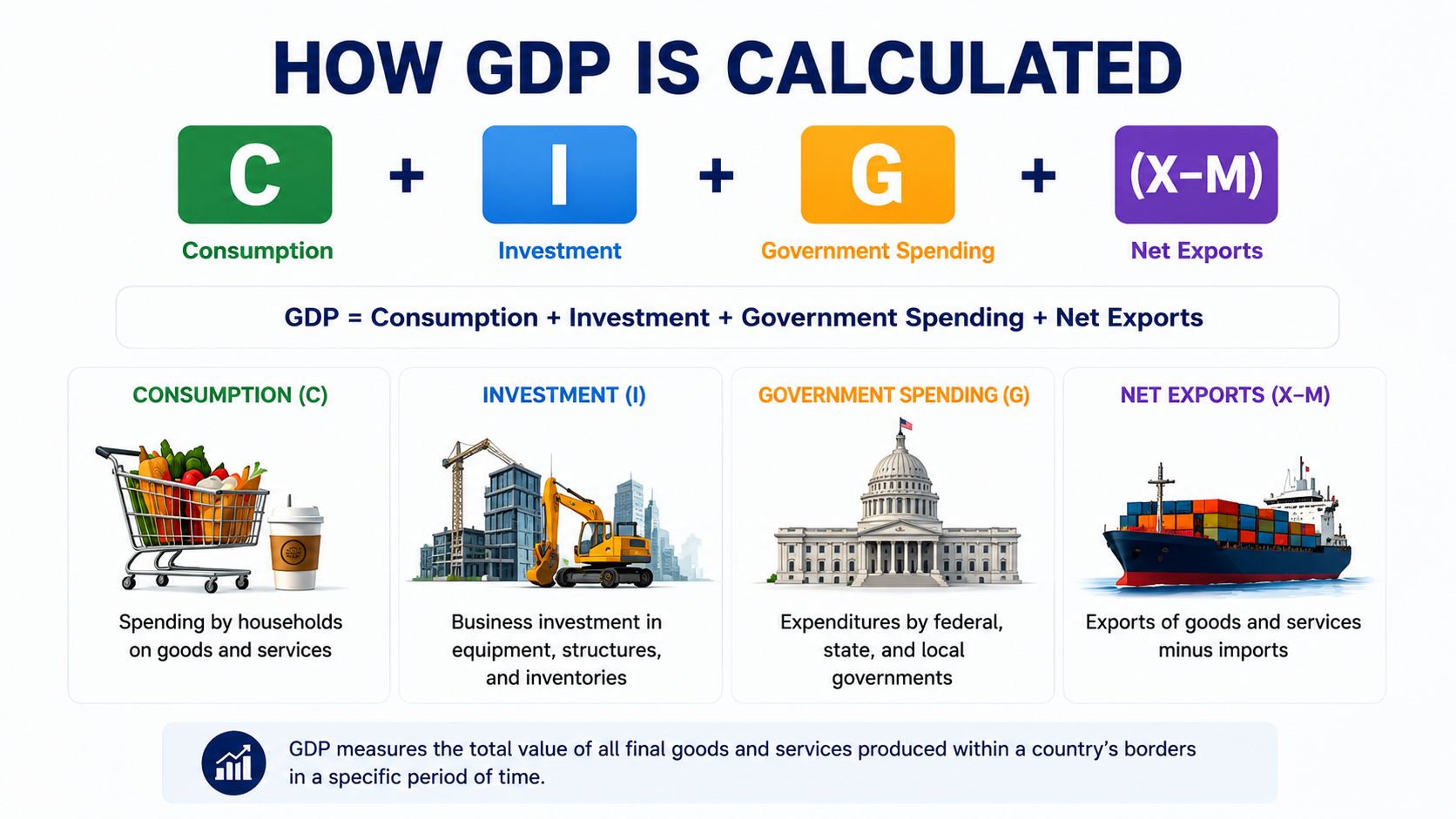
Economists calculate GDP using four major components
GDP = Consumption + Investment + Government Spending + Net Exports
Where
| Component | Description |
| Consumption (C) | Household spending on goods and services |
| Investment (I) | Business spending on equipment, factories, and capital projects |
| Government Spending (G) | Federal, state, and local government expenditures |
| Net Exports (X-M) | Exports minus imports |
Consumer spending is typically the largest driver of U.S. GDP, accounting for roughly two-thirds of economic activity.
This is why retail sales, consumer confidence, and labor market data receive so much attention from investors.
What Is GDP Growth?
While GDP itself is important, markets usually focus on GDP growth.
GDP growth measures how much economic output has increased compared to a previous period.
For example
- Last year's GDP: $100
- This year's GDP: $103
The economy has grown by 3%.
For investors, growth matters because economic expansion often supports higher corporate earnings and stronger business conditions.
Why Does GDP Matter to Investors?
GDP and Corporate Earnings
Economic growth creates demand.
When consumers spend more and businesses invest more, companies generally generate higher revenues and profits.
This is one of the main reasons stock markets tend to perform well during periods of sustainable economic expansion.
Strong GDP growth often supports earnings growth, which is ultimately the foundation of long-term stock market performance.
GDP and Employment
A growing economy typically requires more workers.
As businesses expand production and services, hiring tends to increase and unemployment rates often decline.
Conversely, slowing GDP growth can lead to reduced hiring, weaker labor markets, and lower consumer spending.
GDP and Federal Reserve Policy
GDP is one of the key indicators monitored by the Federal Reserve.
If economic growth becomes too strong, inflationary pressures may increase.
In response, the Fed may raise interest rates to prevent the economy from overheating.
If growth slows significantly, policymakers may consider lowering interest rates to stimulate spending and investment.
As a result, GDP often plays a major role in shaping interest rate expectations.
How GDP Affects Financial Markets
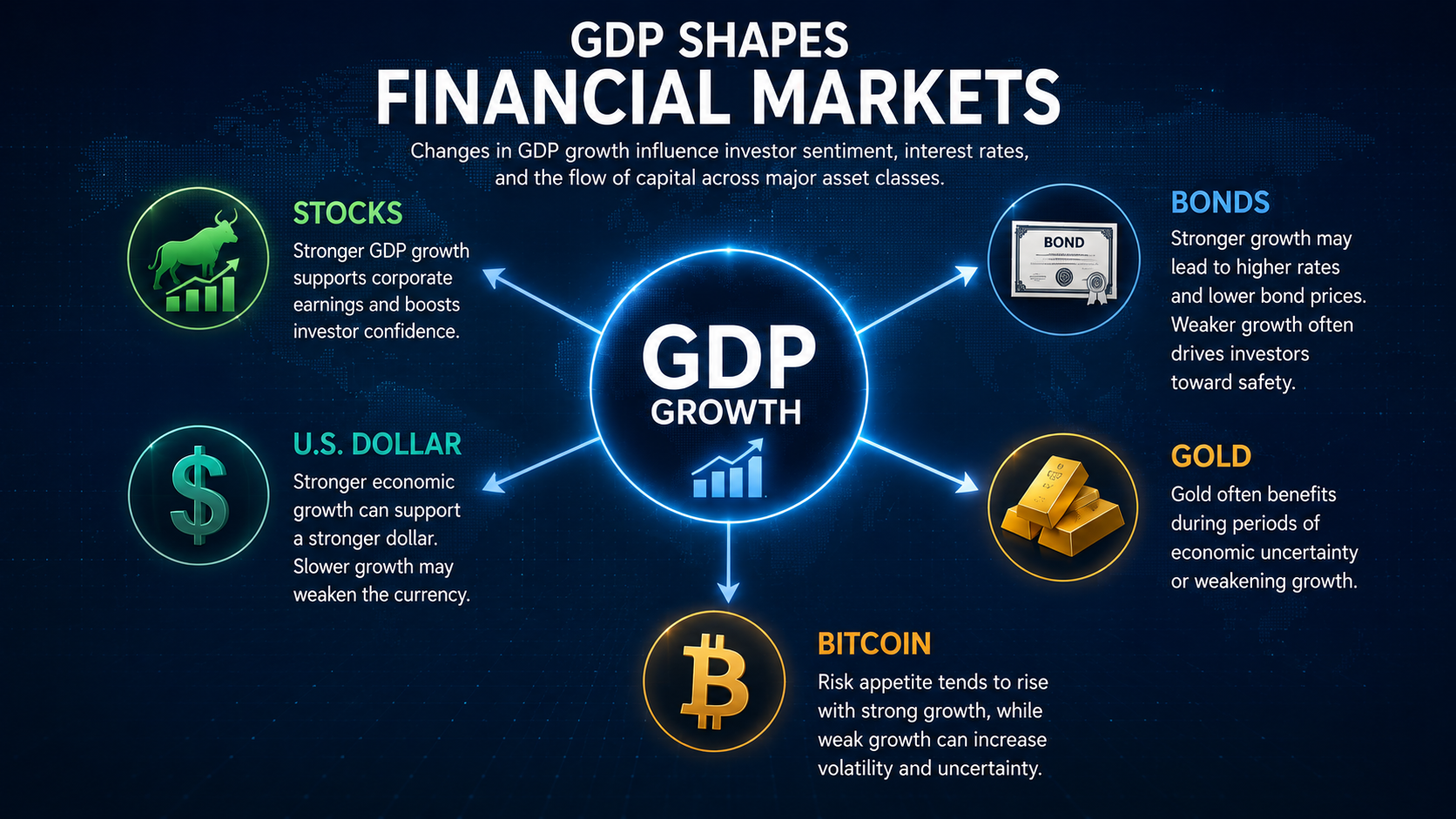
GDP influences nearly every major asset class.
| Asset Class | Strong GDP Growth | Weak GDP Growth |
| Stocks | Positive for corporate earnings and investor confidence | Negative due to recession concerns |
| Bonds | Bond prices may fall as rate expectations rise | Bond prices may rise as investors seek safety |
| U.S. Dollar | Often strengthens due to stronger economic outlook | May weaken if growth slows significantly |
| Gold | Can face pressure during strong growth periods | Often benefits from economic uncertainty |
| Bitcoin | Risk appetite may increase during expansion | Can become more volatile during economic weakness |
However, markets rarely react to GDP in isolation.
What matters most is whether GDP comes in above or below expectations.
Financial markets constantly price in future expectations, not just current conditions.
The Limitations of GDP
Although GDP is extremely important, it is not a perfect measure of economic well-being.
GDP Does Not Measure Quality of Life
An economy can grow while income inequality increases.
Rising GDP does not automatically mean that every household is becoming wealthier.
GDP Does Not Capture Asset Prices
Stock market gains and real estate appreciation are not directly reflected in GDP.
As a result, GDP may not fully represent changes in household wealth.
GDP Can Be Influenced by Debt-Fueled Spending
Government spending can boost GDP growth in the short term.
However, if that growth relies heavily on borrowing, long-term sustainability may become a concern.
This is why investors should look beyond the headline number and examine the quality of economic growth.
Key GDP Concepts Every Investor Should Understand
Focus on Real GDP
Nominal GDP can rise simply because prices are increasing.
Real GDP adjusts for inflation and provides a clearer picture of actual economic growth.
For this reason, professional investors pay close attention to real GDP trends.
Pay Attention to Expectations
Markets often react more strongly to surprises than to the GDP number itself.
A GDP report that exceeds expectations can boost investor confidence, while a disappointing report can trigger risk-off behavior.
Look Beyond GDP
GDP is considered a lagging indicator because it reflects economic activity that has already occurred.
Forward-looking investors also monitor indicators such as
- ISM Manufacturing PMI
- Consumer Confidence
- Retail Sales
- Initial Jobless Claims
- Housing Data
These indicators can provide clues about future economic growth.
What Do Wealthy Investors Look For?
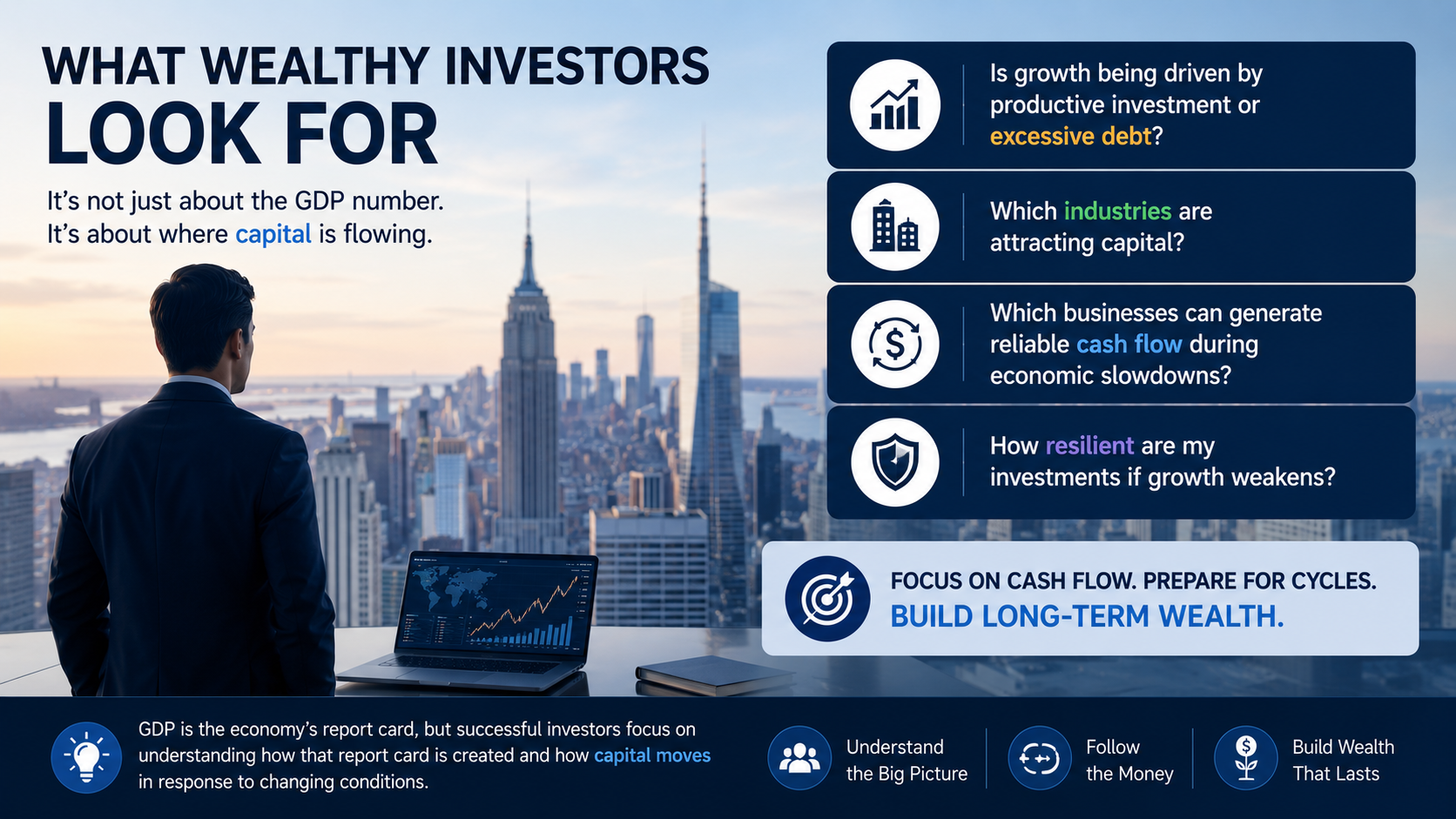
Most people focus on GDP growth.
Wealthy investors focus on where capital is flowing.
GDP growth is ultimately the result of money moving through the economy.
Consumers spend.
Businesses invest.
Governments allocate resources.
Financial markets adjust to those changes.
The most successful long-term investors often ask different questions
- Is growth being driven by productive investment or excessive debt?
- Which industries are attracting capital?
- Which businesses can generate reliable cash flow during economic slowdowns?
- How resilient are my investments if growth weakens?
The goal is not to predict every GDP report.
The goal is to build a portfolio capable of surviving multiple economic cycles.
In investing, survival often matters more than prediction.
Final Thoughts
GDP is one of the most important economic indicators investors can follow.
It provides valuable insight into economic growth, corporate earnings, labor market conditions, and Federal Reserve policy.
Yet the most important lesson is not the GDP number itself.
It is understanding the underlying forces that create economic growth and recognizing how capital moves in response to changing conditions.
Remember this
GDP is the economy's report card, but successful investors focus on understanding how that report card is created.
This was MasterMind.
'[Global] Success Blueprints' 카테고리의 다른 글