What Is Core PCE? Why the Federal Reserve’s Favorite Inflation Gauge Matters for Investors


Hello, this is MasterMind.
Every month, investors around the world focus on a handful of economic reports that can move stocks, bonds, cryptocurrencies, and currencies within minutes.
Among them, one inflation indicator often carries more weight than the others: Core PCE, or the Core Personal Consumption Expenditures Price Index.
While many people are familiar with CPI (Consumer Price Index), the Federal Reserve pays much closer attention to Core PCE when making monetary policy decisions.
So why does the Fed consider Core PCE so important?
And why do financial markets react so strongly whenever this report is released?
Understanding Core PCE is one of the most important steps toward understanding how money flows through the global economy.
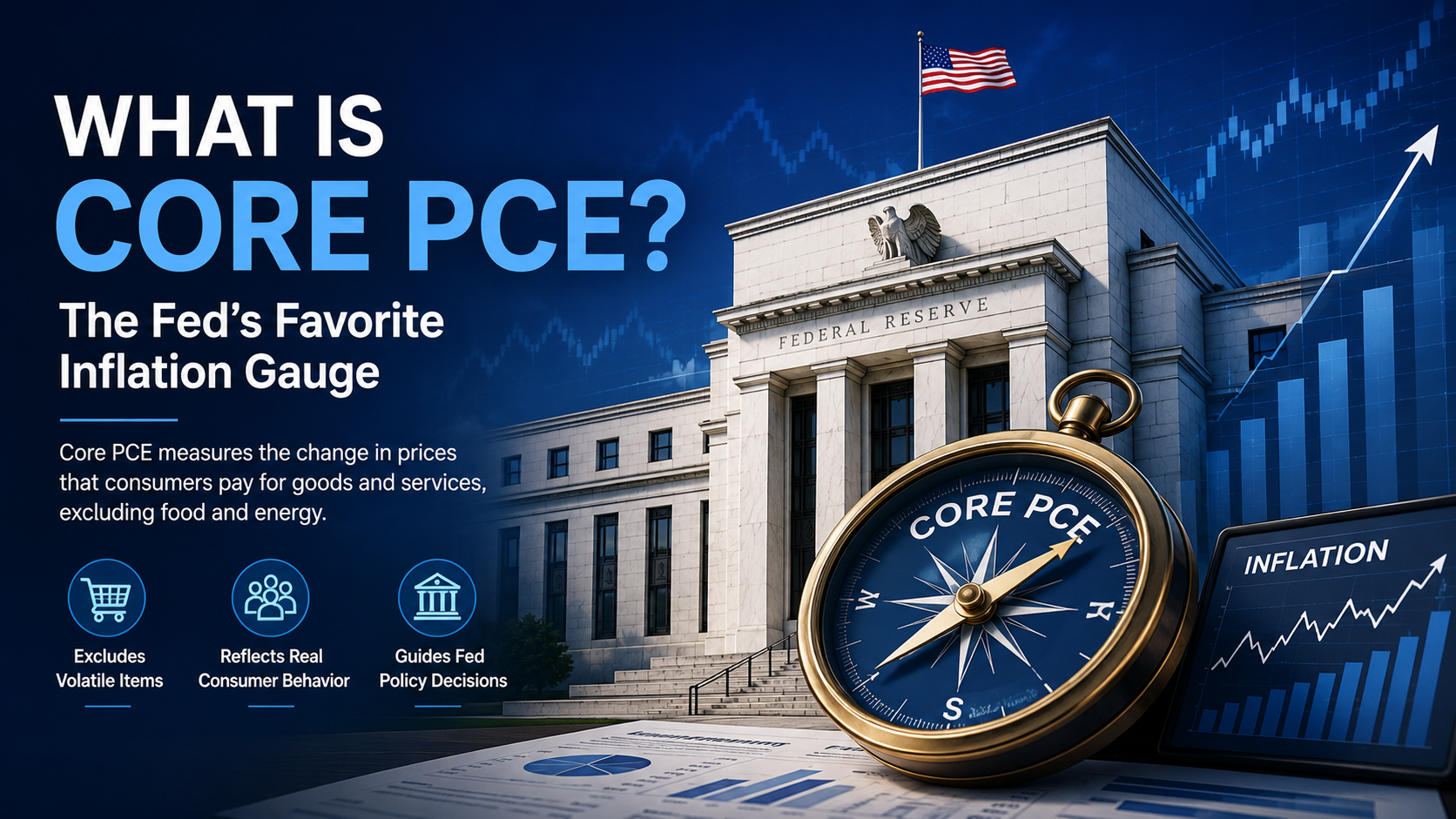
What Is Core PCE?
Core PCE measures changes in the prices consumers pay for goods and services across the U.S. economy.
The word "Core" means that food and energy prices are excluded because they tend to be highly volatile and can distort the underlying inflation trend.
In simple terms, Core PCE is designed to show whether inflation is becoming a long-term problem rather than reacting to temporary price shocks.
Unlike many inflation measures, Core PCE adjusts for changes in consumer behavior.
For example, if the price of one product rises sharply, consumers may switch to a cheaper alternative.
Core PCE captures these substitution effects, making it a more flexible and realistic measure of inflation.
This is one of the primary reasons why the Federal Reserve relies on it when evaluating inflationary pressures.
Why Does the Federal Reserve Prefer Core PCE Over CPI?

Many investors assume CPI is the most important inflation report.
However, policymakers generally place greater emphasis on Core PCE for several reasons.
1. It Reflects Real Consumer Behavior
CPI is based on a relatively fixed basket of goods and services.
Core PCE, on the other hand, adapts to changing consumer spending patterns.
As consumers shift their spending habits, Core PCE adjusts accordingly, providing a more accurate picture of inflation in the real economy.
2. It Uses a Broader Data Set
CPI primarily measures expenses paid directly by consumers.
Core PCE includes a wider range of expenditures, including certain healthcare and government-related spending categories.
Because of this broader scope, Core PCE provides a more comprehensive view of inflation across the economy.
3. It Is the Fed’s Official Inflation Benchmark
The Federal Reserve targets inflation of approximately 2% over the long run.
When policymakers evaluate whether inflation is moving toward that objective, Core PCE is one of the most important metrics they use.
As a result, investors closely watch Core PCE because it can influence expectations for future interest rate decisions.
Three Ways Core PCE Can Move Financial Markets
Core PCE is not just another economic report.
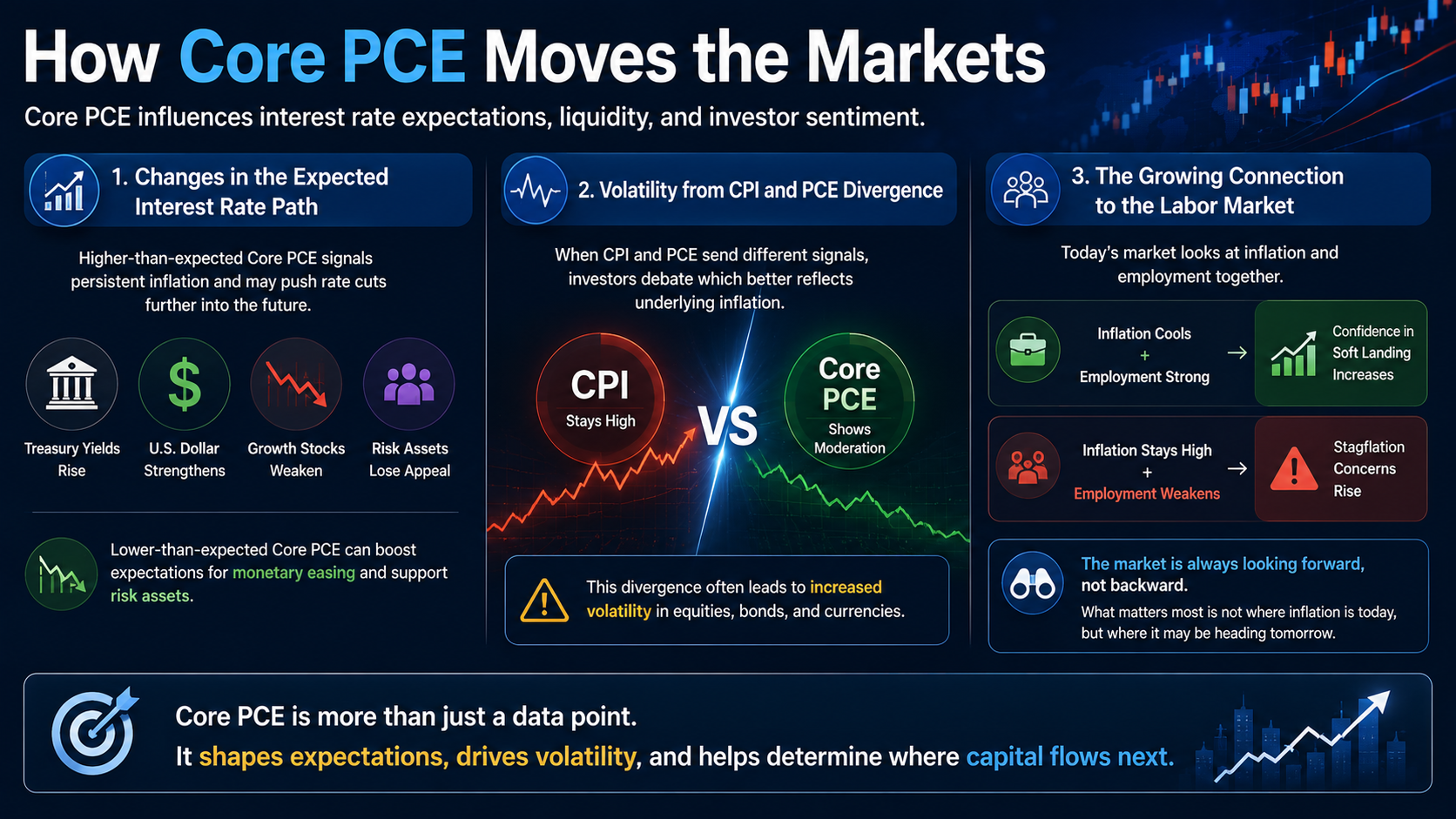
It often shapes expectations for interest rates, liquidity conditions, and overall market sentiment.
1. Changes in the Expected Interest Rate Path
If Core PCE comes in higher than expected, markets may conclude that inflation remains persistent.
This can push expectations for rate cuts further into the future.
When that happens, investors often see:
- Rising Treasury yields
- Stronger U.S. dollar performance
- Weakness in growth stocks
- Reduced appetite for risk assets
Conversely, a lower-than-expected Core PCE reading may strengthen expectations for monetary easing and support risk assets.
2. Market Volatility Caused by CPI and PCE Divergence
There are times when CPI and PCE send different signals.
For example, CPI may remain elevated while Core PCE shows signs of moderation.
When this happens, investors debate which indicator better reflects underlying inflation trends.
The result is often increased volatility across equities, bonds, and currency markets.
3. Its Growing Connection to the Labor Market
Today's market does not evaluate inflation in isolation.
Investors increasingly analyze Core PCE alongside employment data.
If inflation remains elevated while labor market conditions weaken, concerns about stagflation begin to emerge.
On the other hand, if inflation cools while employment remains healthy, markets may become more confident in a soft-landing scenario.
The market is always looking forward, not backward.
What matters most is not where inflation is today, but where it may be heading tomorrow.
Risks Investors Should Watch Closely
One of the biggest risks facing investors today is sticky inflation.
Service-sector inflation tends to be more persistent because it is closely tied to wages and labor costs.
If service inflation remains elevated for longer than expected, the Federal Reserve may be forced to keep interest rates higher for longer.
Another major risk is excessive optimism.
Markets often celebrate a single favorable inflation report, but inflation trends rarely move in a straight line.
A temporary improvement does not guarantee a permanent solution.
Investors who rely too heavily on leverage or aggressive positioning may find themselves vulnerable if inflation unexpectedly rebounds.
In investing, survival is more important than prediction.
What Are Wealthy Investors Watching?
Professional investors and asset managers rarely focus solely on the headline number.
Instead, they focus on the direction of capital flows.
If Core PCE continues to moderate, markets may anticipate easier monetary policy and increased liquidity.
Capital could gradually shift from cash and defensive assets toward growth-oriented investments, technology stocks, and other risk assets.
However, if inflation remains stubbornly high, investors may favor businesses with strong balance sheets, durable cash flows, and pricing power.
These are the types of companies that can survive even when liquidity becomes scarce.
Wealthy investors often ask themselves the following questions:
- What is the market expecting right now?
- What is the market afraid of?
- Can my investments survive a prolonged high-rate environment?
- Do my assets generate sustainable cash flow?
- Is my portfolio built for resilience or simply for optimism?
Strong assets tend to survive even when liquidity contracts.
That is why successful investors focus on capital flows rather than headlines.
MasterMind's Final Thoughts
Core PCE is far more than just an inflation report.
It serves as one of the Federal Reserve’s most important policy guides and often acts as a signal for where global capital may flow next.
Markets do not simply react to numbers.
They react to what those numbers imply about the future.
Investors who understand Core PCE gain a deeper understanding of inflation, interest rates, liquidity, and market psychology.
The market is always pricing in the future.
And in investing, survival matters more than prediction.
The better you understand Core PCE, the better you can understand the forces that truly move financial markets.
Designing success,
MasterMind.
'[Global] Success Blueprints' 카테고리의 다른 글