Why the Unemployment Rate Matters: Its Impact on Interest Rates, Stocks, and Recessions


Hello, this is MasterMind.
When following financial news, one of the most frequently mentioned economic indicators is the unemployment rate.
Every month, investors closely watch U.S. employment data because it can move the Nasdaq, Treasury yields, the U.S. dollar, and even expectations for Federal Reserve policy.
But why does a simple measure of joblessness have such a powerful impact on financial markets?
The answer is simple.
The unemployment rate is not just a labor market statistic.
It is one of the most important indicators connecting consumer spending, corporate earnings, interest rates, stock market performance, and the overall health of the economy.
Historically, rising unemployment has often appeared before or during economic downturns, making it a critical signal for investors trying to understand where the economy is heading next.
Today, financial markets are asking an important question
Is the recent rise in unemployment a healthy slowdown that leads to a soft landing, or is it the beginning of a recession?
Let's explore what the unemployment rate really means, why investors pay so much attention to it, and how it influences the broader economy.
What Is the Unemployment Rate?
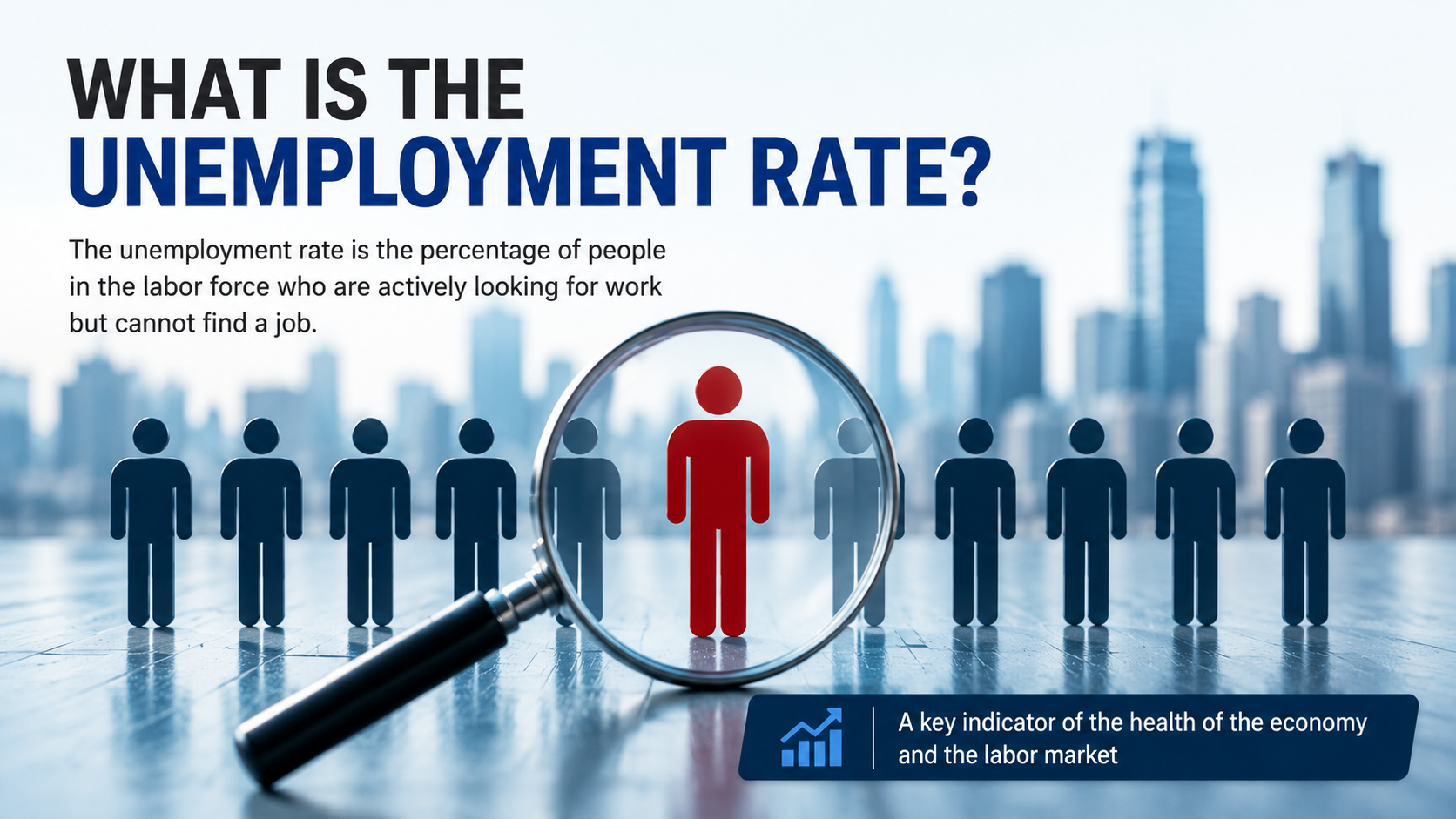
The unemployment rate measures the percentage of people in the labor force who are actively looking for work but cannot find a job.
At first glance, it may seem like a simple employment statistic.
However, from an investor's perspective, it is much more than that.
The unemployment rate serves as a window into the strength of the labor market and the overall economy.
A low unemployment rate generally suggests that businesses are hiring, consumer confidence remains strong, and economic activity is healthy.
A rising unemployment rate, on the other hand, may indicate that companies are slowing hiring, reducing costs, or preparing for weaker economic conditions.
This is why markets pay close attention to every monthly employment report.
Why the Unemployment Rate Matters

The unemployment rate is fundamentally a measure of economic momentum.
The economy runs on a simple cycle.
People earn income through employment.
Income becomes consumer spending.
Consumer spending generates corporate revenue.
Corporate revenue leads to profits, investment, and ultimately stock market growth.
When unemployment rises, this cycle begins to weaken.
Consumers become more cautious.
Businesses experience slower revenue growth.
Companies reduce hiring and investment.
Economic growth starts to slow.
For this reason, investors often view unemployment as a leading signal for future economic conditions, even though economists traditionally classify it as a lagging indicator.
The unemployment rate directly influences expectations for interest rates, stock market performance, and recession risk.
The Unique Nature of Unemployment - A Lagging Indicator With Leading Implications
Economists classify unemployment as a lagging indicator because companies typically do not lay off workers immediately when economic conditions weaken.
Businesses usually cut expenses, reduce expansion plans, and slow hiring before implementing layoffs.
By the time unemployment begins to rise noticeably, economic weakness may already have been developing for months.
However, financial markets are forward-looking.
Investors care less about where unemployment is today and more about where it is heading tomorrow.
A small increase in unemployment can signal weaker consumer spending, declining corporate earnings, tighter financial conditions, and changes in Federal Reserve policy.
That is why unemployment often acts as an early warning signal for investors.
Key Changes Shaping the Market
1. The Sahm Rule Is Back in Focus
One of the most closely watched recession indicators is the Sahm Rule, developed by economist Claudia Sahm.
The rule suggests that a recession may be underway when the three-month average unemployment rate rises by at least 0.5 percentage points above its lowest level over the previous 12 months.
Historically, this indicator has been remarkably effective at identifying economic downturns.
As unemployment trends move closer to this threshold, investors become increasingly concerned about recession risk.

2. Labor Supply and Labor Demand Are Becoming Imbalanced
Recent increases in unemployment are not solely driven by mass layoffs.
Labor supply has expanded as more workers enter the labor market, while labor demand has softened due to the effects of higher interest rates.
This does not necessarily indicate a collapse in employment conditions.
However, it does suggest that the labor market is gradually cooling, which could eventually weigh on consumer spending and economic growth.
3. The Federal Reserve Faces a Difficult Balancing Act
The Federal Reserve has a dual mandate - maintaining price stability and supporting maximum employment.
If unemployment rises too quickly, pressure builds for interest rate cuts.
However, if inflation remains above target, cutting rates too early risks reigniting inflationary pressures.
Keeping rates elevated for too long, on the other hand, could push the economy into a deeper slowdown.
This leaves policymakers facing a difficult trade-off between inflation control and labor market stability.

Risks Investors Should Watch
One of the biggest mistakes investors can make is assuming that weak economic data is always bullish for markets.
In recent years, markets often celebrated weaker economic reports because they increased the likelihood of Federal Reserve rate cuts.
This phenomenon became known as "Bad News Is Good News."
However, once unemployment rises beyond a certain threshold, the narrative changes.
At that point, recession fears begin to outweigh expectations for lower interest rates.
Declining corporate earnings, weaker consumer demand, and slowing economic growth become the dominant concerns.
When that shift occurs, bad news becomes genuinely bad news for financial markets.
What Are Wealthy Investors Watching?
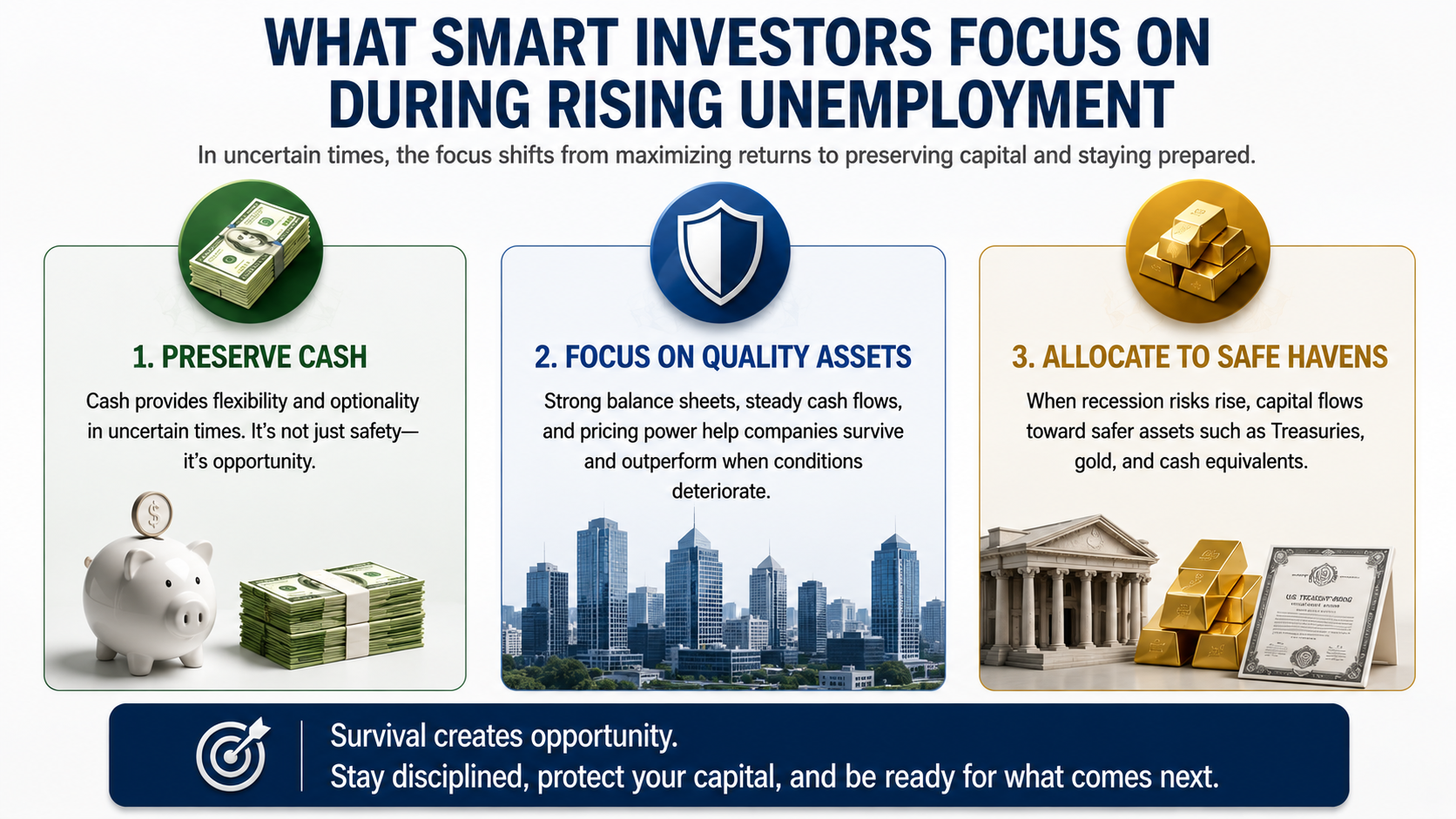
Large institutional investors and high-net-worth individuals focus less on the unemployment rate itself and more on the movement of capital.
During periods of rising economic uncertainty, they tend to evaluate three key factors.
Cash Becomes More Valuable
In uncertain environments, cash is not simply a defensive asset.
It becomes optionality.
Cash provides investors with the flexibility to purchase high-quality assets at attractive valuations when market opportunities emerge.
Strong Assets Stand Out
When liquidity is abundant, even unprofitable companies can perform well.
But when economic conditions weaken, investors begin to prioritize resilience.
Companies with strong balance sheets, durable cash flows, and competitive advantages tend to outperform weaker businesses.
Capital Flows Toward Safety
As recession concerns increase, money often shifts toward safer assets.
Treasuries, gold, cash equivalents, and financially strong businesses typically attract more investor interest.
In uncertain environments, survival becomes more important than maximizing returns.
Ask yourself
- Can my portfolio withstand a prolonged economic slowdown?
- Do my investments generate reliable cash flow?
- Am I prepared to take advantage of opportunities if markets experience a significant correction?
Final Thoughts
The unemployment rate is far more than a labor market statistic.
It is one of the most important indicators connecting consumer spending, corporate earnings, interest rates, stock market performance, and recession risk.
A rising unemployment rate does not automatically mean a recession is inevitable.
However, it does signal that investors should pay closer attention to the health of the economy and the direction of market expectations.
Markets always look ahead.
And in investing, survival is often more important than prediction.
MasterMind's Take
The most successful investors are not the ones who perfectly predict every market move.
They are the ones who recognize warning signs early, manage risk effectively, and position themselves to survive through changing economic cycles.
Focus on resilience, cash flow, and long-term survival.
That is where lasting wealth is built.
This was MasterMind.
'[Global] Success Blueprints' 카테고리의 다른 글