What Is the Fed Funds Rate? How Federal Reserve Interest Rates Shape Global Markets


Hello, this is MasterMind.
If there is one number capable of moving stocks, bonds, real estate, cryptocurrencies, and even currencies around the world, it is the Fed Funds Rate.
Every time the Federal Reserve announces a policy decision, investors immediately begin reassessing risk, liquidity, and future economic growth.
But why does a single interest rate have such a powerful influence on global markets?
The answer is simple.
The Fed Funds Rate determines the price of money.
And the price of money influences nearly every major asset class on Earth.
Understanding the Fed Funds Rate is essential for anyone who wants to understand inflation, stock market valuations, bond yields, Federal Reserve policy, and long-term capital flows.
In this article, we'll explore what the Fed Funds Rate is, why it matters, how it affects financial markets, and why investors are increasingly discussing the Higher-for-Longer interest rate environment.
What Is the Fed Funds Rate?

The Fed Funds Rate is the interest rate at which U.S. banks lend reserve balances to one another overnight.
While this may sound like a technical banking mechanism, it is actually one of the most important interest rates in the world.
The Fed Funds Rate influences
- Treasury yields
- Mortgage rates
- Corporate borrowing costs
- Stock market valuations
- U.S. dollar strength
- Gold prices
- Bitcoin and other digital assets
In simple terms, the Fed Funds Rate represents the price of money.
When money becomes more expensive to borrow, economic activity tends to slow down. When borrowing becomes cheaper, spending and investment typically accelerate.
This is why Federal Reserve policy has such a profound impact on nearly every asset class.
Why the Fed Funds Rate Matters to Investors
Many investors focus on where rates are today.
Markets, however, focus on where rates are likely to go tomorrow.
A rate hold is not necessarily bullish or bearish on its own.
What matters is
- The Federal Reserve's future guidance
- The Dot Plot projections
- Economic forecasts released by policymakers
- Inflation expectations
- Labor market trends
Financial markets constantly price future expectations rather than present conditions.
This is precisely why the debate has shifted from "When will the Fed pivot?" to "Can the Fed actually afford to cut rates?"
How the Fed Funds Rate Influences Financial Markets
1. Inflation Is Proving More Persistent Than Expected
One of the biggest challenges facing policymakers is that inflation has not fully disappeared.
Energy prices remain vulnerable to geopolitical tensions.
Global supply chains continue to face disruptions.
Labor markets remain relatively tight.
These factors create upward pressure on prices and make it more difficult for inflation to sustainably return to the Federal Reserve's 2% target.
As a result, policymakers have little incentive to rush into aggressive rate cuts.
2. The Federal Reserve Fears Inflation More Than Economic Slowdown
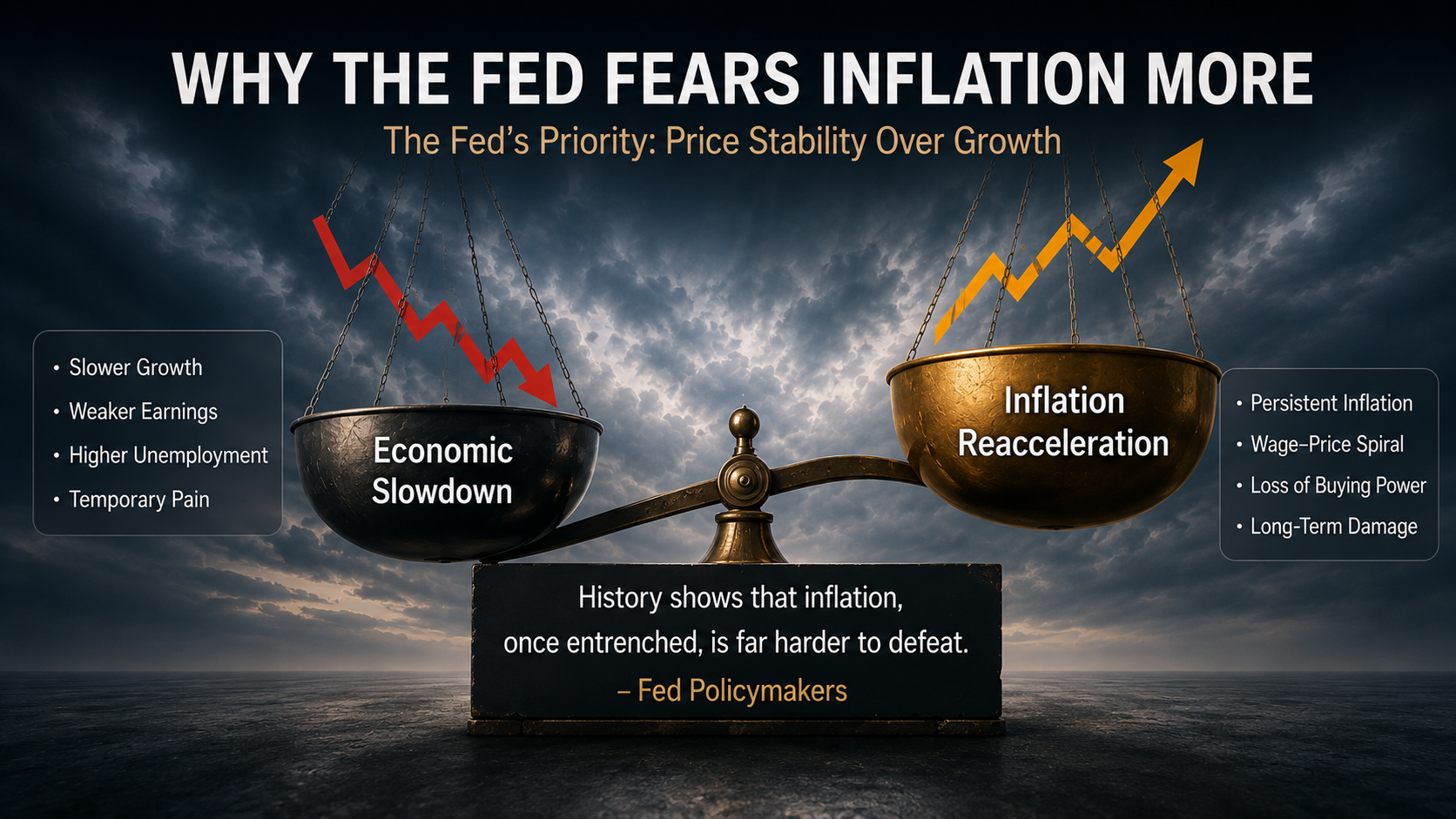
History has taught central bankers an important lesson.
Economic slowdowns can eventually recover.
Entrenched inflation is far harder to eliminate.
The inflationary experience of the 1970s continues to influence modern monetary policy thinking.
Because of this, the Federal Reserve appears willing to tolerate slower growth if it means preventing inflation from accelerating again.
This explains why policymakers often sound more concerned about inflation risks than recession risks.
3. Markets Are Pricing Higher-for-Longer
The market's interpretation of a Fed pause has changed significantly.
In previous cycles, a pause was often viewed as a precursor to rate cuts.
Today, many investors see things differently.
Instead of asking
"When will rates be cut?"
Markets are increasingly asking
"What if rates stay elevated much longer than expected?"
This shift matters because liquidity drives asset prices.
Periods of abundant liquidity tend to support stocks, real estate, and speculative investments.
Periods of tight monetary policy typically reduce risk appetite and increase volatility.

A Real-World Example -The Higher-for-Longer Debate
Most investors view interest rates as economic news.
Professional investors view them as signals for capital allocation.
When rates remain high, money naturally flows toward
- U.S. Treasury securities
- Cash and money market funds
- Dollar-denominated assets
- Companies with strong free cash flow
Meanwhile, assets that rely heavily on cheap financing often face increasing pressure.
These may include
- Highly leveraged companies
- Unprofitable growth stocks
- Commercial real estate
- Speculative investments
The real story is not the interest rate itself.
The real story is where capital chooses to go.
Money flows ultimately determine market direction.
Risks Investors Should Watch Closely
Rising Corporate Credit Stress
Many businesses refinanced debt during the ultra-low-rate era.
As that debt matures, refinancing costs are significantly higher.
Companies with weak balance sheets may face increasing financial pressure, potentially leading to wider credit spreads and default risks.
Dollar Strength and Emerging Market Outflows
Higher U.S. interest rates tend to support the U.S. dollar.
A stronger dollar can create challenges for emerging markets by encouraging capital to flow back toward the United States.
This dynamic can increase volatility across global equity and currency markets.
Valuation Compression in High-Growth Assets
Many technology and growth stocks benefited from expectations of lower future rates.
If rates remain elevated, higher discount rates may pressure valuations.
Companies that fail to deliver strong earnings growth could face significant price corrections.
What Are Wealthy Investors Watching?
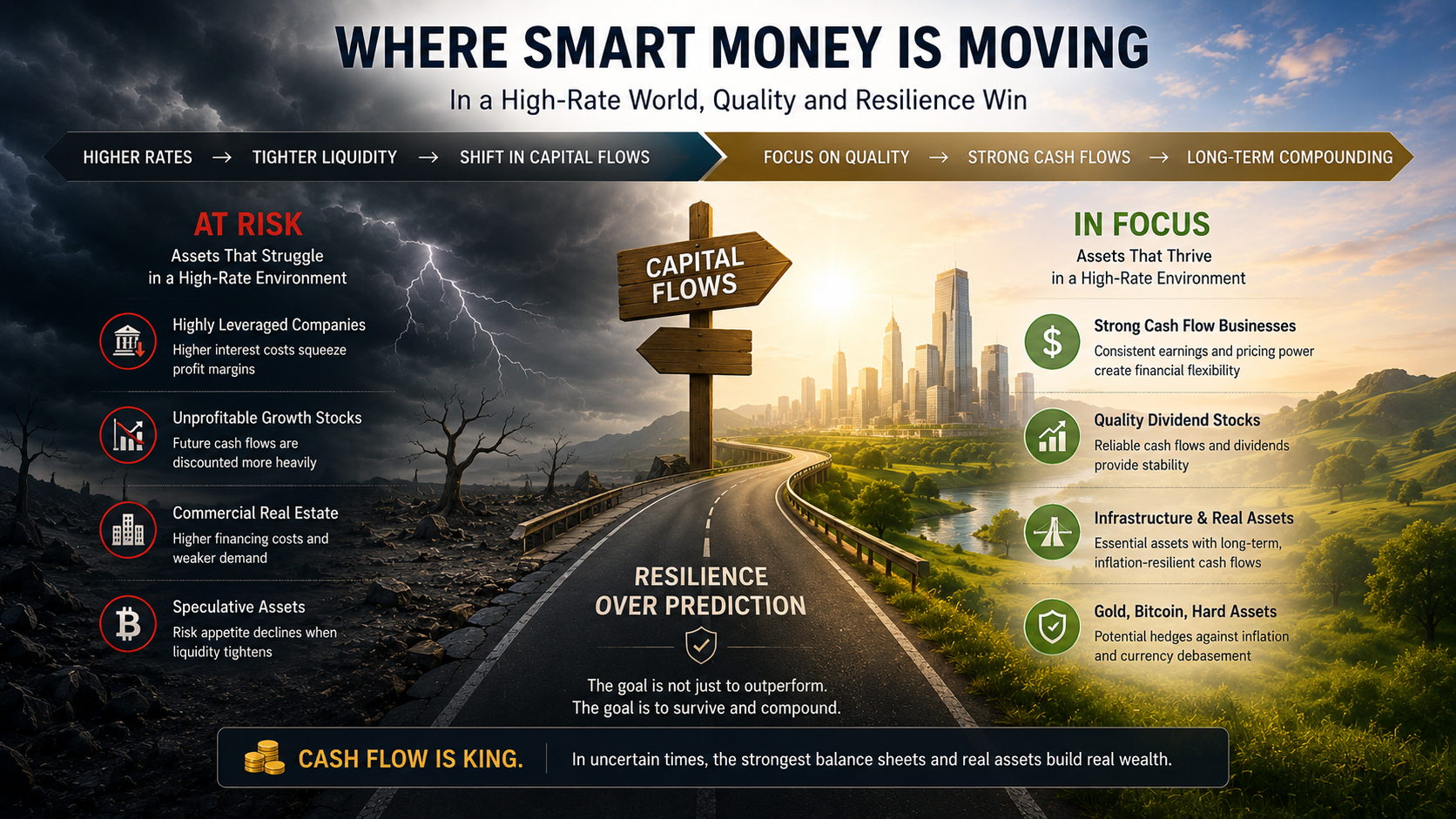
Large institutional investors and wealthy asset owners rarely focus on predicting the next Federal Reserve meeting.
Instead, they focus on resilience.
Periods of tightening liquidity often reveal which assets possess genuine strength.
Investors tend to favor
- Companies with substantial cash reserves
- Businesses with durable competitive advantages
- Infrastructure assets with predictable cash flows
- Alternative stores of value such as gold and Bitcoin
The objective is not simply to outperform during favorable conditions.
The objective is to survive unfavorable conditions.
Ask yourself:
- Can my portfolio perform well without multiple rate cuts?
- Are my investments supported by real cash flow or simply market optimism?
- Do I have sufficient liquidity to take advantage of future opportunities?
- Am I investing based on predictions or based on resilience?
These questions often matter more than any short-term market forecast.
Final Thoughts
The Fed Funds Rate is far more than an economic statistic.
It serves as the foundation of global liquidity and influences the valuation of virtually every major asset class.
While markets continue to hope for a policy pivot, the Federal Reserve remains focused on a different concern
preventing inflation from returning.
This tension between market expectations and policy reality is likely to remain a major driver of volatility in the months ahead.
Successful investors understand that wealth is not built by accurately predicting every policy decision.
It is built by owning assets capable of surviving a wide range of economic environments.
MasterMind's Take:
Markets may continue waiting for rate cuts, but the most successful investors prepare for multiple outcomes. In uncertain environments, resilience matters far more than prediction.
This was MasterMind.
'[Global] Success Blueprints' 카테고리의 다른 글