What Is SEP? Understanding the Federal Reserve’s Economic Projections


Hello, this is MasterMind.
Why do financial markets sometimes surge or crash even when the Federal Reserve leaves interest rates unchanged?
Most investors focus on the Fed’s rate decision itself. However, professional investors know that markets are forward-looking. What matters most is not where interest rates are today, but where the Federal Reserve believes they are heading tomorrow.
That is why investors around the world closely watch the Summary of Economic Projections (SEP), one of the most influential documents released by the Federal Reserve.
Published four times a year alongside selected FOMC meetings, the SEP provides a glimpse into how Federal Reserve officials view the future of the U.S. economy. For many investors, it serves as a roadmap for understanding future interest rates, inflation trends, economic growth, and the direction of liquidity.
In an environment where macroeconomic uncertainty remains elevated, understanding the SEP can provide a significant advantage.
What Is the SEP?
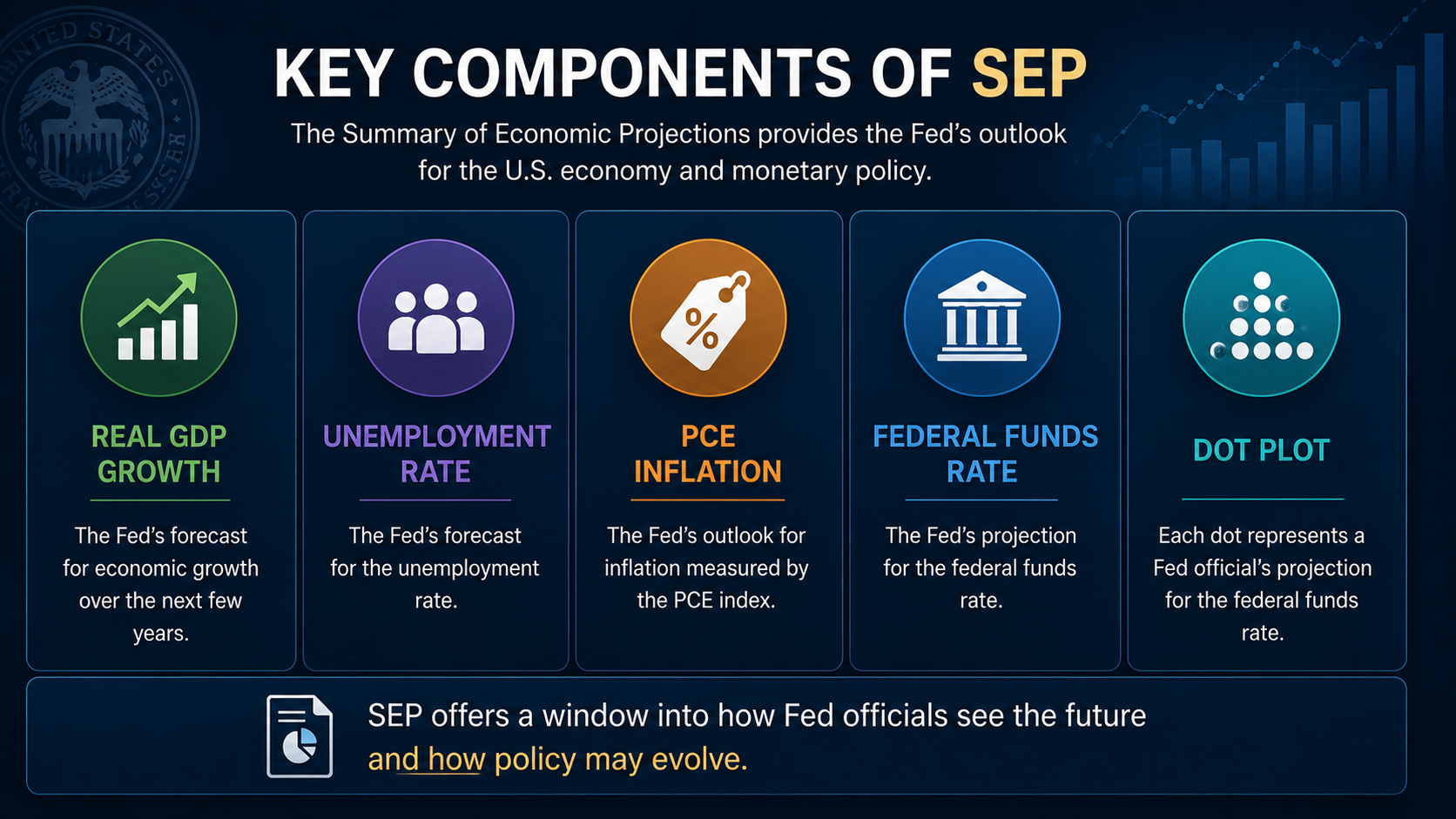
SEP stands for Summary of Economic Projections.
It is a report published by the Federal Reserve that contains economic forecasts from members of the Federal Open Market Committee (FOMC).
The report includes projections for
- Gross Domestic Product (GDP) growth
- Unemployment rate
- Inflation (PCE Inflation)
- Federal Funds Rate
- Longer-run neutral interest rate
In simple terms, the SEP represents the Federal Reserve’s outlook for the U.S. economy over the coming years.
One of its most closely watched components is the famous Dot Plot.
The Dot Plot shows where each Federal Reserve official believes interest rates should be in the future. While it may look like a simple collection of dots, investors treat it as one of the strongest signals regarding future monetary policy.
Because interest rates determine the cost of money, they ultimately influence the valuation of nearly every asset class, from stocks and bonds to real estate and cryptocurrencies.
The Real Purpose of the SEP

The SEP is far more than a collection of economic forecasts.
It provides insight into how the Federal Reserve interprets current economic conditions and how policymakers may react in the future.
Investors rarely focus on the projections themselves.
Instead, they focus on what has changed compared to the previous SEP.
Questions market participants ask include
- Has GDP growth been revised higher or lower?
- Has inflation become more persistent?
- Are unemployment forecasts changing?
- Have expected rate cuts been reduced?
These revisions often have a greater impact on markets than the actual rate decision announced on the same day.
Markets constantly attempt to price the future. The SEP helps investors understand what future the Federal Reserve is currently preparing for.
Key Changes That Move Markets
1. Adjusting Market Expectations
Financial markets are constantly trying to stay ahead of the Federal Reserve.
Whenever economic data weakens, investors often begin pricing in future rate cuts before the Fed officially signals them.
However, if the SEP suggests a more hawkish outlook than markets expected, asset prices can quickly adjust.
When the Fed projects higher rates for longer, investors may rotate out of risk assets and move toward cash, short-term bonds, or defensive sectors.
The market reaction is often driven not by the forecast itself but by the gap between expectations and reality.
2. The Balance Between Growth and Inflation
The SEP simultaneously provides forecasts for economic growth and inflation.
This relationship is critical.
If growth forecasts decline while inflation projections rise, investors begin to worry about stagflation—a scenario where economic growth slows while inflation remains elevated.
Stagflation is particularly challenging because it limits the Federal Reserve’s ability to stimulate the economy through rate cuts.
On the other hand, stable growth combined with declining inflation supports the possibility of a soft landing, one of the most favorable outcomes for financial markets.
3. Changes in the Dot Plot
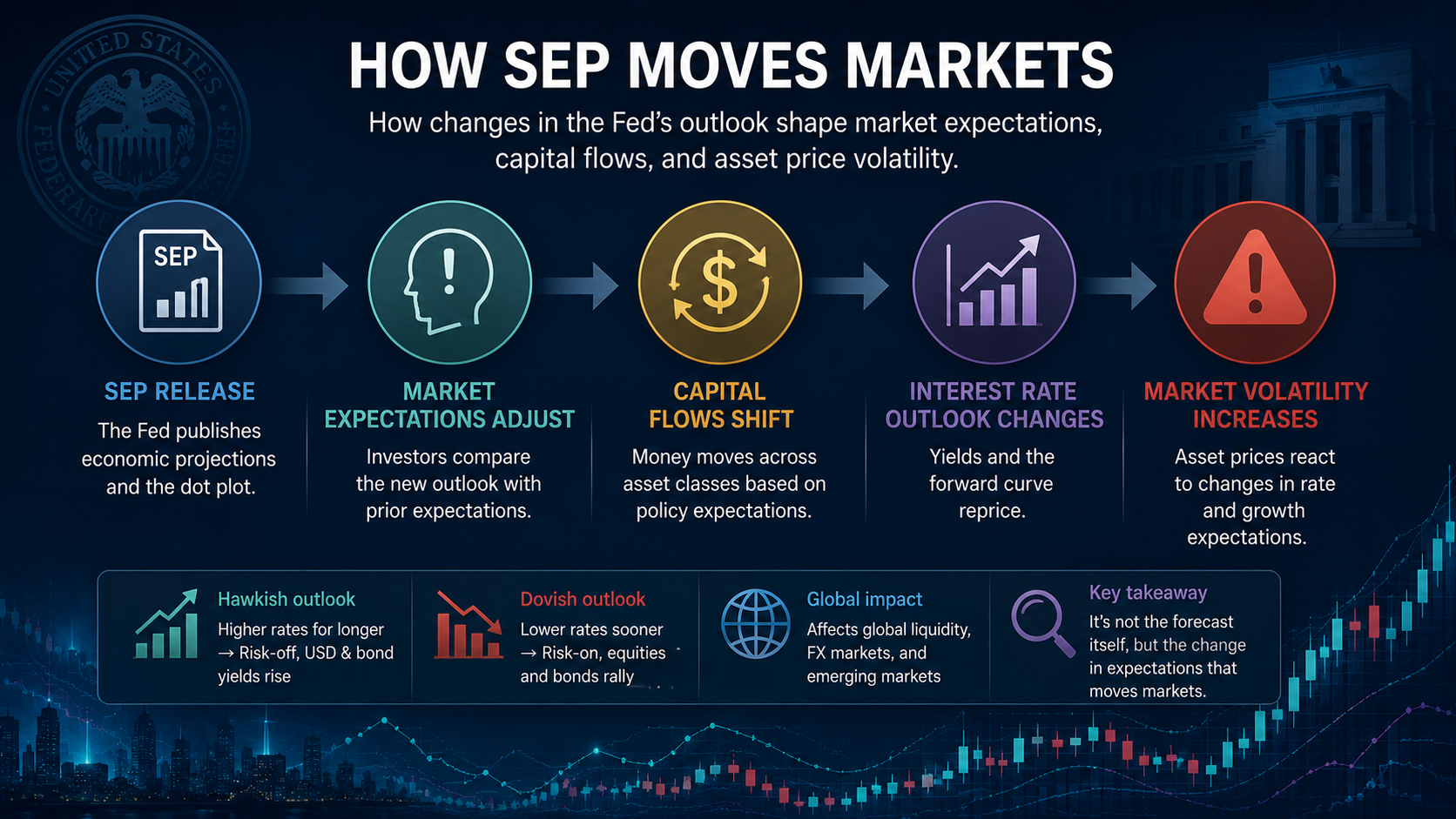
The Dot Plot often attracts more attention than the Fed’s official statement.
When the dots move higher, it signals that policymakers expect interest rates to remain elevated.
When the dots move lower, investors interpret it as a sign that rate cuts may be approaching.
Because future liquidity conditions heavily influence asset prices, even small changes in the Dot Plot can trigger significant market reactions.
4. The Importance of the Neutral Rate
Long-term investors pay special attention to the Fed’s estimate of the longer-run neutral interest rate.
The neutral rate represents the theoretical level of interest rates that neither stimulates nor restricts economic activity.
If Federal Reserve officials gradually raise their estimate of the neutral rate, it could signal a structural shift in the economy.
A higher neutral rate means higher borrowing costs over the long term.
This has major implications for stock valuations, real estate prices, bond markets, and corporate financing conditions.
For investors, this may be one of the most important sections of the entire SEP.
Risks Investors Should Watch
One common mistake is treating the SEP as a prediction of the future.
The Federal Reserve is not forecasting the future with certainty.
It is responding to available economic data and adjusting policy as conditions evolve.
History provides a clear example.
In 2021, Federal Reserve officials largely viewed inflation as temporary. As inflation accelerated far beyond expectations, policymakers were forced to implement one of the most aggressive rate-hiking cycles in decades.
For this reason, investors should not focus solely on whether the projections are accurate.
The more important question is
What is the Federal Reserve worried about?
Is inflation still the primary concern?
Are policymakers becoming more concerned about unemployment?
Is economic growth slowing faster than expected?
The answers often matter more than the projections themselves.
What Are Wealthy Investors Looking At?

Large institutional investors and high-net-worth individuals rarely focus on whether the next rate move will be up or down.
Instead, they focus on how capital flows may change.
Evaluating Survival During Tight Liquidity Conditions
If the SEP signals that interest rates may remain elevated for longer than expected, investors often prioritize companies with strong balance sheets and reliable cash flow generation.
In periods of declining liquidity, businesses that can fund themselves internally tend to outperform those dependent on cheap financing.
Cash flow becomes more valuable than growth stories.
Reassessing Real Assets
If inflation remains persistent within the SEP forecasts, investors often increase exposure to assets that can preserve purchasing power.
These may include
- High-quality real estate
- Infrastructure assets
- Companies with strong pricing power
- Businesses generating stable free cash flow
The goal is not necessarily maximizing returns but protecting long-term wealth.
Questions Every Investor Should Ask
After reviewing a new SEP release, consider asking yourself
- Can my portfolio withstand interest rates remaining elevated for another year?
- Am I investing based solely on expectations of future rate cuts?
- Do the assets I own generate durable cash flow?
- Is the market expecting something different from what the Federal Reserve is projecting?
These questions can help investors remain disciplined during periods of uncertainty.
Final Thoughts
Most retail investors focus on where the stock market might move tomorrow.
Successful long-term investors focus on the direction of interest rates, liquidity, and capital flows.
The SEP is one of the Federal Reserve’s most valuable communication tools because it reveals how policymakers view the future.
The numbers themselves are important.
But the real opportunity lies in understanding why those numbers changed and what concerns are driving the Federal Reserve’s decisions.
Markets are forward-looking.
Those who understand the flow of money are often better prepared for both opportunities and risks.
MasterMind's Take
Markets often fear prolonged high interest rates more than rate hikes themselves. The SEP offers one of the clearest windows into how the Federal Reserve views that risk and where monetary policy may be heading next.
This was MasterMind.
'[Global] Success Blueprints' 카테고리의 다른 글