Nasdaq 100 vs S&P 500 vs Dow Jones: Which Index Is Right for You?


Hello, this is MasterMind.
One of the first decisions every investor faces when entering the U.S. stock market is surprisingly simple on the surface but incredibly important in the long run
Should you invest in the Nasdaq 100, the S&P 500, or the Dow Jones?
Many investors assume these indexes are essentially the same because they all represent the U.S. stock market. However, each index reflects a very different group of companies, responds differently to economic conditions, and delivers a unique investing experience.
The real question is not which index will generate the highest return next year.
The better question is
What kind of companies will protect and grow your wealth when markets become uncertain?
Let's break down the differences and discover which U.S. stock index best matches your investment style.
Understanding the Three Major U.S. Stock Indexes
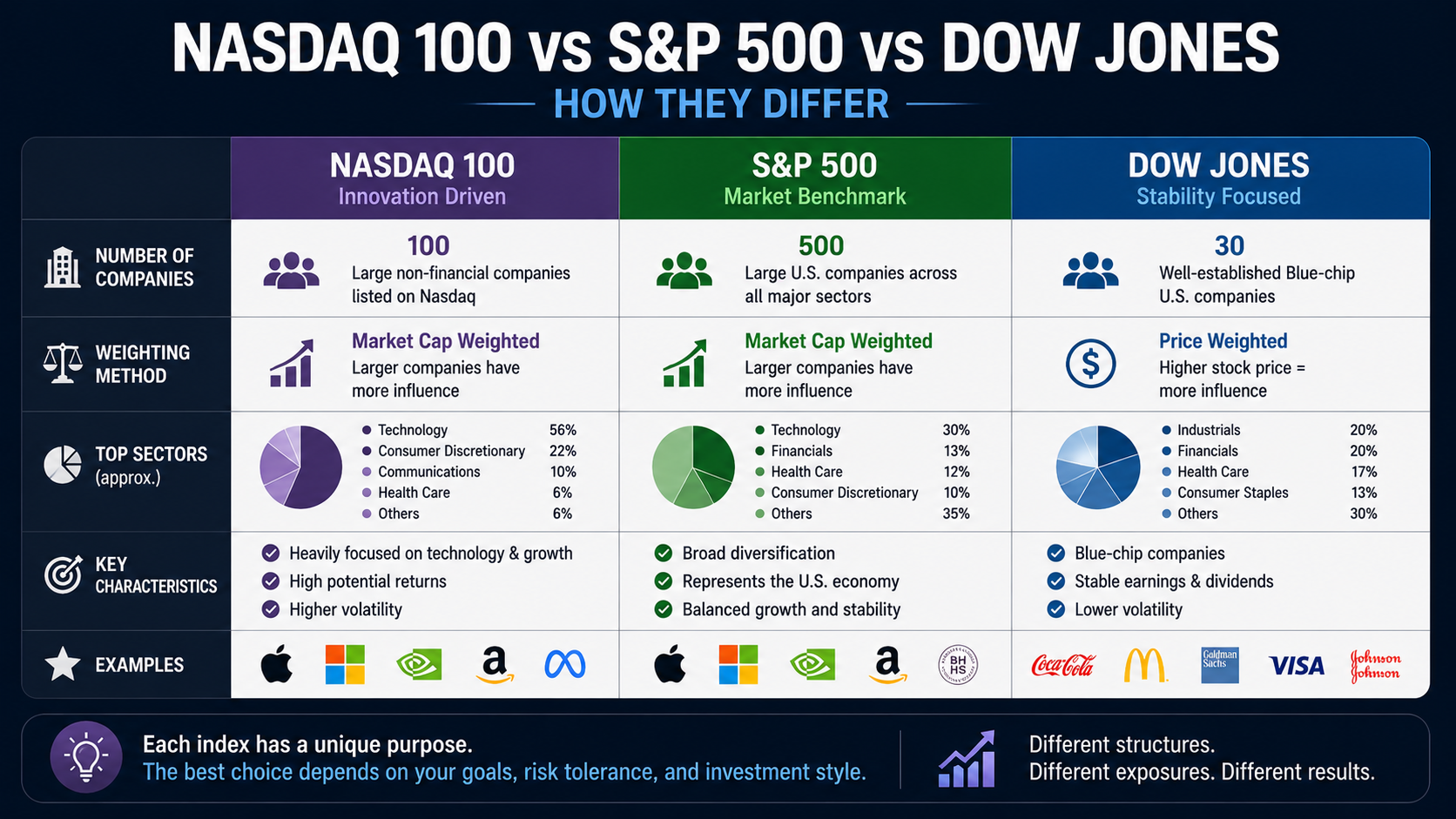
Stock indexes are more than just numbers on a screen.
They represent different philosophies of growth, risk, and economic strength.
Nasdaq 100 - The Innovation Engine
The Nasdaq 100 tracks the largest non-financial companies listed on the Nasdaq exchange.
Some of its biggest holdings include
- Apple
- Microsoft
- Nvidia
- Amazon
- Meta Platforms
- Broadcom
This index is heavily concentrated in technology, artificial intelligence, cloud computing, semiconductors, and digital platforms.
When investors are optimistic about future growth, the Nasdaq 100 often leads the market higher.
However, higher growth potential comes with greater volatility, especially during periods of rising interest rates or economic uncertainty.
S&P 500 - America in One Index
The S&P 500 consists of 500 of the largest publicly traded companies in the United States.
It includes businesses from virtually every major sector
- Technology
- Financials
- Healthcare
- Consumer Goods
- Industrials
- Energy
Major holdings include
- Apple
- Microsoft
- Nvidia
- Berkshire Hathaway
- JPMorgan Chase
- Johnson & Johnson
Because of its broad diversification, many investors consider the S&P 500 the closest representation of the overall U.S. economy.
For most investors, it serves as the foundation of a long-term portfolio.
Dow Jones - The Blue-Chip Classic
The Dow Jones Industrial Average tracks 30 large and established American companies.
Unlike most modern indexes, the Dow is weighted by stock price rather than market capitalization.
Notable components include
- Coca-Cola
- McDonald's
- Goldman Sachs
- Visa
- Johnson & Johnson
The Dow emphasizes stability, profitability, and long corporate track records.
While it may not capture every emerging trend, it often appeals to investors seeking resilience and consistent performance.
Key Forces Shaping These Indexes
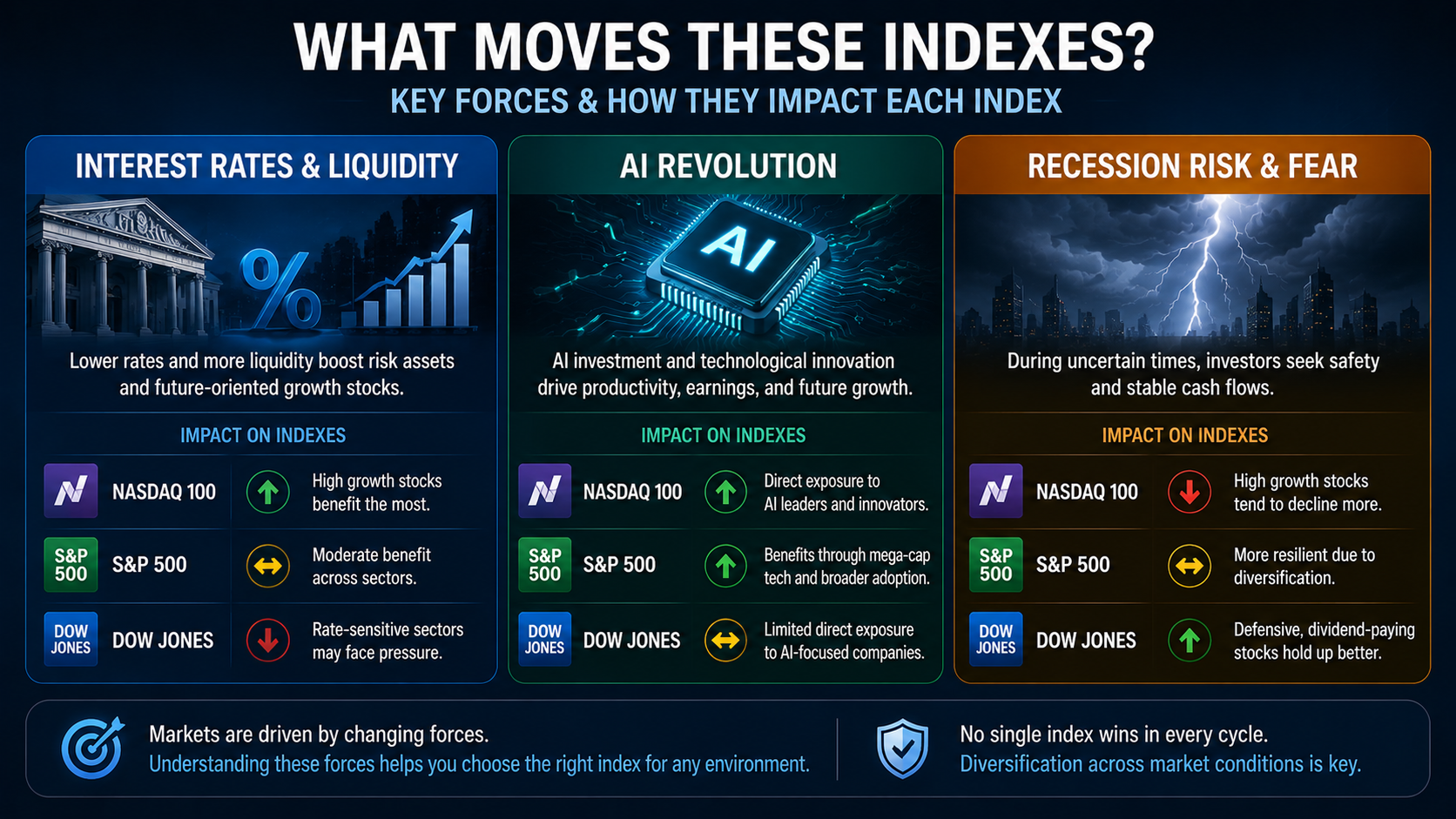
1. Interest Rates and Liquidity
Markets are driven by the flow of capital.
When interest rates fall and liquidity increases, investors become more willing to pay for future growth.
This environment tends to favor the Nasdaq 100.
Conversely, when rates rise, investors often prioritize companies with strong current cash flows and stable earnings, which can benefit Dow components.
The S&P 500 generally falls somewhere in between.
2. The AI Revolution
Artificial intelligence has become one of the most powerful investment themes of the decade.
Companies such as Nvidia, Microsoft, Amazon, and Meta are investing billions of dollars into AI infrastructure and software development.
As a result, the Nasdaq 100 has become one of the primary beneficiaries of this technological transformation.
However, investors should recognize that the S&P 500 is also increasingly influenced by the same mega-cap technology companies.
Today, both indexes are more connected to the AI story than many investors realize.
3. Fear vs. Growth
Markets often react more strongly to fear than optimism.
When recession risks rise, investors typically move away from high-growth assets and toward companies with proven business models and stable cash generation.
In these environments, the Dow Jones may provide relative stability, while the S&P 500 often acts as a middle ground between growth and defense.
Risks Investors Should Understand

Nasdaq 100 - Concentration and Volatility
The Nasdaq 100 has historically delivered strong long-term returns.
However, its heavy exposure to technology means it can experience significant drawdowns during market corrections.
High expectations create high volatility.
S&P 500 - Not as Diversified as It Seems
Although the S&P 500 contains hundreds of companies, a handful of mega-cap technology firms now account for a substantial portion of its performance.
Investors should not assume that broad diversification completely eliminates risk.
Dow Jones - Limited Growth Exposure
The Dow's focus on mature blue-chip companies provides stability, but it may miss some of the most powerful growth opportunities emerging in modern industries.
Over long periods, this can potentially limit overall returns.
What Do Wealthy Investors See in This Trend?
Successful investors rarely ask which index will outperform next year.
Instead, they focus on three critical factors
- Where is capital flowing?
- Which companies generate durable cash flow?
- Which businesses can survive economic downturns?
Today, global capital continues flowing toward dominant technology companies that are leading the AI revolution.
That trend helps explain the strength of the Nasdaq 100.
However, experienced investors rarely concentrate all of their assets in a single theme.
They build portfolios designed to survive multiple economic scenarios rather than trying to predict the future perfectly.
Ask yourself these questions
- Could I remain invested after a 30% market decline?
- Do I value growth more than stability?
- Do I want exposure to the entire U.S. economy?
- Am I willing to bet heavily on technological innovation?
- Is consistent income and cash flow important to me?
Your answers will reveal which index aligns best with your investment style.
Which Index Is Right for You?
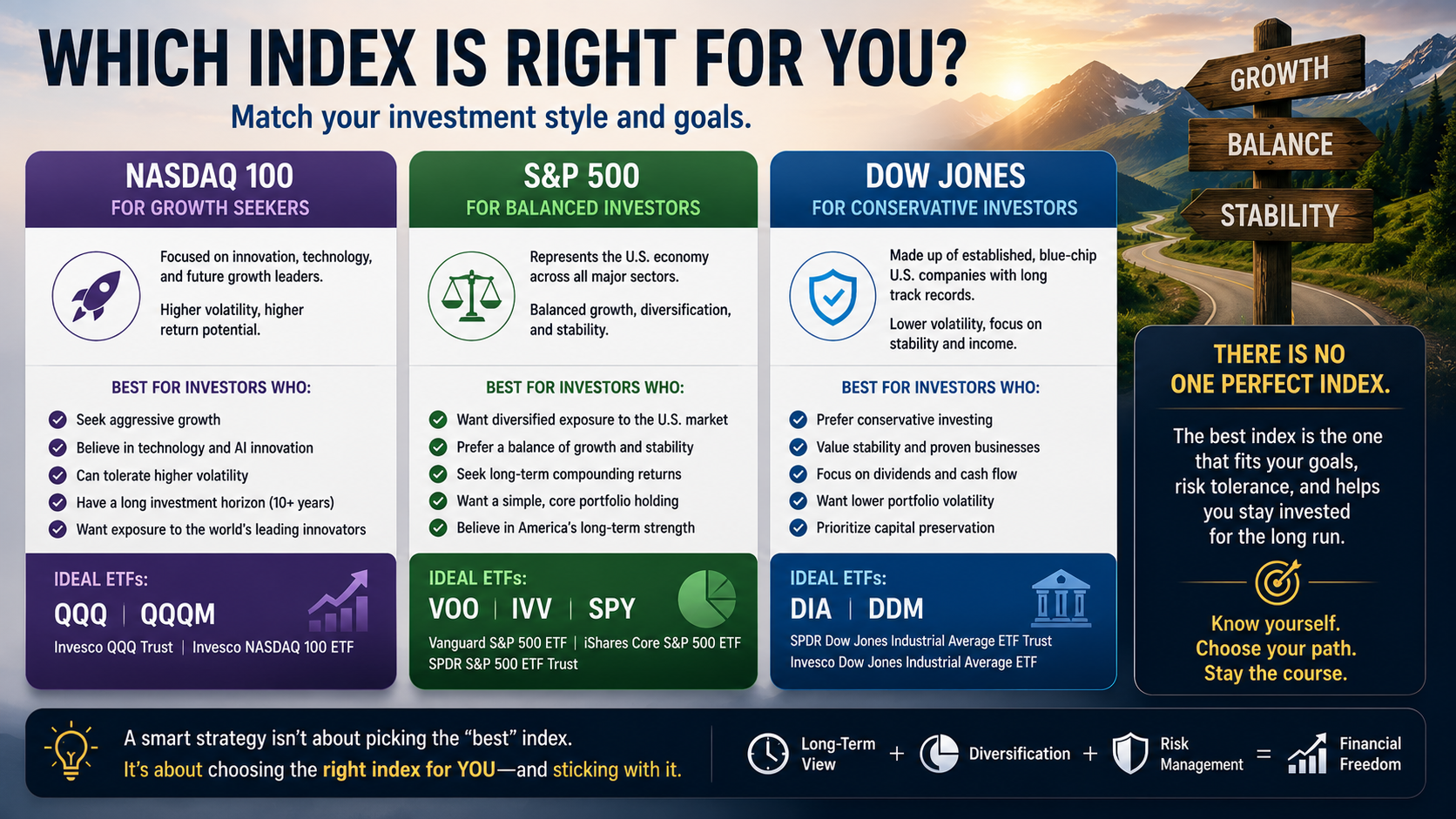
Nasdaq 100
Best for investors who
- Seek aggressive growth
- Believe strongly in technology and AI
- Can tolerate higher volatility
- Have a long investment horizon
S&P 500
Best for investors who
- Want balanced exposure to the U.S. economy
- Prefer diversification
- Seek a combination of growth and stability
- Want a simple long-term investment solution
Dow Jones
Best for investors who
- Prefer conservative investing
- Value stability and dividend-paying companies
- Focus on cash flow and capital preservation
- Want lower portfolio volatility
Final Thoughts
Choosing the best index is not about finding the highest possible return.
It is about selecting an investment strategy that matches your risk tolerance, financial goals, and ability to stay invested during difficult periods.
The Nasdaq 100 represents innovation and growth.
The S&P 500 represents balance and diversification.
The Dow Jones represents stability and resilience.
Markets constantly price in the future, but one principle remains timeless
Capital ultimately flows toward assets with the strongest ability to survive and compound over time.
MasterMind's Take
Great investors are not those who perfectly predict the future.
They are the ones who build portfolios capable of surviving whatever the future brings.
This was MasterMind.
'[Global] Success Blueprints' 카테고리의 다른 글