What Is PPI? Why the Producer Price Index Moves Stocks, Interest Rates, and the Economy


Hello, this is MasterMind.
Whenever a major inflation report is released, financial markets often experience sharp volatility. Stocks surge or plunge, Treasury yields move aggressively, and investors immediately reassess the outlook for Federal Reserve policy.
While most people focus on CPI (Consumer Price Index), professional investors closely monitor another critical indicator - the Producer Price Index (PPI).
Why does Wall Street care so much about producer prices?
And why can a single PPI report reshape expectations for inflation, interest rates, and the stock market?
To answer these questions, we need to understand what PPI truly represents and why it sits at the beginning of the inflation pipeline.
What Is the Producer Price Index (PPI)?
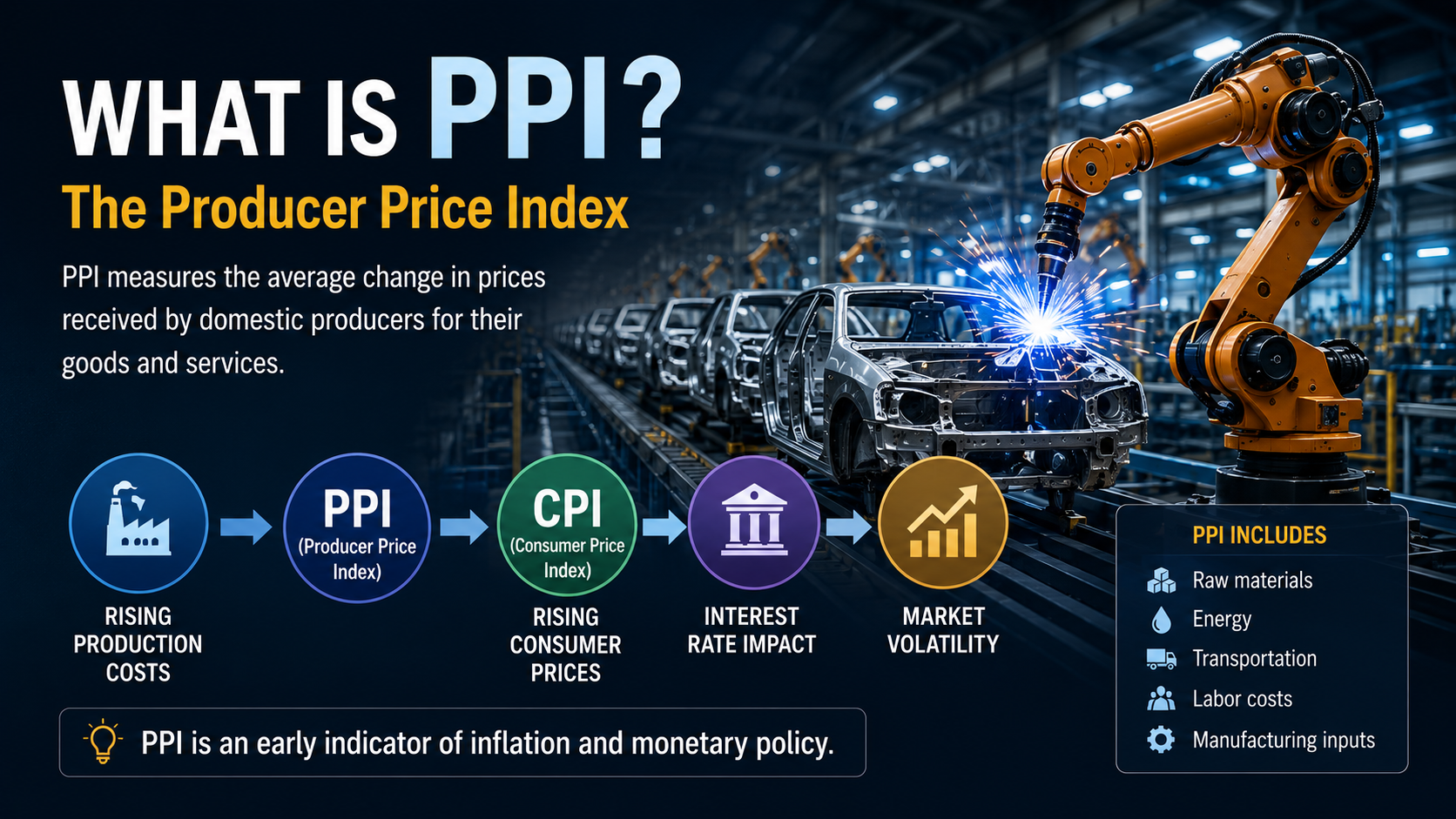
The Producer Price Index (PPI) measures the average change in prices received by domestic producers for their goods and services.
In simple terms, PPI tracks how much it costs businesses to produce products before they reach consumers.
These costs include
- Raw materials
- Energy prices
- Transportation expenses
- Labor costs
- Manufacturing inputs
For example, if steel prices rise significantly, automobile manufacturers face higher production costs.
Eventually, businesses must either absorb those costs or pass them on to consumers through higher prices.
This is why PPI is often viewed as a leading indicator of inflation.
The Real Meaning of PPI - The Starting Point of Inflation

Markets are forward-looking.
Investors are not interested in where inflation is today. They care about where inflation may be headed tomorrow.
The typical economic sequence looks like this
Higher Production Costs
→ Rising Producer Prices (PPI)
→ Rising Consumer Prices (CPI)
→ Persistent Inflation
→ Higher Interest Rates
→ Financial Market Volatility
Because PPI appears early in this chain, investors see it as an early warning system for future inflationary pressures.
This explains why hedge funds, institutional investors, and central bankers pay close attention to every PPI release.
The Key Forces Making PPI More Important Than Ever

1. Rising PPI Can Signal a New Inflation Wave
Financial markets fear one thing above all else - inflation returning after it appears to be under control.
When PPI comes in higher than expected, investors begin to worry that consumer inflation may accelerate in the coming months.
As a result, expectations for Federal Reserve rate cuts often decline.
A stronger-than-expected PPI report can therefore trigger higher Treasury yields and increased volatility in growth stocks.
2. Global Supply Chains Are Becoming More Expensive
For decades, globalization helped keep production costs low.
Companies could source materials and manufacture products wherever costs were cheapest.
That environment is changing.
Geopolitical tensions, supply chain restructuring, trade restrictions, and resource competition have increased production costs across many industries.
These structural changes have made producer prices more volatile and more important for investors to monitor.
3. PPI Influences Interest Rate Expectations
Today's financial markets are highly dependent on monetary policy.
A hotter-than-expected PPI report may suggest inflation remains sticky, forcing the Federal Reserve to keep interest rates higher for longer.
Conversely, a softer PPI reading can reinforce expectations that inflation is cooling, improving the likelihood of future rate cuts.
This is why Treasury yields, the U.S. dollar, and equity markets often react immediately after a PPI release.
4. It Reveals Which Companies Have Pricing Power
Not all businesses can survive rising costs equally well.
Some companies possess strong brands, dominant market positions, or unique products that allow them to raise prices without significantly reducing demand.
Others are forced to absorb higher costs, which damages profitability.
In this way, PPI acts as a stress test for corporate pricing power and business resilience.
Risks Investors Should Watch

Margin Squeeze
One of the biggest dangers of sustained producer inflation is margin compression.
When production costs rise faster than selling prices, corporate profits decline.
Industries with intense competition and limited pricing power are particularly vulnerable.
This can lead to earnings disappointments and weaker stock performance.
The Threat of Stagflation
Perhaps the greatest concern is stagflation.
Stagflation occurs when inflation remains elevated while economic growth slows.
This creates a difficult environment for policymakers.
Raise interest rates too aggressively, and economic activity weakens.
Cut rates too soon, and inflation may accelerate again.
If producer prices continue rising while growth slows, markets may begin pricing in stagflation risks across multiple asset classes.
What Are Wealthy Investors Watching?

Professional investors rarely focus on a single economic data point.
Instead, they focus on capital flows.
When producer inflation rises, money often shifts toward assets with stronger survival characteristics.
These include
- Companies with strong pricing power
- Businesses generating consistent cash flow
- Essential consumer goods providers
- Commodity-related assets
- Inflation-resistant investments
- Short-duration bonds and high-yield fixed income opportunities
The key question is not whether inflation will rise next month.
The key question is whether an asset can continue generating cash flow in a world where capital becomes more expensive.
Successful investors often ask themselves
- Can this company maintain profitability if production costs rise by 20%?
- Does this business have enough pricing power to protect margins?
- Can it continue generating reliable cash flow during periods of tighter liquidity?
Strong assets tend to survive even when liquidity disappears.
And the assets that survive are often the ones that outperform when the next expansion cycle begins.
Final Thoughts
The Producer Price Index is much more than a simple inflation report.
It represents the earliest stage of inflationary pressure within the economy and provides valuable clues about future consumer prices, interest rates, and monetary policy.
Markets react strongly to PPI because investors understand that inflation begins long before consumers notice higher prices.
Ultimately, understanding PPI means understanding where money may flow next.
Markets are driven not only by expectations but also by fear.
And today, one of the market's greatest fears remains the possibility of persistent inflation fueled by rising production costs.
In investing, survival matters more than prediction.
The goal is not to forecast every market move, but to own assets capable of enduring a wide range of economic environments.
This has been MasterMind.
'[Global] Success Blueprints' 카테고리의 다른 글