What Is the Fed Dot Plot? How to Read FOMC Interest Rate Projections


Hello, this is MasterMind.
Every time the Federal Reserve holds an FOMC meeting, financial headlines focus on one question:
"How many rate cuts are coming next?"
Markets react instantly. Stocks surge or fall, bond yields swing, and even Bitcoin can move sharply within minutes.
Yet many investors still don't fully understand one of the most important documents released by the Federal Reserve: the Dot Plot.
Why does a simple chart filled with dots have the power to move trillions of dollars across global markets?
The answer is simple.
Markets don't trade today's interest rates. They trade expectations about tomorrow's interest rates.
And the Fed's Dot Plot is one of the clearest windows into those expectations.
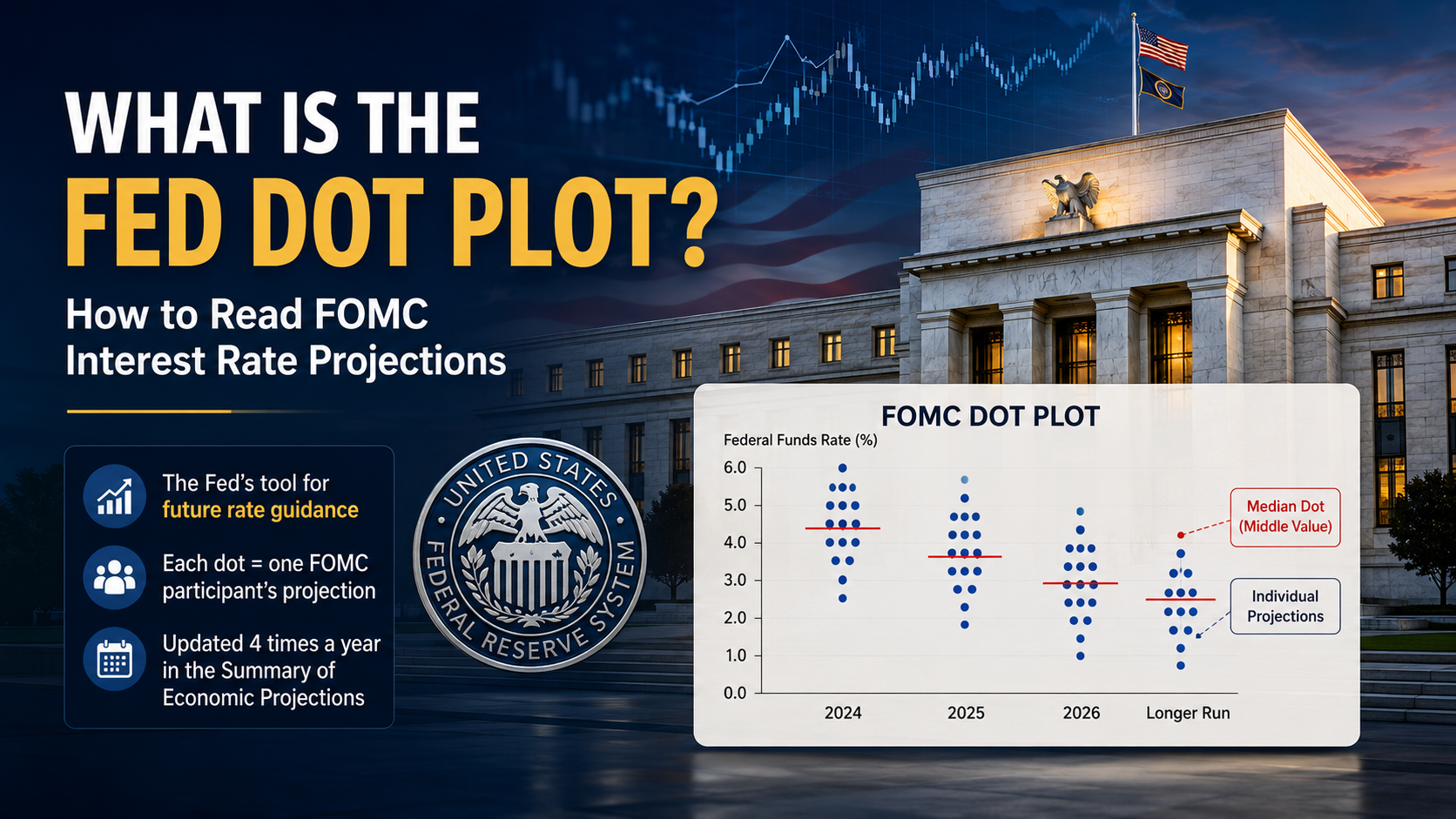
What Is the Fed Dot Plot?
The Fed Dot Plot is a chart that shows where Federal Reserve officials believe interest rates should be in the future.
Each dot represents the interest rate projection of a single FOMC participant.
Several times per year, Federal Reserve governors and regional Fed presidents submit their forecasts for future policy rates.
These projections are then displayed as anonymous dots on a chart.
In other words, the Dot Plot answers a critical question:
"Where does the Federal Reserve think interest rates are heading?"
For investors, that information matters because financial markets are forward-looking.
Stocks, bonds, currencies, and commodities respond less to current interest rates and more to expectations about future monetary policy.
Understanding the Structure of the Dot Plot

The Dot Plot is surprisingly simple.
The vertical axis represents the federal funds rate.
The horizontal axis represents different years, including:
- Current Year
- Next Year
- Following Year
- Longer Run
Each dot represents one policymaker's view of the appropriate interest rate at the end of that period.
For example, if most dots cluster around 3.75%, it suggests that many Fed officials believe rates should be near that level.
However, the real value comes from analyzing patterns rather than individual dots.
The Three Most Important Signals Investors Watch
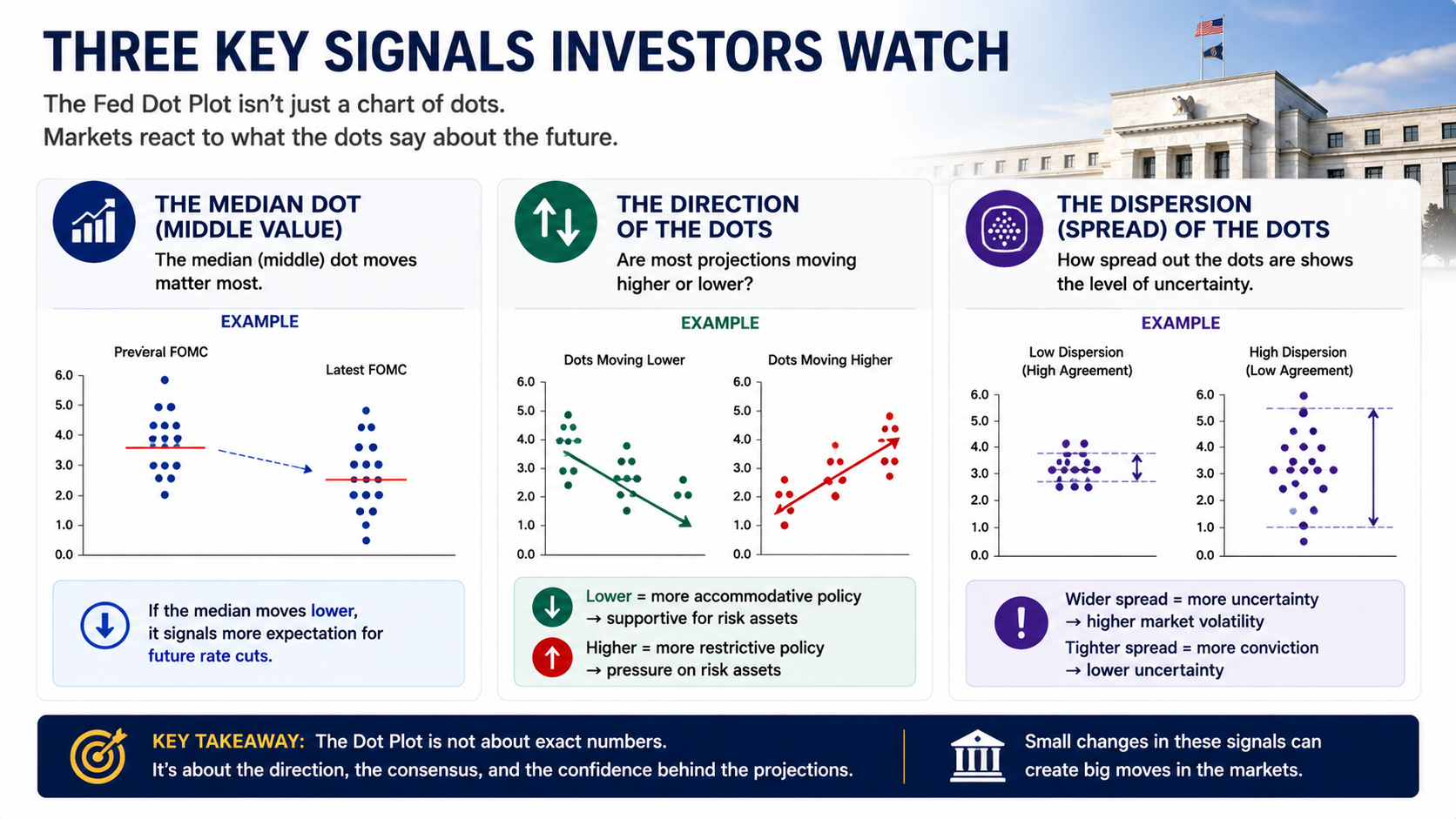
1. The Median Dot
The median projection is often the most important number in the entire chart.
While many investors focus on averages, professional investors typically focus on the median because it represents the Fed's overall center of gravity.
If the median projection moves lower, it suggests the Federal Reserve is becoming more supportive of future rate cuts.
If it moves higher, it may indicate that policymakers expect inflation to remain stubborn and rates to stay elevated for longer.
This single shift can dramatically change market expectations.
2. Are the Dots Moving Higher or Lower?
The overall direction of the dots matters.
When projections shift downward, the market generally interprets it as a signal that monetary policy could become more accommodative.
This tends to support:
- Growth stocks
- Technology companies
- Nasdaq-related investments
- Risk assets such as cryptocurrencies
On the other hand, upward shifts often suggest tighter financial conditions and a longer period of higher interest rates.
That can put pressure on highly valued growth assets.
3. How Spread Out Are the Dots?
One of the most overlooked aspects of the Dot Plot is dispersion.
When dots are tightly clustered, it indicates broad agreement among policymakers.
Markets generally prefer this because it reduces uncertainty.
When dots are widely scattered, it signals disagreement within the Federal Reserve.
That uncertainty often translates into higher market volatility.
In many cases, the spread of the dots can be just as important as the median itself.
Why Investors Should Be Careful
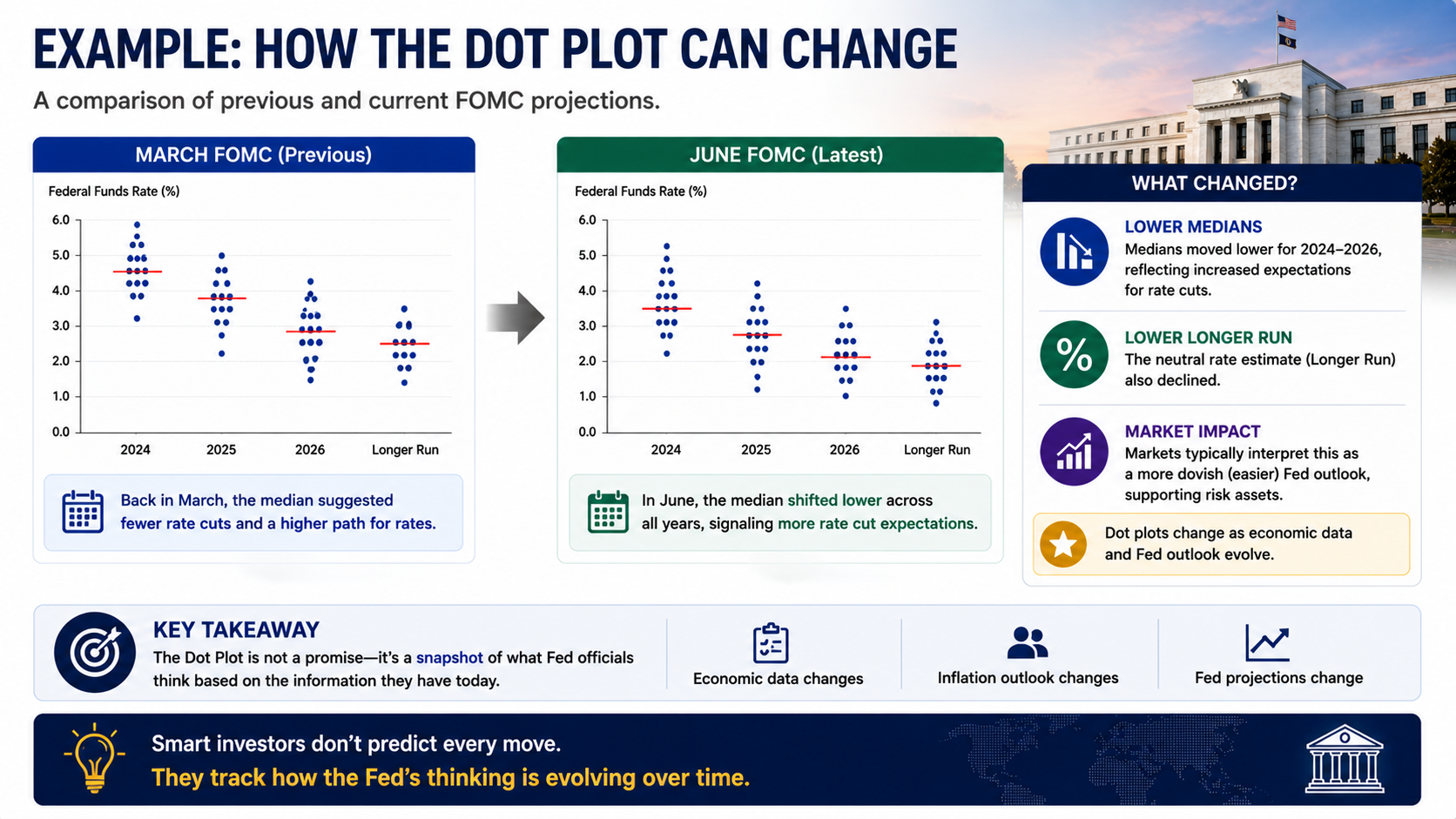
One of the biggest mistakes investors make is treating the Dot Plot as a promise.
It is not.
The Dot Plot is simply a snapshot of what policymakers believe at a specific point in time.
Economic conditions change.
Inflation changes.
Labor markets change.
Consumer spending changes.
As a result, Fed projections can change significantly from one meeting to the next.
The most successful investors don't focus on whether the Fed is exactly right.
Instead, they focus on how the Fed's thinking is evolving over time.
Markets react not only to the projections themselves but also to how those projections differ from expectations.
Sometimes a rate-cut forecast can still trigger a market decline if investors were expecting even more aggressive easing.
What Wealthy Investors Really Watch
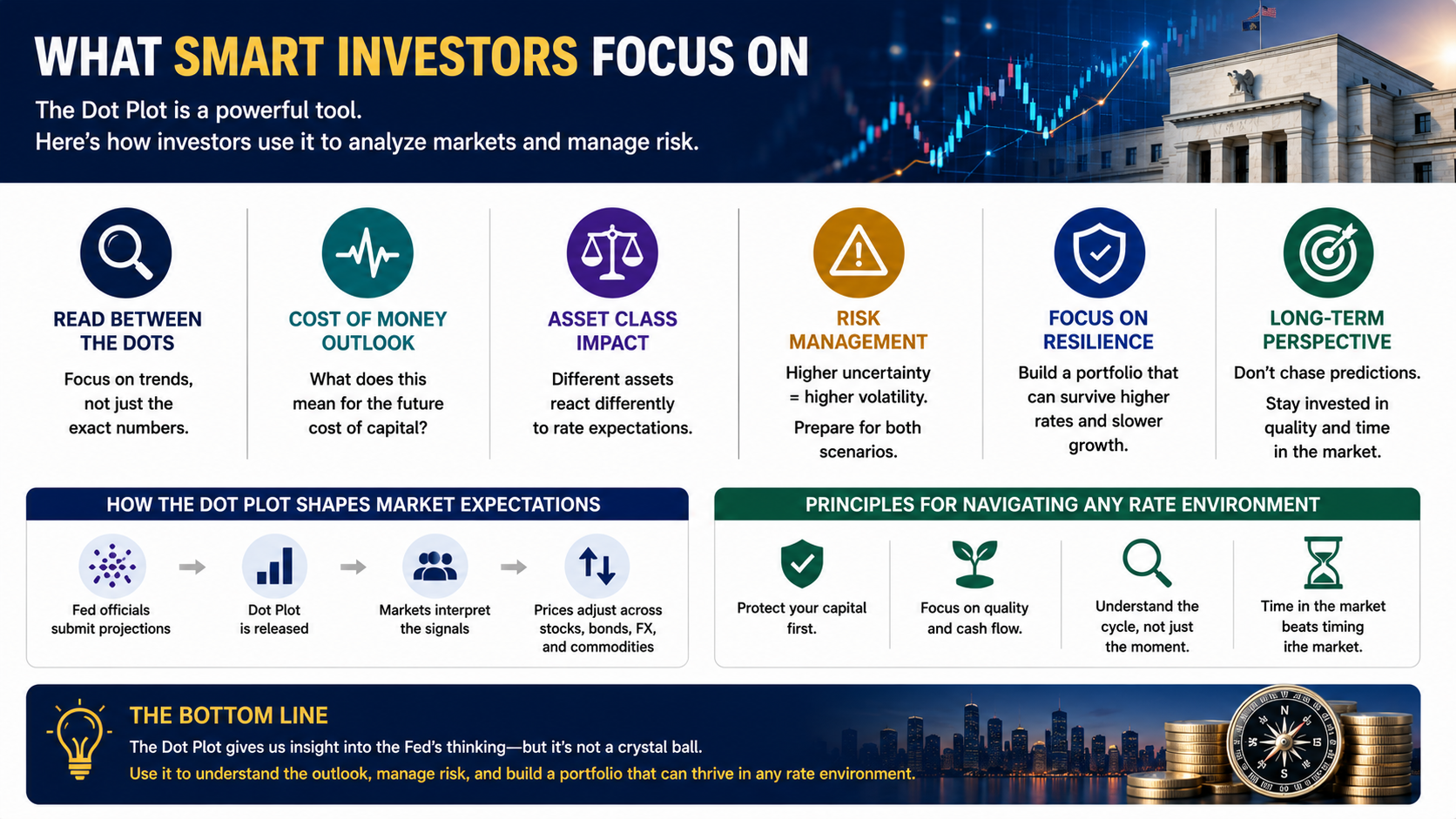
Sophisticated investors rarely obsess over the exact number of projected rate cuts.
Instead, they focus on capital flows.
They ask a different question:
"What does this tell us about the future cost of money?"
One area they watch closely is the "Longer Run" section of the Dot Plot.
This represents the Fed's estimate of the long-term neutral interest rate — a level that neither stimulates nor restricts economic growth.
If that neutral rate gradually rises, it may suggest that the era of ultra-low interest rates is ending.
That shift could have major implications for:
- Equity valuations
- Real estate prices
- Bond markets
- Corporate financing costs
Rather than chasing predictions, wealthy investors focus on resilience.
They constantly evaluate:
- Can my portfolio survive higher rates?
- Do my investments generate sustainable cash flow?
- Am I relying too heavily on cheap debt?
- Which assets remain strong even when liquidity declines?
Markets eventually separate strong assets from weak ones.
When liquidity is abundant, almost everything rises.
When liquidity tightens, true quality becomes visible.
Final Thoughts
The Fed Dot Plot is much more than a chart filled with dots.
It provides valuable insight into how policymakers view inflation, economic growth, and future interest rates.
The median projection helps investors identify the likely direction of monetary policy.
The dispersion of dots reveals the level of uncertainty within the Federal Reserve.
And the Longer Run estimate offers clues about the future cost of capital.
The next time an FOMC meeting concludes, don't just read the headlines.
Look at the Dot Plot itself.
Because markets don't trade the present.
They trade the future.
And understanding the Dot Plot can help investors prepare for that future rather than simply react to it.
MasterMind's Take
Most investors focus on one question:
"How many rate cuts are coming?"
The better question is:
"What happens if the market's expectations are wrong?"
Successful investing is not about predicting every move.
It's about building a portfolio that can survive regardless of what happens next.
Master Mind.
'[Global] Success Blueprints' 카테고리의 다른 글