How to Invest in Gold in 2026 Comparing Physical Gold Gold ETFs and Gold Savings Accounts


Hello, this is MasterMind.
Whenever economic uncertainty rises, investors around the world tend to turn their attention to one asset - gold.
From inflation fears and rising government debt to geopolitical conflicts and market volatility, gold has maintained its reputation as one of the most trusted safe-haven assets in history.
But here's the real question
Should you buy physical gold, invest through ETFs, open a gold account, or gain exposure through mining stocks?

Many investors focus solely on gold prices while overlooking a much more important factor—the investment vehicle itself.
The way you invest in gold can significantly affect your costs, taxes, liquidity, and ultimately your long-term returns.
Today, we'll break down the most popular ways to invest in gold and examine which approach may fit different types of investors.
Why Gold Still Matters in Today's Market
Gold is unique because it is neither a company's stock nor a government's liability.
Unlike fiat currencies, it cannot be printed endlessly.
Unlike bonds, it carries no default risk.
And unlike stocks, it does not depend on corporate earnings.
This is why gold tends to attract capital during periods of uncertainty.
When investors become concerned about inflation, currency debasement, financial instability, or geopolitical tensions, gold often becomes a destination for defensive capital.
Gold does not generate income.
It pays no dividends and offers no interest.
Yet wealthy investors continue to hold it because gold serves a different purpose.
Its primary role is not wealth creation.
Its role is wealth preservation.
Markets constantly price future expectations.
And when markets become fearful, gold often benefits from that fear.
Key Forces Driving Gold Demand
1. Central Banks Are Buying More Gold
Over the past several years, central banks around the world have been increasing their gold reserves.
Many countries are seeking to diversify away from excessive dependence on the U.S. dollar.
This trend represents long-term institutional demand and provides structural support for gold prices.
2. Inflation and Currency Debasement
Government debt levels continue to rise globally.
As fiscal spending expands, concerns about long-term currency purchasing power also increase.
Gold has historically been viewed as a hedge against monetary inflation and currency depreciation.
3. Geopolitical Uncertainty
Wars, trade disputes, sanctions, and supply-chain disruptions create uncertainty across financial markets.
During these periods, investors often seek assets perceived as stores of value.
Gold remains one of the most recognized safe-haven assets worldwide.
4. Market Psychology
Gold is not driven solely by supply and demand.
It is also influenced by investor sentiment.
When fear dominates markets, demand for defensive assets tends to increase.
Gold often acts as a reflection of that fear.
Comparing the Most Popular Gold Investment Methods
| Investment Type | Physical Ownership | Liquidity | Costs | Income Generation | Best For |
| Physical Gold | Yes | Medium | Higher | No | Wealth Preservation |
| Gold ETFs | No | Very High | Low | No | Convenience |
| Gold Accounts | No | High | Medium | No | Small Investors |
| Gold Mining Stocks | No | Very High | Low | Possible Dividends | Growth-Oriented Investors |
1. Physical Gold (Bullion and Coins)
Physical gold remains the purest form of ownership.
Investors can purchase gold bars or coins and hold them directly.
Advantages
- Direct ownership of a tangible asset
- No counterparty risk
- Acts as a long-term store of value
Disadvantages
- Storage and insurance costs
- Wider buy-sell spreads
- Less convenient to trade quickly
Physical gold appeals to investors who prioritize security and long-term wealth preservation over convenience.
2. Gold ETFs
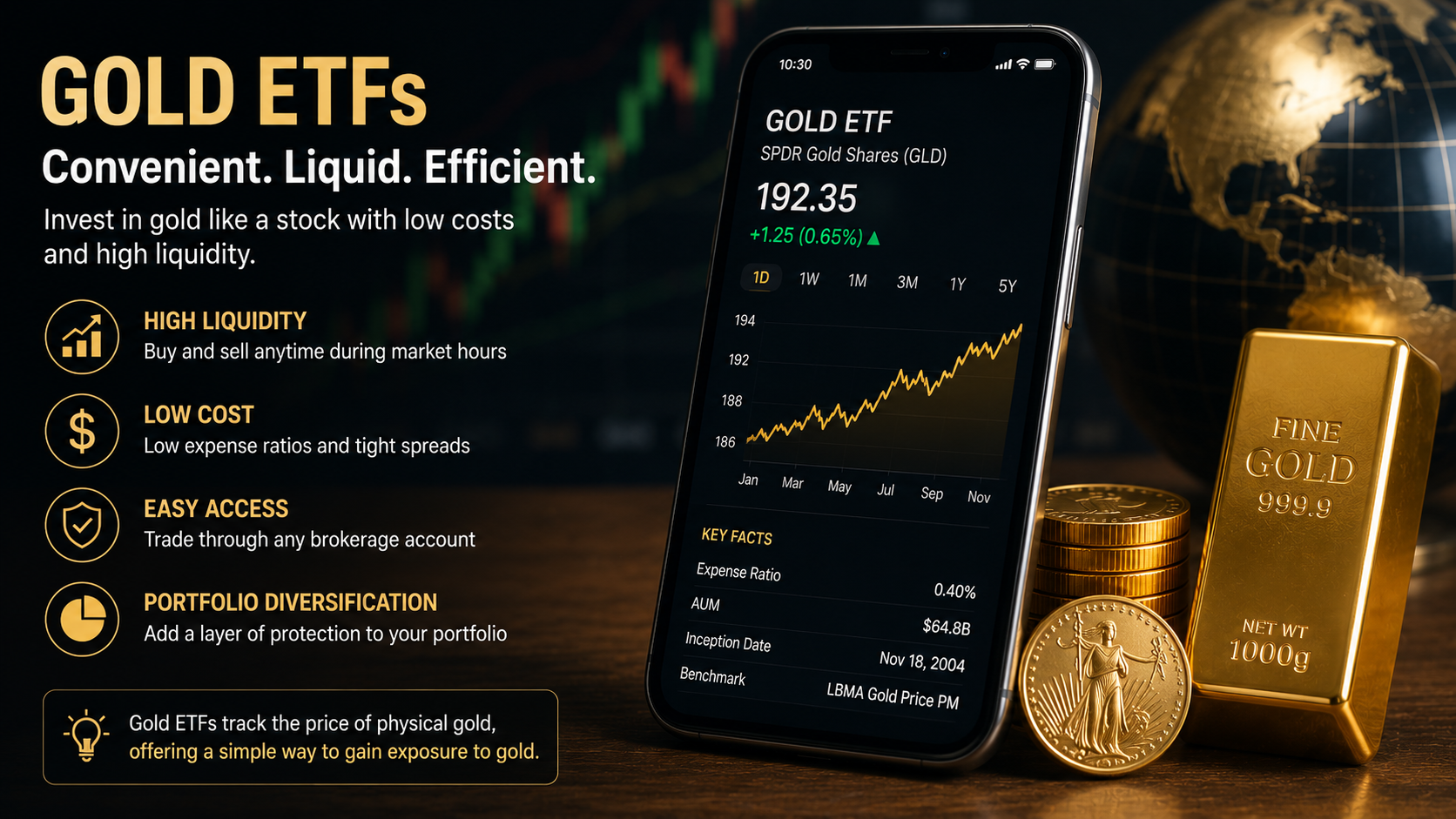
Gold ETFs have become one of the most popular ways to gain exposure to gold prices.
These funds trade like stocks and generally track the price of physical gold.
Advantages
- Extremely liquid
- Easy to buy and sell
- Low transaction costs
- Suitable for retirement and brokerage accounts
Disadvantages
- No direct ownership of gold
- Annual management fees
- Potential tracking differences over long periods
For most retail investors, gold ETFs offer the simplest and most efficient way to gain gold exposure.
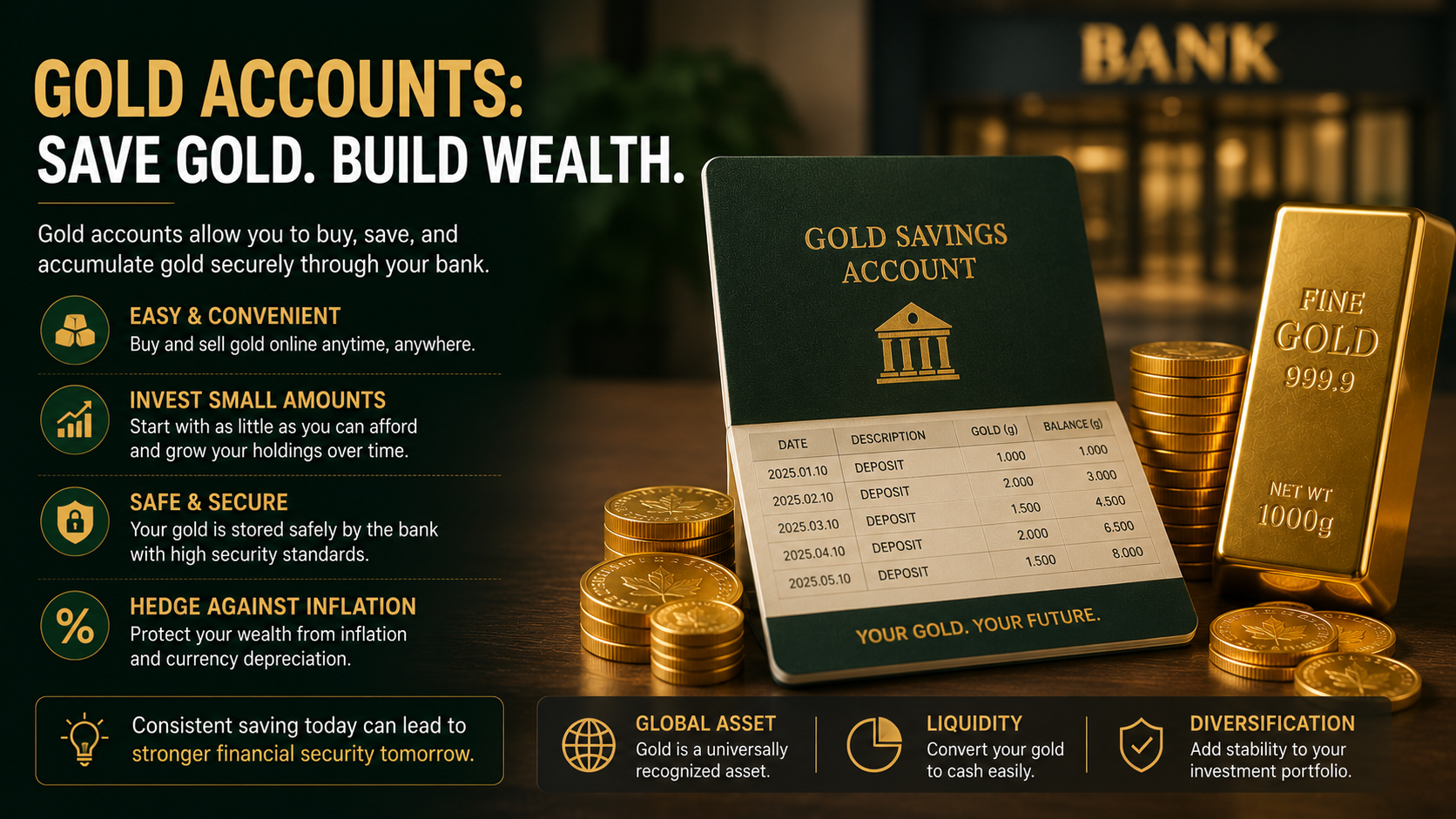
3. Gold Accounts

Many banks offer gold savings or gold accumulation accounts.
Instead of purchasing physical bullion, investors accumulate fractional ownership linked to gold prices.
Advantages
- Easy access
- Suitable for small monthly contributions
- No storage concerns
Disadvantages
- Higher spreads
- Limited flexibility compared to ETFs
- Potential fees depending on the institution
These accounts can work well for beginners who want to build gold exposure gradually.
4. Gold Mining Stocks
Investing in gold mining companies provides indirect exposure to gold prices.
Examples include major global miners and royalty companies.
Advantages
- Potential dividend income
- Opportunity for higher returns than gold itself
- Easy access through stock markets
Disadvantages
- Company-specific risks
- Operational and management risks
- Performance may diverge from gold prices
Mining stocks are often favored by investors seeking growth rather than pure capital preservation.
Risks Every Gold Investor Should Understand
Gold Produces No Cash Flow
Unlike stocks, bonds, or real estate, gold does not generate income.
Its value depends entirely on future market demand.
Rising Interest Rates Can Pressure Gold
When real interest rates rise, income-producing assets become more attractive relative to gold.
This can create headwinds for gold prices.
Gold Can Experience Long Periods of Stagnation
Many investors assume gold always rises during uncertain times.
However, gold has historically gone through multi-year periods of flat or negative returns.
Investors should be prepared for patience.
What Do Wealthy Investors See in Gold?
The wealthy rarely view gold as a tool for getting rich.

Instead, they see it as portfolio insurance.
They understand that every portfolio needs assets designed to survive unfavorable scenarios.
They Focus on Capital Preservation
Protecting purchasing power often becomes more important than maximizing returns.
They Think in Terms of Diversification
Most wealthy investors allocate only a portion of their portfolio to gold.
They avoid concentration and maintain exposure to productive assets alongside defensive assets.
They Pay Attention to Capital Flows
They watch where institutions, central banks, and large pools of capital are moving.
Understanding money flows often reveals emerging risks before they become obvious.
Questions Every Investor Should Ask
- Am I buying gold for speculation or protection?
- What percentage of my portfolio should be defensive assets?
- Could I hold this position if gold prices remained flat for years?
- Do I have enough income-producing assets alongside gold?
The market often rewards those who prepare before uncertainty arrives.
Final Thoughts
Gold is not a magic asset that creates wealth overnight.
It is a tool for preserving purchasing power and protecting portfolios during periods of instability.
For most investors, Gold ETFs provide the best balance of simplicity, liquidity, and cost efficiency.
Physical gold may appeal to those focused on long-term wealth preservation, while gold accounts and mining stocks serve different strategic purposes.
The key is not choosing the "best" gold investment.
The key is selecting the approach that aligns with your goals, risk tolerance, and investment horizon.
MasterMind's Take
Markets constantly change, but one principle remains the same
Successful investors focus less on predicting the future and more on surviving uncertainty.
Gold is not about getting rich quickly.
It is about ensuring that your wealth can endure when the unexpected happens.
MasterMind.
'[Global] Success Blueprints' 카테고리의 다른 글