Why Good Economic News Can Be Bad for Stocks


Hello, this is MasterMind.
A strong economy should be good news for everyone.
More jobs, stronger consumer spending, and rising corporate profits usually signal healthy economic growth.

So why does Wall Street sometimes panic when economic data comes in stronger than expected?
Why do stocks fall after what appears to be good news?
The answer lies in one of the biggest market paradoxes of our time.
Today, we'll explore why a strong economy can create fear in financial markets and what investors should be paying attention to right now.
What Does a Strong Economy Really Mean?
A strong economy typically means people are finding jobs, wages are growing, and consumers are spending money.
As spending increases, businesses generate more revenue and expand their operations.
This creates a positive cycle of growth that benefits both companies and households.
On the surface, the U.S. economy looks remarkably resilient.
The labor market remains strong, consumer spending is holding up, and corporate earnings have been better than many expected.
But financial markets do not trade the present.
Markets trade the future.
And right now, investors are less concerned about today's economic strength and more concerned about what that strength might lead to next.
The Three Market Paradoxes Driving Wall Street
1. A Strong Economy Can Reignite Inflation
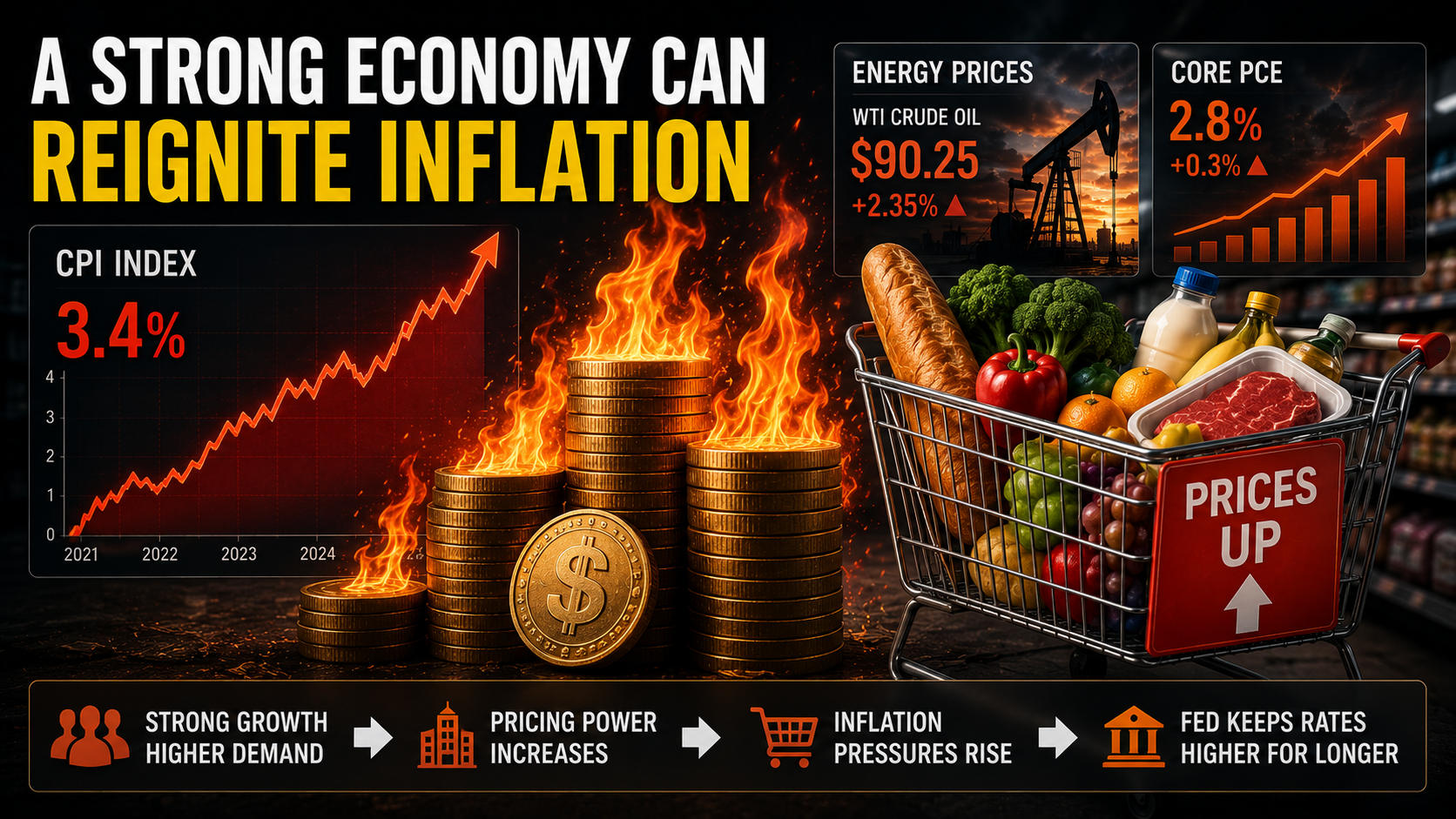
When economic activity accelerates, consumer demand tends to increase.
As demand rises, businesses gain greater pricing power.
If demand grows faster than supply, inflation can begin rising again.
This is exactly what the Federal Reserve wants to avoid.
Over the past several years, inflation has been one of the biggest challenges facing the U.S. economy.
Any signs of renewed inflation could force policymakers to maintain restrictive monetary policies for longer than expected.
In addition, geopolitical tensions and energy price volatility continue to pose inflation risks that investors cannot ignore.
2. Rate Cut Expectations Get Delayed
Interest rates remain one of the most important variables in today's market.
When economic data comes in stronger than expected, the Federal Reserve has less urgency to lower rates.
In fact, strong economic growth often increases the likelihood that rates will remain elevated for an extended period.
This is commonly known as the "Higher for Longer" scenario.
The problem is that much of the market's optimism has been built around expectations of future rate cuts.
If those expectations get pushed further into the future, investors must reassess valuations, growth assumptions, and risk appetite.
This is where strong economic news can become a challenge for markets.
3. When Good News Becomes Bad News
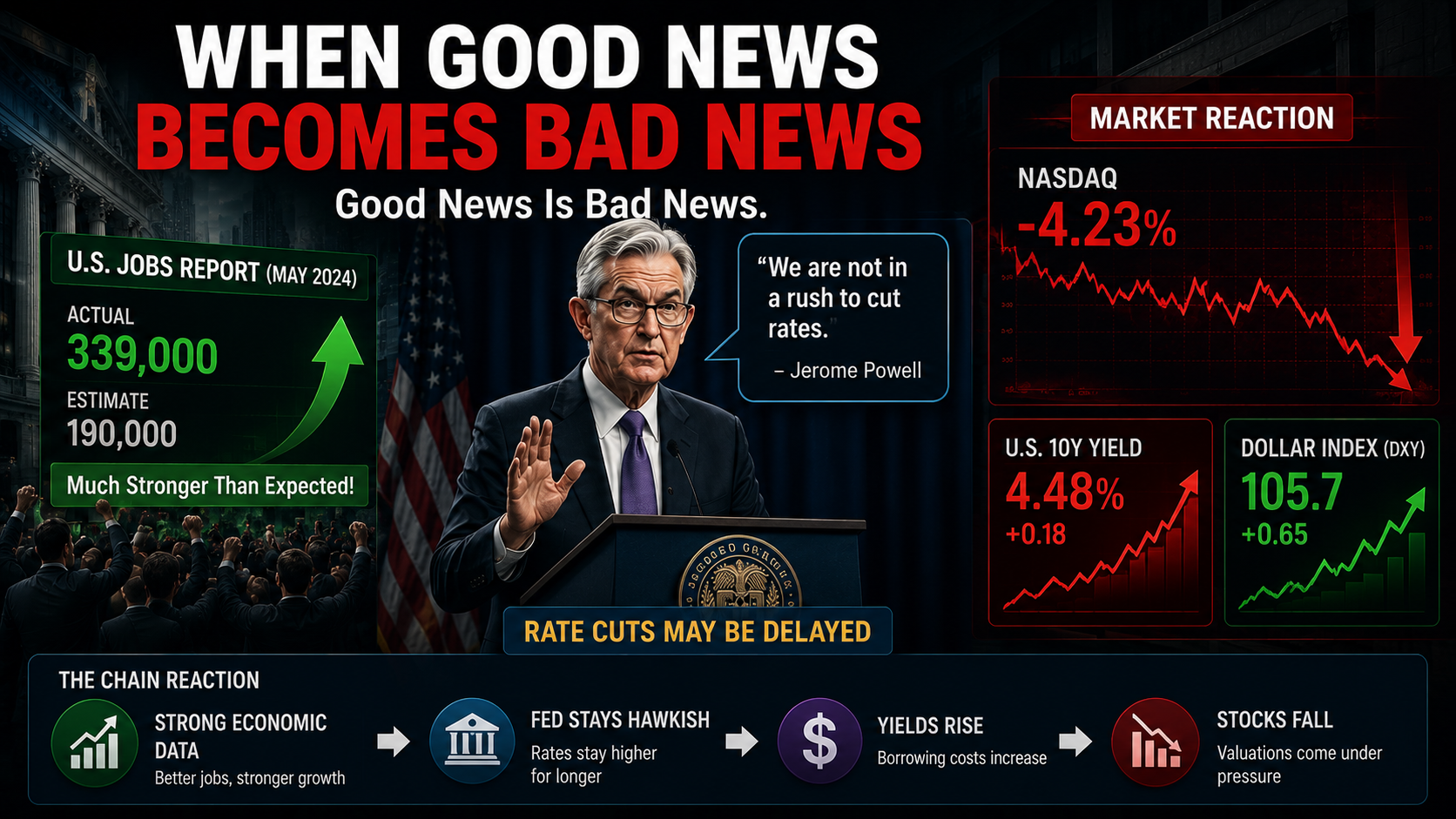
This is perhaps the most fascinating paradox in modern investing.
When strong economic data is released, investors are no longer asking:
"Is the economy healthy?"
Instead, they ask:
"Will the Fed keep rates higher for longer?"
"Will rate cuts be delayed?"
"Could liquidity become tighter?"
The focus immediately shifts from economic strength to monetary policy.
At that moment, good news for the economy can become bad news for the market.
This phenomenon is often referred to as:
Good News Is Bad News.
And it has become one of the defining themes of today's market environment.
What Recently Happened on Wall Street?
This concept is not just theory.
Recent U.S. employment data delivered a much stronger-than-expected result, highlighting the resilience of the American economy.
Normally, such news would be viewed as highly positive.
However, investors quickly focused on the implications for Federal Reserve policy.
A stronger labor market suggested that inflation pressures could remain elevated and that interest rate cuts might be delayed.
As a result, Treasury yields moved higher and pressure increased on growth stocks and other risk-sensitive assets.
The market was not reacting to economic strength itself.
It was reacting to what that strength could mean for future monetary policy.
Risks Investors Should Watch Carefully

When interest rates stay elevated for an extended period, liquidity becomes more restrictive.
This creates challenges across multiple asset classes.
Growth Stocks and Technology Companies
High-growth companies are particularly sensitive to interest rates.
Higher borrowing costs can slow expansion plans and reduce future earnings expectations.
Bitcoin and Risk Assets
Bitcoin and other speculative assets often benefit from abundant liquidity.
When liquidity tightens, investors tend to reduce exposure to riskier investments.
Increased Market Volatility
In today's environment, a single economic report can significantly alter market expectations.
This increases uncertainty and creates larger market swings.
Ultimately, the key question is not the economic data itself.
The real question is how that data changes expectations for Federal Reserve policy.
What Are Wealthy Investors Watching?

Smart money investors rarely focus only on whether the economy is good or bad.
Instead, they pay close attention to where capital is flowing.
In a higher-rate environment, cash becomes more valuable.
Businesses with strong cash flow and healthy balance sheets often outperform companies that depend heavily on external financing.
Wealthy investors typically focus on three critical questions:
Can this asset survive in a higher-rate environment?
Does it generate consistent cash flow?
Can it remain resilient if liquidity conditions tighten further?
Investing is not simply about predicting the future.
It is about surviving long enough to benefit from future opportunities.
Strong assets tend to survive even when liquidity becomes scarce.
And survival often determines who wins during the next market cycle.
Final Thoughts
The U.S. economy remains remarkably strong.
Employment is healthy.
Consumers continue spending.
Businesses are still growing.
Yet financial markets remain nervous.
Why?
Because markets are looking ahead.
A strong economy can fuel inflation.
Inflation can delay interest rate cuts.
Delayed rate cuts can reduce liquidity and pressure financial assets.
In the end, investors are not afraid of a strong economy itself.
They are afraid of what a strong economy might force the Federal Reserve to do next.
MasterMind Insight
Markets do not trade today's reality.
They trade tomorrow's expectations.
Good news is not always good for investors.
Understanding where money is flowing is often more important than understanding today's headlines.
The market's greatest fears often matter more than its greatest hopes.
And in investing, survival is more important than prediction.
This was MasterMind.
'[Global] Success Blueprints' 카테고리의 다른 글