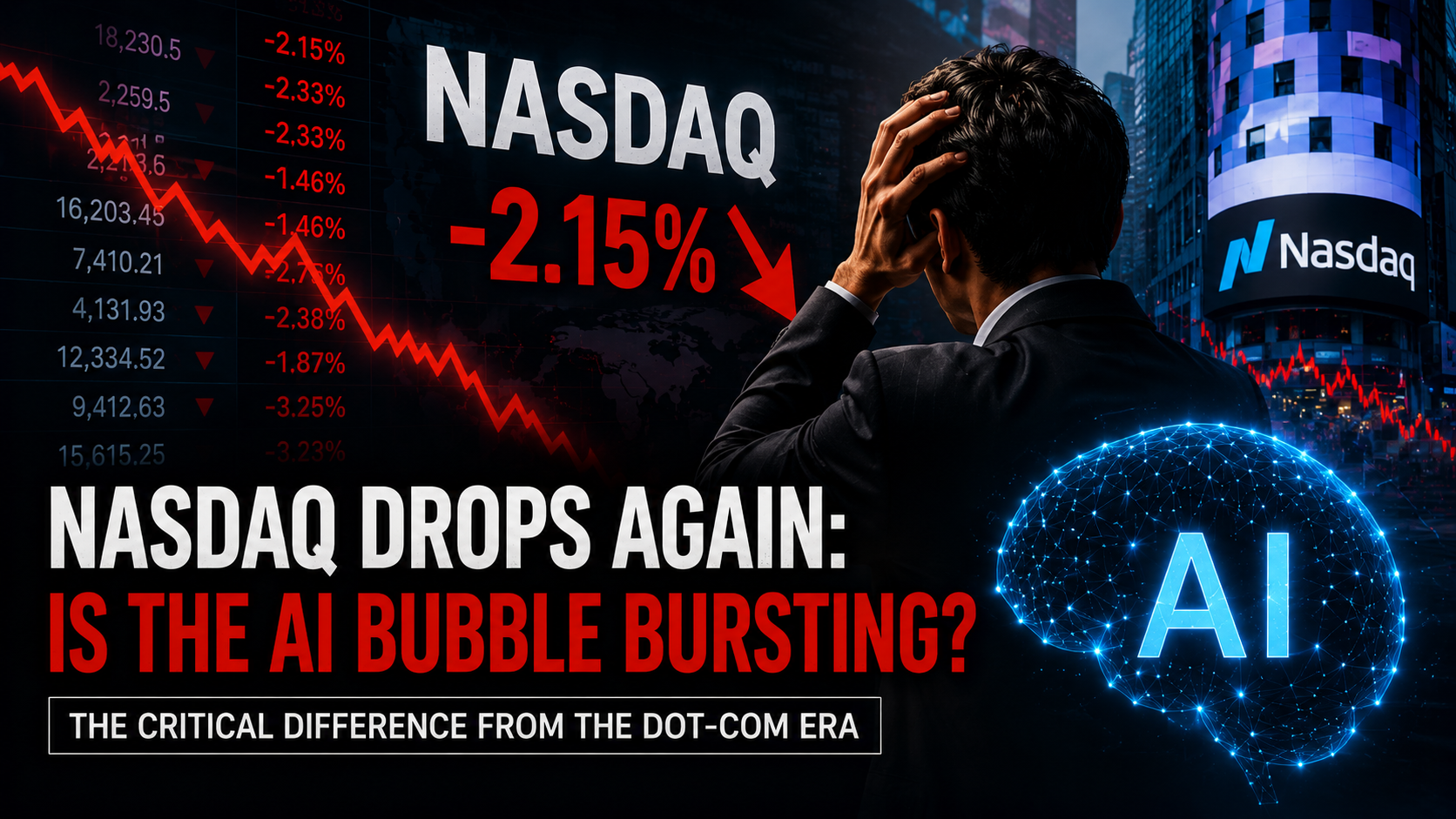
Nasdaq Drops Again: AI Bubble or Buying Opportunity?


Hello, this is MasterMind.
As the Nasdaq experiences renewed volatility and AI-related stocks face sharp pullbacks, investors are asking a familiar question.
Is artificial intelligence becoming another dot-com bubble?
Or are we witnessing the early stages of the biggest technological revolution since the internet?
To answer that question, we need to look beyond short-term price movements and focus on what truly drives markets expectations, capital flows, and economic fundamentals.
Markets always price in the future.
And more often than not, what markets fear matters more than what they hope for.
Today, the market's biggest concern is not whether AI works.
The real concern is whether expectations have run too far ahead of reality.
The Most Important Lesson From the Dot-Com Bubble

During the late 1990s, investors were absolutely right about one thing.
The internet would change the world.
And it did.
The mistake wasn't the technology.
The mistake was valuation.
Companies with no profits, weak business models, and little revenue were rewarded with massive market capitalizations simply because they had a ".com" attached to their name.
Eventually, reality caught up.
When earnings failed to justify expectations, the bubble burst.
Thousands of companies disappeared.
Yet the internet itself survived and transformed the global economy.
That distinction matters.
The bubble failed.
The innovation did not.
Today, investors are asking whether AI will follow a similar path.
Three Key Differences Between AI and the Dot-Com Bubble
1. The Leaders Are Already Generating Massive Cash Flow
One of the biggest differences between today and 2000 is the quality of the companies leading the trend.
The dot-com era was filled with businesses that promised future profits.
The AI era is being led by companies already producing enormous profits today.
NVIDIA, Microsoft, and Meta generate billions of dollars in free cash flow every quarter.
These companies are not relying solely on investor optimism.
They are funding AI expansion with real earnings.
Markets ultimately reward results, not stories.
And AI is increasingly producing measurable results.
This is perhaps the most important distinction between today's AI boom and the dot-com bubble.
2. AI Is Becoming Infrastructure
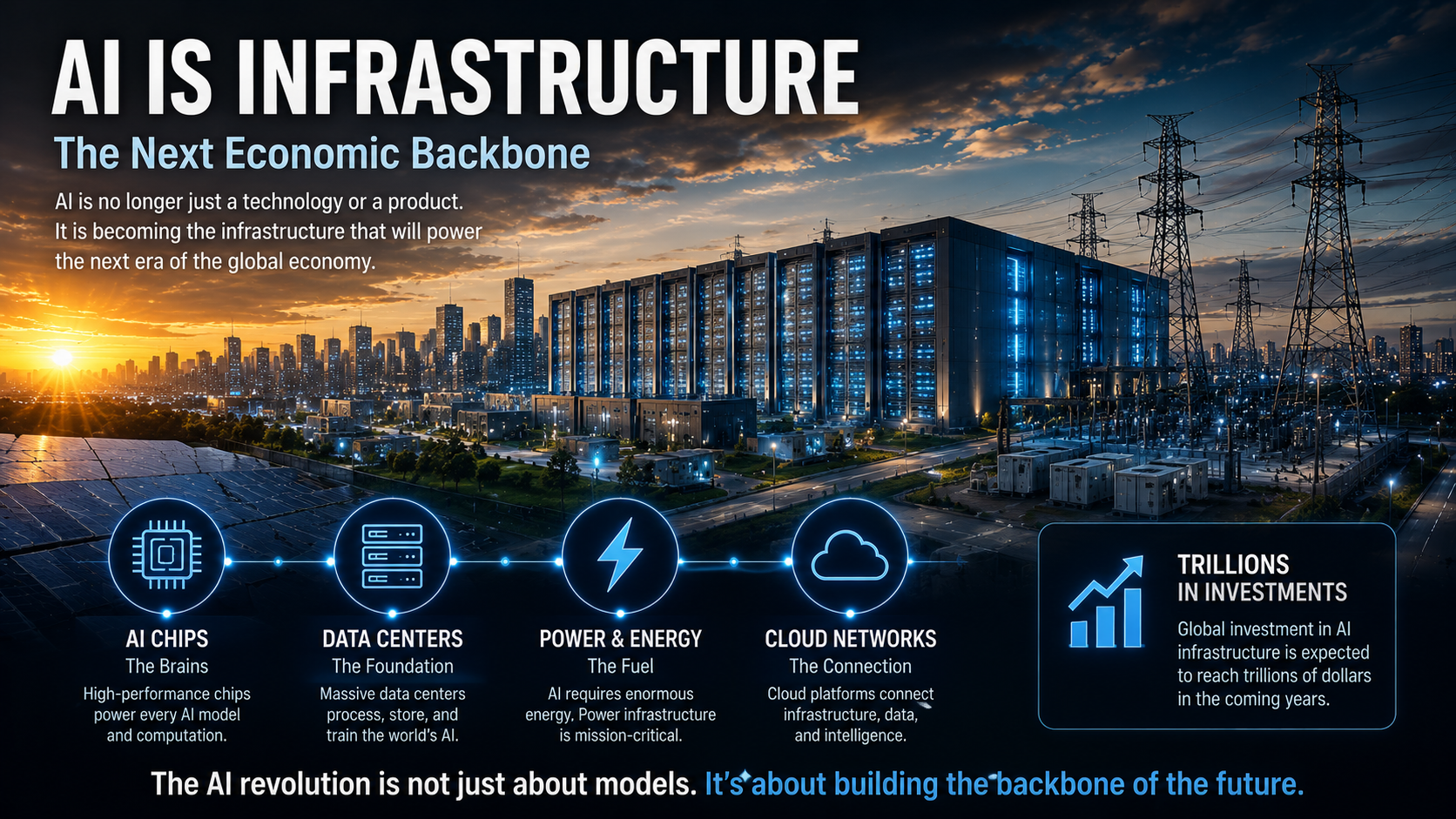
History shows that the technologies with the greatest long-term impact eventually become infrastructure.
Railroads.
Electricity.
The Internet.
Smartphones.
All started as innovations.
Eventually, they became necessities.
AI appears to be following the same path.
Many people still think of AI as a software product.
But the investment activity happening behind the scenes tells a different story.
Technology companies are spending hundreds of billions of dollars building data centers.
Demand for advanced AI chips continues to surge.
Power generation and grid expansion have become strategic priorities.
This isn't simply a race to build better software.
It is a race to build the infrastructure of the future economy.
Industry analysts expect trillions of dollars to be invested in AI infrastructure over the coming years.
That level of capital commitment suggests something far larger than a temporary trend.
3. Investment Continues Despite Economic Slowdown Fears
Global economic growth remains uncertain.
Higher interest rates and recession concerns continue to weigh on markets.
Yet major technology companies are accelerating AI spending.
Why?
Because falling behind may be more dangerous than overspending.
The companies leading today's AI race understand that market leadership is often determined years before the profits fully materialize.
AI investment is not being viewed as an expense.
It is being viewed as a strategic necessity.
Companies are willing to sacrifice short-term margins to secure long-term dominance.
That tells us a great deal about how seriously they view the opportunity.
The AI Infrastructure War Is Just Beginning
Many investors focus on AI models.
But the real battle may be happening underneath the surface.
The railroad era was won by those who built the tracks.
The internet era was won by those who controlled the networks.
The AI era may be won by those who control the infrastructure.
Data centers.
Semiconductors.
Power generation.
Cloud computing.
These assets form the foundation upon which AI applications operate.
Building large-scale AI infrastructure requires extraordinary capital.
Only a small number of companies possess the resources necessary to compete at that level.
As a result, the biggest winners of the AI revolution may not necessarily be the companies with the most exciting products.
They may be the companies that own the most critical infrastructure.
Risks Investors Should Not Ignore
None of this means AI is risk-free.
Far from it.
Every major technological revolution creates winners and losers.
Railroads did.
The internet did.
AI will too.
One growing concern involves the speed at which AI investments can generate returns.
Markets are becoming increasingly focused on one question
When will all of this spending translate into sustainable profits?
Another risk is depreciation.
AI hardware evolves extremely quickly.
A cutting-edge server purchased today could become outdated within a few years.
That means companies may face continuous reinvestment requirements just to remain competitive.
Innovation alone is not enough.
Eventually, every investment must produce returns.
Markets celebrate innovation.
But they reward cash flow.
What Are Wealthy Investors Watching?

When volatility increases, experienced investors tend to become more selective.
Rather than chasing headlines, they focus on capital allocation and financial strength.
They ask questions such as
Can this company survive an economic downturn?
Does it generate sufficient cash flow?
Can it maintain a competitive advantage?
Will it still be standing if liquidity becomes scarce?
Strong assets survive difficult environments.
Weak assets depend on favorable conditions.
That distinction becomes incredibly important during periods of uncertainty.
Investors should ask themselves a simple question
Am I investing in expectations?
Or am I investing in actual business performance?
The answer could determine long-term results.
Final Thoughts
AI enthusiasm may become excessive at times.
Corrections are inevitable.
Volatility is part of every major innovation cycle.
But today's AI landscape is fundamentally different from the dot-com bubble.
The industry is led by companies with real earnings, strong balance sheets, and enormous cash flows.
More importantly, AI is increasingly becoming infrastructure rather than simply another technology trend.
Markets always look ahead.
Which means the most important question may not be
"Will the AI bubble burst?"

Instead, investors should ask
"Who will be the ultimate winners of the AI era?"
In investing, survival matters more than prediction.
Those who focus on cash flow, capital allocation, and long-term competitive advantages often emerge strongest when the dust settles.
This was MasterMind.
'[Global] Success Blueprints' 카테고리의 다른 글