HBM Explained: Why High Bandwidth Memory Is the Oil of the AI Era


The New Global Power Commodity
Hello, this is MasterMind.
Every industrial revolution has been powered by a critical resource.
The 19th century belonged to coal.
The 20th century ran on oil.
And now, as artificial intelligence reshapes the global economy, a new strategic resource is emerging.
It's called HBM (High Bandwidth Memory).
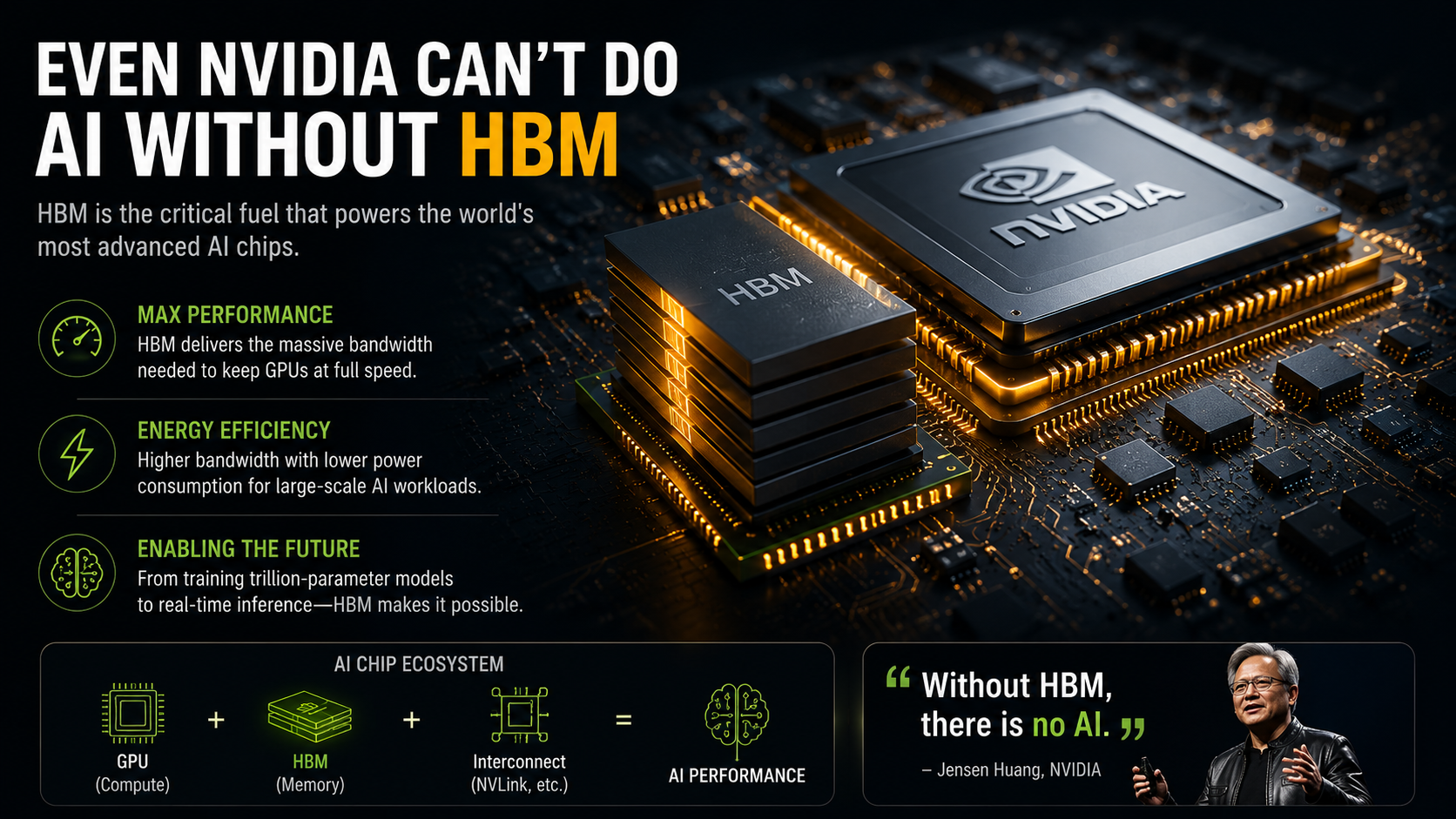
While NVIDIA has become the public face of the AI revolution, there is one component even NVIDIA cannot live without.
HBM.
In fact, many industry insiders have started saying:
"Without HBM, there is no AI."
That may sound dramatic, but the numbers tell a compelling story.
As AI models grow larger and data centers consume unprecedented amounts of computing power, HBM has quietly become one of the most valuable technologies in the world.
Just as oil fueled the industrial economy of the twentieth century, HBM is increasingly becoming the fuel of the AI economy.
So why is HBM suddenly so important?
And why are the world's largest technology companies racing to secure it?
Let's take a closer look.
The Real Bottleneck of AI Isn't Computing Power
Most people assume AI performance depends primarily on GPUs.
That was true during the early stages of the AI boom.
Today, however, the biggest challenge is no longer raw computing power.
The challenge is data movement.
Modern large language models contain hundreds of billions—or even trillions—of parameters.
Every second, enormous amounts of data must move between memory and processors.
Imagine owning a Formula 1 race car but trying to fuel it through a plastic drinking straw.
No matter how powerful the engine is, performance will suffer.
The same thing happens inside AI systems.
Even the most advanced AI chips become inefficient if data cannot reach them fast enough.
This challenge is often called the Memory Wall.
HBM was specifically designed to break through that wall.
What Makes HBM Different?
Traditional memory technologies were designed for general-purpose computing.
HBM was designed for extreme performance.
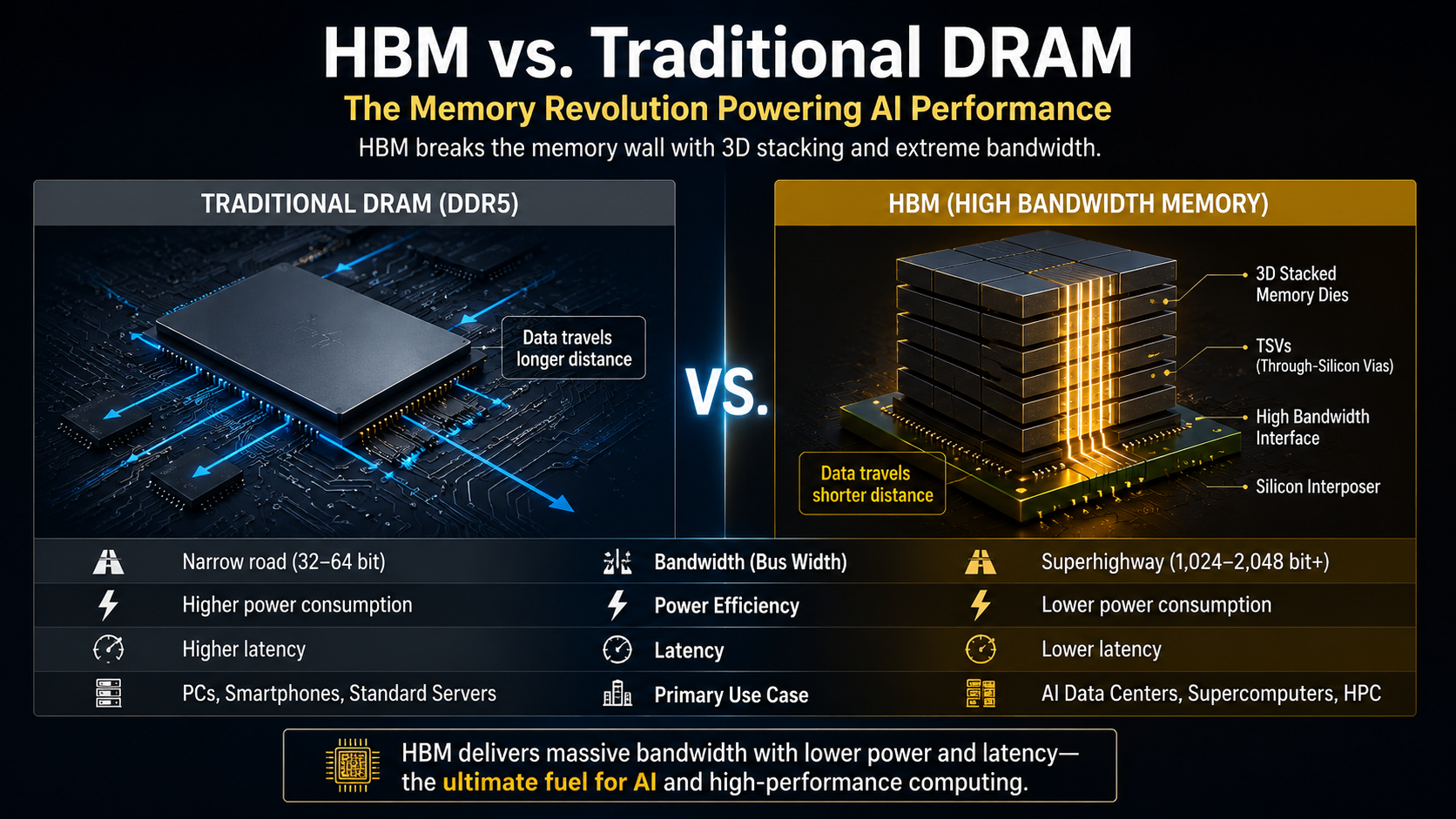
Instead of placing memory chips side by side, HBM stacks multiple memory layers vertically and connects them using microscopic pathways called Through-Silicon Vias (TSVs).
This architecture dramatically increases memory bandwidth while reducing power consumption.
| Attribute | Traditional DRAM | HBM |
| Architecture | Horizontal 2D layout | Vertical 3D stacked design |
| Data Bandwidth | Relatively limited | Extremely high |
| Power Efficiency | Moderate | Significantly higher |
| Primary Use Case | PCs, smartphones, standard servers | AI data centers, supercomputers, HPC |
The result is simple.
HBM creates a massive high-speed highway for data.
The wider the highway, the faster AI processors can operate.
That is why HBM has become an essential component of modern AI infrastructure.
Why Memory Makers Suddenly Hold the Power
For decades, memory chips were viewed as commodity products.
Prices fluctuated constantly, and manufacturers often struggled through boom-and-bust cycles.
AI has changed that dynamic completely.
HBM is extraordinarily difficult to manufacture.
Advanced packaging, precision stacking, and strict yield requirements make production challenging even for leading semiconductor companies.
At the same time, demand is exploding.
As a result, global HBM production capacity is being booked years in advance.
This has fundamentally shifted the balance of power within the semiconductor industry.
Leading memory suppliers such as SK hynix, Samsung Electronics, and Micron now possess significant strategic leverage.
Major technology companies including Microsoft, Alphabet, Amazon, Meta, and NVIDIA are increasingly signing long-term supply agreements to secure future HBM capacity.
What was once a commodity product has become a strategic resource.
The conversation is no longer about buying memory.
It is about securing future AI infrastructure.
The New Resource War of the AI Age

Every technological revolution creates competition for critical resources.
The industrial era competed for coal.
The automotive era competed for oil.
The AI era is competing for advanced semiconductors and memory.
Today, hyperscalers are investing hundreds of billions of dollars into AI infrastructure and next-generation data centers.
However, building a data center is only part of the equation.
Without access to advanced chips and HBM, those facilities cannot achieve their intended performance.
A billion-dollar AI data center without sufficient HBM is little more than an expensive warehouse filled with servers waiting for critical components.
This is why HBM has become a strategic asset rather than a simple semiconductor product.
The competition is no longer just about software.
It is about securing the hardware that makes AI possible.
Why HBM Has Become So Valuable
Several factors have combined to make HBM one of the most valuable technologies in the world.
First, demand is growing at an unprecedented pace.
Every new generation of AI models requires more memory and higher bandwidth.
Second, HBM manufacturing is extremely complex.
Only a small number of companies possess the technology, expertise, and production capabilities required to produce advanced HBM at scale.
Third, supply remains constrained.
When rising demand meets limited supply, strategic value increases dramatically.
This combination has transformed HBM from a niche memory technology into a critical foundation of the AI economy.
Conclusion - From Oil Wells to Memory Stacks
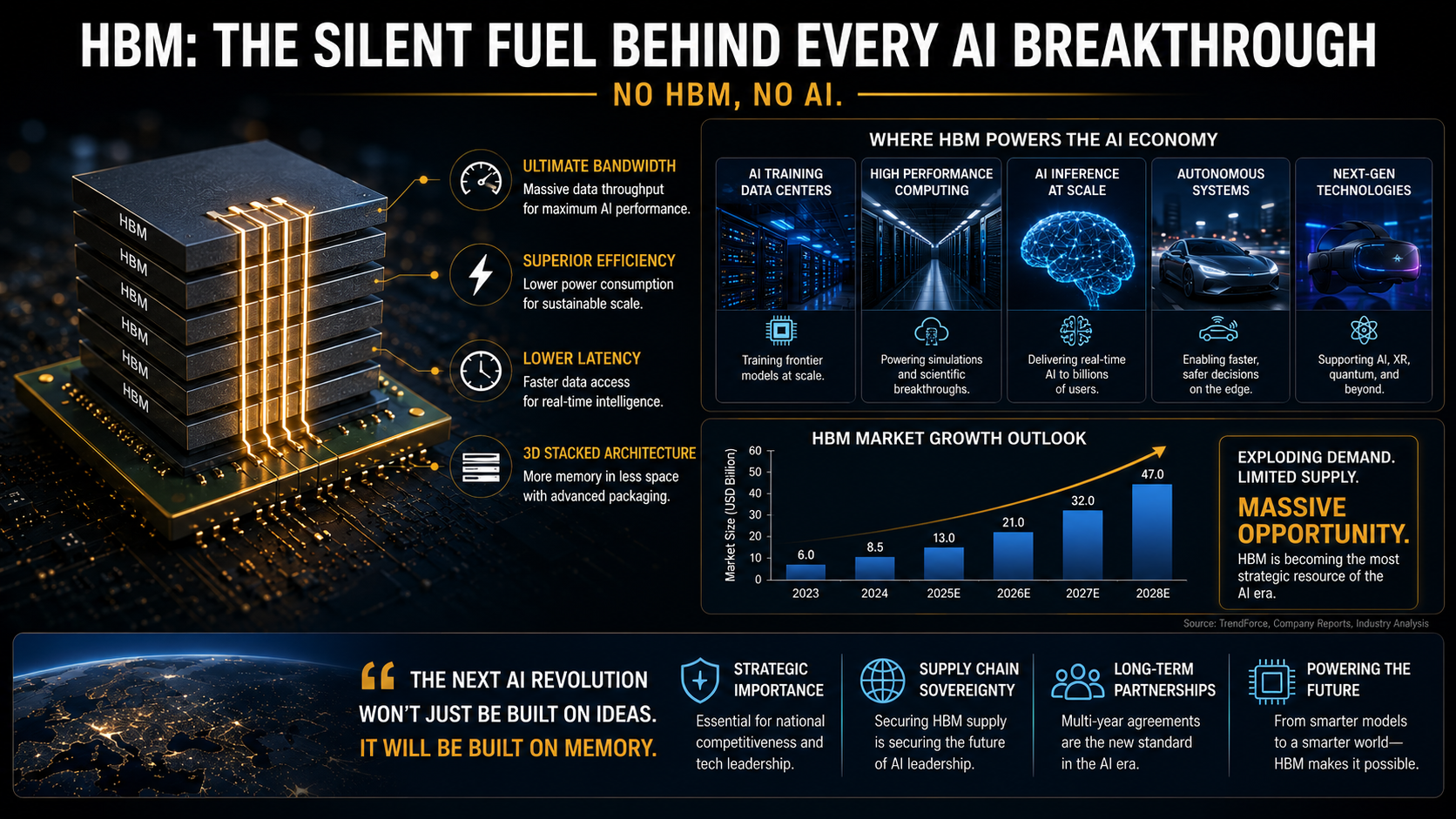
The comparison between oil and HBM is more than a catchy headline.
Both resources share remarkably similar characteristics.
Oil powered factories, transportation networks, and industrial economies.
HBM powers AI models, data centers, and digital economies.
Both are difficult to produce.
Both are essential to growth.
And both create enormous advantages for those who control supply.
Many people view the AI revolution as a battle of algorithms.
In reality, it is also a battle of infrastructure.
The next AI breakthrough may not depend on who builds the smartest model.
It may depend on who controls the memory that powers it.
And increasingly, that memory is HBM.
Thank you for reading.
Stay ahead of the market.
This has been MasterMind.
'[Global] Success Blueprints' 카테고리의 다른 글