The AI Debt Race: Why Big Tech Is Borrowing Instead of Spending Cash


Hello, this is MasterMind.
Something unusual is happening in the U.S. financial markets.

A cash-rich technology giant stands at the center of a rapidly expanding AI economy, balancing massive cash reserves,
corporate debt financing, and ambitious infrastructure investments to secure future market leadership.
Alphabet, Microsoft, Amazon, and Meta are all spending at unprecedented levels to expand AI infrastructure. Data centers are growing larger, demand for advanced chips continues to surge, and capital expenditures are reaching levels rarely seen in modern corporate history.
This raises an important question.
If these companies already have hundreds of billions of dollars in cash, why are they borrowing money to invest in artificial intelligence?
The answer goes far beyond a simple financing decision.
It reveals one of the largest capital allocation battles in modern economic history.
Today, we'll examine the real movement of money behind Big Tech's AI spending boom and what it could mean for investors over the next decade.
Understanding the Real Nature of the AI Race
When most people think about artificial intelligence, they think about chatbots, AI assistants, or search engines.
But the market is focused on something much bigger.
Infrastructure.

Every AI model depends on an enormous physical foundation: advanced GPUs, hyperscale data centers, electrical grids, cooling systems, fiber networks, and cloud infrastructure.
This means the AI race is not simply a software competition.
It is a capital-intensive industrial buildout.
In many ways, today's technology giants are building the digital highways of the future economy.
The companies that control the infrastructure may ultimately control the flow of computing power, data, and future profits.
That is why AI spending has become one of the largest investment cycles in modern corporate history.
The Key Forces Driving This Trend
1. The Cost of Falling Behind Is Greater Than the Cost of Investing
In traditional industries, companies can often adjust investment cycles according to economic conditions.
AI changes that equation.
Today, executives increasingly view AI as a survival strategy rather than a growth opportunity.
If competitors continue investing aggressively while one company slows spending to protect margins, the long-term consequences could be severe.
Market share may disappear.
Customers may migrate elsewhere.
Future revenue streams could be permanently damaged.
Big Tech executives are not being driven by unbridled optimism.
They are weaponizing capital out of a profound fear of technological irrelevance.
In today's market, the fear of falling behind is often stronger than the fear of overspending.
2. Financial Flexibility and Capital Efficiency
Many investors assume that issuing debt signals financial weakness.
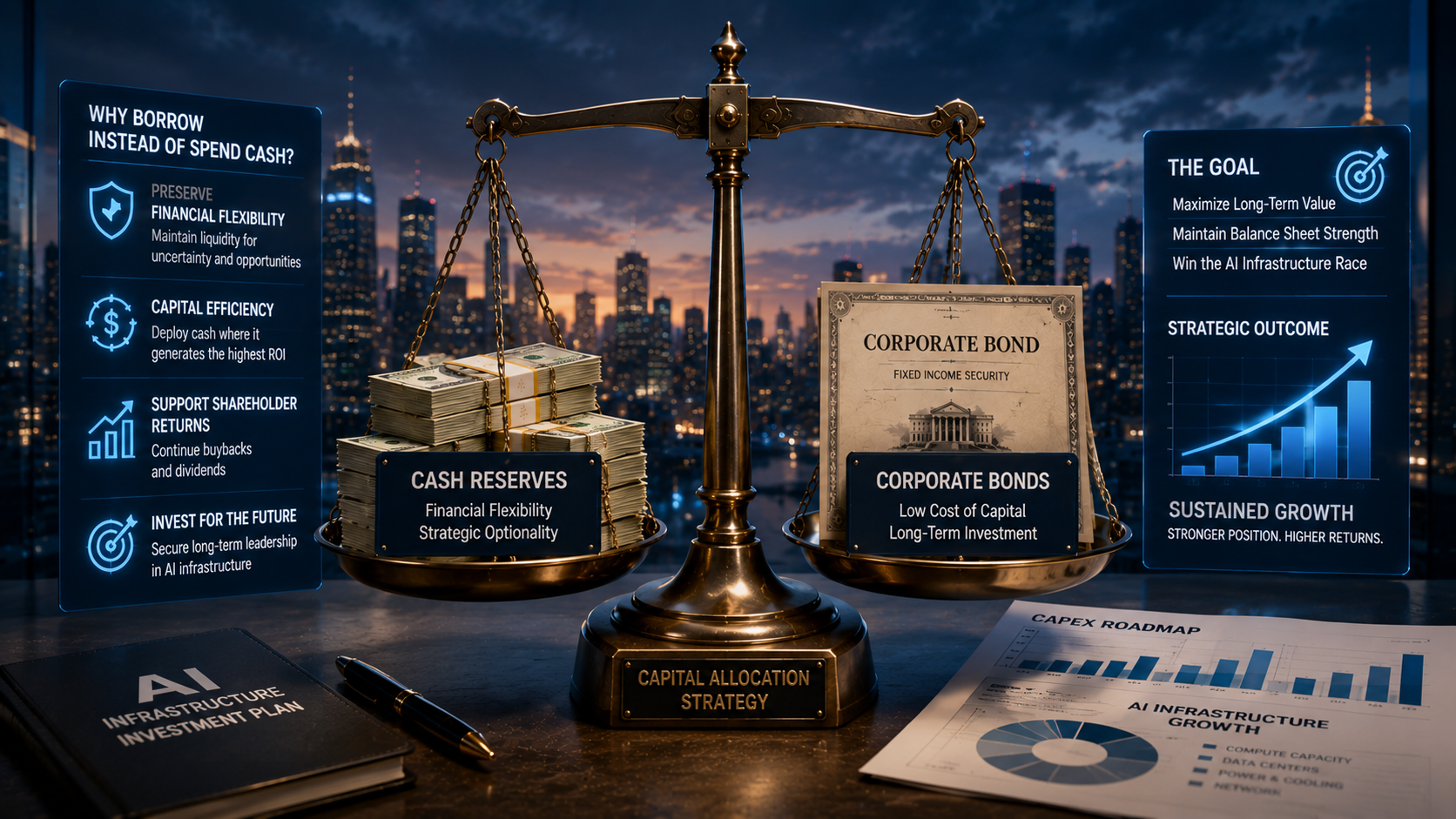
For elite corporations, the opposite is often true.
The objective is not simply to spend cash.
The objective is to maximize capital efficiency.
AI infrastructure requires hundreds of billions of dollars in long-term investment.
Using all available cash reserves would reduce flexibility during future economic downturns, unexpected disruptions, or strategic opportunities.
By issuing bonds and accessing debt markets, Big Tech can preserve liquidity while simultaneously funding aggressive expansion.
This approach allows management teams to maintain optionality while continuing to invest at scale.
In other words, borrowing is not a sign of financial stress.
It is a strategic allocation decision designed to strengthen long-term competitive positioning.
3. Investors Want AI Growth and Shareholder Returns
Wall Street expects companies to achieve two objectives simultaneously.
Invest heavily in AI.
And continue rewarding shareholders.
Technology giants are under constant pressure to maintain stock buybacks, dividends, and other shareholder return programs.
If every dollar of cash flow were redirected toward AI infrastructure, shareholder returns would inevitably suffer.
Debt financing provides a solution.
Companies can continue expanding their AI footprint while preserving the financial resources needed to support investors.
In many cases, borrowing has become a tool for balancing long-term industrial ambitions with short-term market expectations.
4. AI Has Become a Winner-Takes-Most Market
Financial markets are forward-looking.

And today, investors believe AI could create extraordinary advantages for early leaders.
The larger a company's infrastructure footprint becomes, the more data it can process.
More data improves AI performance.
Better AI products attract more customers.
More customers generate greater revenue and lower unit costs.
This creates a powerful self-reinforcing cycle.
As a result, many executives see AI as a winner-takes-most market where delaying investment may have permanent consequences.
That perception has transformed the AI race into a capital-intensive strategic contest unlike anything the technology sector has experienced before.
Risks Investors Should Not Ignore
Every investment boom carries risks.

The biggest concern today is the growing gap between spending and monetization.
Technology giants are investing enormous amounts of capital today.
But the timeline for generating meaningful returns remains uncertain.
If interest rates stay elevated for longer than expected, financing costs could increase.
If AI adoption or monetization develops more slowly than investors anticipate, current valuations may become difficult to justify.
History offers many lessons.
Railroads.
Electricity.
Telecommunications.
The internet.
Every transformative technological revolution experienced periods when infrastructure investment dramatically outpaced actual cash generation.
AI may follow a similar path.
The technology can be revolutionary while certain investments still prove disappointing.
Investors should remember that these two realities can coexist.
What Are Smart Investors Watching?
Sophisticated investors rarely chase headlines.
Instead, they follow the flow of capital.
The key question is not necessarily who will build the best AI model.
The more important question is who benefits directly from the AI investment cycle.
When technology companies spend hundreds of billions of dollars on infrastructure, that money flows into semiconductors, data centers, electrical equipment, power generation, cooling systems, networking hardware, and cloud infrastructure.
These businesses often generate real cash flow long before the ultimate winners of the AI software race become obvious.
Smart investors understand that predicting the final winner is difficult.
Identifying the suppliers that profit regardless of the outcome is often much easier.
This leads to two important questions:
- Is the company I own directly benefiting from the AI infrastructure boom, or simply talking about AI?
- Can this business survive an extended period of higher interest rates and economic uncertainty?
In volatile markets, strong balance sheets and durable cash flows often matter far more than exciting narratives.
Final Thoughts
The fact that cash-rich technology giants are borrowing billions to finance AI infrastructure is not a sign of weakness.
It is a strategic decision driven by competition, capital efficiency, and the pursuit of long-term market leadership.
We are witnessing one of the largest concentrated investment cycles in corporate history.
The winners could shape the global economy for decades.
But investors should never confuse innovation with guaranteed investment success.
The most important task is understanding where capital is flowing, who is generating sustainable cash flow, and which businesses can thrive even when market conditions become more challenging.
So ask yourself:
Where is the money moving next?
Are you investing in the companies building the highways of the AI economy, or are you simply betting on the vehicles driving across them?
Success does not belong to those who simply follow trends. It belongs to those who recognize change early and prepare for it before everyone else.
This was MasterMind, designing success through understanding the flow of capital.
'[Global] Success Blueprints' 카테고리의 다른 글