Bitcoin Breaks Below $60,000 - Is It Time to Buy or Time to Run?


Panic Selling or the Beginning of a Great Rebalancing?
Hello, this is MasterMind.
Bitcoin temporarily broke below the critical $60,000 level, sending shockwaves through the cryptocurrency market.
For many investors, this wasn't just another support line. It was a psychological fortress. As Bitcoin slipped beneath one of the most closely watched price zones in the market, fear quickly spread across the crypto ecosystem.
Only months ago, investors were talking about new all-time highs. Today, sentiment has shifted dramatically. After a sharp correction from its previous peak, uncertainty has replaced optimism.
But here's the question that matters:
Has the crypto market fundamentally broken?
Or are we witnessing a temporary shock caused by a major shift in global capital flows?
Should investors run for safety, or prepare for opportunity while focusing on survival?
Today, we're going beyond price action to examine what the market truly fears and where money is moving next.

Why the $60,000 Breakdown Matters
Many investors focus on price.
Professional investors focus on psychology.
The $60,000 level was more than a number. It represented a major support zone where institutional demand had repeatedly appeared.
For many market participants, it also coincided with long-term technical levels that historically acted as key support during previous market cycles.
When a level like this breaks, the impact goes far beyond charts.
It signals weakening confidence.
The market has begun pricing in future uncertainty, and leveraged positions that were built on bullish expectations are now being forced out of the system.
This is why the current decline is not simply a price problem.
It is a liquidity and sentiment problem.
The Key Forces Driving the Selloff
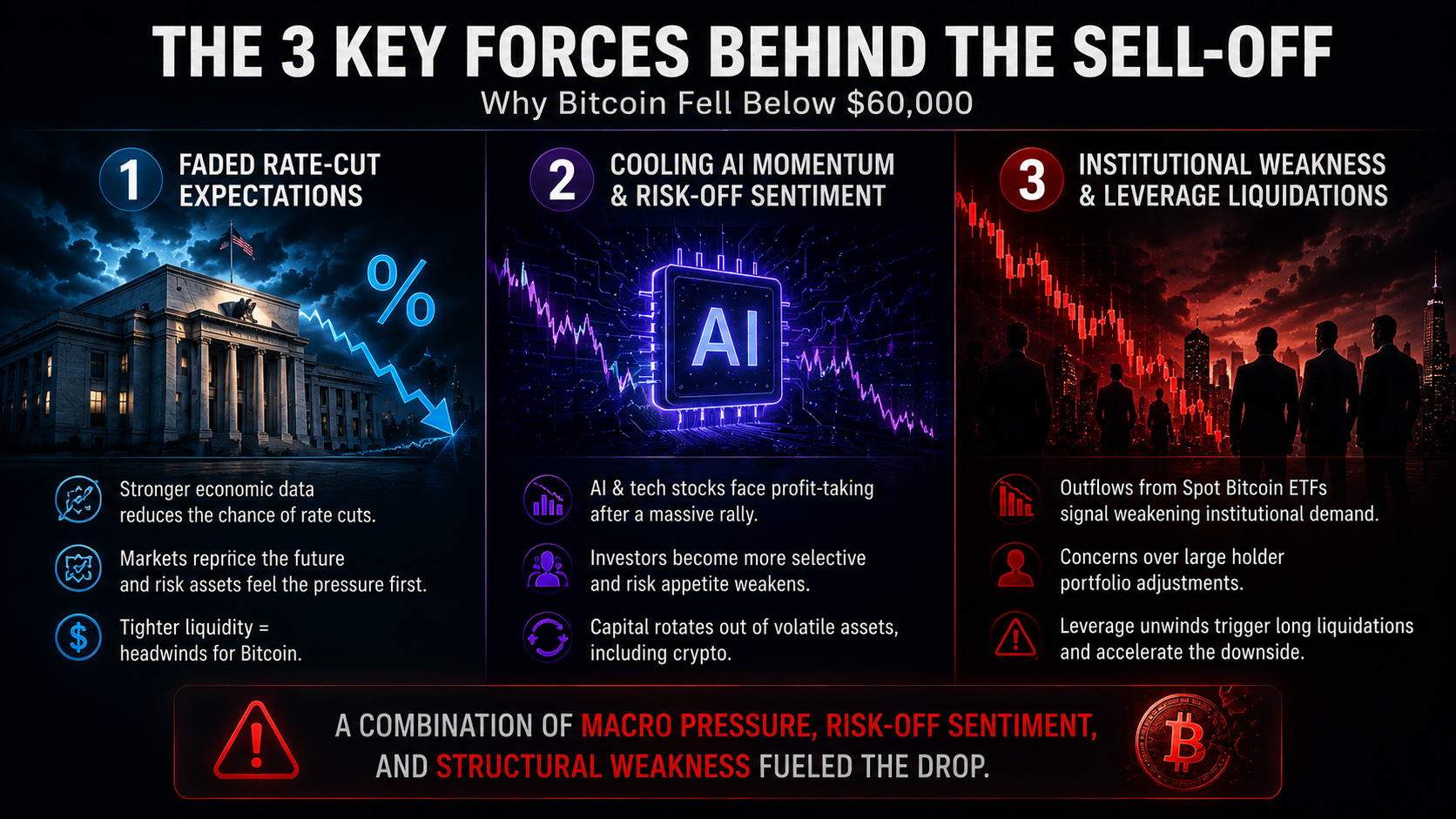
This decline cannot be explained by a single headline.
Instead, it reflects a combination of macroeconomic pressure and weakening market flows.
1. Fading Rate-Cut Expectations
For much of the year, investors expected the Federal Reserve to begin lowering interest rates.
However, stronger-than-expected economic data has forced markets to reconsider that assumption.
Markets always price the future.
As expectations for easier monetary policy fade, risk assets are often the first to feel pressure.
Bitcoin occupies a unique position in financial markets.
Some view it as digital gold, while others treat it as a high-risk growth asset.
In periods of tightening liquidity, the risk-asset narrative tends to dominate.
As a result, Bitcoin becomes vulnerable to shifts in monetary policy expectations.
2. Cooling AI Momentum and Global Risk-Off Sentiment
Over the past few years, artificial intelligence has been the most powerful growth story in global markets.
Technology stocks, semiconductor companies, and AI infrastructure businesses attracted enormous amounts of capital.
But no trend rises forever.
As profit-taking emerges across major technology sectors, investors are becoming more selective.
When risk appetite weakens, capital often exits the most volatile assets first.
Bitcoin has not been immune to this shift.
The broader move toward risk reduction has placed additional pressure on crypto markets.
3. Institutional Flow Weakness and Leverage Liquidations

Market structure matters.
Recent outflows from spot Bitcoin ETFs have raised concerns about institutional demand.
At the same time, speculation about potential portfolio adjustments by major holders has weakened investor confidence.
Once key support levels broke, leverage became the dominant story.
This triggered a classic long squeeze.
Traders who had borrowed heavily to bet on higher prices were forced to close positions, creating additional selling pressure.
In environments like this, markets stop focusing on valuation and start focusing on survival.
That is often when volatility reaches its peak.
Risks Investors Should Watch
The greatest risk today is not necessarily price.
It is volatility.
Periods of uncertainty can produce large price swings in both directions, making emotional decision-making extremely dangerous.
Another factor worth monitoring is mining economics.
If Bitcoin remains under pressure for an extended period, some mining operations could face profitability challenges.
Should weaker miners begin selling reserves to cover operating costs, additional supply could enter the market.
This is why investors should avoid two common mistakes.
The first is panic selling at the worst possible moment.
The second is blindly buying every dip without a risk-management plan.
Both decisions are driven by emotion.
The goal should not be predicting every market move.
The goal should be staying in the game.
What Are Wealthy Investors Watching?
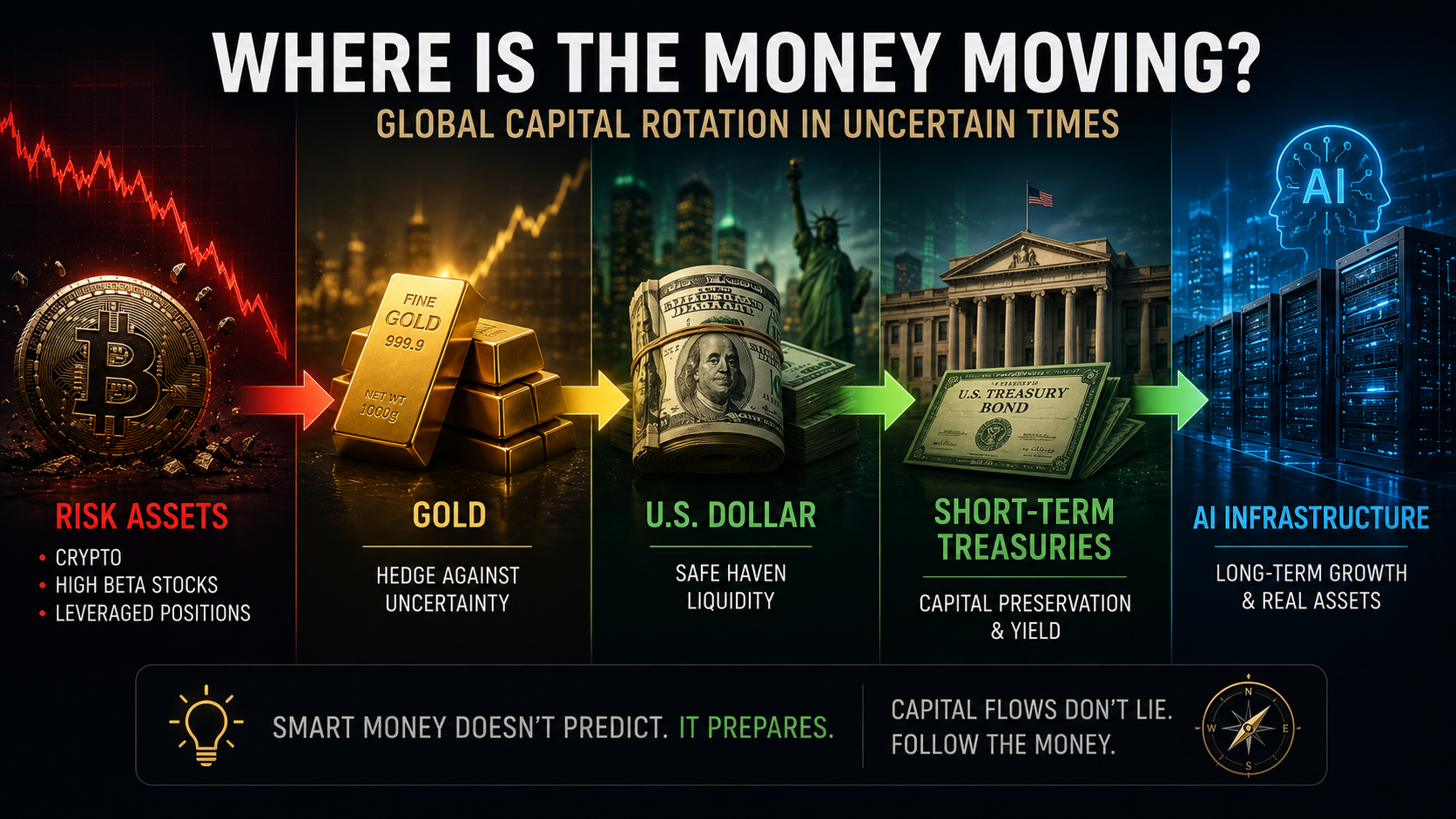
Large investors rarely focus on price alone.
They focus on capital flows.
Instead of asking, "How far has Bitcoin fallen?"
They ask, "Where is the money going?"
Today, some capital is rotating away from risk assets and into defensive positions such as cash, gold, and short-duration fixed income.
At the same time, capital continues flowing toward sectors with visible cash flows and long-term growth potential, including AI infrastructure, data centers, semiconductor manufacturing, and power infrastructure.
This does not necessarily mean investors are abandoning Bitcoin.
It may simply reflect a broader portfolio rebalancing process designed to improve resilience during uncertain economic conditions.
Wealthy investors rarely attempt to buy the exact bottom.
Instead, they build structures that allow them to survive regardless of what happens next.
They understand a simple truth:
In investing, survival matters more than prediction.
Investors should ask themselves:
- Am I relying on leverage?
- Do I have enough cash to handle further volatility?
- Is this decline driven by a fundamental problem with Bitcoin itself, or by broader macroeconomic conditions?
- Are my decisions based on analysis, or on fear and greed?
These questions often matter more than the price chart.
Final Thoughts - Watch the Flow of Money, Not Just the Price
Bitcoin's fall below $60,000 has undoubtedly shaken investor confidence.
But price alone rarely tells the full story.
Markets move through cycles of optimism and fear.
Strong assets survive difficult environments.
Weak assets do not.
The most important skill in investing is not predicting the future with perfect accuracy.
It is maintaining the ability to survive uncertainty.
The real danger is not when a chart breaks.
The real danger is when your discipline breaks.
Today, the market is pricing in fear.
But not every period of fear becomes a long-term crisis.
Sometimes it is simply the temporary turbulence created by a major shift in capital allocation.
Ultimately, the most important question is not where Bitcoin trades today.
It is understanding what the market fears and where money is moving next.
Markets will continue to create both opportunities and risks.
Only those who survive the difficult periods will be around to benefit from the next cycle.
Master Mind.
'[Global] Success Blueprints' 카테고리의 다른 글