Why Is NVIDIA Challenging the MacBook?


A New Battle for the Future of AI PCs Has Begun

For the past several years, Apple has been the undisputed king of the premium laptop market.
The launch of Apple Silicon was more than just a successful product release—it fundamentally changed the direction of the PC industry. With exceptional power efficiency, impressive performance, long battery life, and deep hardware-software integration, the MacBook established a new benchmark for premium laptops.
Many analysts believed it would take years for Windows manufacturers to catch up.
But NVIDIA's new RTX Spark platform is raising an important question:
Why would a company that already dominates the AI data center market suddenly enter the laptop battlefield?
The answer has little to do with selling more laptops.
It has everything to do with controlling the next stage of the AI revolution.
As artificial intelligence moves from massive data centers into everyday devices, the personal computer is becoming the next strategic battleground.
The Era Apple Dominated
Apple built a powerful competitive advantage through its unified architecture.
By integrating the CPU, GPU, and memory into a single system, Apple dramatically reduced power consumption while maintaining impressive performance.
The result was a laptop capable of handling demanding workloads while remaining quiet, cool, and incredibly efficient.
While many Windows laptops relied on larger batteries, heavier chargers, and aggressive cooling systems to achieve high performance, Apple's approach focused on efficiency from the ground up.
The MacBook didn't simply become a successful product.
It became the new standard.
The Rules of Competition Are Changing

For years, laptop competition revolved around two key metrics:
CPU performance and battery life.
But the AI era is introducing an entirely new benchmark.
On-device AI.
Until recently, most AI services depended on cloud computing. Tasks such as image generation, language translation, and AI assistants required powerful remote servers.
That model is beginning to change.
Concerns about privacy, latency, operating costs, and internet dependency are pushing the industry toward local AI processing.
Future laptops won't simply access AI.
They will run AI directly on the device.
Document creation, image generation, video editing, real-time translation, and personalized AI assistants may increasingly operate without sending data to external servers.
In this environment, traditional CPU performance alone is no longer enough.
Memory bandwidth, AI accelerators, and specialized processing architectures become the new competitive advantage.
Why NVIDIA Is Entering the Laptop Market

NVIDIA already sits at the center of the AI economy.
Today, most cutting-edge AI models are developed and trained using NVIDIA-powered infrastructure.
But data centers are only part of the company's long-term vision.
As AI expands into everyday life, hundreds of millions of PCs and laptops could become the next major computing platform.
NVIDIA doesn't just want to power AI servers.
It wants to power AI devices.
This is where CUDA becomes incredibly important.
Over the past decade, NVIDIA has built one of the strongest developer ecosystems in technology.
Millions of AI researchers, software developers, engineers, and content creators already rely on CUDA-based workflows.
NVIDIA's goal is to extend that ecosystem from data centers to personal computers.
Once users and developers become deeply integrated into a software ecosystem, switching becomes increasingly difficult.
If developers can use the same AI environment on their laptops that they use in data centers, NVIDIA gains a powerful strategic advantage in the next generation of computing.
The NVIDIA-Microsoft Alliance
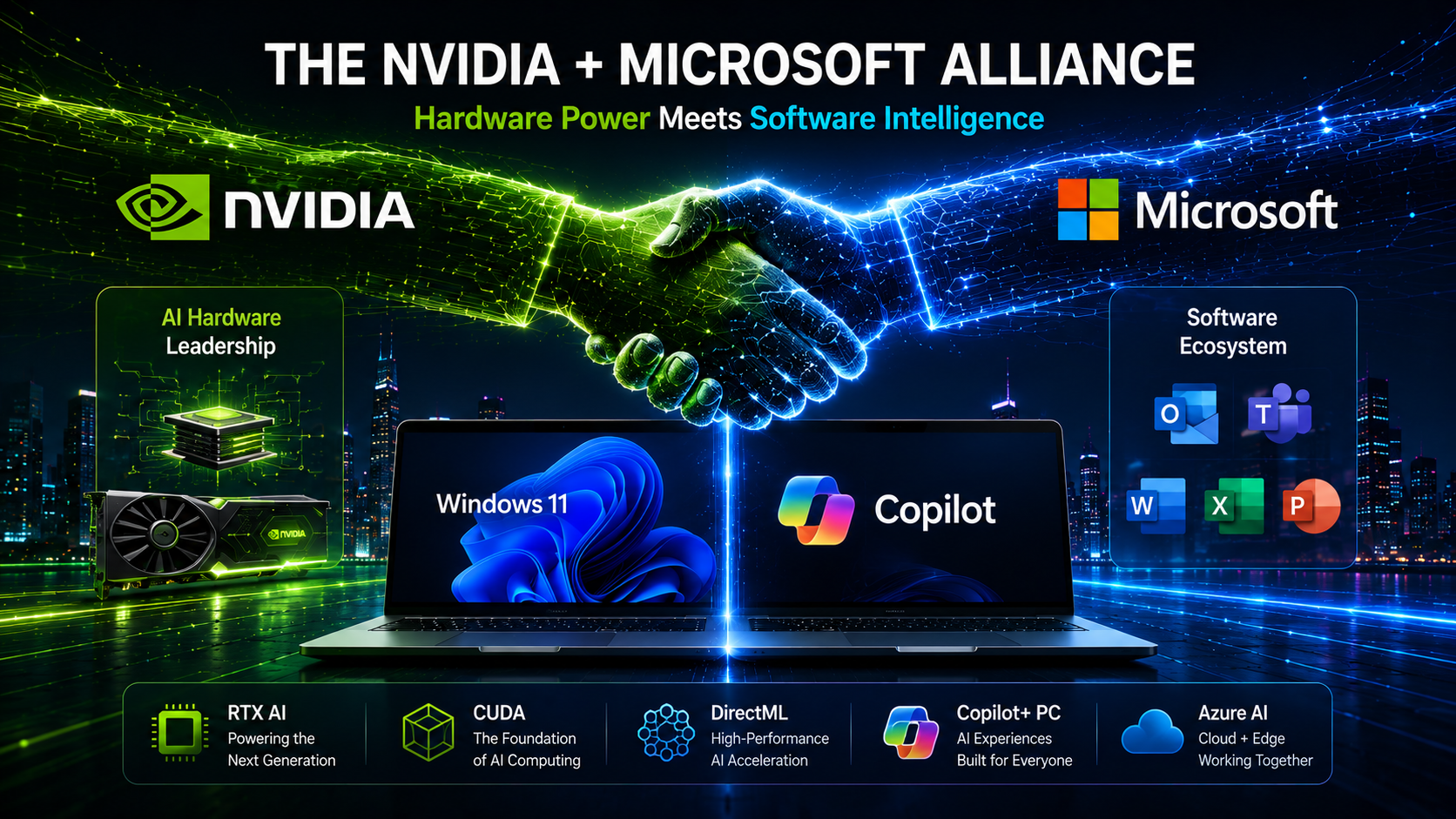
What makes this battle particularly interesting is that NVIDIA is not fighting alone.
Microsoft has become a critical ally.
As Microsoft integrates AI deeper into Windows through Copilot and future AI services, it requires powerful hardware capable of running advanced AI workloads locally.
The partnership creates a natural alignment.
NVIDIA provides AI computing power.
Microsoft provides the operating system and software ecosystem.
For years, Apple's greatest advantage was the seamless integration between hardware and software.
Now NVIDIA and Microsoft are attempting to build a competing AI-first ecosystem.
This transforms the competition from a simple laptop race into a much larger battle over AI platforms.
Who Will Win?
At this stage, it would be premature to predict that NVIDIA can dethrone the MacBook.
Apple continues to invest heavily in AI capabilities and next-generation silicon.
Its ecosystem, brand loyalty, and user experience remain powerful advantages.
But the more important question isn't who wins.
The real story is that the definition of a personal computer is changing.
The industry is moving beyond CPU speed and battery life.
The next era of competition will be defined by AI capability.
Conclusion

The AI revolution began inside massive data centers.
Now that technological and financial battle is moving onto the laptops sitting on our desks.
Apple will defend its position through world-class hardware design, software integration, and ecosystem strength.
NVIDIA will leverage its dominance in AI infrastructure and developer tools to expand into personal computing.
Ultimately, the most important shift isn't which company wins.
It's that laptops are evolving into something entirely new.
The future laptop will no longer be just a computer.
It will become a personal AI data center.
And RTX Spark may be one of the first signals that this transformation has already begun.
MasterMind — Designing Success Through Insight.
'[Global] Success Blueprints' 카테고리의 다른 글