What Happens When U.S. Treasury Yields Rise?


Why the Entire Global Market Watches the U.S. 10-Year Treasury

Hello, this is Mastermind.
Lately, the global financial market has felt increasingly unstable. Almost every major financial headline seems to mention the same thing
“U.S. Treasury yields are rising again.”
And whenever that happens, the reaction spreads everywhere
- Stocks become volatile
- Bitcoin pulls back
- Gold weakens
- The dollar strengthens
- Even mortgage rates start climbing
But why does one number — the U.S. 10-year Treasury yield — have the power to shake nearly every asset market on Earth?
The answer is simple.
U.S. Treasury yields are not just another economic indicator.
They are the foundation of the global financial system.
Today, let’s break down why Treasury yields matter so much, why markets are suddenly nervous again, and what rising yields could mean for investors moving forward.
What Is a U.S. Treasury Bond?
A U.S. Treasury bond is essentially
a loan made to the U.S. government.
The government spends enormous amounts of money on
- defense
- infrastructure
- healthcare
- public services
- interest payments on existing debt
Since tax revenue alone is not enough to cover all of those expenses, the government issues Treasury securities to borrow money from investors.
In return, investors receive interest payments.
Simple in theory.
But in reality, U.S. Treasuries sit at the center of the global economy.
Why Do Treasury Yields Move?
Treasury yields reflect market expectations.
More specifically, the market constantly asks one key question
“How long will interest rates stay high?”
If investors believe
- inflation will remain sticky,
- the Federal Reserve will delay rate cuts,
- or the U.S. economy is still too strong,
then Treasury yields tend to rise.
On the other hand, yields usually fall when
- recession fears increase,
- inflation cools,
- or investors expect aggressive rate cuts.
In many ways, Treasury yields act as
the market’s real-time forecast for the future economy.
Why Markets Are Nervous Right Now
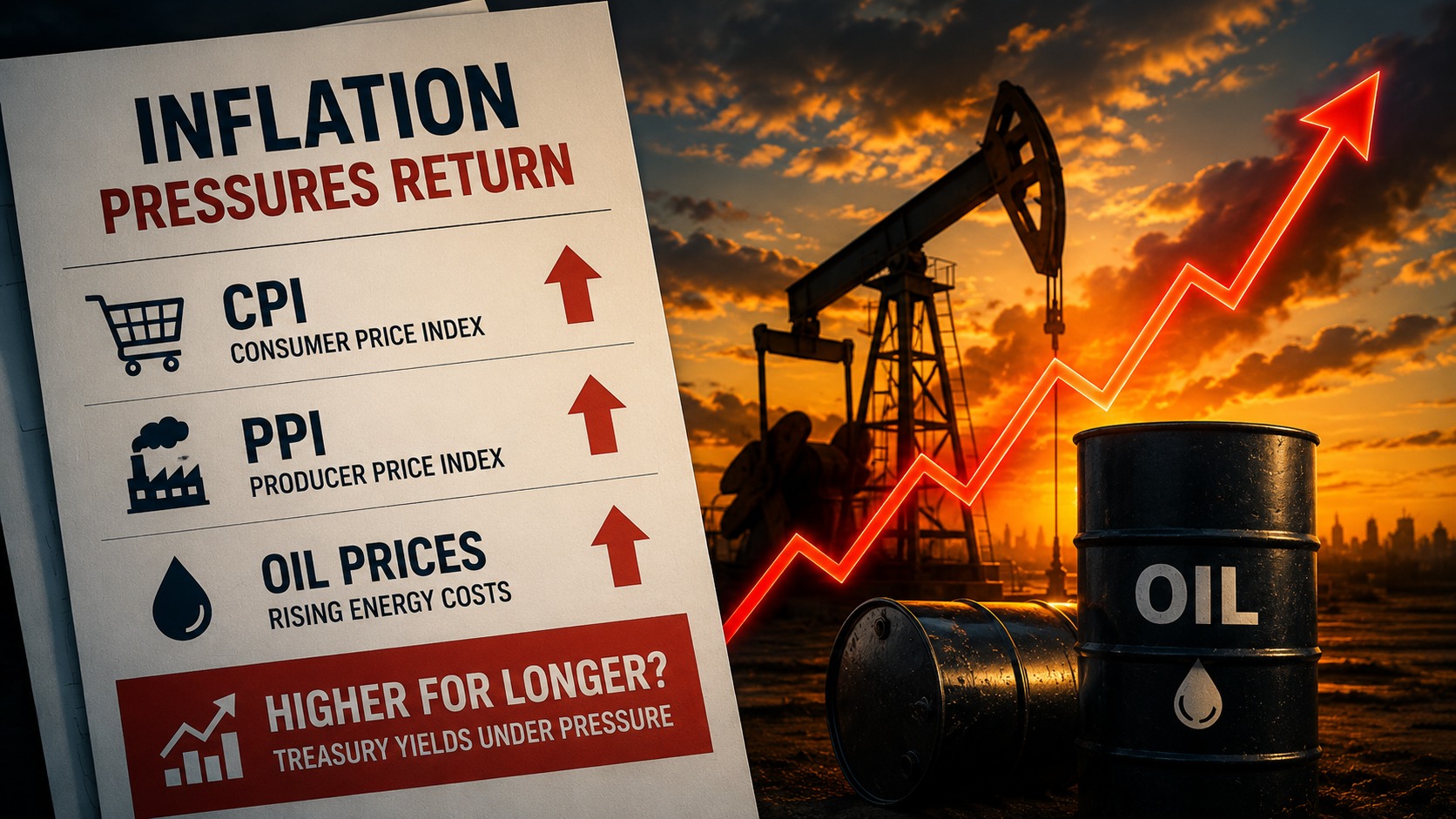
Recently, markets have become extremely sensitive to movements in the U.S. 10-year yield.
The biggest reason?
Inflation fears are returning.
Recent economic data has suggested that inflation may not be cooling as quickly as investors hoped.
Markets are closely watching
- CPI (Consumer Price Index)
- PPI (Producer Price Index)
- wage growth
- energy prices
- services inflation
At the same time, geopolitical tensions in the Middle East and rising oil prices have increased concerns that inflation could reaccelerate.
As a result, markets are beginning to shift from
“The Fed will cut rates soon”
to
“What if rates stay higher for much longer?”
And in some cases, investors are even starting to discuss the possibility of additional rate hikes.
That fear is now pushing Treasury yields higher again.
What Happens When Treasury Yields Rise?
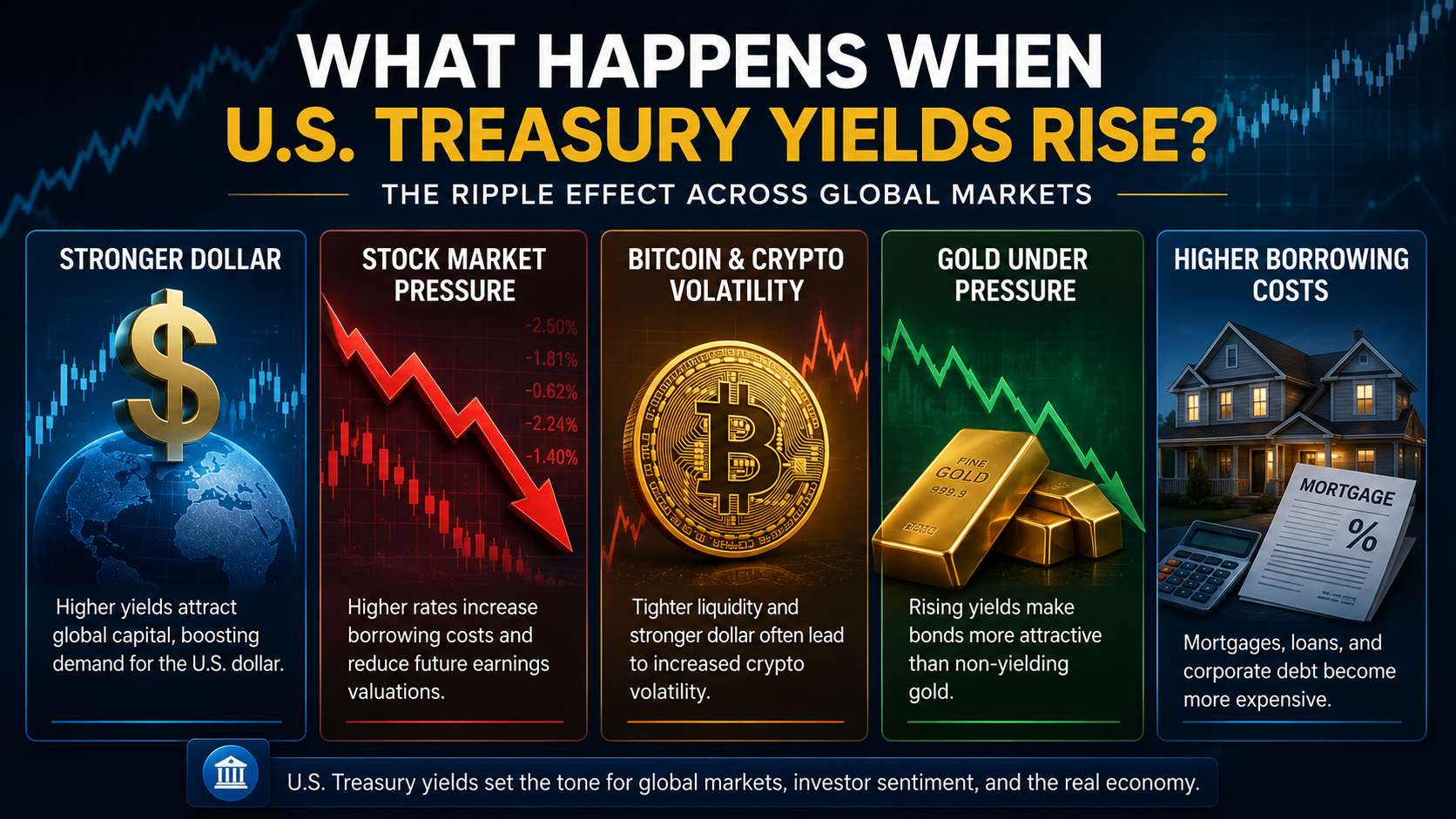
1. The U.S. Dollar Strengthens
When Treasury yields rise, global capital tends to flow toward the United States.
Why?
Because investors see
safe government bonds paying attractive returns.
That increases demand for the U.S. dollar.
A stronger dollar often creates pressure on
- emerging markets
- global liquidity
- foreign currencies
- international capital flows
2. Stocks Come Under Pressure
Higher yields are generally negative for stocks, especially:
- technology companies
- growth stocks
- AI-related stocks
Why?
Because higher interest rates reduce the present value of future earnings.
In simple terms:
investors become less willing to pay high valuations for future growth.
That’s why rising Treasury yields often lead to
- lower risk appetite
- higher volatility
- pressure on equity markets
Right now, the market may actually fear interest rates more than AI hype.
3. Bitcoin and Crypto Become More Volatile
Bitcoin also reacts strongly to Treasury yields.
Crypto tends to perform well during periods of
- easy liquidity
- low interest rates
- weaker dollar conditions
But when yields rise
- liquidity conditions tighten,
- the dollar strengthens,
- and investors become more risk-averse.
That often leads to increased volatility across crypto markets.
Recently, markets have repeatedly followed the pattern of
Rising Treasury yields → Bitcoin pullback
4. Gold Faces Pressure
Gold is traditionally viewed as a safe-haven asset.
But gold has one major weakness
it pays no yield.
Treasuries, meanwhile
- are considered safe,
- and also provide interest income.
So when Treasury yields rise sharply, investors may rotate away from gold and into bonds instead.
That can pressure gold prices lower.
5. Real Estate and the Economy Slow Down
Treasury yields also influence borrowing costs throughout the economy.
As yields rise
- mortgage rates increase,
- corporate borrowing becomes more expensive,
- consumer loans get pricier.
That can slow
- housing demand
- consumer spending
- business investment
In other words, Treasury yields do not just impact Wall Street.
They directly affect the real economy.
Why the U.S. 10-Year Treasury Matters So Much
Markets treat the U.S. 10-year Treasury yield as
the “temperature gauge” of the global economy.
When the 10-year yield moves, it affects
- capital flows
- currency markets
- stock valuations
- crypto sentiment
- global liquidity
That’s why financial markets around the world react so strongly whenever Treasury yields surge.
What Smart Investors Focus On
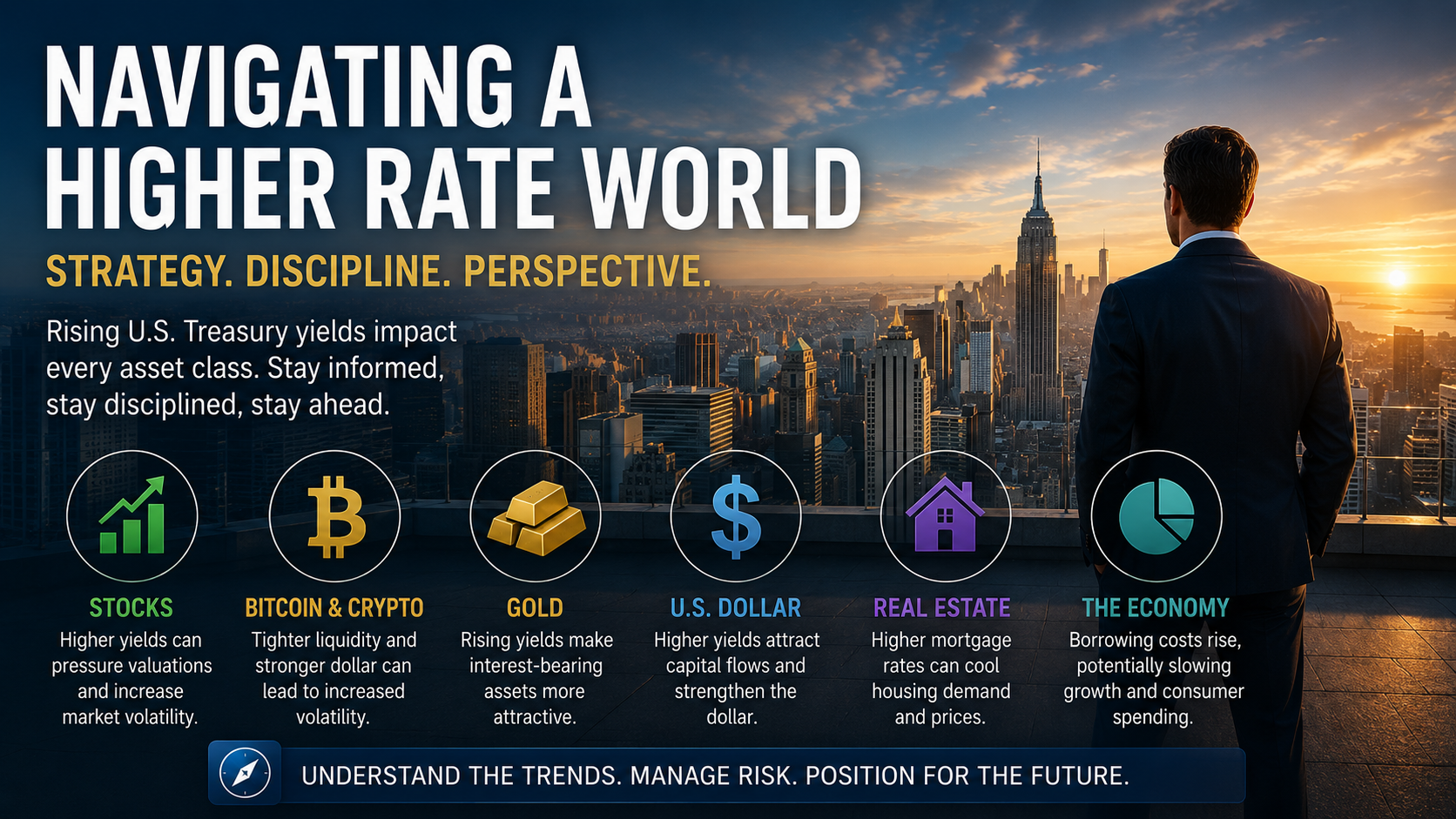
Experienced investors do not simply panic when yields rise.
Instead, they watch
- where money is flowing,
- which assets remain resilient,
- and which sectors can survive in a higher-rate environment.
The key question today is not
“Will markets go up tomorrow?”
The real question is
“Can my portfolio survive a prolonged high-rate environment?”
This is no longer a market where every asset rises together.
In a world of higher interest rates, investors are increasingly rewarding
- strong cash flow,
- durable business models,
- and real profitability.
Final Thoughts
U.S. Treasury yields are ultimately
the backbone of the global financial system.
They influence
- stocks
- Bitcoin
- gold
- currencies
- real estate
- and even personal borrowing costs
That is why the world watches the U.S. 10-year Treasury so closely.
When markets become volatile, understanding the flow of money becomes more important than chasing short-term headlines.
Because in the end, successful investors are not the ones who react emotionally.
They are the ones who understand the structure behind the market.
What’s your view on rising Treasury yields and the future of the market?
Feel free to share your thoughts in the comments.
Mastermind
'[Global] Success Blueprints' 카테고리의 다른 글