What Is Self-Serving Bias? How It Affects Investing and How to Overcome It


Hello, this is MasterMind.
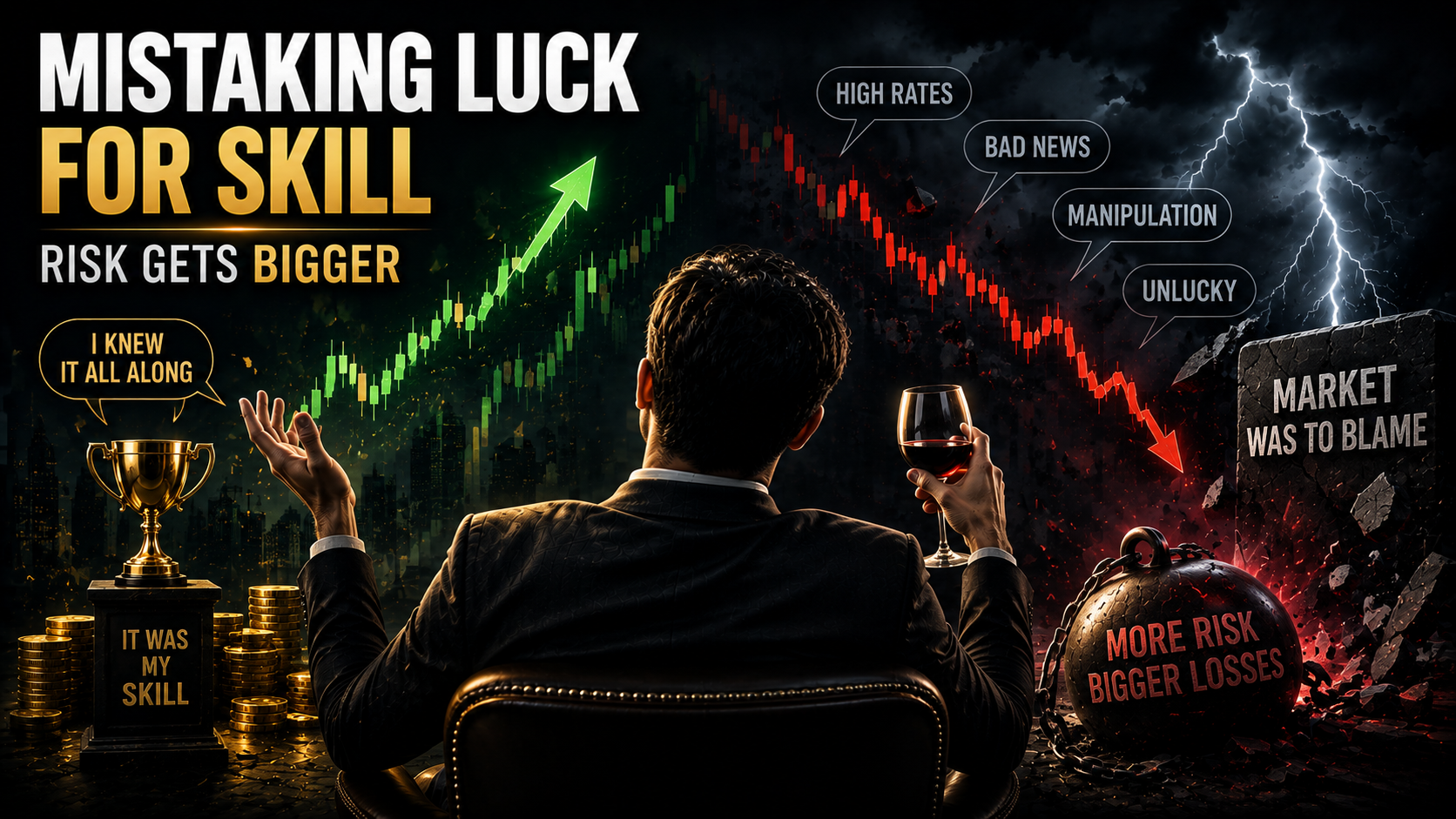
When one of your stocks rises, do you credit your research, conviction, and ability to spot an opportunity?
And when that same stock falls, do you immediately blame the Federal Reserve, interest rates, Wall Street, unexpected news, or irrational market behavior?
External forces absolutely matter. Stock prices are influenced by earnings, Treasury yields, liquidity, economic growth, investor expectations, and countless events outside an individual investor’s control.
The problem begins when we use one standard to explain our winners and another to explain our losers.
This psychological tendency is known as self-serving bias, and it can quietly distort the way investors evaluate both their skill and their risk.
The Bottom Line
Self-serving bias is the tendency to attribute successful investment outcomes to personal skill while blaming unsuccessful outcomes on external factors. If left unchecked, it can cause investors to overestimate their abilities, underestimate risk, and repeat the same mistakes.

What Is Self-Serving Bias?
Self-serving bias is a cognitive bias widely studied in psychology and behavioral finance.
In simple terms, people tend to explain positive outcomes through internal factors such as intelligence, effort, skill, or judgment.
Negative outcomes, meanwhile, are more likely to be explained through external factors such as bad luck, difficult circumstances, government policy, other people, or unpredictable events.
Imagine receiving an excellent grade on an exam.
You might think
“I studied hard and understood the material.”
But after receiving a poor grade, the explanation might suddenly become
“The exam was unfair.”
Investing can produce the same pattern.
When a stock rises 30%, an investor may conclude that the gain validates the original analysis.
When the stock falls 30%, the explanation may shift toward interest rates, short sellers, institutional selling, the Fed, or an unexpected economic shock.
Any of those external explanations could be legitimate.
The issue is not whether outside forces matter.
The issue is whether the investor applies the same standard of evaluation to both success and failure.

How Self-Serving Bias Works in Investing
Financial markets are complex systems.
Corporate earnings, valuations, interest rates, liquidity, positioning, economic growth, investor psychology, and expectations all interact to determine asset prices.
Yet the human mind naturally wants simple explanations.
Under self-serving bias, an investor’s feedback loop can begin to look like this
Investment Decision → Market Outcome → Attribution → Self-Evaluation → Next Investment Decision
After a profitable investment
Profit → “My analysis was right” → Greater confidence → Larger position
After an unsuccessful investment
Loss → “The market was wrong” → Limited self-review → Same process repeated
The danger is subtle.
The investor may feel as though experience is producing greater expertise when experience is actually producing greater confidence without a corresponding improvement in decision quality.
This can become especially dangerous during a long bull market.
Why Bull Markets Can Strengthen Self-Serving Bias
Bull markets make it unusually difficult to distinguish skill from favorable market conditions.
Suppose an investor’s portfolio gains 20%.
That sounds impressive in isolation.
But what if the S&P 500 gained 30% during the same period?
The investor made money, but the result does not necessarily prove superior stock-selection ability.
Now consider the opposite environment.
Suppose the broad market falls 20%, while an investor’s portfolio declines only 10%.
The portfolio still lost money, but evaluating the strategy solely by its negative return would ignore important context.
This is why investment performance should rarely be evaluated in isolation.
Investors need to ask
How much of my result came from the market, and how much came from my decisions?
This distinction becomes especially important after several successful years.
A rising market can make aggressive strategies look brilliant.
Concentrated portfolios, speculative growth stocks, leverage, and excessive risk-taking may all work for surprisingly long periods when liquidity and market momentum remain favorable.
That does not necessarily mean the underlying process is sound.
Why Is Self-Serving Bias Dangerous for Investors?
The greatest danger of self-serving bias is not that it automatically causes losses.
It is that it can interfere with the feedback mechanism investors need to improve.
Investors Stop Learning From Their Mistakes
Investing is an ongoing process of testing assumptions and updating decisions.
A losing investment can contain valuable information.
Perhaps the company’s growth was overestimated.
Perhaps the valuation was too high.
Perhaps the balance sheet was weaker than expected.
Perhaps the position was simply too large.
But if every loss is explained as bad luck or irrational market behavior, the investor has little reason to examine these possibilities.
The result can be repeated mistakes disguised as unrelated bad outcomes.
Luck Can Be Mistaken for Skill
One of the most important challenges in investing is separating skill from favorable circumstances.
An investor who takes excessive risk during a strong bull market may generate excellent returns.
Those returns can then create greater confidence.
Greater confidence can lead to larger positions.
Larger positions can eventually create larger losses when market conditions change.
The initial success was real.
The interpretation of that success may have been wrong.
In a powerful bull market, many investors can look exceptionally skilled. Investment ability, however, is not measured only by how much money is made when markets rise. It also becomes visible in how risk is managed when conditions change.
Self-Serving Bias vs. Overconfidence Bias

Self-serving bias and overconfidence bias are closely related, but they are not identical.
Self-serving bias concerns how we explain outcomes.
Overconfidence concerns how highly we rate our own knowledge, judgment, or forecasting ability.
The two can reinforce each other
Successful Trade → Credit Personal Skill → Confidence Increases → Overconfidence → More Risk
Another psychological bias can then enter the process: confirmation bias.
Once investors become convinced that their original thesis is correct, they may naturally seek information supporting that belief while discounting evidence that challenges it.
A profitable trade can therefore do something surprisingly dangerous.
It can make the investor less willing to question the process that produced it.
Self-Serving Bias, Alpha, and Beta
A useful way for U.S. investors to think about self-serving bias is through the concepts of alpha and beta.
Beta broadly represents exposure to movements in the overall market.
Alpha represents performance beyond what would be expected from that market exposure.
Consider an investor heavily concentrated in technology stocks during a powerful technology bull market.
If the portfolio rises sharply, the investor may attribute the performance entirely to superior company analysis.
But a significant portion of the return may have resulted from sector momentum, falling interest rates, expanding valuations, or broad risk appetite.
In other words, what feels like alpha may partly be beta.
Individual investors do not need to perform sophisticated institutional performance attribution after every trade.
Simply comparing portfolio performance with an appropriate benchmark can provide valuable context.
The question is straightforward
Did I outperform because of my decisions, or did I simply own assets that benefited from the prevailing market environment?
How Self-Serving Bias Can Affect Financial Markets
Self-serving bias does not independently determine the price of stocks, bonds, the U.S. dollar, gold, or Bitcoin.
But when similar psychological tendencies appear across large groups of investors, they can influence risk appetite and capital flows.
| Asset | Possible Behavior Under Strong Self-Serving Bias | Potential Consequence |
| U.S. Stocks | Bull-market gains interpreted as superior skill | Larger positions and performance chasing |
| Bonds | Excessive confidence in a personal rate forecast | Greater duration and interest-rate risk |
| U.S. Dollar / FX | Short-term currency calls interpreted as repeatable skill | Increased directional exposure |
| Gold | Strong conviction in one macro scenario | Excessive portfolio concentration |
| Bitcoin / Crypto | Large gains interpreted as forecasting ability | Position sizes that ignore volatility |
| Cash | Cash viewed as a failure during bull markets | Reduced liquidity and defensive capacity |
The broader lesson is not that investors should avoid risk.
Risk is an unavoidable part of investing.
The issue is whether investors understand why they are taking that risk and what would happen if their assumptions prove wrong.
Capital constantly moves between assets as interest rates, liquidity, growth expectations, inflation expectations, and risk appetite change.
A portfolio can therefore perform well not because every underlying investment thesis was correct, but because the broader flow of capital happened to favor that particular exposure.
How Can Investors Reduce Self-Serving Bias?
Self-serving bias is a natural psychological tendency. Eliminating it completely is unrealistic.
A better objective is to build a decision-making process that makes the bias easier to detect.
Keep an Investment Journal
Memory becomes unreliable once the outcome of an investment is known.
After a stock rises, investors can unconsciously remember themselves as having been more confident in the thesis than they actually were.
After a stock falls, previously ignored risks can suddenly appear obvious.
An investment journal creates a record before hindsight changes the story.
Before investing, consider writing down
- Why am I considering this investment?
- What assumptions must remain true?
- What are the biggest risks?
- What evidence would prove my thesis wrong?
- What would make me reduce or exit the position?
- How much of the expected return depends on the overall market?
The purpose is not to predict every possible outcome.
It is to preserve the reasoning that existed before the result was known.
Separate Market Returns From Personal Skill
When a portfolio performs well, compare it with an appropriate benchmark.
For a diversified U.S. equity portfolio, the S&P 500 may provide a useful starting point, although sector-focused or specialized portfolios may require different benchmarks.
Instead of asking only
“How much did I make?”
Ask
“How did I perform relative to the risks I took and the market environment I was given?”
This is a much more difficult question—and a much more useful one.
Separate Internal and External Causes of Losses
When an investment fails, divide the possible causes into two categories.
External factors might include
Fed policy, recession, regulatory changes, geopolitical shocks, industry disruption, or unexpected macroeconomic events.
Internal factors might include
Poor fundamental analysis, paying too high a valuation, excessive position sizing, weak diversification, or inadequate risk management.
Sometimes the external explanation will genuinely be the most important one.
But even then, another question remains
Was my portfolio unnecessarily vulnerable to that external shock?
That question brings the analysis back to something the investor can control.
Use a Pre-Mortem
A pre-mortem reverses the normal investment process.
Before buying an asset, imagine that the investment has already failed badly.
Then ask
“If I look back six months from now and this investment has been a major failure, what probably caused it?”
Perhaps earnings growth slowed.
Perhaps margins collapsed.
Perhaps the company refinanced debt at much higher rates.
Perhaps a competitor gained market share.
Perhaps the valuation multiple contracted even though earnings remained strong.
Thinking through failure before committing capital makes it easier to identify risks that optimism might otherwise hide.
Separate a Good Outcome From a Good Decision
This may be the most important distinction.
A good investment outcome does not necessarily mean the original decision was good.
A speculative trade made with little research can produce a large profit.
The result was good.
The process may still have been poor.
Likewise, a carefully researched investment with reasonable valuation and disciplined position sizing can lose money because of an unpredictable event.
The result was bad.
The decision process may still have been reasonable.
Over long periods, investors should focus on building repeatable decision quality, not merely celebrating favorable outcomes.
What Do Wealthy Investors Look for in This Pattern?

Investors focused on preserving and compounding wealth over decades often approach markets differently from someone trying to maximize the result of the next trade.
The central question becomes less about being right and more about remaining financially resilient when they are wrong.
Follow the Movement of Capital
A stock price rising does not automatically prove that the company’s fundamentals improved.
Capital may be flowing into equities because interest rates declined.
Growth stocks may outperform because discount rates fell.
Defensive stocks may attract money because recession fears increased.
Treasuries and gold may strengthen because investors are seeking safety.
Understanding where money is coming from and where it is going helps investors distinguish personal investment skill from favorable market conditions.
Focus on Cash Flow
Over long periods, financial survival depends heavily on cash flow.
For a business, that means asking whether the company can generate cash, service debt, fund investment, and remain competitive through difficult economic conditions.
For an investor, it means thinking beyond price appreciation.
A rising stock price can validate an investor emotionally without validating the underlying economics of the business.
Price and fundamental value can move together, but they do not have to move together at every moment.
Prioritize Asset Survival
The objective of risk management is not to eliminate every loss.
It is to prevent individual mistakes from becoming financially destructive.
Diversification, reasonable position sizing, liquidity, and limits on leverage all reflect the same principle
You should not need every prediction to be correct in order to remain in the game.
An investor who survives an incorrect forecast can learn, adjust, and invest again.
An investor who takes catastrophic risk may not get that opportunity.
Think in Decades, Not Trades
Long-term investing places less emphasis on individual victories and more emphasis on repeatable processes.
No investor can remove emotion entirely.
Rules can help.
Position-size limits, diversification standards, rebalancing policies, investment journals, and predefined risk criteria reduce the amount of discretion required when emotions are strongest.
Investors can periodically ask themselves
- How much of my recent performance came from the overall market?
- What part of my losses came from decisions I could have controlled?
- What evidence would make me change my current investment thesis?
- Can my portfolio survive if my highest-conviction idea is wrong?
- Am I focusing on cash flow and financial durability, or simply recent price performance?
These questions do not guarantee better returns.
They can, however, produce a more honest investment process.
Final Thoughts
Self-serving bias is the natural tendency to credit ourselves for success while assigning failure to forces outside our control.
In everyday life, that tendency can protect confidence and self-esteem.
In investing, however, it can make objective learning more difficult.
Bull-market gains can turn into overconfidence when investors mistake favorable conditions for superior skill. Losses can become recurring mistakes when every setback is blamed entirely on the market.
The solution is not to assume every success was luck or every failure was your fault.
The goal is to evaluate both using the same standard.
When an investment succeeds, examine how much help came from the broader market, liquidity, and economic environment.
When it fails, examine both the external shock and the parts of the decision you could have controlled.
The key lesson to remember is simple
Before calling a profit skill, check how much the market helped. Before blaming a loss on the market, examine your own decision process.
Investing is not about predicting every market move correctly.
It is about continually testing your assumptions, correcting mistakes, controlling risk, and preserving enough capital to participate in the opportunities that come next.
In investing, prediction matters—but survival matters more.
This was MasterMind.
'[Global] Success Blueprints' 카테고리의 다른 글