What Is Earnings Season? Why Stocks Rise or Fall After Earnings and How Investors Should Respond


Hello, this is MasterMind.
Have you ever watched a stock jump 15% or 20% after an earnings report and wondered whether you had already missed the opportunity?
Or perhaps you have seen the opposite: a company beats Wall Street estimates on both revenue and earnings, yet its stock falls sharply after hours.
That leads to one of the most common questions investors face every quarter
If the earnings were good, why did the stock go down?
The answer lies in how financial markets price expectations.
During earnings season, investors are not simply evaluating what a company earned over the previous three months. They are comparing those results with what Wall Street had already expected and, more importantly, reassessing what the company may earn in the future.
Understanding that process is essential for interpreting post-earnings rallies, selloffs, and sector rotations.
The Bottom Line
Stocks do not move simply because earnings are “good” or “bad.” They move when actual results, forward guidance, cash-flow expectations, and valuation differ from what investors had already priced in.
That distinction explains much of the seemingly irrational volatility surrounding earnings announcements.
What Is Earnings Season?
Earnings season is the period when publicly traded companies release their quarterly financial results.
In the United States, earnings season generally becomes especially active several weeks after each calendar quarter ends.
Investors typically focus on metrics such as
- Revenue
- Earnings per share (EPS)
- Operating income
- Operating margin
- Free cash flow
- Segment-level growth
- Capital expenditures
- Forward guidance
Large U.S. companies can influence far more than their own share prices.
An earnings report from a major semiconductor company, cloud provider, bank, retailer, or industrial company can change expectations across an entire industry.
That makes earnings season more than a collection of corporate report cards.
It is one of the primary periods when Wall Street tests its expectations against economic reality.
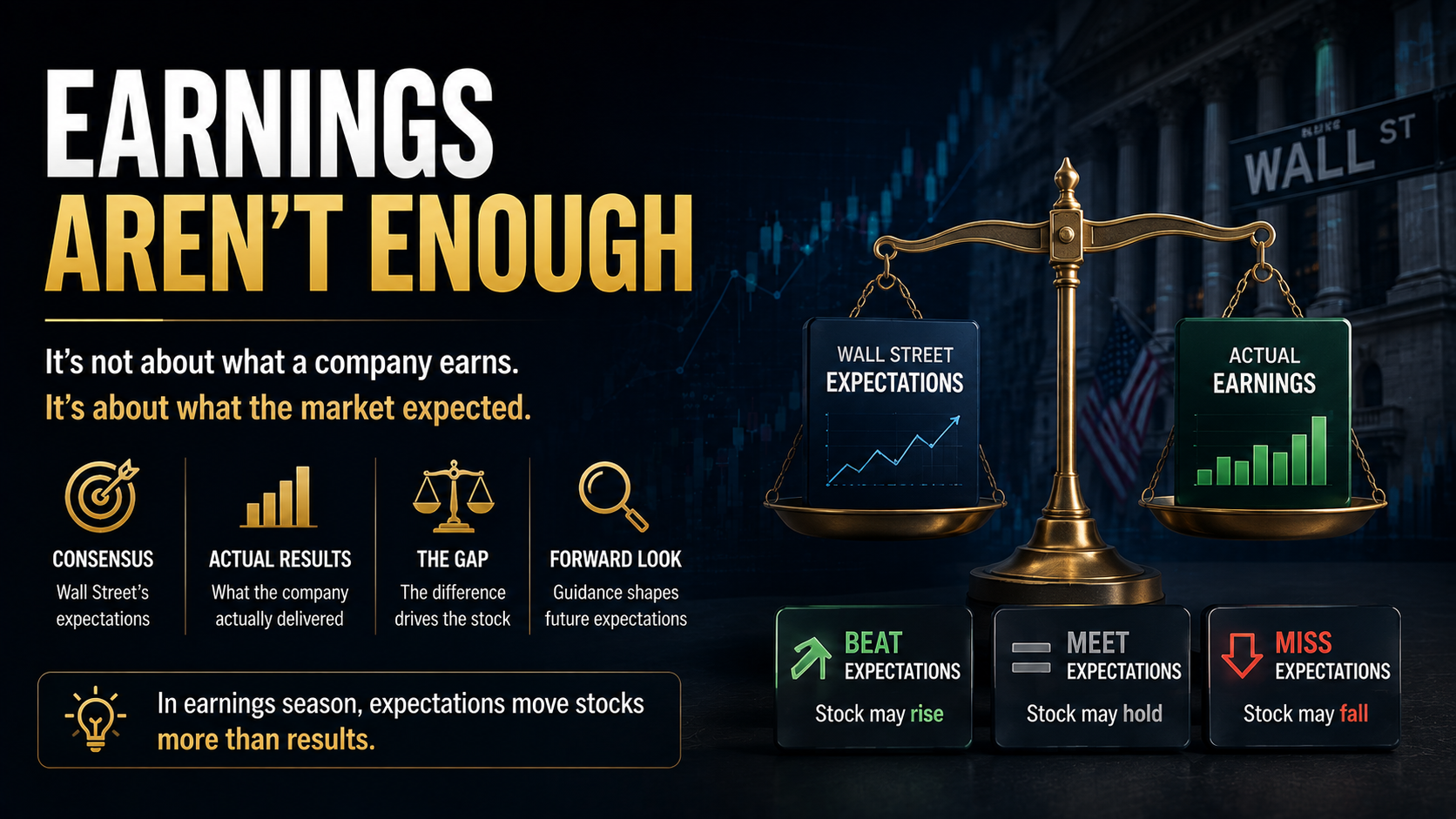
What Does Wall Street Consensus Mean?
Before a company reports earnings, analysts have already produced estimates for its revenue, EPS, margins, and other financial metrics.
The combined expectation of analysts is commonly referred to as the consensus estimate.
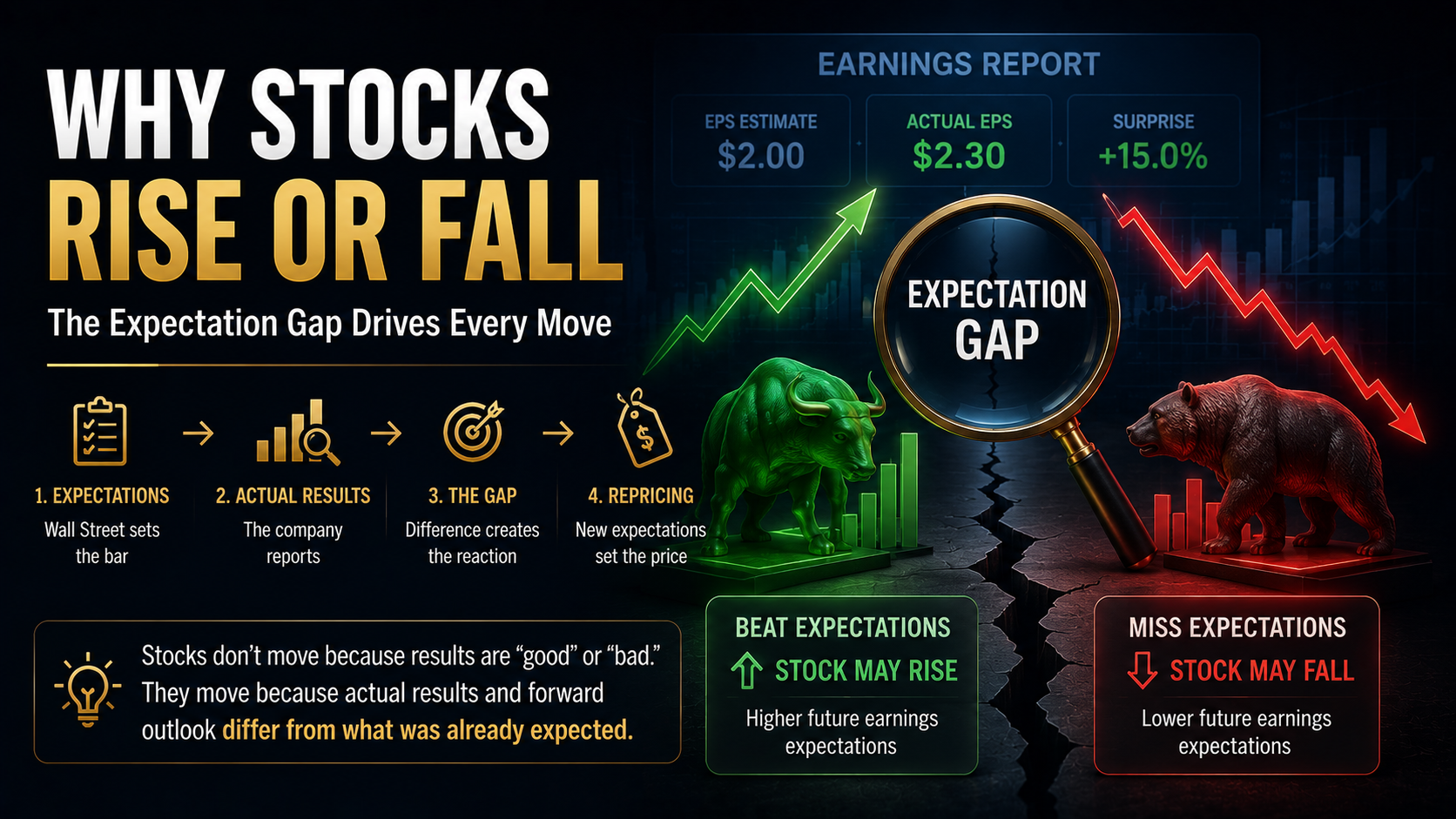
Suppose Wall Street expects a company to generate
- $10 billion in quarterly revenue
- $2.00 in EPS
The company instead reports
- $10.8 billion in revenue
- $2.30 in EPS
The company has exceeded expectations.
Investors commonly describe this as an earnings beat or earnings surprise.
But there is an important distinction.
A company's profits can grow substantially from the previous year and still disappoint Wall Street.
Imagine EPS rises from $1.50 to $2.00.
On the surface, that represents strong earnings growth.
But if Wall Street expected $2.40, the report may still be interpreted negatively.
This leads to one of the most important principles of earnings-season investing
Absolute growth matters, but the gap between expectations and reality often determines the immediate stock reaction.
Why Do Stocks Surge or Crash After Earnings?
A useful way to understand post-earnings price movements is
Existing Expectations → Actual Results → Forward Outlook → New Expectations → Repricing
The earnings announcement provides new information.
Investors then use that information to update assumptions about future revenue, margins, cash flow, and ultimately the value of the business.
That repricing can happen extremely quickly.
Earnings Beats and Misses Are Only the Beginning
The first numbers investors usually see are revenue and EPS.
If both significantly exceed consensus estimates, the stock may rise as investors increase their future earnings assumptions.
If results miss expectations, the stock may fall.
However, investors should not stop there.
A company can beat both revenue and EPS estimates and still fall 10% after hours.
Why?
Because Wall Street is always looking forward.
Why Forward Guidance Can Matter More Than Reported Earnings
Forward guidance refers to management's expectations for future revenue, earnings, margins, demand, or other business metrics.
This is often one of the most important components of an earnings report.
Consider a company that reports excellent quarterly results but tells investors that revenue growth is likely to slow during the next quarter.
The market may conclude
“The previous quarter was strong, but future earnings may not be as strong as we expected.”
The stock can therefore decline despite the headline earnings beat.
The opposite can also happen.
A company may miss estimates for the previous quarter but issue unexpectedly strong guidance for the coming quarters.
Investors may look past the weak historical results and bid the stock higher.
A simplified framework looks like this
| Reported Results | Forward Guidance | Potential Market Interpretation |
| Beat | Raised | Strongest combination |
| Beat | Lowered | Strong quarter, weaker future |
| Miss | Raised | Weak past, improving outlook |
| Miss | Lowered | Most challenging combination |
These are not mechanical trading rules.
Valuation, positioning, interest rates, and expectations before the announcement can completely change the stock's reaction.
What Does “Priced In” Mean?
One of the most important concepts during earnings season is that markets anticipate events.
A stock does not wait until earnings day to reflect expectations.
Investors may spend weeks analyzing
- Industry demand
- Channel checks
- Competitor results
- Product launches
- Supply-chain conditions
- Commodity prices
- Cloud spending
- Advertising trends
- Consumer spending
- Interest rates
If investors become increasingly optimistic, the stock may rally substantially before earnings.
By the time the company officially reports strong numbers, much of the good news may already be reflected in the share price.
This is what investors mean when they say an outcome was “priced in.”
The company can therefore report excellent numbers and still sell off.
The problem was not necessarily the earnings.
The problem may have been that expectations were even higher.
Markets do not reward good news in isolation. They respond to the difference between new information and the expectations embedded in the price.
Why the Quality of Earnings Matters
Headline EPS is useful, but sophisticated investors look beneath it.
Two companies can report similar earnings growth while having completely different underlying financial conditions.
Revenue Quality
Investors should determine where growth is coming from.
Is demand genuinely expanding?
Or did revenue increase because of temporary pricing, acquisitions, or a one-time contract?
Sustainable demand generally deserves more attention than temporary revenue boosts.
Operating Margins
A rapidly growing company may still face problems if costs are rising faster than revenue.
If sales grow 20% while operating margins consistently deteriorate, the economics of that growth deserve closer examination.
Cash Flow
Accounting earnings and actual cash generation are not identical.
For long-term investors, operating cash flow and free cash flow can provide important evidence about the underlying health of a business.
Ultimately, companies survive, reinvest, repay debt, repurchase shares, and return capital using cash.
Inventory
Inventory can be particularly important for semiconductor, industrial, retail, automobile, and consumer-goods companies.
If inventories grow much faster than sales, it may indicate weakening demand or potential future discounting.
Why Earnings Season Matters to Investors
Earnings season concentrates enormous amounts of new information into a relatively short period.
Investors receive
- Financial results
- Forward guidance
- Management commentary
- Analyst estimate revisions
- Industry demand signals
- Capital-spending plans
- Margin expectations
Institutional investors then reassess where capital should be allocated.
This is why earnings season can produce dramatic rotations between sectors and individual companies.
The underlying principle is simple
Markets are constantly deciding which businesses deserve capital based on their expected future returns.
Earnings season provides fresh evidence for making that decision.
How Should Investors Evaluate a Stock That Surges After Earnings?
A sharp post-earnings rally can be exciting, but the percentage gain alone tells investors very little.
The first question should be
What changed?
Did Revenue and EPS Both Beat Expectations?
An EPS beat driven primarily by aggressive cost cutting can have a different long-term meaning than a report showing strong revenue growth, expanding margins, and rising earnings.
Was Guidance Raised?
A guidance increase can force analysts to revise future earnings estimates higher.
That can provide more fundamental support for a rally than a one-quarter earnings surprise alone.
Did Cash Flow Improve?
Improving free cash flow can strengthen the case that earnings growth reflects genuine economic improvement in the business.
What Happened to Valuation?
A great company can still become an expensive stock.
If the share price rises much faster than earnings expectations, investors may simply be paying a much higher multiple for the same business.
The distinction between business quality and purchase price remains important even after an outstanding earnings report.
Why Chasing a Post-Earnings Gap Can Be Dangerous
A stock that jumps 15% after hours can trigger powerful fear of missing out.
But the initial reaction does not always become the final reaction.
A stock may surge in after-hours trading and give back much of the gain during the regular session.
Management commentary during the earnings call can also change how investors interpret the headline results.
Rather than focusing exclusively on the gap higher, investors can ask
- Was the rally driven by sustainable operating improvement?
- Was guidance raised?
- Are analyst earnings estimates likely to rise?
- Has valuation become significantly more demanding?
- Is the market simply reacting to extremely low expectations?
The more important question is not whether the stock jumped.
It is whether the information responsible for the jump meaningfully changed the company's future cash-generating potential.
Is a Post-Earnings Crash a Buying Opportunity?
The same logic applies in reverse.
When a stock falls 20% after earnings, investors may immediately assume it has become cheap.
But a lower stock price does not automatically mean a lower valuation.
The first question should be
Did the price fall, or did the value of the business fall with it?
Temporary Problems vs. Structural Deterioration
Some earnings disappointments can be temporary.
Examples might include
- One-time expenses
- Temporary supply disruptions
- Foreign-exchange headwinds
- Short-lived production interruptions
If the company's long-term competitive position and cash-generating ability remain intact, investors may eventually treat the selloff differently.
Structural problems require more caution.
Potential warning signs include
- Declining market share
- Persistent revenue weakness
- Falling operating margins
- Major guidance cuts
- Rising inventories
- Weakening free cash flow
- Increasing debt
- Loss of competitive advantage
When several of these factors appear simultaneously, the market may not simply be reacting emotionally.
It may be lowering its estimate of the company's long-term earning power.
A stock that has fallen 30% is not automatically 30% cheaper in economic terms.
If future earnings estimates fall even faster, the valuation may remain expensive.
Why Automatically Averaging Down Can Be Risky
Investors often become anchored to the price they originally paid.
After a large earnings-related decline, buying more shares can appear attractive because it lowers the average cost basis.
But the original purchase price has no influence on the company's future value.
The more important question is whether the original investment thesis still holds.
If the earnings report reveals weaker growth, deteriorating margins, rising debt, or a damaged competitive position, a lower stock price may reflect genuinely weaker fundamentals.
Before averaging down, investors should reassess the business rather than simply react to the percentage decline.
Managing Risk Before an Earnings Report
Earnings announcements create a special type of risk.
Stocks can gap sharply higher or lower before the regular trading session begins.
That means investors may not always be able to exit at the price they expected.
No investor can consistently predict every earnings surprise, management comment, or guidance revision.
This changes the key question before an earnings report from
“Will the company beat estimates?”
to
“What happens to my portfolio if my expectations are wrong?”
That is a fundamentally different way of thinking about risk.
Successful long-term investing does not require correctly predicting every quarterly report.
It requires surviving the reports that surprise you.
Why the Earnings Call Matters
The press release provides the numbers.
The earnings call often provides the context.
During the call, management discusses business conditions and answers questions from analysts.
Several areas deserve particular attention.
Demand
Are customers ordering more products or services?
Are sales cycles becoming longer?
Is demand accelerating or slowing?
Pricing Power
Can the company raise prices without losing significant demand?
Strong pricing power can help protect margins during inflationary periods.
Margins
Is revenue growth translating into higher operating profits?
A company growing sales while sacrificing increasingly large amounts of profitability may face a different long-term outlook.
Capital Expenditures
Capital expenditures, or CapEx, can provide clues about management's confidence in future demand.
This is particularly important for industries such as semiconductors, AI infrastructure, utilities, telecommunications, and manufacturing.
Changes in Management Language
Investors should also listen for changes in tone.
Management moving from language such as “strong demand” to “stable demand” may appear insignificant, but subtle wording changes can reveal shifts in business momentum.
The income statement tells investors what happened.
Guidance and management commentary help explain what may happen next.
How Earnings Season Can Affect the Broader Market
Earnings reports do not only move individual stocks.
Large companies can influence entire sectors and major U.S. indexes.
| Market | Potential Earnings-Season Impact |
| Individual stocks | Repricing based on results and guidance |
| Sectors | Industry leaders can reset expectations for competitors and suppliers |
| S&P 500 / Nasdaq | Mega-cap earnings can materially influence index performance |
| Treasury market | Corporate growth and CapEx expectations can affect the economic and rate outlook |
| U.S. dollar | Changes in U.S. growth expectations can indirectly affect currency markets |
| Gold | Risk sentiment and macro expectations can influence safe-haven demand |
| Bitcoin | Liquidity and broader risk appetite can affect crypto valuations |
These relationships are not fixed.
For example, exceptionally strong corporate earnings may initially support equities.
But if investors interpret those results as evidence that the economy remains unusually strong, Treasury yields could rise.
Higher long-term yields can then pressure the valuation multiples of expensive growth stocks.
For U.S. investors, corporate earnings therefore need to be viewed alongside Treasury yields, liquidity conditions, and valuation.
Earnings Season and Sector Rotation
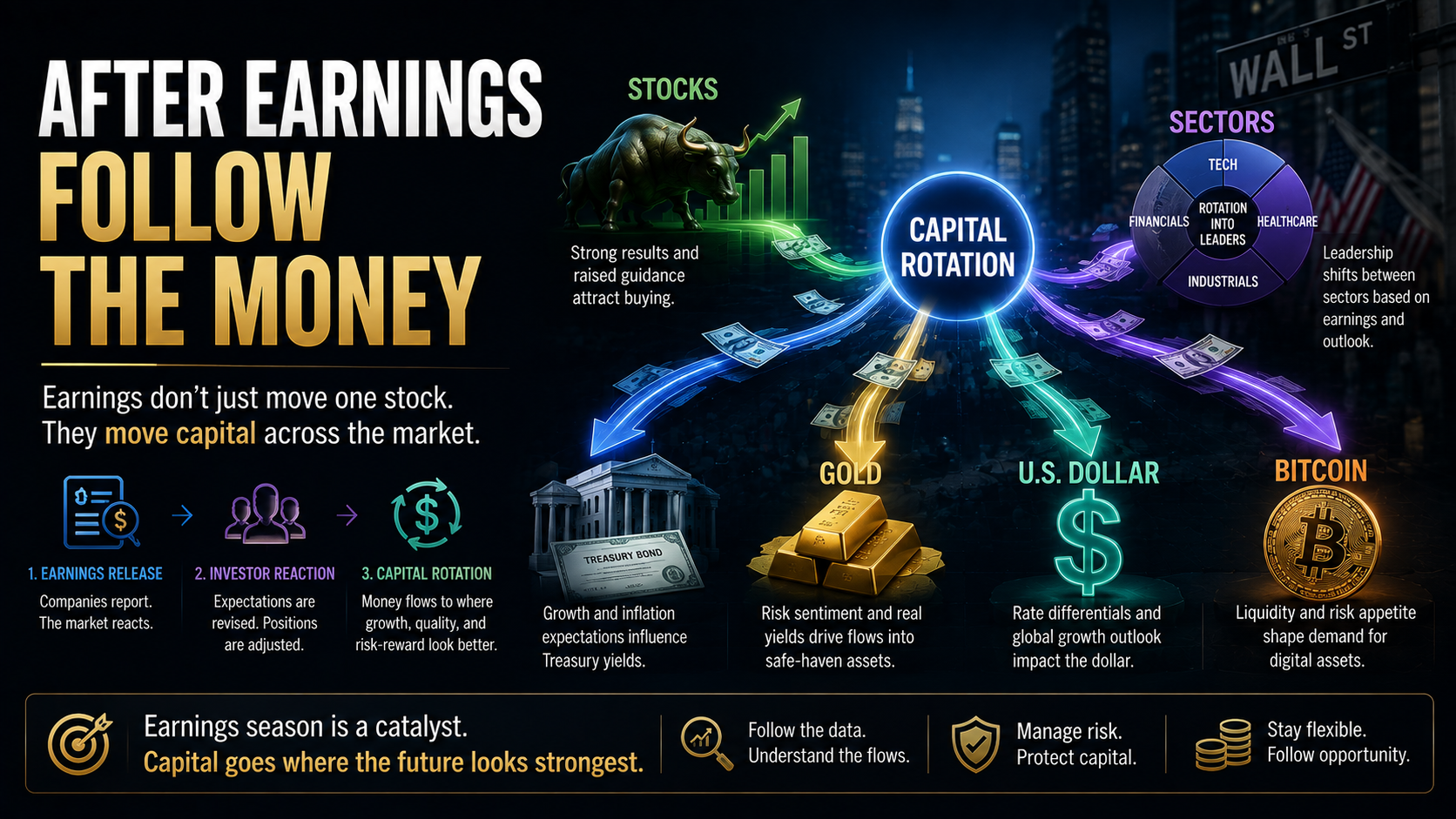
One of the most useful ways to analyze earnings season is to look beyond individual companies.
Suppose several semiconductor companies report stronger-than-expected demand and raise guidance.
Investors may conclude that the improvement is not company-specific.
Capital could begin moving across the broader ecosystem, potentially affecting
- Chip designers
- Semiconductor manufacturers
- Memory producers
- Equipment suppliers
- Data-center infrastructure
- Power and cooling companies
The opposite can happen when several companies in the same industry cut guidance.
Capital may leave that industry and rotate toward sectors offering stronger earnings visibility, better cash flows, or more attractive valuations.
This is why earnings season can reveal something larger than who beat EPS estimates.
It can reveal where Wall Street believes the next dollar of earnings growth may come from.
An Earnings Report Checklist for Investors
Instead of looking at the stock price first, investors can analyze earnings in the following order.
1. Revenue and EPS
What did the company actually report?
2. Consensus Expectations
How did those results compare with Wall Street estimates?
3. Forward Guidance
Did management raise, maintain, or lower its outlook?
4. Margins
Is growth becoming more or less profitable?
5. Cash Flow
Is accounting profit translating into real cash generation?
6. Inventory and Debt
Are there signs of future operating or financial pressure?
7. Valuation
How much future growth is already reflected in the stock price?
8. Market Reaction
How did the stock trade after hours and during the regular session, and what happened to peers in the same industry?
This framework helps separate a dramatic stock-price reaction from the underlying economic change in the business.
Questions to Ask After Every Earnings Report
Instead of asking whether a stock will rise tomorrow, long-term investors can ask
- Did the company genuinely beat expectations?
- Did management raise or lower future guidance?
- Are revenue, margins, and cash flow improving together?
- Is the problem temporary or structural?
- How much optimism was already priced into the stock?
- Has the long-term investment thesis changed?
- Did the earnings report change expectations for the entire industry?
- Can my portfolio absorb an outcome that differs from my expectations?
These questions will not predict every short-term move.
That is not their purpose.
Their purpose is to help investors distinguish price volatility from changes in fundamental value.
What Do Wealthy Investors Look for During Earnings Season?

While much of the market focuses on whether a stock is up or down after hours, long-term capital tends to focus on a different set of questions.
Follow the Money
A 20% rally in one company is interesting.
A simultaneous repricing across an entire industry can be much more important.
If a strong earnings report causes competitors, suppliers, and infrastructure companies to rise together, investors may be witnessing a broader change in expected industry profitability.
Likewise, if capital continues leaving an industry despite decent earnings, larger forces such as interest rates, valuation, or economic conditions may be dominating company-specific fundamentals.
Follow the Cash Flow
Over long periods, businesses need cash.
Consider two growth patterns.
Revenue Growth → Profit Growth → Cash-Flow Growth
versus
Revenue Growth → Rising Costs → Weakening Cash Flow
Both companies may initially appear to be growing.
But their long-term economics can be very different.
Look for Financial Survivability
Fast growth attracts attention during bull markets.
Survivability becomes important when conditions deteriorate.
Cash reserves, debt levels, margins, free cash flow, competitive advantages, and pricing power can determine which companies continue investing through difficult periods and which are forced to retreat.
Think Beyond the Quarter
Investing is not a competition to predict every quarterly EPS number.
The more durable objective is to own assets whose long-term economics remain attractive while controlling the damage when assumptions prove wrong.
That leads to several useful questions
Did the stock fall, or did the business deteriorate?
Did the stock rally because future cash flows improved, or because expectations became more optimistic?
How much growth is already embedded in today's valuation?
If my thesis is wrong, can my portfolio survive the mistake?
These questions are more valuable than attempting to predict every after-hours move.
Final Thoughts
Earnings season is one of the clearest examples of how markets convert expectations into prices.
A strong earnings report does not guarantee a higher stock price.
A weak earnings report does not automatically create a bargain.
The more useful framework is
Results → Consensus → Guidance → Margins → Cash Flow → Valuation → Market Reaction
When a stock surges or crashes after earnings, investors should look beyond the percentage move and determine what actually changed.
Did future earnings expectations improve?
Did the company's competitive position strengthen?
Did cash-flow expectations rise?
Or did the market simply correct an expectation that had become too optimistic?
The most important lesson to remember during earnings season is this
Investors should analyze not just how far a stock moved, but what changed in the expectations and fundamental value behind that move.
Long-term success does not require predicting every earnings surprise.
It requires avoiding the kind of mistakes that prevent you from staying invested long enough for compounding to work.
This was MasterMind.
'[Global] Success Blueprints' 카테고리의 다른 글