What Is the Illusion of Control in Investing? How It Increases Risk and How Investors Can Avoid It


Hello, this is MasterMind.
Have you ever spent hours studying a company, reviewing earnings reports, watching Treasury yields, analyzing charts, and following every Federal Reserve headline—only to see the market move in the exact opposite direction you expected?
The more work investors put into research, the easier it becomes to believe they understand what will happen next.
A few successful trades can make that feeling even stronger.
“I knew this stock would rally.”
“I understand how this market works.”
“I can get out before everyone else.”
But there is an important difference between making an informed decision and controlling the outcome of that decision.
Financial markets contain too many variables for any individual investor to control.
Behavioral psychology describes our tendency to overestimate our influence over uncertain outcomes as the illusion of control.
For investors, understanding this bias matters because it can quietly lead to excessive trading, concentrated positions, unnecessary leverage, and poor risk management.
The Bottom Line
The illusion of control occurs when investors believe their research, experience, or actions give them more control over market outcomes than they actually have. The solution is not to stop analyzing markets, but to focus on controlling portfolio risk rather than trying to control the market itself.
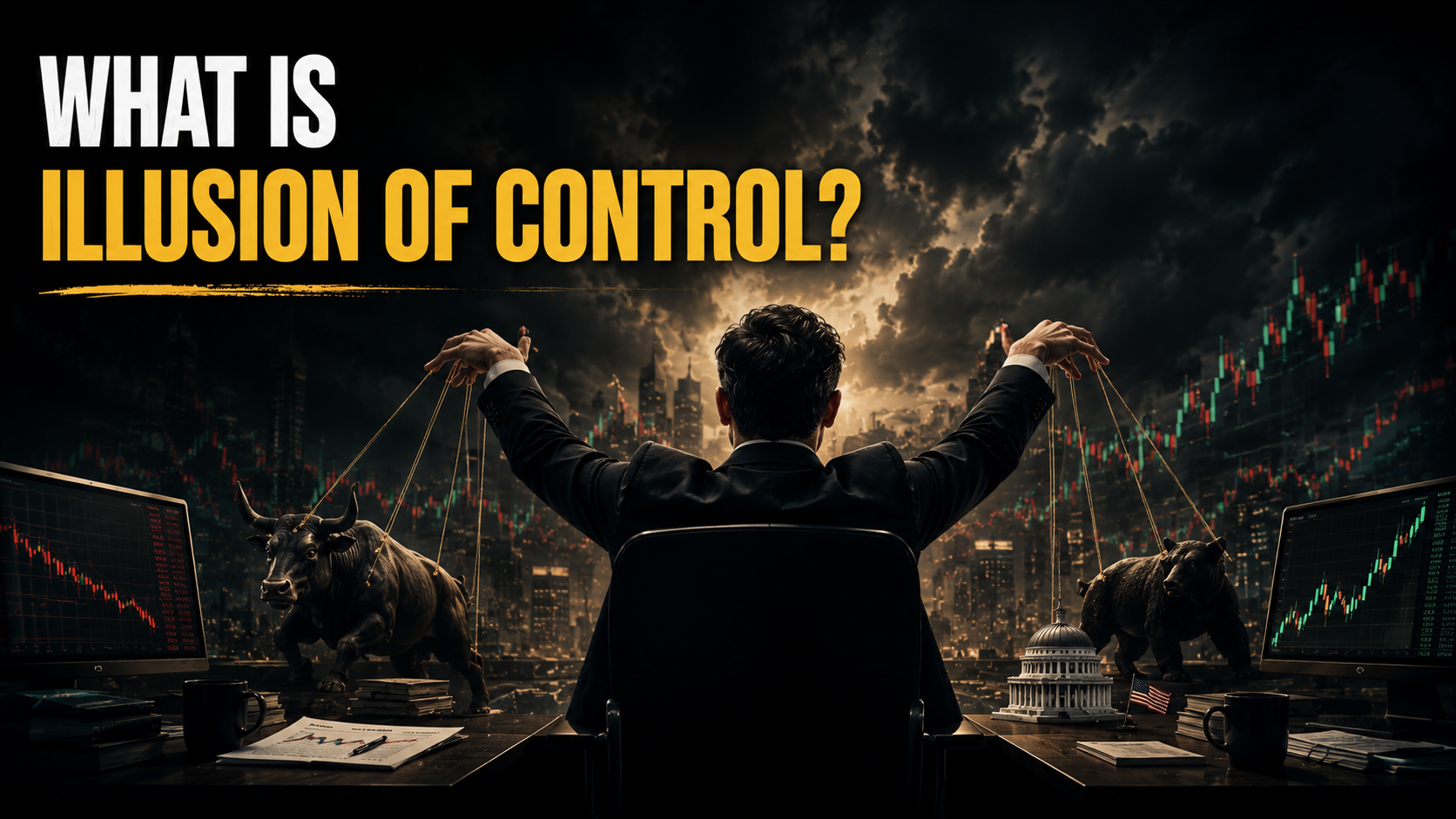
What Is the Illusion of Control?
The illusion of control is a psychological bias widely associated with the research of psychologist Ellen Langer.
It describes our tendency to believe that our choices or actions can influence outcomes that are substantially affected by chance or forces outside our control.
A classic example involves lottery tickets.
People may place greater value on a lottery ticket when they personally choose the numbers rather than receiving randomly assigned numbers.
Yet choosing the numbers does not improve the mathematical probability of winning.
Investing creates a similar psychological environment.
Investors can choose
- which stocks to buy,
- when to enter,
- how much capital to invest,
- which valuation model to use,
- which economic indicators to follow,
- and when to sell.
Because we control so many parts of the decision-making process, it becomes surprisingly easy to feel that we also control the outcome.
We do not.
You can choose to buy shares of a company.
You cannot choose what price the market assigns to those shares tomorrow.
That distinction is at the heart of the illusion of control in investing.
How the Illusion of Control Works in Financial Markets
Financial markets are almost perfectly designed to encourage this bias.
Investors constantly receive information and constantly make decisions.
The psychological process often looks something like this
More information → perceived pattern → successful outcome → greater confidence → greater risk exposure
Each stage can reinforce the next.
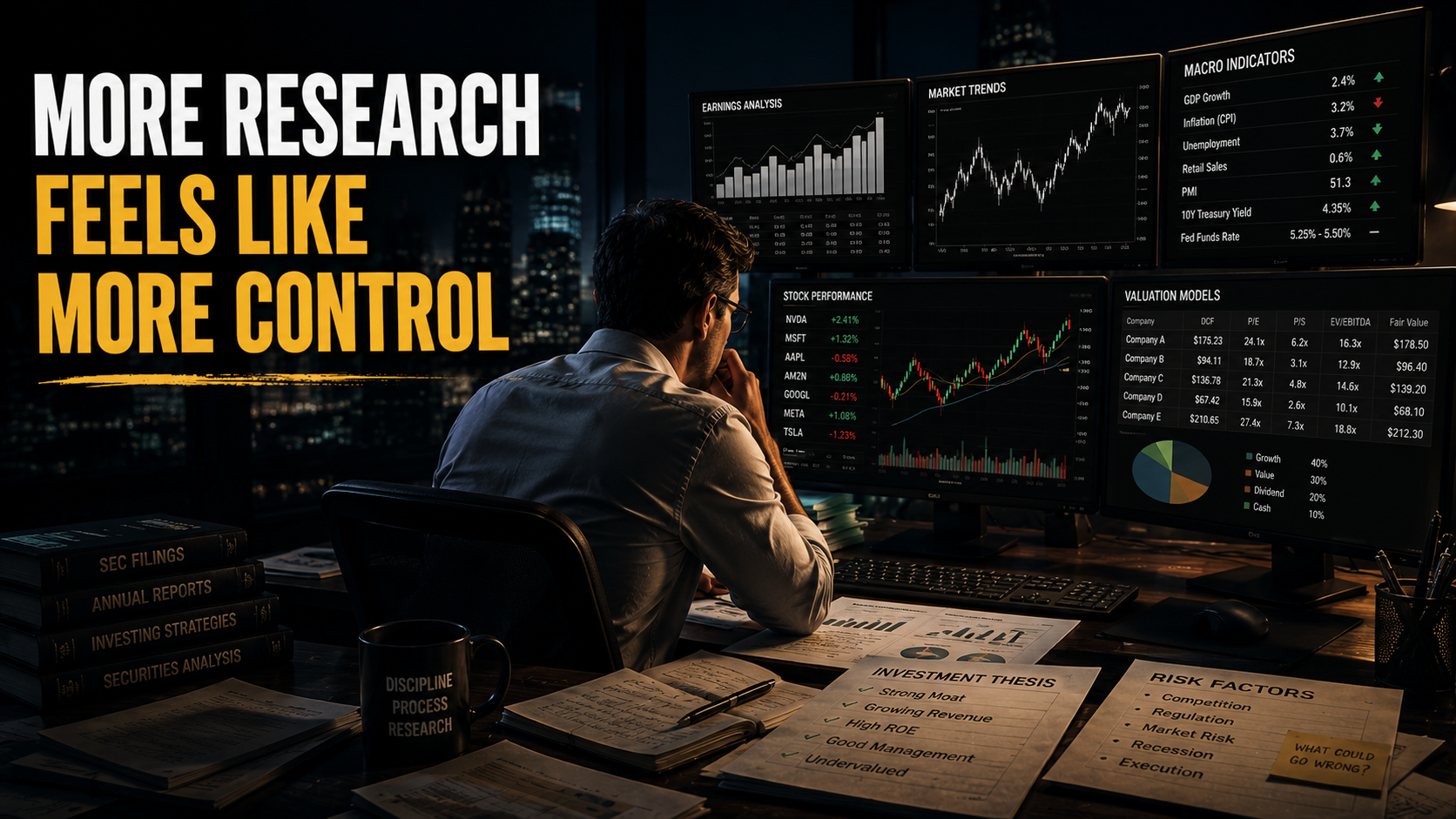
More Information Can Feel Like More Control
Research matters.
Reading SEC filings, studying earnings reports, comparing valuations, following monetary policy, and understanding an industry's competitive structure can improve investment decisions.
But better information does not eliminate uncertainty.
An investor may understand a company extremely well and still be unable to predict
- next quarter's demand,
- a competitor's new product,
- an unexpected earnings warning,
- changes in Treasury yields,
- a shift in Federal Reserve policy,
- geopolitical shocks,
- or a sudden change in market sentiment.
Research can improve the quality of a decision.
It cannot guarantee the outcome.
Analysis is a tool for improving probabilities, not a machine for producing certainty.
Why Investors See Patterns That May Not Exist
Humans are extremely good at recognizing patterns.
That ability is useful in everyday life, but financial markets can turn it against us.
Suppose an investor notices that a particular technical setup was followed by a rally three times.
The investor may begin treating that relationship as a reliable rule.
But markets are influenced by countless variables simultaneously.
Interest rates may have been falling.
Liquidity may have been expanding.
The entire technology sector may have been rallying.
Risk appetite may have been unusually strong.
What looks like a repeatable trading signal may partly reflect a favorable market environment.
This tendency to perceive meaningful connections in noisy or random information is sometimes associated with apophenia, or excessive pattern recognition.
Markets contain patterns.
But not every pattern contains predictive power.
When a Bull Market Makes Everyone Feel Smarter
The illusion of control can become especially powerful during strong bull markets.
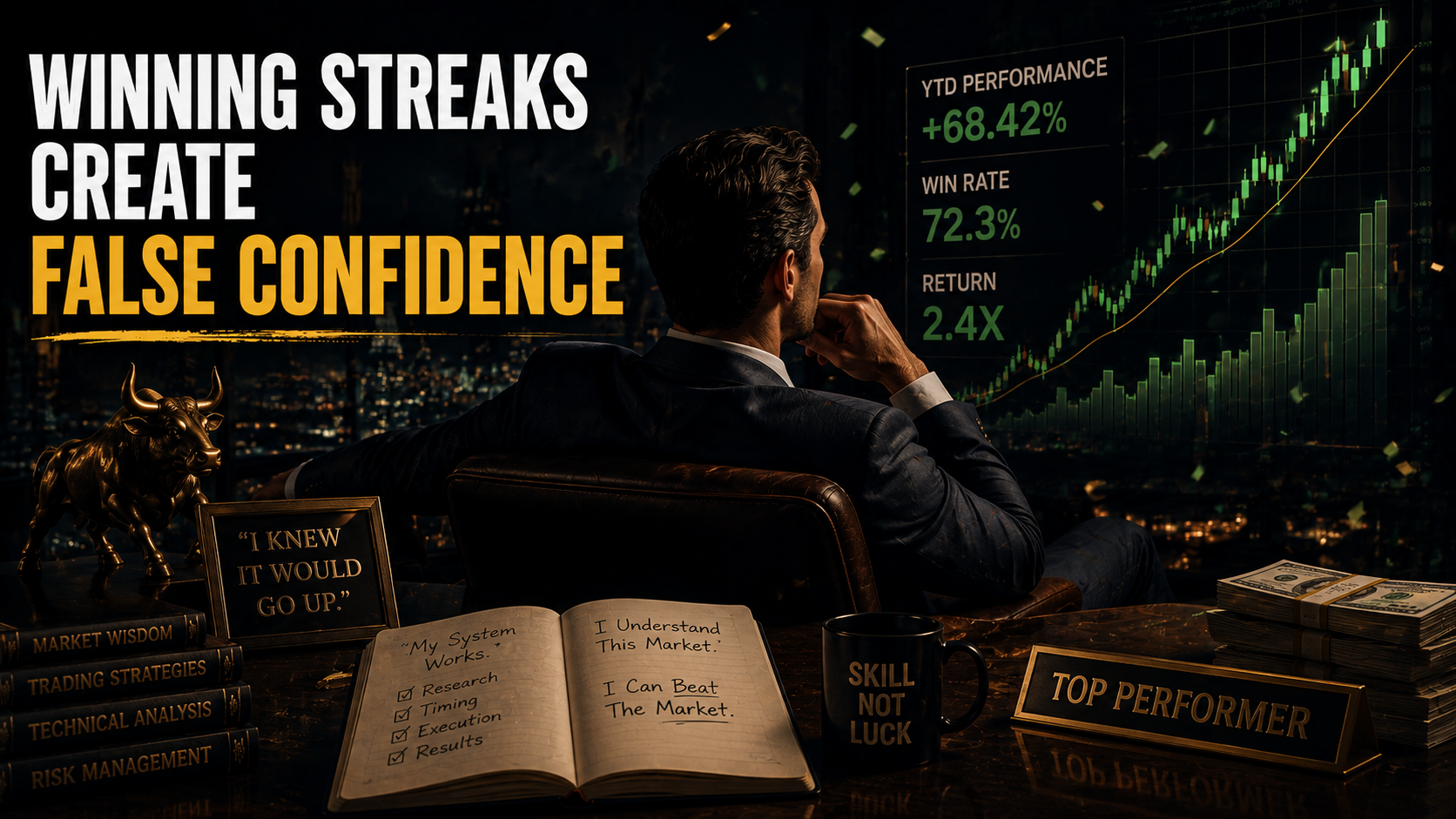
Imagine an investor buys several semiconductor and AI stocks and nearly every position rises.
After several successful trades, the natural conclusion may be
“My analysis is working.”
Perhaps it is.
But another explanation may also matter.
The entire sector could be benefiting from expanding valuations, strong earnings expectations, falling yields, or a massive wave of institutional capital flowing into AI-related equities.
Investment results rarely come entirely from one source.
They usually contain some combination of
skill + market environment + luck
The danger begins when investors attribute nearly every successful outcome to skill while blaming unsuccessful outcomes entirely on unusual external events.
That can gradually increase risk-taking.
Position sizes become larger.
Diversification decreases.
Leverage begins to look reasonable.
Eventually, a strategy designed for one market environment encounters a different one.
Hindsight Bias Makes the Problem Worse
Another behavioral bias can reinforce the illusion of control: hindsight bias.
After an event occurs, the outcome often appears more obvious than it actually was beforehand.
After a stock rallies, investors may think
“I knew the earnings report would be strong.”
After the Federal Reserve cuts rates
“It was obvious the Fed had to cut.”
After a market correction
“The valuation was clearly unsustainable.”
But before those events occurred, multiple outcomes were possible.
Hindsight compresses uncertainty.
When investors repeatedly reinterpret uncertain predictions as things they “knew” would happen, they may begin overestimating their forecasting ability.
Illusion of Control vs. Overconfidence
The illusion of control and overconfidence are closely related, but they are not identical.
Overconfidence means overestimating your own knowledge, skill, or forecasting ability.
The illusion of control means overestimating how much your actions or decisions can influence an uncertain outcome.
For example
“I understand this company better than most investors.”
That is primarily overconfidence.
Now consider
“I have researched this company so thoroughly that I know how the stock will react.”
That moves closer to the illusion of control.
In real-world investing, the two biases frequently reinforce each other.
Greater confidence can create a stronger sense of control, while a stronger sense of control can encourage investors to take larger risks.
Why the Illusion of Control Is Dangerous for Investors
Confidence itself is not necessarily harmful.
Investors need enough confidence to make decisions and remain disciplined during volatility.
The problem begins when confidence causes investors to underestimate uncertainty.
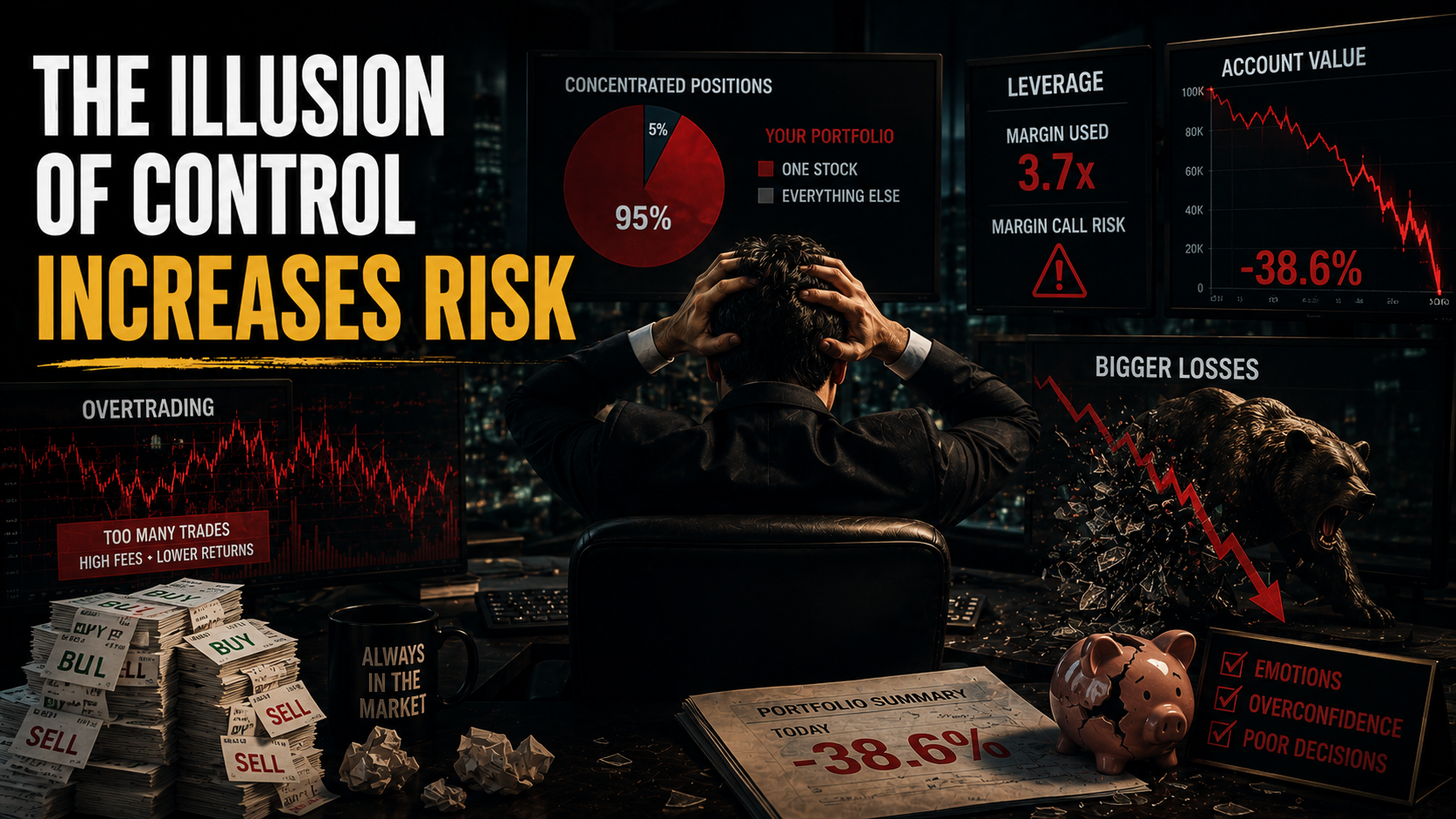
Risk Management Starts to Disappear
Every sensible investment strategy must allow for one uncomfortable possibility
You could be wrong.
The illusion of control makes that possibility feel less important.
An investor may increase a position because the thesis appears certain.
When the price falls, instead of reassessing the thesis, the investor may continue buying because the market is supposedly “wrong.”
Sometimes buying weakness is rational.
Sometimes it simply increases exposure to a broken thesis.
The difference depends on disciplined analysis rather than confidence alone.
Overtrading Becomes More Attractive
The more investors believe they understand short-term market movements, the more frequently they may feel compelled to act.
A stock drops.
Buy.
It rebounds.
Sell.
A Fed official speaks.
Reposition.
Treasury yields move.
Reposition again.
A new inflation report arrives.
Trade again.
Constant action can create the psychological feeling of control.
But activity and investment performance are not the same thing.
Higher trading frequency can increase transaction costs, taxes in taxable accounts, emotional decision-making, and opportunities to make mistakes.
Sometimes the most disciplined investment decision is to do nothing.
Portfolios Become Too Concentrated
Familiarity can also create false confidence.
An investor who spends months studying one industry may reasonably understand it better than before.
But knowledge can gradually turn into the belief that the risks are also fully understood.
That can encourage excessive concentration.
The problem is that even an excellent company can be affected by factors outside the investor's analysis
interest rates, regulation, recession, competition, valuation compression, technological disruption, or changing capital flows.
Knowing an asset well does not make the asset controllable.
How the Illusion of Control Appears Across Asset Classes
The bias is not limited to individual stocks.
It can appear differently across nearly every major financial market.
| Asset Class | How the Illusion of Control Appears | Potential Risk |
| U.S. Stocks | Excessive confidence in stock selection or technical signals | Concentration, overtrading, leverage |
| Treasuries & Bonds | Confidence in predicting Fed policy and interest rates | Duration and interest-rate risk |
| U.S. Dollar / FX | Treating one macro scenario as certain | Currency concentration and timing risk |
| Gold | Oversimplifying inflation and interest-rate relationships | Misreading real-rate and dollar dynamics |
| Bitcoin / Crypto | Believing short-term market timing is repeatable | Extreme volatility and leverage risk |
U.S. Stocks
In equities, the illusion of control often appears through stock-picking confidence.
An investor correctly identifies several winning companies and begins increasing position sizes.
This may work extremely well during a favorable market cycle.
But when liquidity, valuations, or earnings expectations change, the same strategy can suddenly produce very different results.
U.S. Treasuries and Bonds
Bond investors face a different version of the problem.
Consider the statement
“The Fed is going to cut rates, so long-duration Treasuries have to rise.”
The first part may ultimately be correct.
The second part is not guaranteed.
Inflation expectations, fiscal policy, Treasury issuance, term premiums, economic growth, and market positioning can all influence long-term yields.
Even a correct macroeconomic forecast does not guarantee a profitable market outcome.
The U.S. Dollar
Currency markets are driven by relative conditions between economies.
Interest-rate differentials, capital flows, economic growth, risk sentiment, and geopolitical events all matter.
A simple narrative such as “Fed cuts equal weaker dollar” may work in one environment and fail in another.
Gold
Gold provides another useful example.
Investors sometimes reduce gold to a single rule
“Inflation rises, therefore gold rises.”
Reality is more complicated.
Real interest rates, the dollar, central-bank demand, geopolitical risk, liquidity, and investor positioning can all influence gold prices.
Complex markets rarely obey a single permanent formula.
Bitcoin and Crypto
Crypto markets may create an especially strong sense of control because they operate around the clock.
Investors can constantly watch prices and constantly trade.
During a powerful crypto bull market, several successful entries and exits can create the impression that short-term timing has become a repeatable skill.
Combine that belief with high volatility and leverage, and a relatively small forecasting mistake can become a very large portfolio loss.
The Most Important Distinction: What Can You Actually Control?
One of the most useful ways to reduce the illusion of control is to divide investing into two categories.
What Investors Can Control
Investors can generally control
- asset allocation,
- position size,
- diversification,
- cash reserves,
- use of leverage,
- entry and exit rules,
- rebalancing discipline,
- investment horizon,
- tax awareness,
- and the amount of risk they are willing to accept.
What Investors Cannot Control
Investors cannot reliably control
- tomorrow's stock prices,
- the exact path of interest rates,
- the next recession,
- unexpected corporate events,
- geopolitical shocks,
- short-term market sentiment,
- what other investors will do,
- or when the next major correction will occur.
This distinction leads to one of the most important principles in investing
The market is not a game of controlling outcomes. It is a game of managing risk when outcomes cannot be controlled.
How Investors Can Reduce the Illusion of Control
The goal is not to eliminate confidence or stop analyzing markets.
The goal is to build a process that assumes uncertainty will always exist.
Separate Forecasting From Control
Economic and company analysis can help investors evaluate probabilities.
It cannot make outcomes certain.
Instead of thinking
“This stock will rise.”
A more useful framework might be
“The long-term fundamentals appear attractive, but valuation, rates, and execution remain meaningful risks.”
The second statement leaves room for uncertainty.
Think in Scenarios, Not Certainties
Investors often build portfolios around one expected future.
A more resilient approach considers several.
Suppose your base case is that lower inflation allows the Federal Reserve to cut interest rates.
Then ask
What happens if inflation remains sticky?
What happens if the Fed cuts because the economy enters a recession?
What happens if rates decline but the market already priced in the entire move?
Scenario analysis forces investors to confront the possibility that a reasonable forecast can still produce an unexpected investment outcome.
Judge the Decision, Not Just the Result
A profitable trade is not automatically a good decision.
A losing investment is not automatically a bad decision.
A reckless trade can make money because of luck.
A disciplined investment can lose money because an unpredictable event occurs.
This is why keeping an investment journal can be useful.
Record what you believed before the outcome was known.
Later, compare the original reasoning with what actually happened.
This makes it harder for hindsight bias to rewrite your investment history.
Use Position Size to Respect Uncertainty
One of the simplest ways to acknowledge uncertainty is through position sizing.
You may have strong conviction in an investment.
But conviction does not eliminate uncertainty.
The question therefore becomes
If I am completely wrong, can my portfolio survive?
That question is often more important than asking how much money you could make if everything goes right.
Remember That Doing Nothing Is Also a Decision
Modern markets provide endless opportunities to act.
Brokerage apps, financial television, social media, economic releases, and real-time price alerts constantly encourage investors to respond.
But activity is not control.
Sometimes the most rational response to new information is no response at all.
Patience is also an investment decision.
What Do Wealthy Long-Term Investors Look For?
Long-term wealth management is less about predicting every market move and more about building a portfolio capable of surviving many different environments.
That changes the questions investors ask.
Follow the Flow of Capital
Capital is always moving.
Money can rotate from growth stocks into value stocks, from equities into bonds, from risk assets into cash, or from defensive assets back into cyclical investments.
The goal is not necessarily to predict every rotation.
The more useful question is
How would a major change in capital flows affect my portfolio?
Focus on Cash Flow
Market prices can move dramatically even when the underlying business changes very little.
Over longer periods, however, the ability of a company to generate sustainable cash flow becomes increasingly important.
Instead of asking only
“How high could this stock go?”
Long-term investors may also ask
“Can this business continue generating cash through a difficult economic cycle?”
Evaluate Asset Survivability
A portfolio should not only perform when the investor's primary forecast is correct.
It should also have some ability to survive when that forecast is wrong.
Recessions happen.
Interest rates change.
Market leadership rotates.
Bubbles form and eventually deflate.
Unexpected events occur.
Survivability means building a portfolio that does not require one perfect economic scenario to succeed.
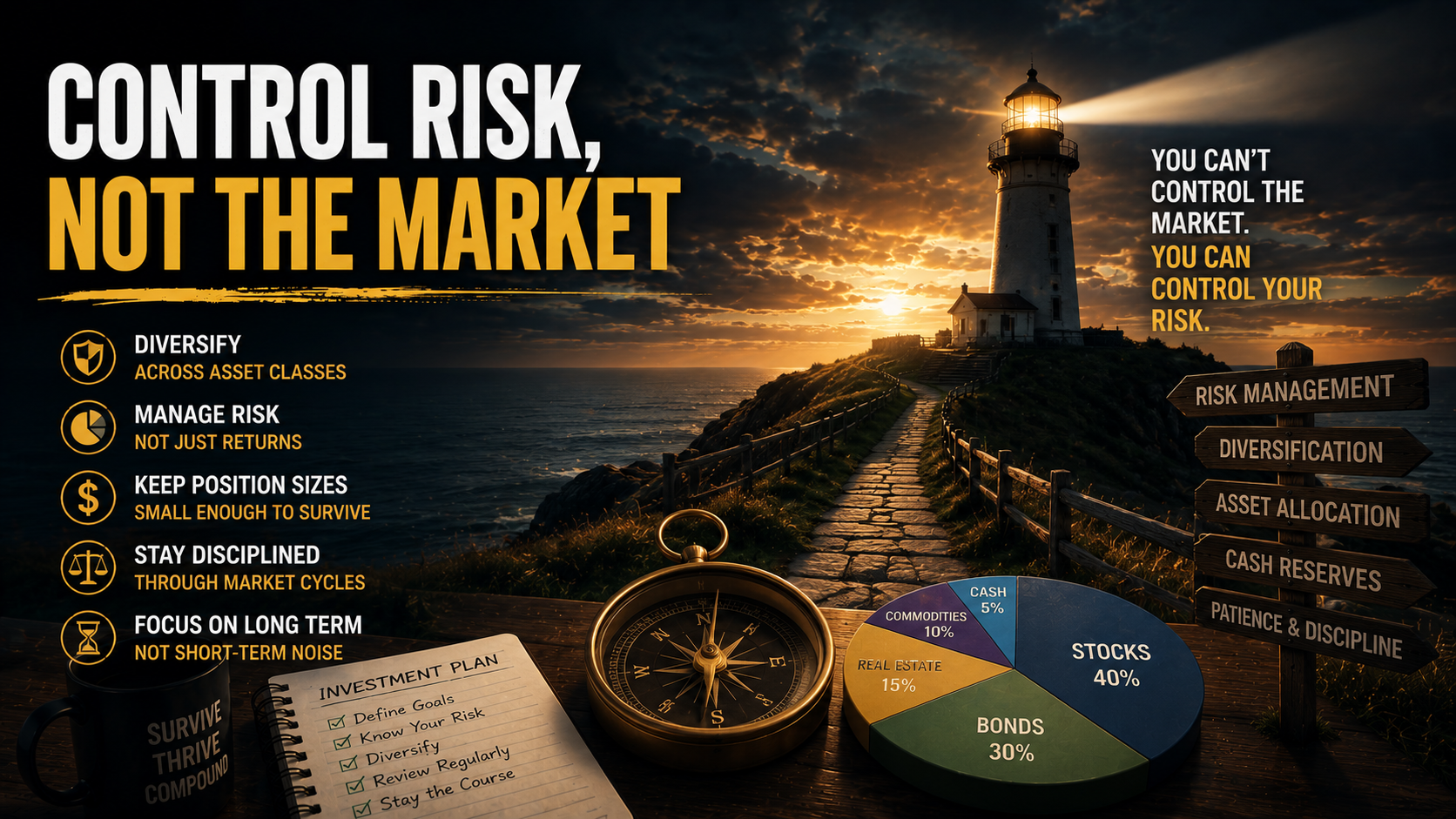
Control Exposure, Not the Market
Long-term investors cannot control the S&P 500, the Federal Reserve, Treasury yields, or Bitcoin.
They can control how much exposure they have to each source of risk.
That difference may sound simple, but it represents a major shift in investment psychology.
Ask yourself
- Am I analyzing the market, or am I starting to believe I can control it?
- How much of my recent performance came from skill, and how much came from the market environment?
- Would my portfolio survive if my strongest investment thesis were completely wrong?
- Am I overly concentrated because I feel unusually confident about one asset?
- Do I clearly understand which risks I can control and which I cannot?
- Am I paying enough attention to cash flow and financial durability rather than price predictions?
Final Thoughts
The illusion of control is the tendency to believe that our knowledge, choices, and actions give us more influence over uncertain outcomes than they actually do.
For investors, this bias can be particularly dangerous because financial markets constantly reward us with the feeling of control.
We can research.
We can forecast.
We can buy.
We can sell.
But we cannot determine what the market does next.
You cannot control tomorrow's stock price, but you can control your position size.
You cannot control the Federal Reserve's next decision, but you can control your exposure to interest-rate risk.
You cannot control market fear and greed, but you can control your leverage, diversification, cash reserves, and investment discipline.
That is the deeper lesson behind the illusion of control.
Successful investing is not about gaining control over an uncontrollable market. It is about controlling your own risk well enough to survive when the market proves you wrong.
Because in investing, predicting correctly matters—but surviving when you are wrong matters even more.
This was MasterMind.
'[Global] Success Blueprints' 카테고리의 다른 글