What Is Korea’s NSDS? How It Detects Naked Short Selling and Why It Matters


Hello, this is MasterMind.
Short selling is a normal part of U.S. equity markets. Hedge funds use it to express bearish views, market makers use short positions to facilitate trading, and institutional investors use it to hedge portfolio risk.
But what happens when a trader sells shares without properly securing the ability to deliver them?
That is where the distinction between legitimate short selling and naked short selling becomes critical.
South Korea has overhauled its short-selling infrastructure around that distinction. At the center of the new framework is the Naked Short-selling Detecting System, or NSDS, operated by the Korea Exchange.
For U.S. investors, NSDS is more than a technical change in a foreign market. It is part of a broader effort to strengthen market integrity, improve confidence in Korea’s equity-market infrastructure, and create clearer rules for domestic and global institutional investors.
So how does NSDS actually work, and could it change the way global capital views Korean stocks?
The Bottom Line
NSDS is a centralized monitoring system designed to compare institutional investors’ available share balances with actual sell orders and identify potential naked short-selling violations.
The important distinction is that Korea is not eliminating short selling.
Instead, the framework combines institutional-level controls designed to prevent orders beyond available balances with centralized monitoring designed to detect potential violations after trades enter the market.
In other words
The goal is not to eliminate bearish investing. It is to make sure short selling occurs within enforceable rules.
What Is Short Selling?
To understand NSDS, we first need to separate ordinary short selling from naked short selling.
In a traditional stock investment, an investor buys shares first and sells them later.
Short selling reverses that sequence.
Suppose a stock trades at $100.
An investor who expects the stock to decline borrows one share and sells it for $100.
If the stock later falls to $80, the investor can buy the share back for $80 and return it to the lender.
Ignoring borrowing costs, fees, and other expenses, the $20 difference represents the economic gain.
Short selling therefore allows negative views about a company to be reflected in market prices.
Covered Short Selling vs. Naked Short Selling
The critical difference is whether the seller has properly secured the shares needed for settlement.
| Type | Basic Structure | General Korean Treatment |
| Covered or borrowed short sale | Shares are borrowed or appropriately secured before the sale | Permitted under applicable rules |
| Naked short sale | Shares are sold without the required borrowing or availability | Prohibited |
This distinction should be familiar to American investors.
U.S. short-selling rules also include requirements designed to address the ability to borrow or deliver securities. Korea’s system is different in its implementation, but the underlying market-integrity problem is similar
How do regulators make sure investors are not selling shares they are not legally entitled to sell short?
NSDS is Korea’s answer to part of that problem.
What Is Korea’s NSDS?
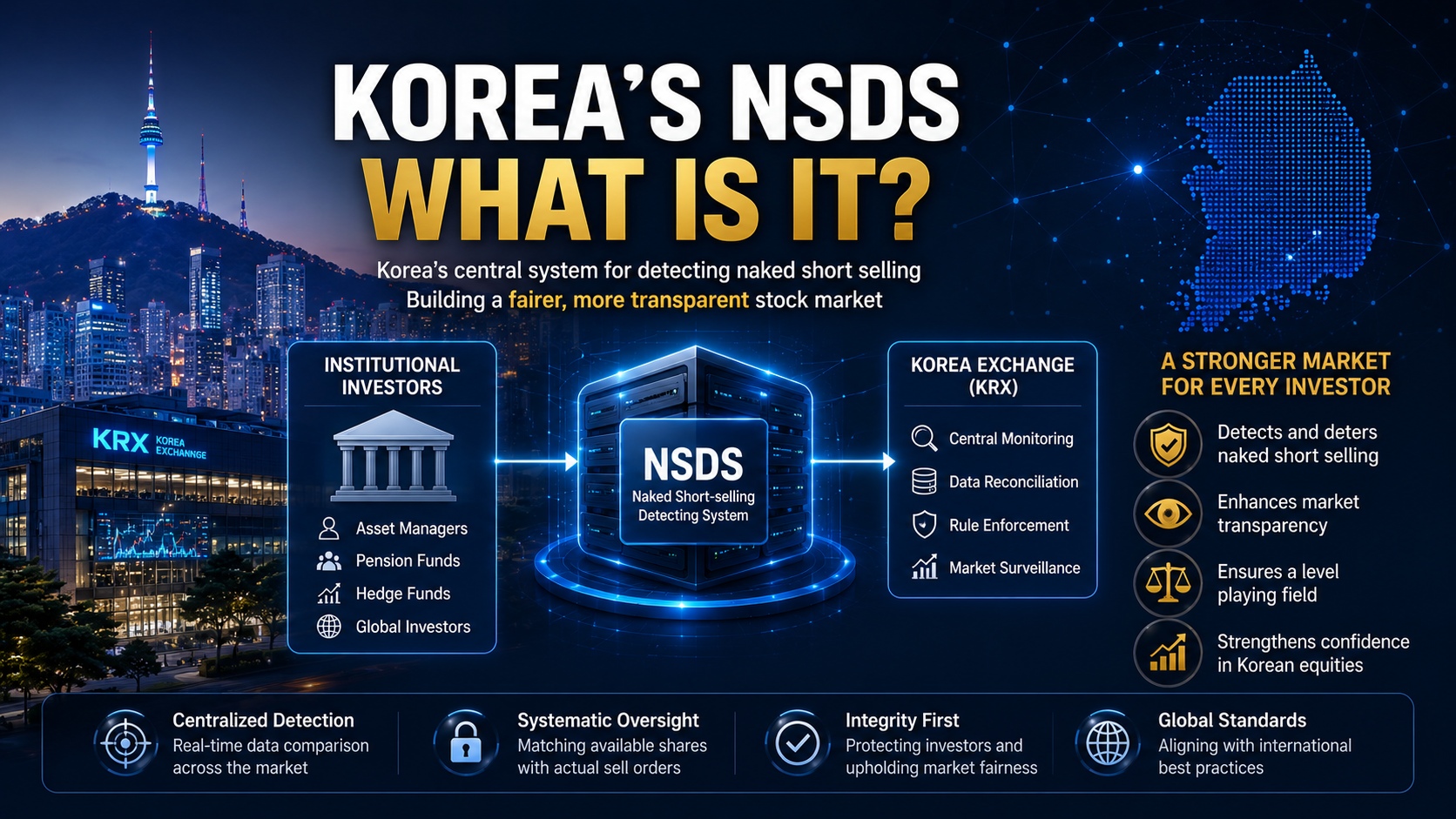
NSDS stands for Naked Short-selling Detecting System.
It is the Korea Exchange’s centralized short-selling monitoring system.
At a basic level, NSDS connects two important sets of information
What an institutional investor should be able to sell
and
what that investor actually sells into the market.
The simplified process looks like this
Institutional holdings and borrowed shares
↓
Internal balance-management system
↓
Sell orders submitted to the market
↓
Balance and transaction data collected
↓
NSDS compares the data
↓
Potential naked short-selling violations are flagged
This may sound straightforward, but the infrastructure behind it matters.
Large institutional investors can execute huge numbers of transactions across complex portfolios. Shares can be borrowed, returned, recalled, transferred, or affected by other transactions throughout the trading day.
That makes short-sale compliance fundamentally a data reconciliation problem.
NSDS attempts to make that reconciliation more systematic.
How Does Korea’s Short-Selling Computerization Work?
One of the easiest mistakes is to think NSDS is a single system that blocks every illegal order in real time.
The actual structure is more layered.
There are two major lines of defense.
1. Institutional Balance Controls Help Prevent Invalid Orders
Certain institutional investors subject to Korea’s short-selling system requirements must maintain systems capable of managing their available sell balances.
Think of this as the institution’s internal inventory system.
It needs to know how many shares are
- currently owned,
- borrowed,
- returned,
- recalled,
- or otherwise available for sale.
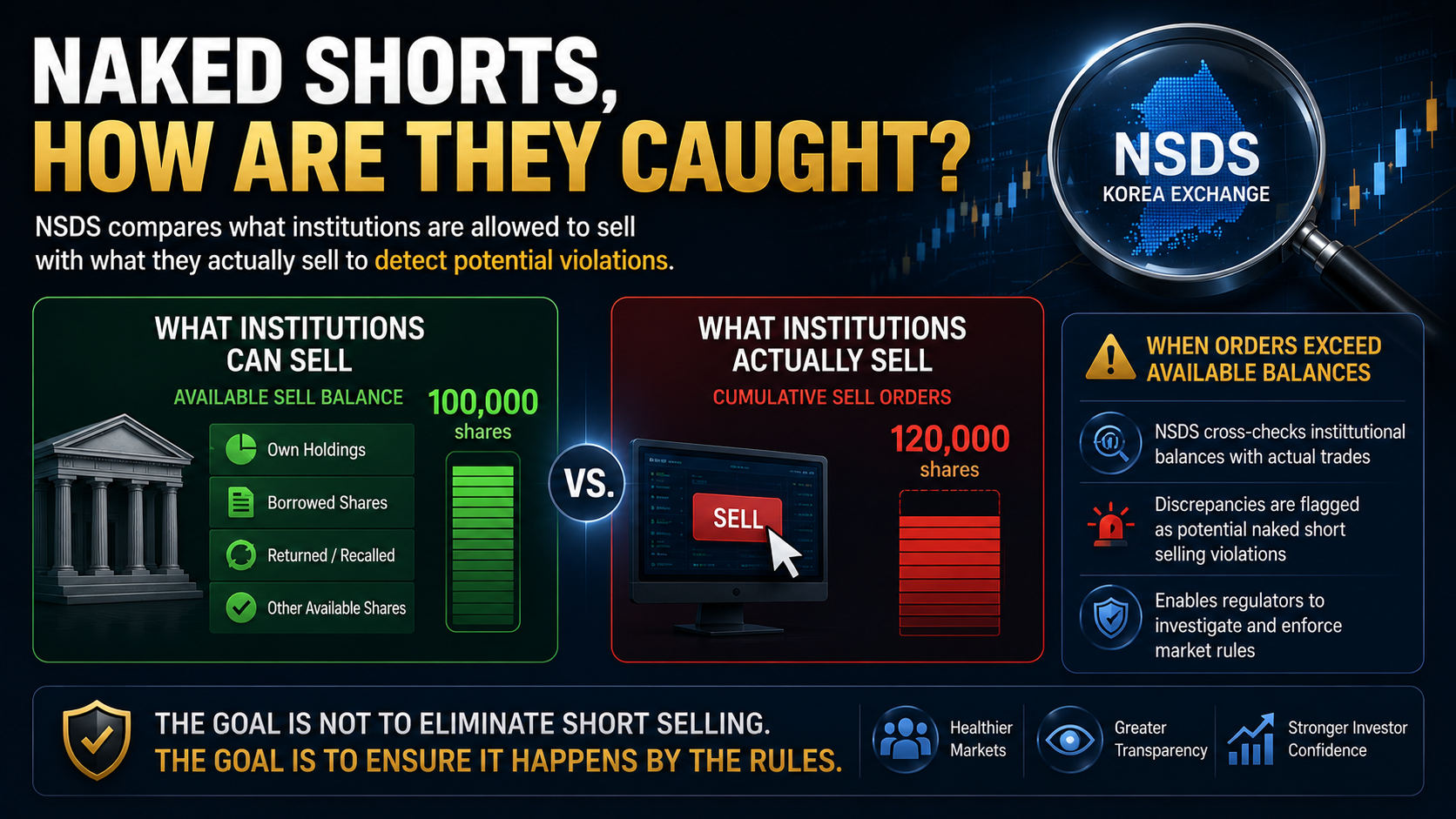
Suppose an institution effectively has 100,000 shares of Company A available to sell.
Its internal controls should prevent it from submitting sell orders beyond the permitted balance without the necessary share availability.
This is the preventive layer.
For American investors, the concept can be understood as part of the broader compliance infrastructure surrounding whether shares are available before a short transaction is executed.
2. NSDS Provides Centralized Monitoring
The second layer sits at the exchange level.
Institutions provide relevant balance and intraday balance-change information, while the Korea Exchange can compare that information with actual market transaction data.
NSDS can then look for discrepancies.
For example
Available sell balance: 100,000 shares
Cumulative sell orders: 120,000 shares
That 20,000-share difference does not automatically prove a violation.
But it creates something regulators can investigate.
This is why NSDS is better understood as a centralized detection and reconciliation system, not simply as a real-time kill switch for every suspicious trade.
Does NSDS Block Naked Short Selling in Real Time?
Not exactly.
This distinction matters because descriptions of Korea’s reforms sometimes blur together two different functions.
The institutional investor’s own balance-management system provides the preventive control intended to stop sell orders that exceed available balances.
NSDS provides the centralized detection layer by comparing institutional balance information with actual market activity.
A simplified framework is
Institutional system
Pre-trade prevention
↓
Broker controls
Compliance and internal-control verification
↓
Korea Exchange NSDS
Centralized reconciliation and ongoing post-trade detection
This layered structure is important.
Financial markets rarely rely on one control mechanism. They generally use multiple layers so that a failure at one point can potentially be detected somewhere else.
Why Are Short-Selling Registration IDs Important?
Centralized monitoring only works if regulators can connect transactions with the institution responsible for them.
That creates an identity problem.
Imagine receiving millions of transactions without being able to reliably match them to the institution whose balance records are being examined.
The comparison would be far less useful.
Korea’s framework therefore uses short-selling registration identification for institutions subject to the relevant requirements.
Conceptually, the process looks like this
Institution
↓
Identifiable balance records
↓
Sell orders carrying relevant identification
↓
Central reconciliation
This gives the monitoring system a way to connect an institution’s reported position information with its actual market activity.
A useful analogy is accounting.
A company cannot reconcile its bank account unless individual transactions can be matched with the underlying ledger.
NSDS applies a similar logic to short-selling oversight.
Why Does NSDS Matter?
The biggest issue is not whether short selling is bullish or bearish.
It is trust in the rules of the market.
Financial markets depend on disagreement.
One investor believes a company is undervalued and buys.
Another believes it is overvalued and sells.
A third may short the stock.
That disagreement is part of price discovery.
Problems arise when investors begin to believe that certain participants operate under fundamentally different rules.
That can damage confidence even when the underlying market mechanism is legitimate.
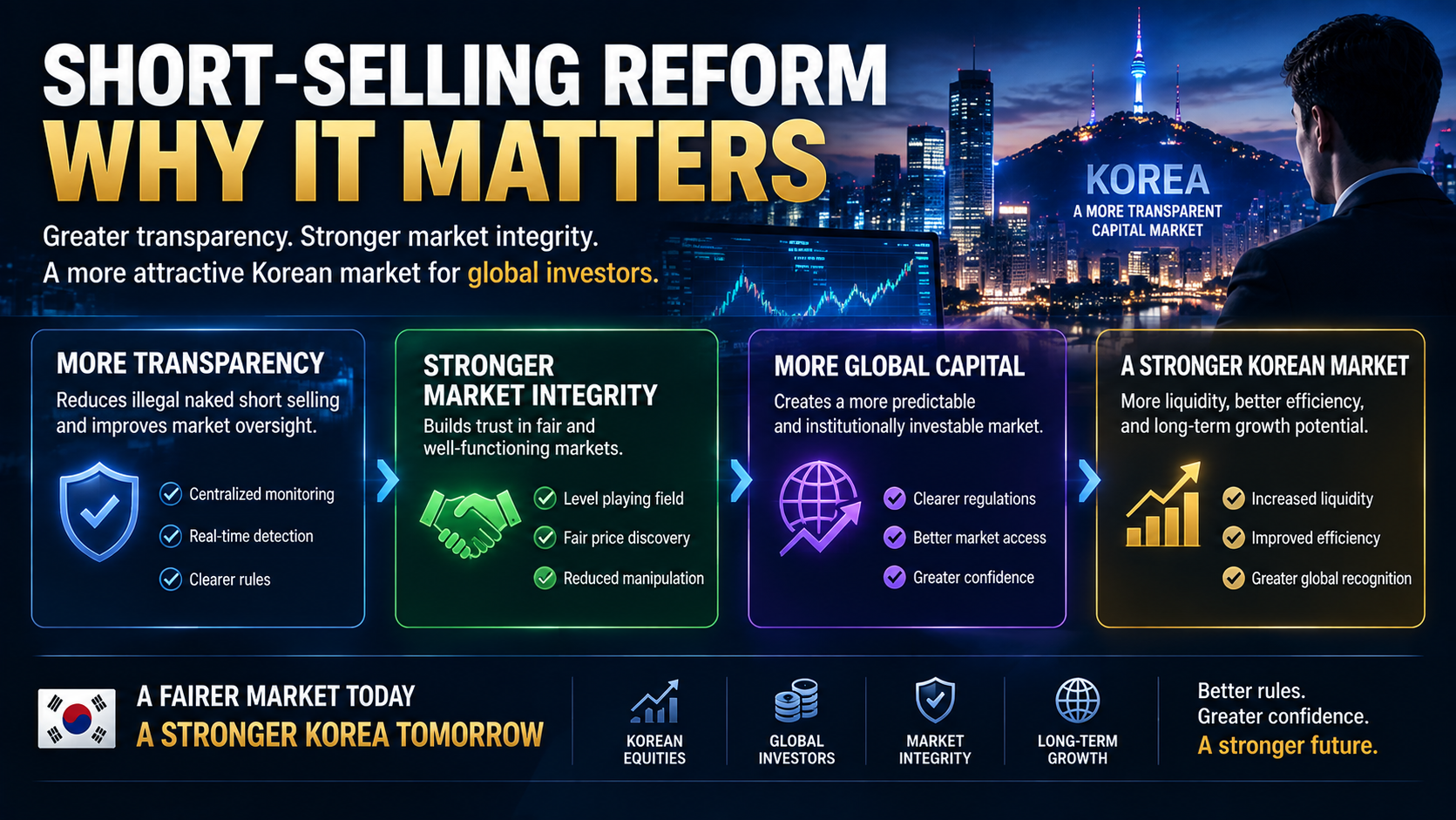
NSDS is therefore best understood as market infrastructure designed to improve the credibility of the trading process.
A healthy market does not require everyone to agree on price. It requires investors to trust the process through which that price is formed.
Will NSDS Make Korean Stocks Go Up?
This is where investors should be careful.
Short-selling reform is not automatically bullish for Korean equities.
Legal short selling remains part of the market.
If a company is losing market share, generating weak cash flow, carrying excessive leverage, or trading at an unsustainable valuation, investors can still become bearish.
A simple equation such as
NSDS → less short selling → higher stock prices
misses the point.
The more meaningful long-term question is whether better enforcement improves confidence in the fairness and reliability of Korean market infrastructure.
That could matter to asset allocation.
But it is very different from saying the reform guarantees higher equity prices.
Why Allow Short Selling at All?
If naked short selling creates regulatory problems, why not simply eliminate short selling?
Because legitimate short selling performs several useful market functions.
Price Discovery
Short sellers allow negative information and bearish expectations to enter market prices.
Without them, markets may become more efficient at reflecting optimism than skepticism.
Liquidity
A diverse population of buyers and sellers can contribute to more active markets.
Hedging
Institutional investors do not always short stocks because they expect those companies to collapse.
A fund might short an index, sector, or individual security to offset another risk elsewhere in its portfolio.
Relative-Value Strategies
An investor might buy one semiconductor company while shorting another, expressing a view about relative performance rather than predicting an outright market crash.
This is why the policy objective is generally not
Stop short selling.
It is
Allow legitimate short selling while enforcing the rules governing it.
How Could NSDS Affect the Korean Stock Market?

The effects should be separated into short-term market mechanics and long-term market structure.
| Area | Near-Term Consideration | Longer-Term Consideration |
| Korean equities | Adjustment to new compliance systems | Potential improvement in market confidence |
| Institutional trading | Higher compliance and infrastructure requirements | Clearer operating framework |
| Short selling | Greater scrutiny of positions and balances | Better distinction between legal and illegal activity |
| Foreign investors | Adaptation and compliance costs | Potential benefit from clearer, more predictable rules |
| Retail investors | Improved perception of oversight | Potential improvement in confidence |
| Market pricing | No guaranteed directional impact | Potentially stronger confidence in price discovery |
Korean Equities
NSDS does not change the fundamental variables that ultimately drive Korean stock prices.
Those still include
- corporate earnings,
- interest rates,
- economic growth,
- global liquidity,
- exchange rates,
- valuations,
- and investor expectations.
What NSDS can potentially change is the institutional environment in which those prices are formed.
That distinction matters.
What Does It Mean for Foreign Investors?
For international investors, regulation creates both costs and benefits.
More compliance can increase operational complexity.
Global institutions may need systems, procedures, reporting infrastructure, and internal controls that satisfy Korean requirements.
That is a real cost.
But institutional investors also value
- predictable rules,
- reliable settlement,
- enforceable market standards,
- transparent trading infrastructure,
- and confidence that competitors are subject to similar requirements.
So the question is not simply whether Korea has “more regulation.”
The more important question is
Are the rules clear, predictable, enforceable, and compatible with efficient market access?
For global capital, good regulation is not necessarily the least regulation.
It is regulation investors can understand and incorporate into their operating models.
Could NSDS Reduce Market Volatility?
Investors should be cautious with this claim.
NSDS cannot prevent stocks from collapsing.
A company can still fall 20%, 30%, or more if earnings deteriorate, leverage becomes dangerous, a recession hits, or investors sharply reduce their valuation assumptions.
Those declines can occur through perfectly legal selling.
NSDS therefore should not be viewed as an anti-crash mechanism.
Its purpose is narrower
to strengthen controls and detection surrounding prohibited short-selling activity.
Better enforcement may reduce certain forms of trading-related uncertainty, but fundamental market risk remains.
Does NSDS Matter for Bonds, the Dollar, Gold, or Bitcoin?
Directly, very little.
NSDS is primarily an equity-market infrastructure reform.
Other assets are driven by much larger forces.
| Asset | Direct NSDS Impact | More Important Drivers |
| Korean equities | Relatively meaningful | Earnings, rates, valuation, capital flows |
| Korean government bonds | Low | Inflation, monetary policy, growth |
| Korean won | Low | Rate differentials, trade, global risk appetite |
| Gold | Very low | Real yields, dollar, geopolitical risk |
| Bitcoin | Very low | Global liquidity, rates, risk appetite |
There could be indirect effects if reforms improve global perceptions of Korean capital markets.
But investors should avoid forcing every regulatory change into a macro narrative.
Sometimes market infrastructure is simply market infrastructure.
Does NSDS Automatically Trigger Short Covering?
No.
Short covering occurs when an investor who previously sold a stock short buys shares back to close the position.
Because short covering creates buy orders, a large wave of covering can push prices higher.
But the introduction of NSDS does not automatically force legitimate short sellers to close their positions.
A short seller's decision will still depend on factors such as
- the company's earnings outlook,
- valuation,
- borrowing costs,
- price momentum,
- portfolio risk,
- and the original investment thesis.
Investors should therefore separate two ideas
Changes in short-selling regulation
and
changes in actual short positions.
They are related, but they are not the same thing.
Does a High Short Interest Mean a Stock Will Fall?
Not necessarily.
High short interest can signal that many investors see significant risks in a company.
But it does not tell you whether those investors are correct.
Suppose a heavily shorted company suddenly reports earnings far above expectations.
Short sellers may rush to buy shares back.
That can produce a short squeeze, where buying by short sellers themselves accelerates the stock's rise.
On the other hand, a company with very little short interest can still collapse if its business deteriorates.
The better question is therefore not
“How much short interest does this stock have?”
It is
“Why are sophisticated investors shorting this company?”
That question takes us back to fundamentals.
What Investors Should Watch
1. Do Not Confuse Short-Selling Reform With a Short-Selling Ban
NSDS is designed to strengthen compliance and detection.
It does not eliminate legitimate bearish positions.
2. Separate Pre-Trade Prevention From Centralized Detection
Institutional balance-management systems are intended to prevent orders beyond available balances.
NSDS provides centralized reconciliation and detection.
Understanding that distinction prevents investors from overestimating what one system can accomplish.
3. Short-Selling Data Is a Signal, Not an Investment Thesis
Rising short interest may be worth investigating.
But it should be combined with
- revenue trends,
- operating margins,
- free cash flow,
- leverage,
- valuation,
- competitive positioning,
- and earnings revisions.
4. Ask Why the Short Position Exists
Is the company losing customers?
Are margins collapsing?
Is valuation extreme?
Is debt becoming difficult to service?
Or is the short position simply part of a hedge?
The reason matters more than the headline number.
5. Market Reform Does Not Create Corporate Cash Flow
Better market infrastructure can improve confidence.
It cannot turn an unprofitable company into a profitable one.
For long-term investors, the value of a business ultimately depends far more on its ability to generate sustainable cash flows than on short-term changes in trading rules.
Could Short-Selling Reform Help Revalue Korean Equities?
This is where the discussion becomes especially relevant to U.S. investors.
Korean equities have historically traded at valuation discounts that investors often describe under the broad label of the “Korea discount.”
But no single factor explains that discount.
Investors may consider
- corporate governance,
- shareholder returns,
- ownership structures,
- geopolitical risk,
- currency risk,
- market accessibility,
- regulatory predictability,
- and the treatment of minority shareholders.
Short-selling infrastructure is only one piece of that larger puzzle.
NSDS alone will not eliminate the Korea discount.
But improvements in trading infrastructure, governance, shareholder policies, and market accessibility can accumulate over time.
That is how market rerating usually happens.
Markets are rarely rerated because of one reform. They are rerated when enough improvements accumulate to change how investors price risk.
What Would Long-Term Capital Watch?
Large pools of capital are unlikely to buy Korean equities simply because NSDS exists.
They will watch what happens next.
Follow the Money
Do foreign institutional flows improve as the framework becomes established?
Does liquidity improve?
Do compliance requirements discourage certain participants?
Do global funds increase their strategic allocation to Korean equities?
The policy announcement matters less than the behavior of capital after implementation.
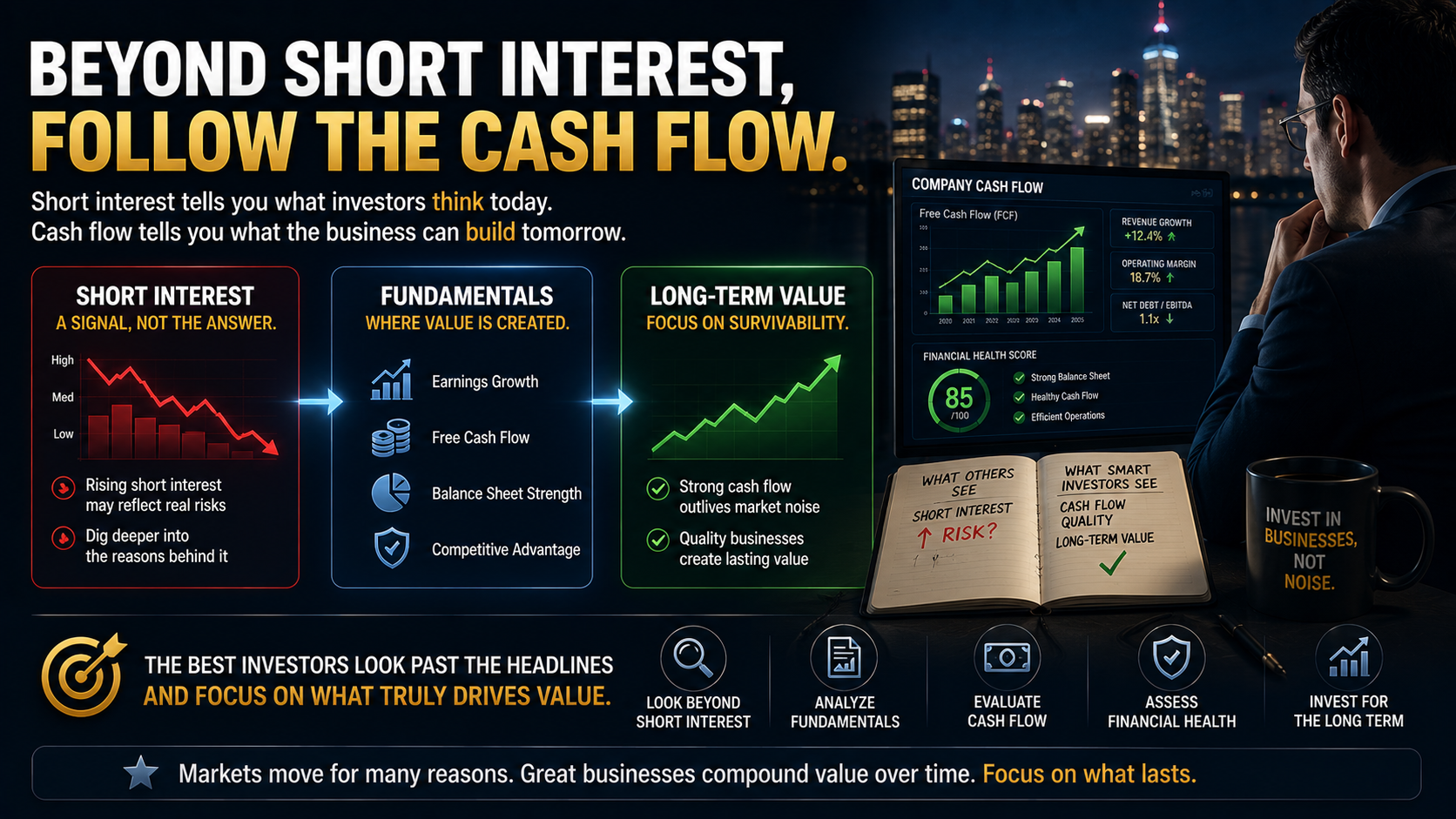
Follow the Cash Flow
A stock can be affected by short selling in the short term.
But over long periods, business value gravitates toward economic performance.
Investors should ask
Is revenue growing?
Are margins sustainable?
Is free cash flow improving?
Can the company manage its debt?
Does it have durable competitive advantages?
Short-selling data cannot replace those questions.
Focus on Financial Survivability
When liquidity is abundant, weak and strong companies can rise together.
When financial conditions tighten, differences become visible.
Companies with excessive leverage and weak cash generation may become vulnerable.
Businesses with strong balance sheets and durable free cash flow have a better chance of surviving unexpected shocks.
The goal of investing is not to predict every decline.
It is to own assets capable of surviving environments you failed to predict.
Questions Investors Should Ask When Short Interest Rises
When short-selling activity increases around a company, investors can use it as a reason to investigate rather than panic.
Ask
What risk are short sellers seeing?
Then ask
Is that risk visible in the company's earnings, balance sheet, or cash flow?
And finally
Is the stock falling because the business is deteriorating, or because interest rates, liquidity, and market sentiment are temporarily moving capital elsewhere?
Distinguishing between those two situations is one of the most valuable skills in long-term investing.
The Data Investors Can Monitor
Understanding NSDS is useful, but investors still need company-level information.
Short-Selling Volume
Look at whether short-selling activity is increasing over time rather than focusing on one unusual trading session.
Short Positions
Accumulated short positions can provide more context than daily trading volume alone.
Securities Lending Data
Borrowing activity can offer additional information, but borrowed shares do not necessarily translate one-for-one into short sales.
Earnings Revisions
This is particularly important.
If short positions are increasing while analysts are cutting earnings estimates, bearish investors may be responding to a deteriorating fundamental outlook.
But if operating performance continues improving while bearish positioning rises, investors may want to examine whether expectations and fundamentals are diverging.
Ultimately, a more complete framework combines
Short-selling data + earnings + free cash flow + balance-sheet strength + valuation
No single metric tells the entire story.
The Bigger Lesson Behind Korea’s NSDS
Debates about short selling can quickly become emotional.
Long-term investors should approach the subject differently.
The objective is not to decide whether short sellers are “good” or “bad.”
The more useful question is
Can investors trust the process that produces market prices?
Markets work because buyers and sellers hold different expectations.
Short sellers are part of that disagreement.
But price discovery becomes more credible when participants believe the same rules apply across the market.
That is the broader significance of Korea’s NSDS.
It is not fundamentally a tool for making stocks rise.
It is infrastructure designed to strengthen confidence in how market prices are formed.
Final Thoughts
Korea’s Naked Short-selling Detecting System (NSDS) represents an important change in the country’s short-selling oversight infrastructure.
The framework combines institutional balance-management systems intended to prevent sell orders beyond available balances with centralized monitoring by the Korea Exchange designed to compare position information with actual market activity and identify potential violations.
That distinction matters.
NSDS does not abolish short selling.
It does not guarantee that Korean stocks will rise.
And it does not eliminate the possibility of sharp market declines.
Its deeper purpose is to strengthen the distinction between legitimate short selling and prohibited naked short selling while improving confidence in the integrity of the trading process.
For U.S. investors considering Korean equities, that makes NSDS part of a much larger question
Is Korea becoming a more transparent, predictable, and institutionally investable capital market?
The answer will not be determined by one system.
It will depend on market accessibility, corporate governance, shareholder returns, regulatory consistency, liquidity, and ultimately the quality of the businesses themselves.
And for individual companies, the most important question remains unchanged
Are short sellers exposing a genuine weakness in the business, or is market sentiment temporarily diverging from the company's underlying cash-generating power?
That is why long-term investors should look beyond the short position itself.
Follow the fundamentals. Follow the cash flow. Follow where capital is moving.
Because investing is not about predicting every market move.
It is about owning assets that can survive when your prediction is wrong.
This was MasterMind.
'[Global] Success Blueprints' 카테고리의 다른 글