What Is an Optical Transceiver? How It Works and Why It Matters for AI Data Centers


Hello, this is MasterMind.
The artificial intelligence investment cycle began with an intense focus on GPUs. As AI models became larger and more computationally demanding, high-bandwidth memory, advanced packaging, and semiconductor manufacturing capacity quickly became equally important parts of the infrastructure story.
But another bottleneck is becoming increasingly difficult to ignore.
What happens when thousands—or eventually tens of thousands—of high-performance accelerators can perform calculations faster than the network can move data between them?
Expensive computing resources can spend valuable time waiting for data.
This is why optical transceivers have become an important part of the AI data center infrastructure stack.
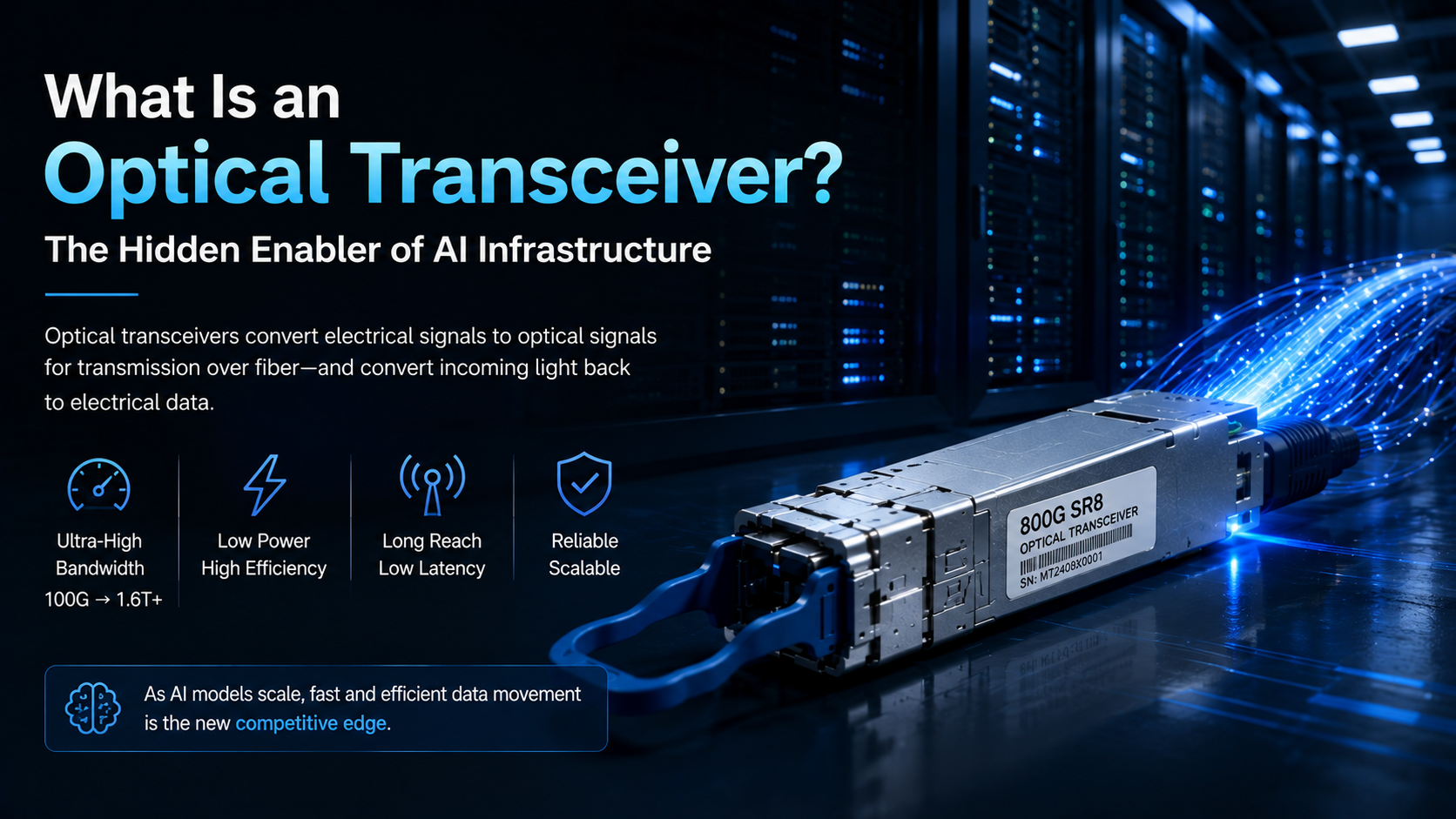
An optical transceiver converts electrical signals into optical signals for transmission over fiber and converts incoming optical signals back into electrical signals. As AI clusters scale and network bandwidth moves from 400G toward 800G, 1.6T, and beyond, optical connectivity becomes increasingly important to overall system performance.
For U.S. investors, understanding optical transceivers is therefore about much more than understanding a networking component.
It is about understanding where the next AI infrastructure bottleneck may emerge—and where capital must flow to remove it.
Key takeaway
Optical transceivers convert electrical and optical signals to enable high-speed data transmission, making them an increasingly important part of the infrastructure connecting GPUs, servers, and network switches inside large AI data centers.
What Is an Optical Transceiver?
An optical transceiver is a device that both transmits and receives optical signals.
The word "transceiver" itself combines transmitter and receiver.
Its fundamental job is relatively simple
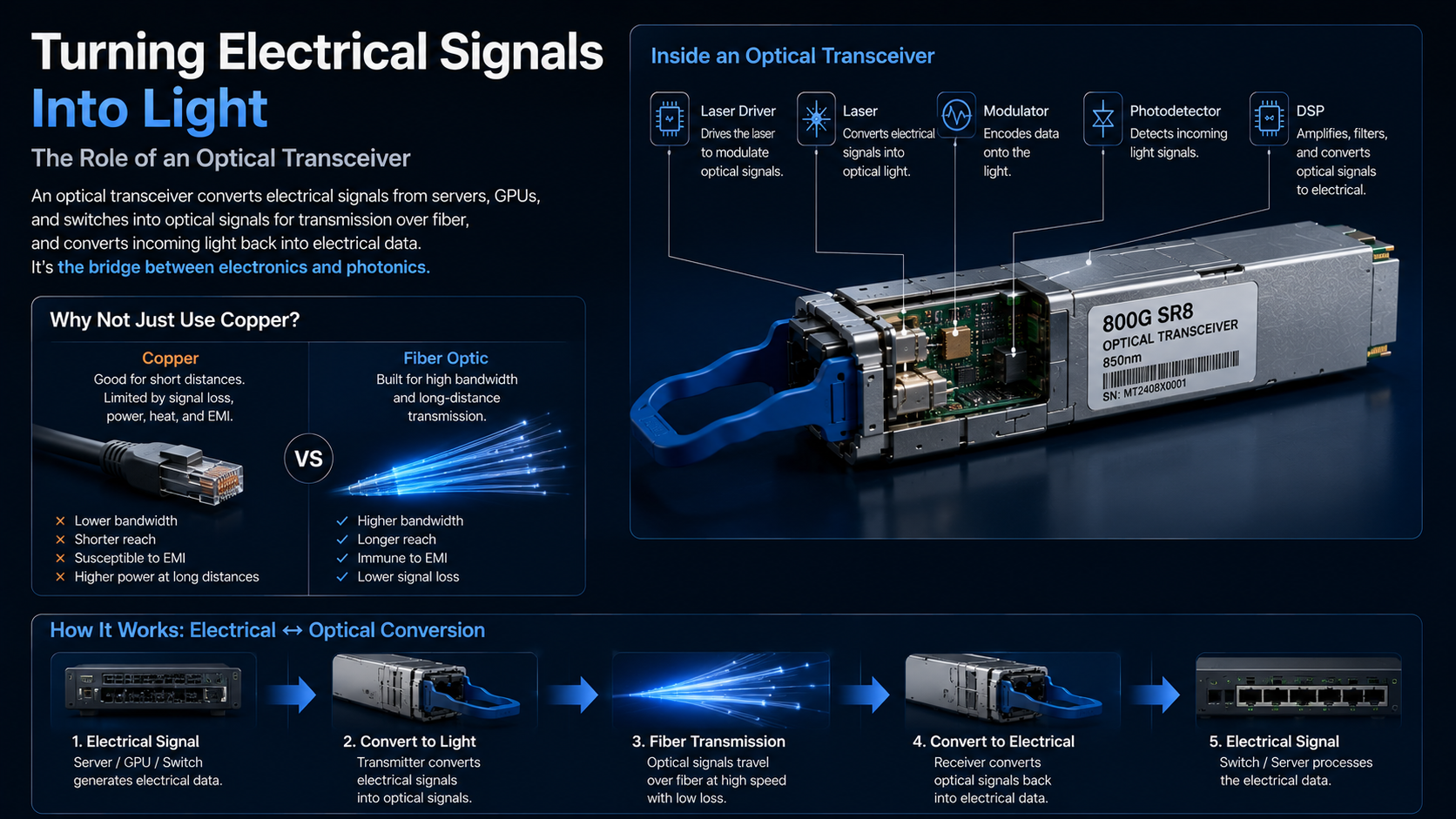
Electrical signal → Optical signal → Fiber transmission → Optical signal → Electrical signal
Servers, GPUs, and network switches operate primarily using electrical signals.
Fiber-optic cables, however, transmit information using light.
Something therefore needs to bridge these two worlds.
That is the role of the optical transceiver.
A useful analogy is to think of fiber as a high-speed interstate highway.
The optical transceiver is the on-ramp and off-ramp that allows electronic computing equipment to access that highway.
Fiber can carry enormous quantities of information, but the electrical data generated by computing equipment must first be converted into a form that can travel optically.
Why Not Just Use Copper?
Copper connections remain useful, particularly across relatively short distances.
The challenge becomes more significant as bandwidth requirements and transmission distances increase.
At very high data rates, electrical connections can face increasing challenges involving signal integrity, power consumption, heat, and transmission distance.
Optical communication offers several advantages for large-scale data center networks
- High bandwidth
- Longer transmission distances
- Lower signal degradation over distance
- Resistance to electromagnetic interference
- Greater scalability for high-speed networks
This does not mean fiber replaces every copper connection inside a data center.
The economics depend on distance, architecture, performance requirements, and power consumption.
But as AI clusters become larger and faster, the point at which optical connectivity becomes economically and technically attractive can move closer to the computing resources themselves.
That trend is one reason optical networking has become strategically important to the AI infrastructure buildout.
How Does an Optical Transceiver Work?
The exact design varies by product and network architecture, but optical transceivers typically combine optical components with semiconductor electronics.
Important elements can include lasers, photodetectors, drivers, amplifiers, digital signal processing, and other control circuitry.
1. The Server Generates an Electrical Signal
A server, GPU system, or network switch first produces data in electrical form.
That electrical signal reaches the optical transceiver.
2. Electrical Data Is Converted Into Light
The transmitting side of the module uses optical components to encode information onto an optical signal.
In simplified form
Electrical data → Light
The optical signal then enters the fiber.
3. Fiber Carries the Data
The light travels through fiber to another part of the network.
This is where optical communication provides one of its major advantages: large quantities of data can be transmitted efficiently across distances that become increasingly challenging for high-speed electrical connections.
4. Light Is Converted Back Into Electricity
At the destination, a photodetector detects the incoming optical signal.
The receiving electronics convert it back into an electrical signal that the network switch, server, or other computing equipment can process.
The entire process can therefore be summarized as
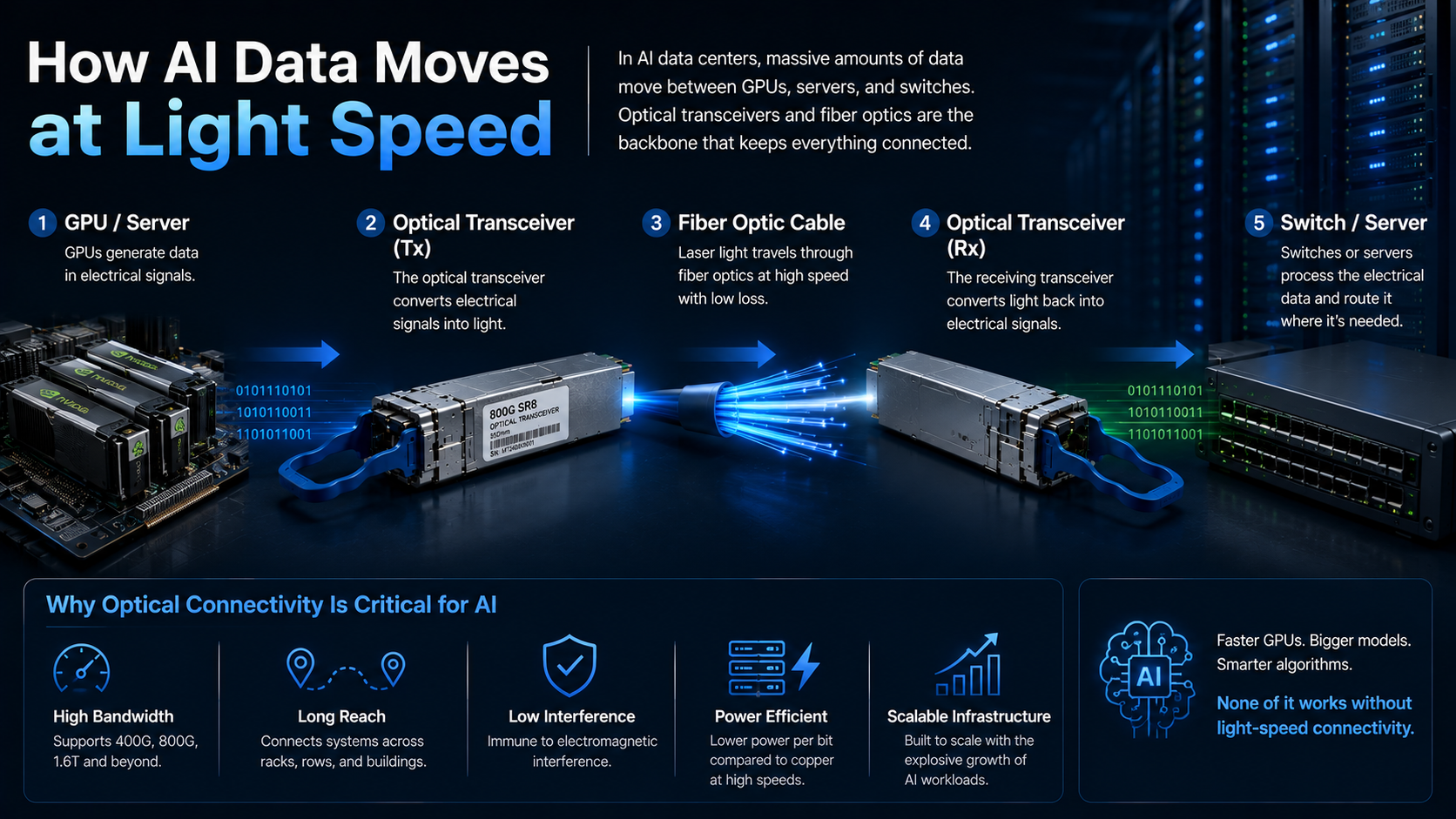
GPU/Server → Electrical Signal → Optical Transceiver → Fiber → Optical Transceiver → Electrical Signal → Switch/Server
This conversion happens at extremely high speeds and forms part of the invisible infrastructure behind modern cloud computing.
Why Are Optical Transceivers Important for AI Data Centers?
The answer lies in how AI changes data center traffic.
Traditional cloud data centers have historically handled substantial North-South traffic—data moving between servers inside the data center and users or systems outside it.
Large AI clusters generate enormous amounts of East-West traffic as well.
This is data moving between servers, accelerators, and switches inside the data center.
Training a large AI model can require many accelerators to work together on the same workload.
Those processors must continually exchange information.
As the number of GPUs increases, the network connecting them becomes increasingly important.
A Faster GPU Does Not Solve a Slow Network
Imagine a restaurant employing thousands of world-class chefs.
If ingredients can only enter the kitchen through one narrow doorway, adding more chefs eventually stops improving output.
The chefs spend more time waiting.
AI infrastructure faces a similar problem.
The GPUs are the chefs.
The network is the system transporting ingredients and completed dishes.
At sufficient scale, buying more compute without improving connectivity can produce diminishing returns.
This changes how investors should think about the AI hardware cycle.
The competitive battlefield is gradually expanding from chip performance toward system performance.
The AI Bottleneck Keeps Moving
One of the most useful frameworks for understanding semiconductor investment cycles is the idea of a moving bottleneck.
When one constraint is solved, another part of the system becomes the limiting factor.
AI infrastructure provides a clear example.
Larger AI Models
↓
More Compute Required
↓
More GPUs and Accelerators
↓
Greater Memory Bandwidth Requirements
↓
HBM Expansion
↓
Larger GPU Clusters
↓
More Accelerator-to-Accelerator Communication
↓
Network Bottlenecks
↓
Higher-Speed Optical Connectivity
Early in the AI investment cycle, GPUs were the obvious scarcity.
As accelerator performance increased, HBM became a major constraint.
Advanced packaging then became another critical capacity bottleneck.
As AI clusters become larger, networking and data movement receive more attention.
This leads to an important investment principle
Capital does not only chase the most powerful technology. It also flows toward whatever is preventing the entire system from scaling.
Understanding where the bottleneck is moving can therefore be more valuable than simply identifying which technology currently receives the most headlines.
What Do 100G, 400G, 800G, and 1.6T Mean?
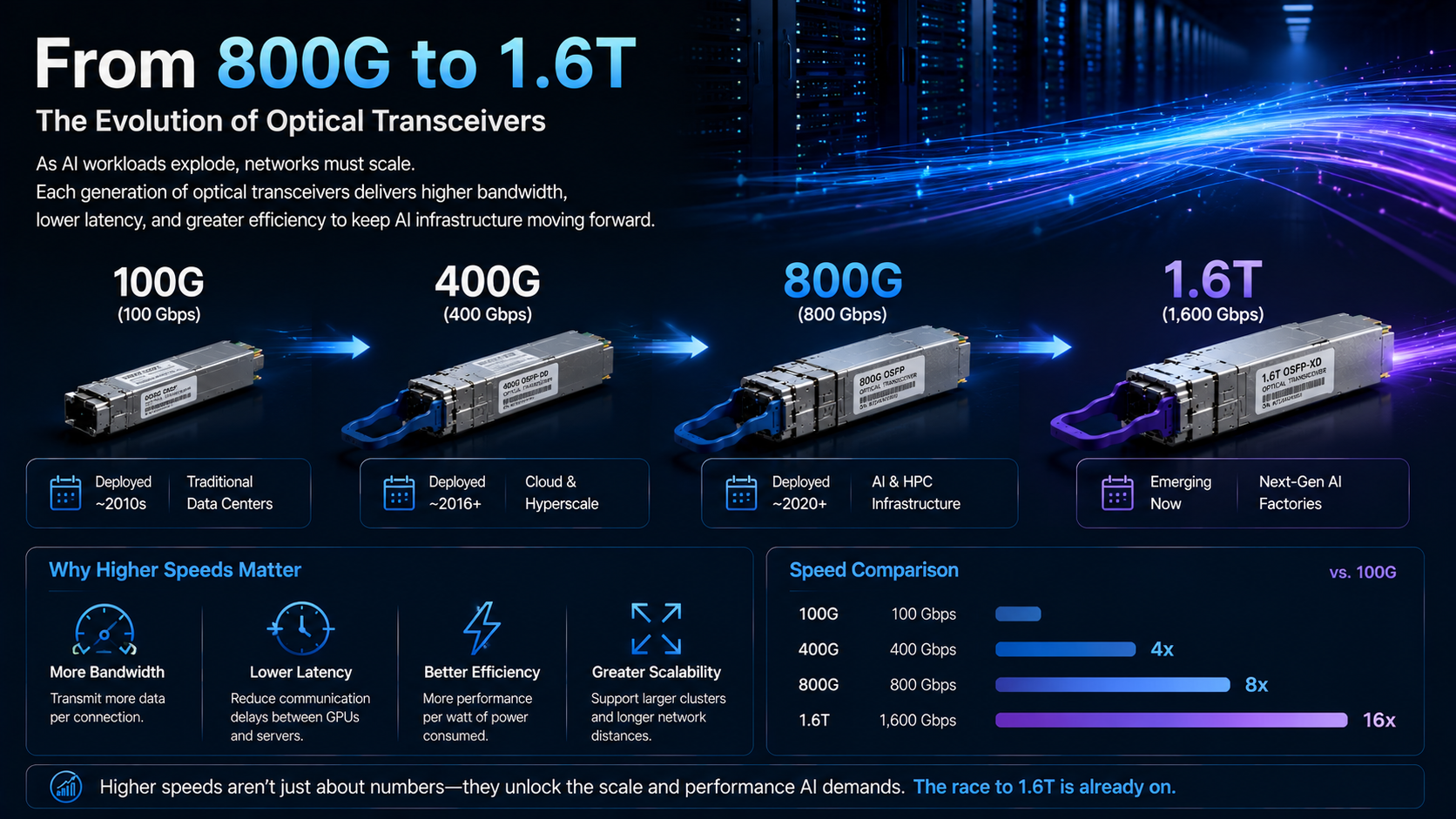
Optical networking discussions frequently include terms such as 100G, 400G, 800G, and 1.6T.
At a basic level, these describe network transmission capacity.
| Generation | Approximate Capacity | Typical Direction of Use |
| 100G | 100 Gbps | Traditional data center networking |
| 400G | 400 Gbps | Large cloud and hyperscale networks |
| 800G | 800 Gbps | High-performance AI infrastructure |
| 1.6T | 1.6 Tbps | Next-generation AI and hyperscale networking |
Higher numbers mean more data can be transmitted over a connection.
But moving from 400G to 800G and eventually 1.6T is not simply a matter of installing a faster laser.
Engineers must deal with increasingly difficult problems involving
- Signal integrity
- Power consumption
- Thermal management
- Optical design
- Digital signal processing
- Packaging
- Manufacturing yield
- Reliability
This creates both opportunities and risks for optical networking suppliers.
A company announcing a next-generation product is not necessarily the same as a company capable of manufacturing that product reliably, profitably, and at hyperscale volumes.
Optical Transceivers and the AI CapEx Cycle
The AI infrastructure investment cycle does not stop with GPUs.
More accelerators require more memory.
More compute systems require more networking.
Larger networks require more high-speed optical connections.
And the entire system requires additional power and cooling infrastructure.
The capital chain can be simplified as
AI CapEx
↓
GPUs and Accelerators
↓
HBM and Advanced Packaging
↓
Servers and Network Switches
↓
Optical Transceivers
↓
Fiber and Optical Components
↓
Power and Cooling Infrastructure
This matters particularly for U.S. investors because much of the global AI infrastructure cycle is being driven by hyperscale cloud providers and large technology companies.
Their capital expenditure decisions can ripple through multiple layers of the semiconductor and networking supply chain.
However, optical transceiver demand should not be treated as a standalone leading indicator for total AI CapEx.
Cloud infrastructure budgets include compute, networking, buildings, power systems, cooling, storage, and many other categories.
Optical orders are better viewed as one piece of evidence about the intensity and direction of AI infrastructure spending.
How Optical Networking Affects the Broader AI Supply Chain
The transition toward faster optical networking affects more than optical module manufacturers.
| Industry | Potential Impact |
| Network Equipment | More demand for high-speed switches and AI cluster connectivity |
| Optical Components | Migration toward 400G, 800G, 1.6T and future generations |
| Semiconductors | Demand for networking silicon, DSPs, drivers and optical-related chips |
| Silicon Photonics | Greater integration between semiconductor and optical technologies |
| Advanced Packaging | More complex integration of electronics and photonics |
| Power Infrastructure | Greater focus on network energy efficiency |
| Cooling | Increasing thermal-management requirements across AI infrastructure |
This is why analyzing AI infrastructure only through GPU shipments can provide an incomplete picture.
A GPU does not operate in isolation.
Its economic value depends partly on memory, networking, power, cooling, software, and the surrounding infrastructure being capable of supporting it.
Why Power Efficiency Matters for Optical Transceivers
The AI data center industry increasingly faces a constraint that cannot be solved simply by purchasing more chips
power.
AI accelerators consume substantial electricity, but GPUs are not the only source of data center power demand.
Networking equipment also consumes energy.
As network bandwidth increases, the amount of energy required to move data becomes increasingly important.
This creates a shift in how optical networking technology should be evaluated.
The question is no longer only
How fast can it transmit data?
Another question is becoming equally important
How much energy does it consume per bit of data transmitted?
Bandwidth, power efficiency, heat, and reliability therefore become interconnected competitive factors.
This is also one reason technologies such as silicon photonics and co-packaged optics are receiving increasing attention.
What Is Silicon Photonics?
Silicon photonics uses semiconductor manufacturing techniques to integrate optical functions onto silicon-based platforms.
The long-term goal is to combine more optical functionality with scalable semiconductor manufacturing.
As optical networks become faster, traditional approaches can face increasing challenges involving cost, component count, power consumption, and integration density.
Silicon photonics potentially addresses some of these issues by bringing electronic and optical technologies closer together.
However, investors should avoid treating the phrase "silicon photonics" as an automatic investment thesis.
Technical challenges remain.
These can include
- Light-source integration
- Packaging
- Thermal management
- Testing
- Manufacturing yield
- Production costs
The relevant investment question is therefore not simply whether a company has silicon photonics technology.
It is whether that technology can achieve commercial-scale manufacturing, customer qualification, competitive economics, and acceptable margins.
Pluggable Optical Transceivers vs. Co-Packaged Optics
Most data center optical connections today rely heavily on pluggable optical transceivers.
These modules can be inserted into and removed from networking equipment.
That provides significant advantages in maintenance, replacement, and operational flexibility.
But higher network speeds create another challenge.
Electrical signals must travel from the switch ASIC to the optical module.
As bandwidth increases, moving those electrical signals across the board can become more difficult and power-intensive.
One proposed solution is Co-Packaged Optics (CPO).
CPO moves the optical engine much closer to the networking silicon.
The simplified difference looks like this
Traditional Pluggable Architecture

Switch ASIC
↓
Electrical Connection
↓
Optical Transceiver
↓
Fiber


Co-Packaged Optics

Switch ASIC ↔ Optical Engine
              ↓
            Fiber
The objective is to reduce electrical transmission distance and potentially improve power efficiency and signal performance.
But investors should be careful with the assumption that CPO will immediately replace pluggable optical modules.
Maintenance, reliability, manufacturing yield, standardization, cost, and operational flexibility all matter.
Technology transitions rarely occur overnight.
Different architectures may coexist for years depending on application and economics.
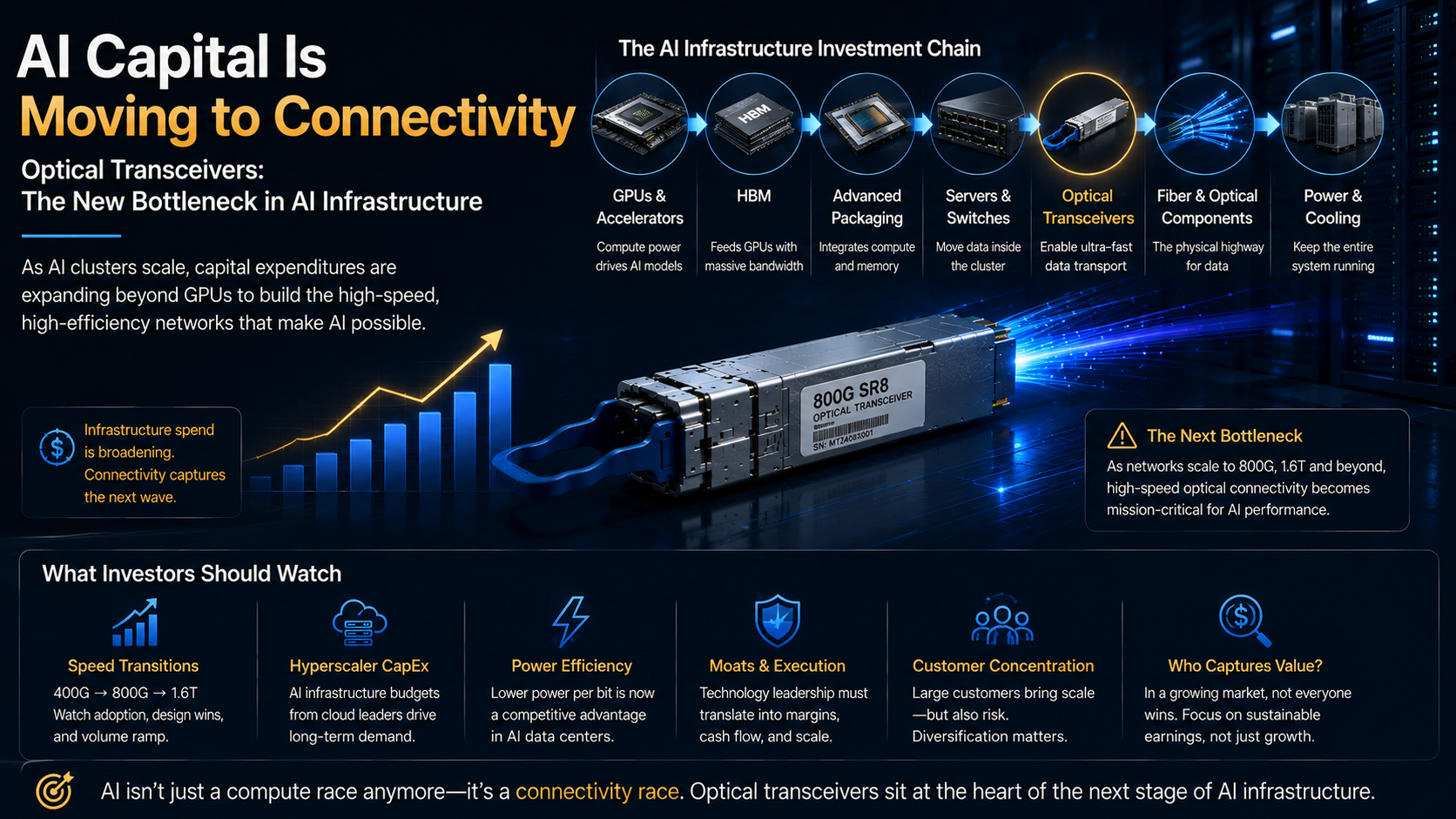
What Should Investors Watch in the Optical Transceiver Market?
For long-term investors, industry growth alone is not enough.
The important question is whether that growth becomes durable earnings and free cash flow.
1. The Transition From 400G to 800G and 1.6T
Product-generation transitions can reshape competitive positions.
Investors should look beyond product announcements and examine whether suppliers can obtain customer qualification, reach volume production, maintain yield, and generate acceptable margins.
2. Hyperscaler and Cloud CapEx
Capital spending from major cloud service providers can influence demand throughout the AI networking supply chain.
Watch data center construction, AI infrastructure budgets, network investment, and management commentary on future capacity requirements.
3. Revenue Growth vs. Cash Flow
Rapidly expanding industries can still produce weak economics.
Competition can pressure prices while R&D and capital expenditures consume cash.
Revenue growth should therefore be analyzed alongside
- Gross and operating margins
- Inventory
- Capital expenditures
- Free cash flow
- Working capital
- Return on invested capital
4. Customer Concentration
Large hyperscale customers can generate substantial volume for suppliers.
That is both an opportunity and a risk.
If a company depends heavily on a small number of customers, changes in purchasing schedules or inventory management can create significant earnings volatility.
5. Power Efficiency and Thermal Performance
Future optical networking competition will not be based solely on bandwidth.
Investors should increasingly consider performance per watt, thermal characteristics, reliability, and total cost of ownership.
6. Who Captures the Value?
Perhaps the most important question is not whether optical networking grows.
It is
Which layer of the supply chain captures the economics of that growth?
A growing market can still produce poor shareholder returns if competition pushes prices down faster than volumes increase.
What Are the Major Risks?
AI infrastructure is a powerful structural trend, but structural growth does not eliminate cycles.
AI CapEx Slowdowns
Hyperscalers may periodically slow investment after aggressive expansion.
A temporary pause can affect networking suppliers even if long-term AI demand remains intact.
Pricing Pressure
Rapidly growing markets attract competition.
Higher shipment volumes do not automatically translate into higher margins.
Technology Transitions
A supplier that dominates one optical generation may not necessarily dominate the next.
Transitions toward faster modules, silicon photonics, or new architectures can create winners and losers.
Inventory Cycles
Supply chains rarely move smoothly.
Customers can over-order during periods of scarcity and later reduce purchases while working through excess inventory.
This creates an important distinction
End-market demand can remain healthy while component suppliers experience a temporary downturn.
Investors who ignore this difference can mistake a normal inventory correction for structural deterioration—or structural deterioration for a temporary correction.
What Would Long-Term Capital Watch?
Long-term investors tend to focus less on individual technology specifications and more on three questions
Where is capital moving?
Who generates sustainable cash flow?
Which businesses can survive the next downturn?
Follow the Money
The first phase of the AI infrastructure boom concentrated enormous amounts of capital around compute.
As systems scale, investment can spread through the infrastructure stack
GPU → HBM → Advanced Packaging → Networking → Optical Connectivity → Power → Cooling
This does not mean each segment will experience the same growth rate or profitability.
It means the AI investment cycle increasingly needs an entire physical ecosystem.
Capital tends to move toward the parts of that ecosystem that constrain further expansion.
Follow the Cash Flow
An impressive technology is not automatically a great business.
A company can grow revenue rapidly while consuming most of its cash through R&D, inventory, and capital expenditures.
The stronger long-term question is whether technological leadership converts into pricing power, margins, and free cash flow.
Focus on Survival
AI infrastructure spending will not necessarily rise in a straight line forever.
There will likely be periods of overinvestment, digestion, inventory adjustment, and technological transition.
That makes several questions worth asking
Can this company survive if AI CapEx growth slows?
Does its competitive position strengthen as networks move from 800G toward 1.6T?
Is revenue growth converting into sustainable free cash flow?
How dependent is the company on one or two hyperscale customers?
Does the next technology transition expand its opportunity—or threaten its existing business?
Long-term investing is not only about identifying the fastest-growing industry.
It is also about identifying the businesses capable of surviving when growth temporarily disappoints.
Optical Transceivers Reveal the Bigger AI Infrastructure Story
Optical transceivers make more sense when viewed as part of the entire AI system.
The infrastructure chain can be simplified as
GPU → HBM → Advanced Packaging → Network Switches → Optical Transceivers → Silicon Photonics/CPO → Fiber → Power and Cooling
GPUs perform the calculations.
HBM feeds those processors with data.
Advanced packaging brings high-performance components together.
Networking and optical connectivity allow thousands of processors to operate as part of a much larger computing system.
Power and cooling keep everything running.
This is the broader transformation taking place across AI infrastructure.
The competition is no longer simply about building the fastest individual processor.
It is increasingly about how efficiently an entire computing system can calculate, store, move, and exchange enormous quantities of data.
Final Thoughts
An optical transceiver converts electrical signals into optical signals and converts incoming light back into electrical data, enabling high-speed communication across modern data center networks.
Its growing importance in the AI era reflects a larger structural shift.
As GPU clusters become larger, the amount of information that must move between accelerators, servers, and network switches increases dramatically.
For investors, this means the optical networking opportunity should not be evaluated only through market-growth forecasts.
The more useful indicators include the transition from 400G to 800G and 1.6T, hyperscaler CapEx, power efficiency, customer concentration, margins, free cash flow, silicon photonics adoption, and the evolution of co-packaged optics.
The most important idea to remember is simple
AI performance is no longer determined only by how quickly data can be computed. It increasingly depends on how quickly and efficiently that data can move. Optical transceivers sit at one of the critical gateways in that process.
And from a long-term investment perspective, the opportunity is often found not by chasing the technology receiving the most attention today, but by identifying where the next bottleneck is forming and where capital must move to solve it.
This was MasterMind.
'[Global] Success Blueprints' 카테고리의 다른 글