What Is a Zero-Coupon Bond? How It Works and Why Interest Rates Matter


Hello, this is MasterMind.
What if a bond paid no interest at all?
Most investors associate bonds with regular coupon payments followed by the return of principal at maturity. But there is another type of fixed-income security that makes no periodic interest payments and can still generate a return for investors.
It is called a zero-coupon bond.
Why would investors buy a bond that pays no income along the way? Where does the return come from? And why can long-term zero-coupon bonds experience surprisingly large price swings when Treasury yields move?
Understanding zero-coupon bonds goes far beyond learning about one corner of the bond market. The concept connects directly to present value, duration, the Treasury yield curve, interest-rate risk, and even the valuation of long-duration growth stocks.
For U.S. investors, it provides one of the clearest ways to understand a fundamental principle of financial markets
The value of an asset today depends heavily on when its future cash flows arrive and what discount rate the market applies to them.
Key Takeaway
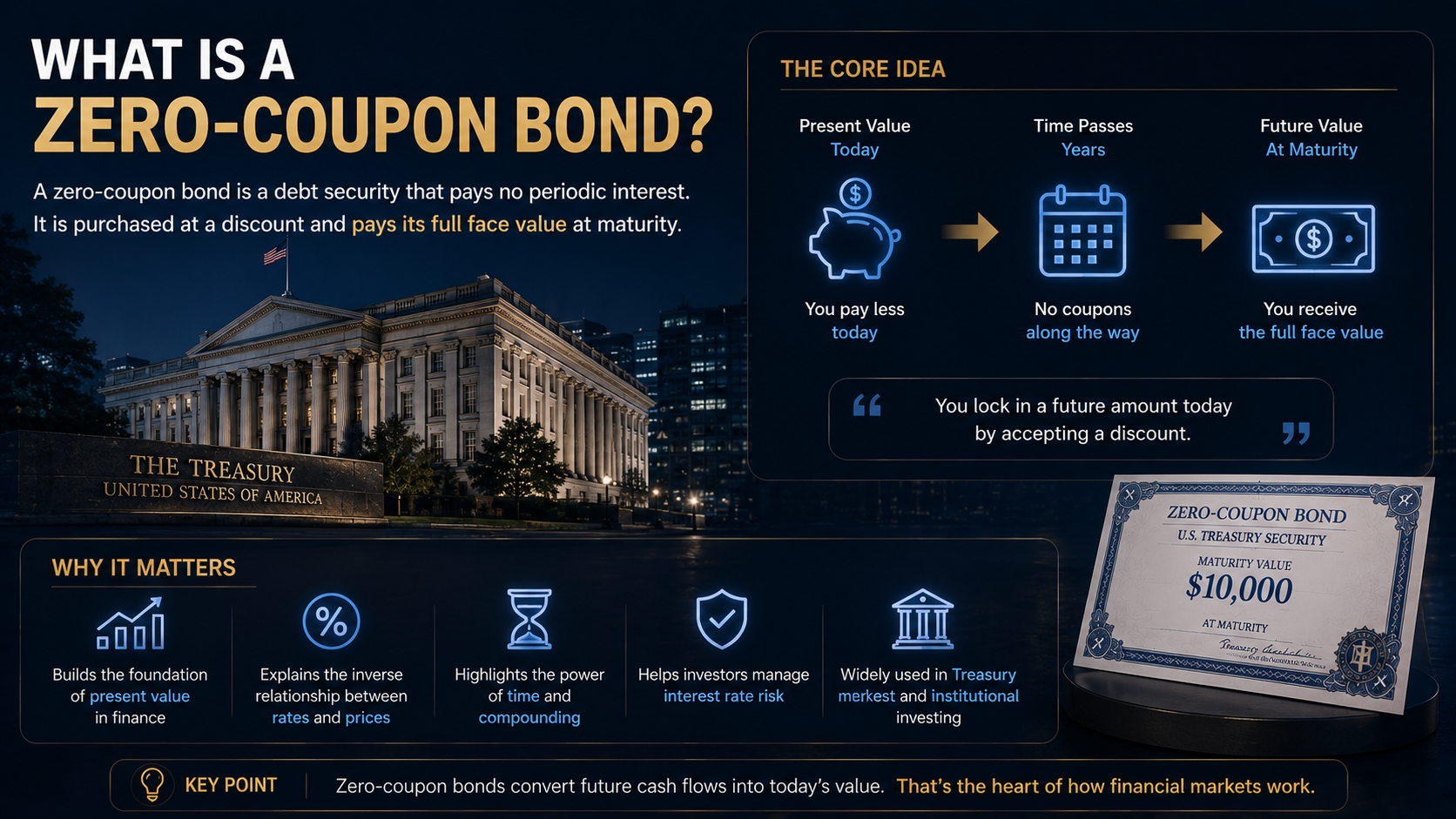
A zero-coupon bond pays no periodic interest. Instead, it is purchased at a discount to its face value and pays its full face value at maturity. Because all of its cash flow arrives at the end, long-term zero-coupon bonds can be highly sensitive to changes in interest rates.
What Is a Zero-Coupon Bond?
A zero-coupon bond is a bond that does not make periodic coupon payments.
With a conventional coupon bond, investors generally receive interest payments throughout the life of the bond and receive the principal at maturity.
A zero-coupon bond works differently.
There are no quarterly, semiannual, or annual coupon payments. Instead, the investor purchases the security below its face value and receives the full face value when the bond matures.
Consider a simplified example.
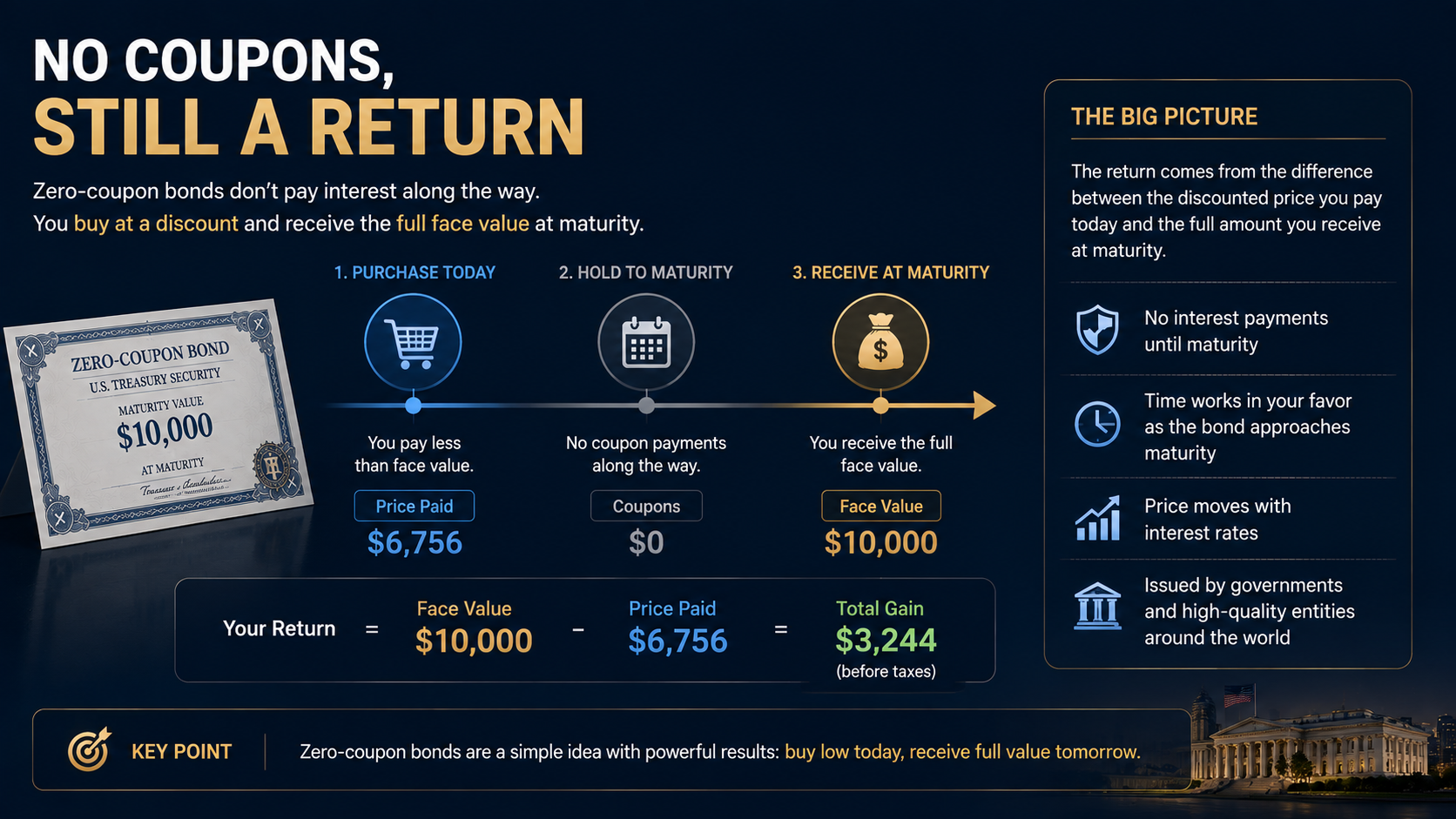
Suppose a zero-coupon bond will pay $10,000 in 10 years.
If the required annual yield is 4%, its present value would be approximately $6,756.
| Item | Amount |
| Purchase price | About $6,756 |
| Maturity | 10 years |
| Periodic coupon | $0 |
| Face value at maturity | $10,000 |
| Difference | About $3,244 |
The investor does not receive $3,244 as a separate coupon.
Instead, the bond gradually moves toward its $10,000 maturity value as time passes, assuming market conditions and credit considerations remain consistent.
In simple terms
A zero-coupon bond allows an investor to purchase a future payment at a discount today.
How Do Zero-Coupon Bonds Work?
The fundamental concept behind zero-coupon bond pricing is the time value of money.
A dollar today is worth more than a dollar received years from now because money available today can be invested and potentially earn a return.
Financial markets therefore discount future cash flows to determine what they are worth today.
For a basic zero-coupon bond, the relationship can be expressed as
Present Value = Face Value ÷ (1 + Yield)^Years to Maturity
Suppose an investor will receive $10,000 ten years from now.
At different required yields, that future $10,000 has very different present values.
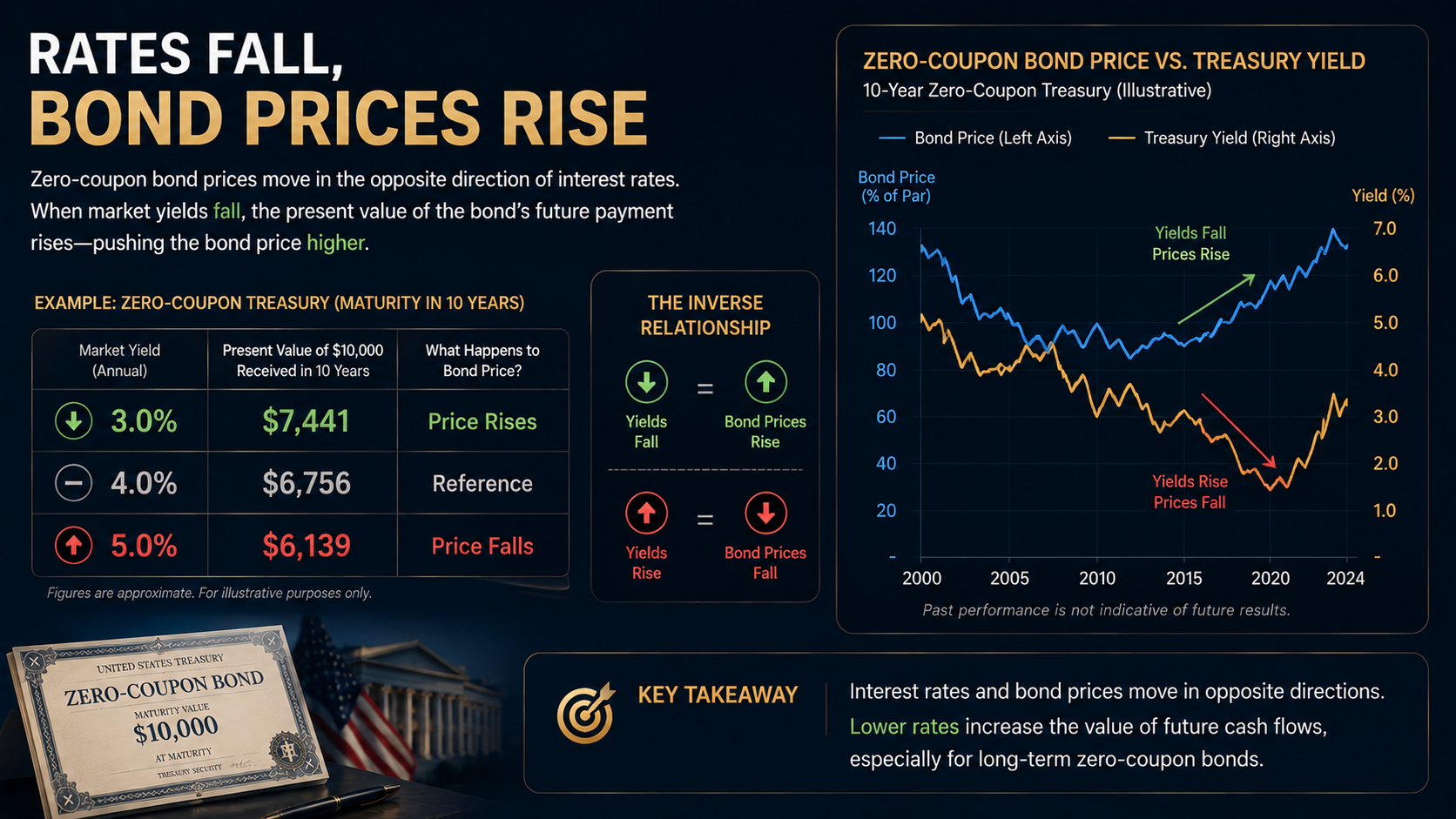
| Market Yield | Present Value of $10,000 in 10 Years |
| 3% | About $7,441 |
| 4% | About $6,756 |
| 5% | About $6,139 |
This simple calculation explains one of the most important relationships in fixed-income investing.
Higher interest rates reduce bond prices.
Lower interest rates increase bond prices.
Why Do Zero-Coupon Bond Prices Rise When Interest Rates Fall?
Suppose you own a zero-coupon bond that promises to pay $10,000 ten years from now.
If market yields fall, investors no longer require as large a discount on that future payment.
The present value of the $10,000 therefore increases.
The opposite occurs when rates rise.
A higher required return means the future $10,000 must be discounted more heavily, reducing what investors are willing to pay for the bond today.
The fundamental relationship is
Interest rates rise → Zero-coupon bond prices fall
and
Interest rates fall → Zero-coupon bond prices rise
This relationship applies broadly across fixed-income markets.
But it can be especially powerful with long-term zero-coupon bonds because of duration.
Zero-Coupon Bonds and Duration
Duration is one of the most important concepts in bond investing.
At a basic level, duration measures the timing of a bond's cash flows. It is also closely related to how sensitive a bond's price is to changes in interest rates.
A conventional coupon bond distributes some of its cash flows before maturity through regular interest payments.
A zero-coupon bond does not.
Every dollar promised by the bond arrives at maturity.
This creates an important characteristic
The Macaulay duration of a zero-coupon bond equals its maturity.
A 20-year zero-coupon bond therefore has a Macaulay duration of 20 years.
A conventional 20-year coupon bond generally has a shorter Macaulay duration because some cash is returned to the investor through coupon payments before the maturity date.
As a result, other things being equal, long-term zero-coupon bonds can be considerably more sensitive to changes in interest rates.
When yields fall
The discount rate applied to the distant maturity payment declines.
Its present value can increase substantially.
When yields rise
The distant payment is discounted more aggressively.
Its present value can fall substantially.
This highlights an important distinction for investors
Credit safety and price stability are not the same thing.
A high-quality government security can have very little default risk while still experiencing significant market-price volatility if it has a long duration.
Zero-Coupon U.S. Treasury Securities
For American investors, zero-coupon bonds are particularly relevant to the Treasury market.
The U.S. Treasury does not regularly issue traditional long-term zero-coupon Treasury bonds in the same way it issues coupon-bearing Treasury notes and bonds.
However, investors can gain exposure to zero-coupon Treasury cash flows through STRIPS, short for
Separate Trading of Registered Interest and Principal of Securities.
Through the STRIPS program, the individual interest and principal payments of eligible Treasury securities can be separated and traded as individual securities.
Each separated payment effectively becomes a zero-coupon security.
For example, the principal payment from a Treasury bond can be separated from its coupon payments. An investor buying that principal STRIP pays a discounted price today and receives the principal amount at maturity without receiving intermediate coupons.
This makes Treasury STRIPS one of the most important real-world examples of zero-coupon securities in the U.S. fixed-income market.

Why Are Zero-Coupon Bonds Important?
Zero-coupon bonds are important for more than their potential price appreciation when yields decline.
They provide one of the cleanest demonstrations of how financial markets value future money.
1. High Sensitivity to Interest Rates
Because their cash flow is concentrated at maturity, long-term zero-coupon bonds can respond strongly to changes in long-term yields.
This makes duration risk especially important.
A large decline in yields can generate substantial price appreciation.
But the reverse is equally important.
If yields rise unexpectedly, long-duration zero-coupon bonds can experience significant mark-to-market losses.
They should therefore not be viewed simply as an easy way to profit from falling rates.
2. No Coupon Reinvestment Risk
A conventional coupon bond periodically distributes cash.
Those coupon payments must then be reinvested if the investor wants to continue compounding the money.
But future reinvestment rates are unknown.
Suppose an investor initially buys a bond yielding 5%, but interest rates later fall to 2%.
Future coupon payments may have to be reinvested at much lower yields.
This is known as reinvestment risk.
Zero-coupon bonds eliminate the reinvestment risk associated with interim coupon payments because there are no coupons to reinvest.
Assuming the issuer meets its obligations and the security is held to maturity, the relationship between the purchase price and maturity value provides a clearly defined return path.
3. Future Liability Planning
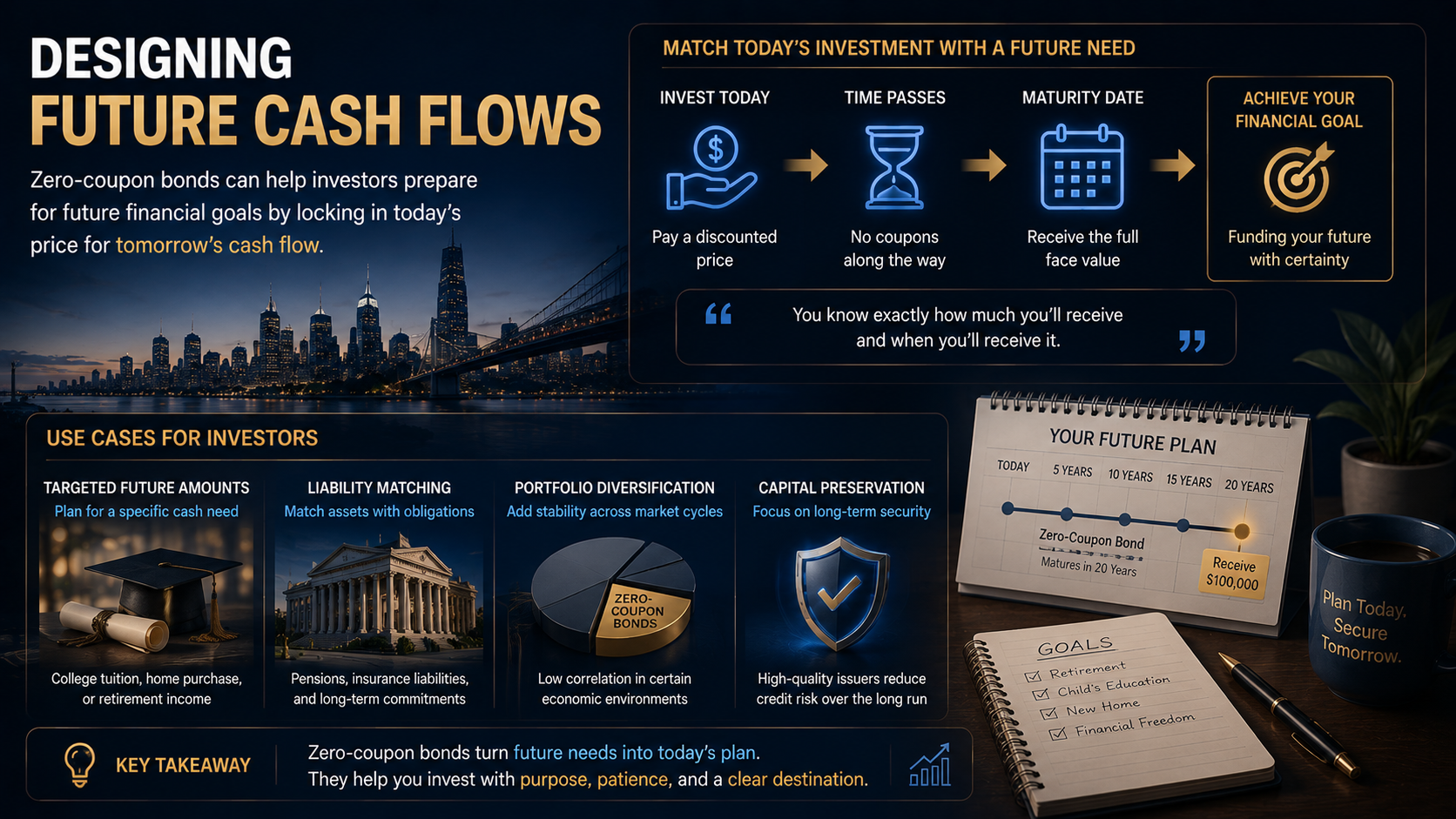
Zero-coupon securities can also be useful when an investor or institution knows that a specific amount of money will be needed at a specific future date.
Imagine that an investor expects to need $100,000 in 15 years.
A security designed to mature around that date can help align the investment with the future liability.
This basic concept is closely related to asset-liability matching, which is particularly important for pension funds, insurance companies, and other institutions managing long-term obligations.
For individual investors, the same logic can apply to long-term goals such as retirement or other future financial commitments.
Zero-Coupon Bonds and the Yield Curve
Zero-coupon securities are also important for understanding the yield curve.
A conventional Treasury bond contains multiple cash flows.
There may be dozens of coupon payments plus the final principal payment.
That makes it harder to isolate the exact discount rate associated with one particular future date.
Zero-coupon cash flows solve much of this problem.
Because each zero-coupon security represents a single future payment, investors can derive spot rates for different maturities.
Connecting those rates produces what is often called a zero-coupon yield curve, or spot-rate curve.
This helps analysts understand how the market is pricing money at different points in the future.
In other words, the yield curve is not merely a chart of interest rates.
It is a representation of how markets value time, inflation uncertainty, monetary policy expectations, economic growth, and risk across different horizons.
What Do Zero-Coupon Bonds Have in Common With Growth Stocks?
One of the most useful lessons from zero-coupon bonds is that the same valuation logic can be applied to other assets.
Consider a high-growth technology company.
Investors may be willing to accept relatively low current earnings because they expect much larger cash flows many years into the future.
Those distant cash flows must still be discounted back to their present value.
When discount rates rise, distant cash flows lose more present value than near-term cash flows.
That is why high-growth stocks are sometimes described as long-duration equities.
They are not literally bonds, but their valuations can exhibit similar sensitivity to changes in discount rates.
This helps explain why rapidly rising long-term Treasury yields can create pressure on highly valued technology and growth stocks.
Conversely, falling real yields and long-term interest rates can sometimes provide a more supportive valuation environment.
The deeper principle is the same
Financial markets are constantly deciding how much a future stream of cash is worth today.
That principle connects bonds, stocks, real estate, and many other financial assets.
How Interest Rates Can Affect Zero-Coupon Bonds and Other Assets
Interest rates influence multiple asset classes, although the relationships are not mechanical.
| Asset | Falling-Rate Environment | Rising-Rate Environment |
| Zero-coupon bonds | Generally positive for prices | Generally negative for prices |
| Long-duration growth stocks | Lower discount rates can support valuations | Higher discount rates can pressure valuations |
| Conventional bonds | Generally positive for prices | Generally negative for prices |
| U.S. dollar | Narrowing rate differentials can be negative | Higher relative U.S. yields can be supportive |
| Gold | Falling real yields can be supportive | Rising real yields can create pressure |
| Bitcoin | Easier liquidity conditions can be supportive | Tight liquidity can create pressure |
There is an important qualification.
Why interest rates are moving often matters more than the direction alone.
Suppose long-term Treasury yields collapse because investors suddenly fear a severe recession.
Long-duration Treasury securities may rally sharply.
Stocks, however, could fall because investors are simultaneously reducing earnings expectations.
Alternatively, Treasury yields could rise because economic growth is stronger than expected. That may hurt bond prices while supporting some cyclical companies through stronger revenue and earnings expectations.
Investors therefore need to look beyond the simple formula of "rates down equals risk assets up."
The macroeconomic reason behind the move matters.
Key Risks Investors Should Understand
Interest-Rate Risk
The longer the maturity of a zero-coupon bond, the greater its potential sensitivity to interest-rate movements.
A long-term zero-coupon Treasury security can therefore experience substantial price volatility even when its underlying credit risk is extremely low.
Holding to Maturity vs. Selling Early
There is a major difference between planning to hold a bond until maturity and expecting to sell it before maturity.
An investor holding an appropriate security until maturity can focus on its promised maturity cash flow, subject to the issuer's ability to pay.
An investor who needs to sell early must accept the market price available at that time.
If yields have risen substantially, that price could be considerably below the investor's purchase price.
Inflation Risk
A nominal payment of $100,000 received 20 years from now may have significantly less purchasing power than $100,000 today.
Long-term zero-coupon bonds therefore expose investors to inflation risk.
Nominal yields should not be considered in isolation.
Expected inflation and real interest rates are also important.
Credit Risk
Zero-coupon structure does not eliminate default risk.
A corporate zero-coupon bond and a Treasury-based zero-coupon security can have very different credit characteristics.
Investors should evaluate the issuer separately from the bond's payment structure.
A Major U.S. Tax Consideration: Phantom Income
American investors should understand one particularly important feature of taxable zero-coupon bonds.
Even though the investor may not receive cash interest during the year, the IRS can generally require a portion of the bond's original issue discount (OID) to be recognized as taxable interest income as it accrues.
This is sometimes described as phantom income.
The investor may therefore owe tax on income that has economically accrued even though no corresponding coupon payment was received in cash.
Tax treatment varies depending on the security, account type, and applicable federal, state, and local tax rules.
This makes the account in which a zero-coupon security is held potentially important.
Investors should therefore avoid assuming
"No coupon payment means no annual tax liability."
The two are not necessarily the same.
What Should Long-Term Investors Watch?
Experienced investors generally do not look at zero-coupon bonds only through the question
"Will the Fed cut rates?"
They look at the broader structure surrounding interest rates.
Important variables include
- Long-term Treasury yields
- Inflation expectations
- Real yields
- Federal Reserve policy expectations
- Economic growth
- Fiscal conditions and Treasury supply
- Credit risk
- Portfolio duration
- Future liquidity needs
The distinction between the federal funds rate and long-term Treasury yields is particularly important.
The Federal Reserve can lower short-term policy rates while long-term yields remain elevated because of inflation expectations, stronger growth, term premium, or fiscal concerns.
Therefore
A Fed rate cut does not automatically guarantee that long-term zero-coupon bond prices will surge.
For a long-duration security, the movement in the relevant market yield matters more than the policy headline itself.
What Do Wealthy Investors Look for in This Environment?
Sophisticated investors often view zero-coupon bonds less as a stand-alone trade and more as a tool for managing cash flow, duration, liquidity, and long-term liabilities.
Follow the Flow of Money
When yields are high, future fixed cash flows are discounted more heavily.
If inflation subsequently moderates and long-term yields decline, existing long-duration bonds may appreciate.
But identifying the exact peak in yields is extremely difficult.
The more durable question is not whether an investor can perfectly time the bond market.
It is whether the portfolio can survive if the interest-rate forecast is wrong.
Match Assets With Future Cash Needs
Some investors need regular income today.
Others have sufficient current cash flow and care more about a known financial obligation 10, 15, or 20 years from now.
Zero-coupon securities may be more naturally suited to the second problem because their cash flows are concentrated at maturity.
The appropriate asset therefore depends on the investor's financial objective.
Focus on Asset Resilience
High-quality long-duration government securities can potentially provide diversification during certain recessionary or disinflationary environments.
But the same securities can struggle badly during persistent inflation and rising-rate regimes.
The important question is therefore not simply
"Is this a safe asset?"
A better question is
"Which specific risk is this asset designed to protect me from?"
Think in Decades, Not Headlines
Long-term investing is not primarily about predicting the next Federal Reserve meeting.
Investors can instead ask
Do I need income today or a specific amount of money in the future?
Does the current yield adequately compensate me for long-term inflation risk?
Can I hold the security if interest rates move against me?
Is my portfolio overly dependent on one interest-rate scenario?
Do I have enough liquidity to avoid selling long-duration assets during a market shock?
These questions move the discussion away from short-term forecasting and toward portfolio survival.
And survival is what allows long-term compounding to continue.
Conclusion
A zero-coupon bond is a bond that makes no periodic interest payments. Instead, investors purchase the security at a discount and receive its face value at maturity.
The structure is simple, but the financial principles behind it are fundamental.
Future money must be discounted to determine its present value.
When market yields rise, the present value of distant cash flows falls.
When yields decline, their present value rises.
Because zero-coupon bonds concentrate all of their cash flow at maturity, long-term zero-coupon securities can have particularly high sensitivity to interest-rate changes.
The same principle extends far beyond fixed income.
It helps explain why growth stocks can react strongly to Treasury yields, why real rates matter for gold, and why discount rates influence valuations throughout global financial markets.
The key message to remember is this
A zero-coupon bond is not simply a bond that pays no interest. It is one of the clearest examples of how financial markets convert future cash flows into present-day prices.
Once you understand that relationship, you begin to see why interest rates sit at the foundation of almost every major asset valuation framework.
Rather than trying to predict every change in rates, long-term investors should understand how their assets will respond when rates, inflation, liquidity, and economic conditions move differently than expected.
Building a portfolio that can survive those different environments matters more than perfectly forecasting the next one.
This was MasterMind.
'[Global] Success Blueprints' 카테고리의 다른 글