What Is the Natural Rate of Unemployment? How It Affects Inflation, Fed Policy, and Markets


Hello, this is MasterMind.
Is a falling unemployment rate always good news for the economy?
At first glance, the answer seems obvious. When more people have jobs, household income rises, consumer spending improves, and businesses generate stronger revenue. Yet the Federal Reserve does not simply celebrate every decline in unemployment.
In fact, when unemployment falls too far below a sustainable level, the Fed may become more concerned about wage pressures, inflation, and an overheating economy.
This is why investors need to understand the natural rate of unemployment.
The natural rate of unemployment is not merely an academic concept. It helps explain why strong employment data can push Treasury yields higher, delay interest-rate cuts, strengthen the U.S. dollar, and pressure the valuations of growth stocks.
To understand where monetary policy and asset prices may be heading, investors must look beyond whether unemployment is simply “high” or “low.” The more important question is whether the labor market is tighter or weaker than the economy can sustainably support.
Key Takeaway
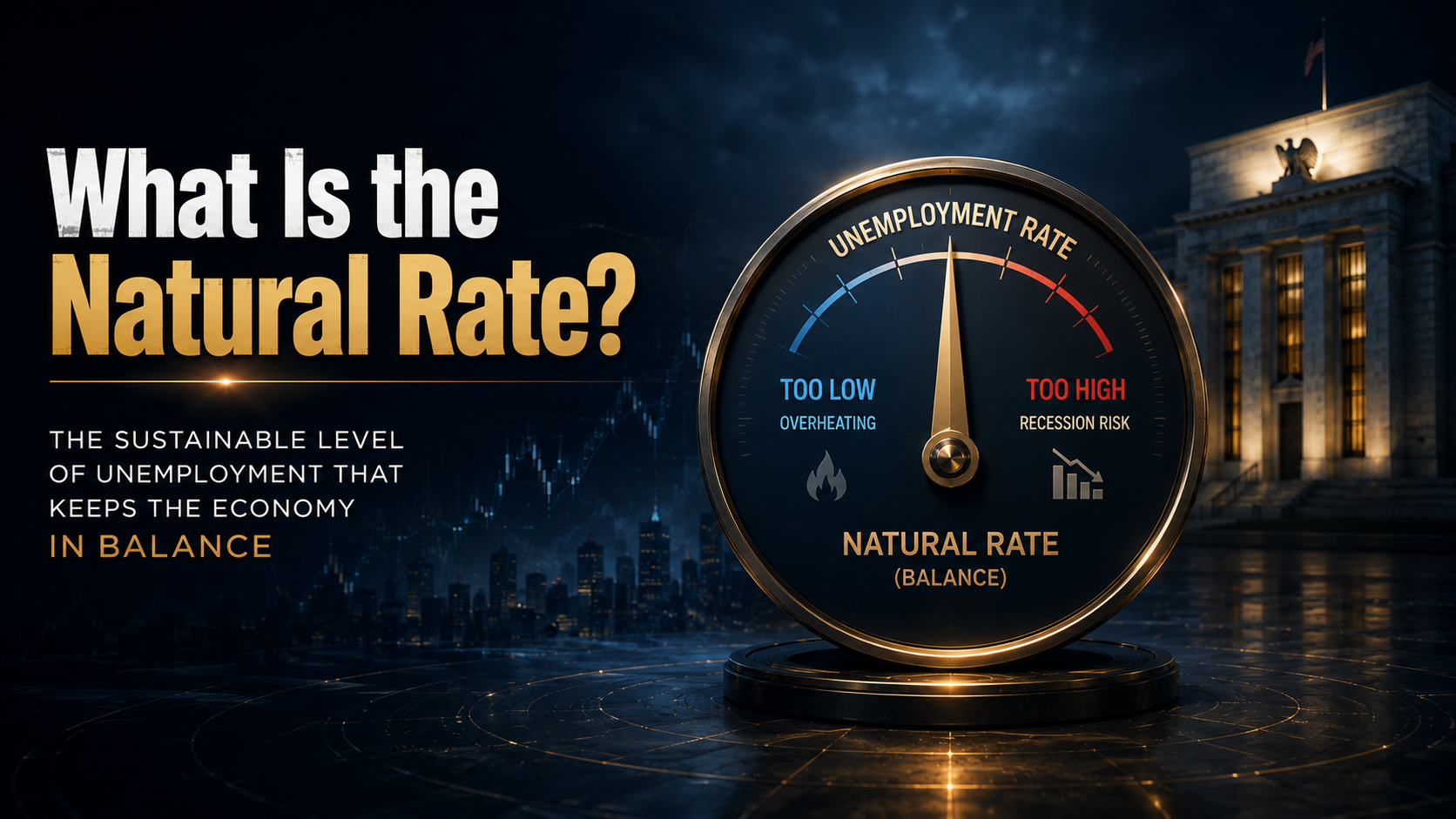
The natural rate of unemployment is the lowest unemployment rate an economy can sustain without creating persistent inflation pressure, making it an important reference point for Federal Reserve policy, interest rates, and financial-market liquidity.
What Is the Natural Rate of Unemployment?
The natural rate of unemployment is the level of unemployment that remains even when the economy is operating near full capacity and is not in a recession.
In other words, it is the unemployment rate that exists because of the normal structure and movement of the labor market rather than because of weak economic demand.
One of the most common misunderstandings is that full employment means an unemployment rate of zero.
That is not how a real economy works.
Even during a strong expansion, some people are
- leaving one job to search for another
- entering the labor force for the first time
- relocating to a different city
- learning new skills
- transitioning between industries
- searching for a job that better matches their experience
For that reason, some unemployment always exists.
The natural rate of unemployment represents the level of unemployment consistent with a normally functioning labor market.
It is often described as the unemployment rate that can be sustained without causing inflation to accelerate.
The Three Main Types of Unemployment
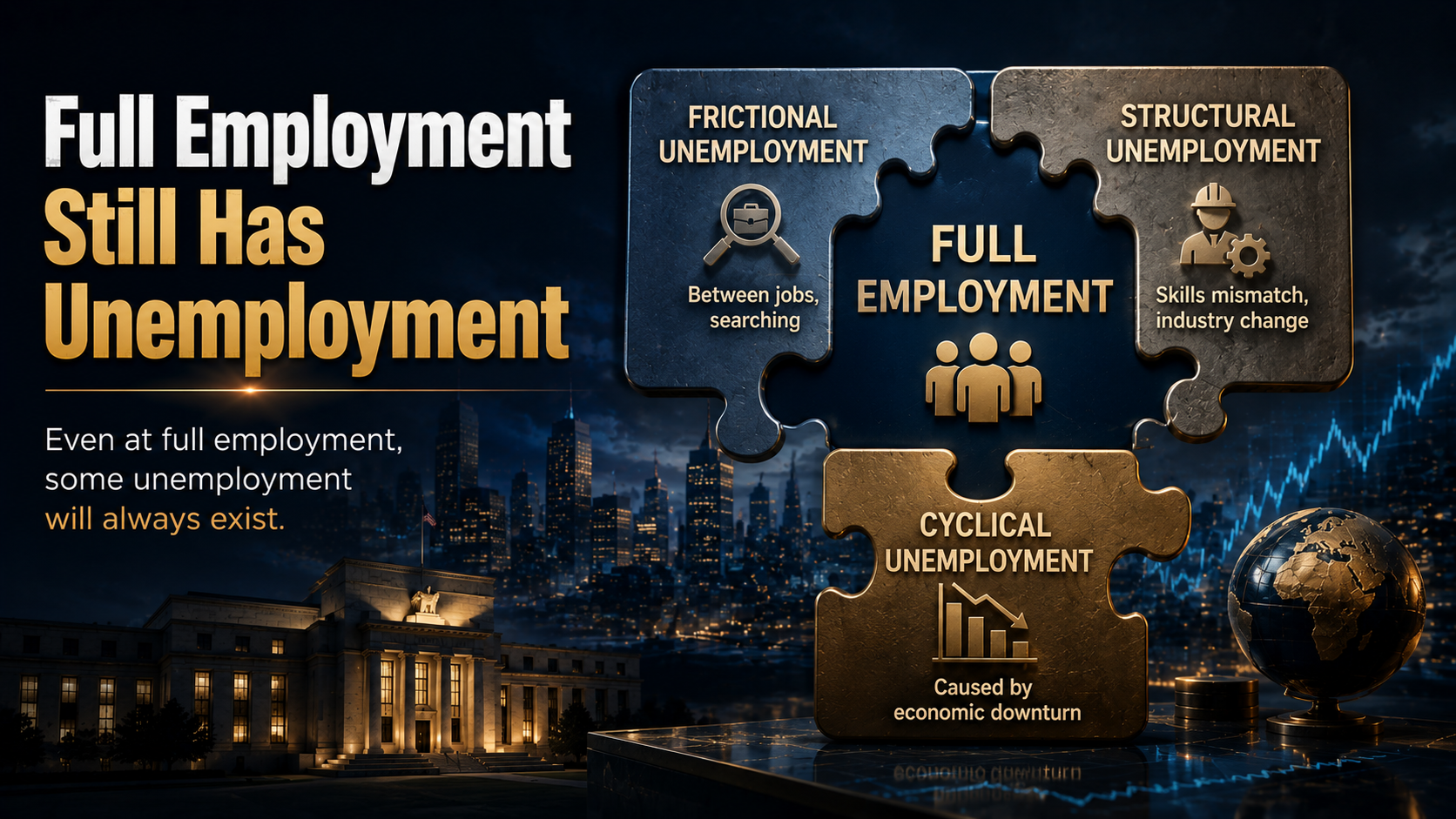
To understand the natural rate of unemployment, it helps to separate unemployment into three broad categories.
Frictional Unemployment
Frictional unemployment occurs when workers are temporarily between jobs.
Examples include
- a software engineer leaving one company for a better position
- a college graduate searching for a first full-time job
- a worker moving to another state before beginning a new job
- an employee taking time to find a role with higher pay or better conditions
Frictional unemployment is not necessarily a sign of economic weakness.
In many cases, it reflects labor mobility and workers’ confidence that better opportunities are available.
A healthy labor market often includes some frictional unemployment because people are willing to move between employers rather than remain in poorly matched positions.
Structural Unemployment
Structural unemployment occurs when the skills workers possess no longer match the skills employers need.
This may result from
- automation
- artificial intelligence
- globalization
- energy transitions
- changes in consumer demand
- the decline of older industries
- the emergence of new business models
For example, demand may weaken for workers in a declining manufacturing industry while rising for data-center technicians, semiconductor engineers, cybersecurity specialists, and AI infrastructure workers.
The economy may still be creating jobs, but those jobs may not be located in the same regions or require the same skills as the jobs being lost.
Structural unemployment tends to last longer than frictional unemployment because retraining, education, and geographic mobility take time.
Cyclical Unemployment
Cyclical unemployment is caused by a downturn in the business cycle.
When demand weakens, companies sell fewer products and services. They may respond by reducing hiring, cutting investment, freezing wages, or laying off workers.
This type of unemployment rises during recessions and generally falls during economic recoveries.
The natural rate of unemployment does not include cyclical unemployment.
A simple way to understand the relationship is
Natural unemployment = frictional unemployment + structural unemployment
When cyclical unemployment is close to zero, the economy is often described as being near full employment.
Why Is There Unemployment Even at Full Employment?
The labor market is not a machine in which every worker can instantly fill every available position.
Workers differ in
- skills
- experience
- education
- location
- wage expectations
- industry knowledge
- scheduling needs
Jobs also differ in the same ways.
A worker who loses a retail position cannot immediately become a semiconductor engineer. A job opening in Texas may not help an unemployed worker in New York who cannot relocate. A company may need a highly specialized employee even while many people remain unemployed elsewhere.
This mismatch creates natural unemployment.
A useful way to think about the labor market is as a matching system.
Millions of workers are searching for jobs, and millions of companies are searching for employees. The process takes time, even in a strong economy.
Therefore, an unemployment rate of zero would not necessarily represent a healthy economy. It could instead signal an extreme shortage of available workers.
How the Natural Rate of Unemployment Works
The natural rate of unemployment matters because it connects labor-market conditions to wages, inflation, and monetary policy.
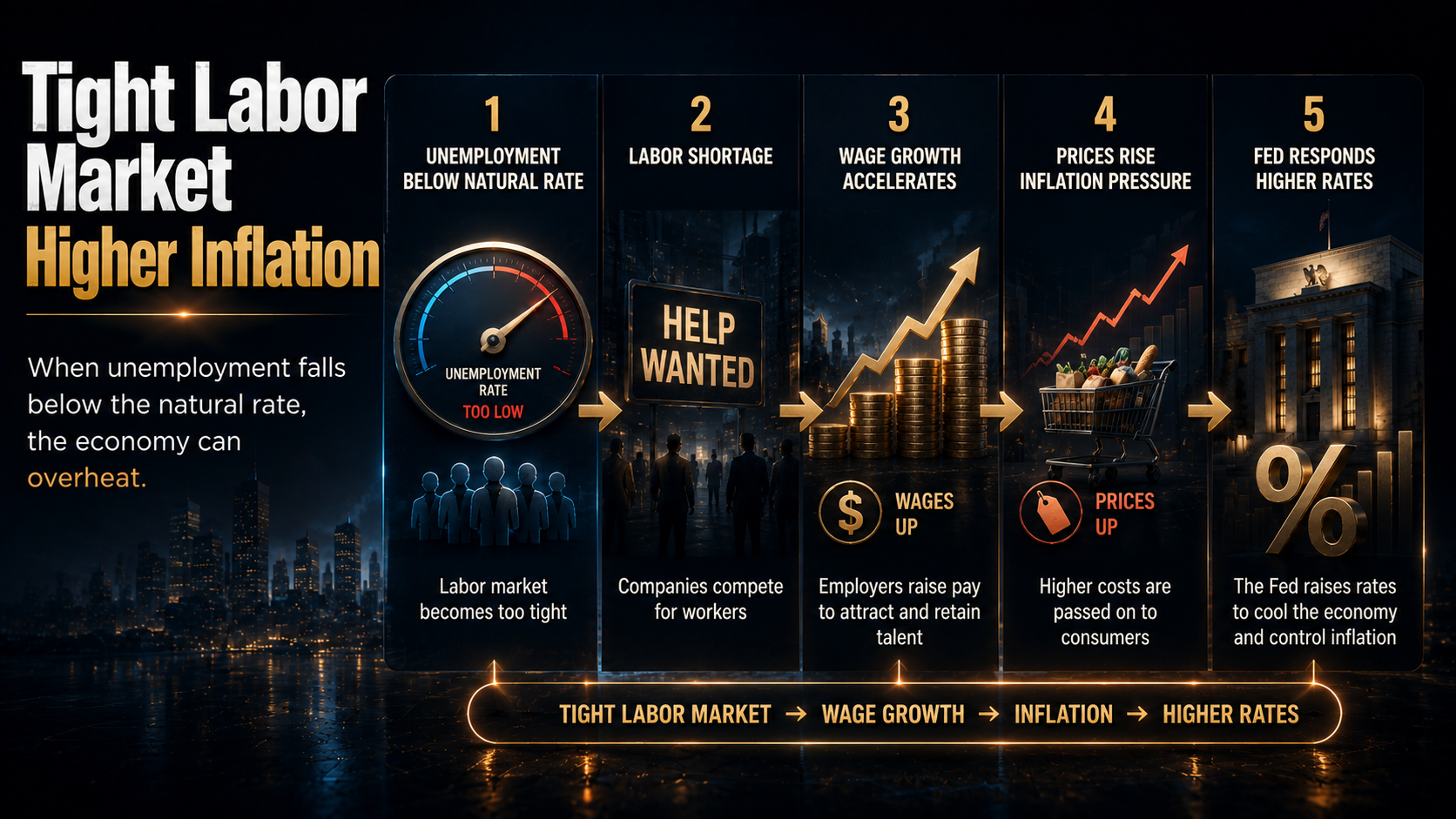
When the actual unemployment rate falls below the natural rate, the labor market becomes unusually tight.
Companies may struggle to fill open positions. To attract or retain workers, employers may offer
- higher wages
- signing bonuses
- improved benefits
- flexible work arrangements
- faster promotions
Higher worker income can support stronger consumer spending.
However, rising labor costs may also reduce corporate margins. Businesses may respond by increasing prices, cutting other expenses, investing in automation, or accepting lower profitability.
The basic mechanism can be summarized as follows
Unemployment below the natural rate → labor shortages → faster wage growth → higher business costs and demand → stronger inflation pressure
If inflation pressure becomes persistent, the Federal Reserve may keep interest rates higher for longer or tighten monetary policy further.
The opposite can also occur.
When actual unemployment rises above the natural rate, more workers compete for fewer jobs. Wage growth may slow, household spending may weaken, and companies may become less willing to invest.
The process then looks like this
Unemployment above the natural rate → labor-market slack → slower wage growth → weaker consumption → lower inflation pressure and greater recession risk
In that environment, the Fed may consider reducing interest rates if inflation is under control.
The Natural Rate of Unemployment and Inflation
The natural rate of unemployment is closely related to the concept sometimes called the non-accelerating inflation rate of unemployment, or NAIRU.
The basic idea is that there is a level of unemployment below which inflation may begin to accelerate.
This does not mean that every decline in unemployment automatically causes inflation. The relationship is influenced by many other factors, including
- productivity growth
- immigration
- labor-force participation
- technology
- supply-chain conditions
- commodity prices
- inflation expectations
- corporate pricing power
Still, labor-market tightness remains important because wages are a major cost for many businesses, especially in service industries.
If wages rise rapidly but productivity does not increase at the same pace, businesses may need to raise prices to protect margins.
This is one reason the Fed pays close attention not only to the unemployment rate but also to
- average hourly earnings
- employment cost data
- job openings
- quits
- hiring rates
- labor-force participation
- productivity
- unit labor costs
The unemployment rate alone never tells the full story.
Why the Natural Rate of Unemployment Is Not a Fixed Number
The natural rate of unemployment cannot be directly observed.
It must be estimated.
That estimate changes over time because the structure of the labor market changes.
Factors that may influence the natural rate include
Demographics
An aging population, changes in retirement behavior, and shifts in the size of the working-age population can affect labor supply.
Labor-Force Participation
The unemployment rate only counts people actively looking for work.
If discouraged workers stop searching, the unemployment rate may fall even though the labor market has not meaningfully improved.
Immigration
An increase in labor supply may reduce worker shortages and allow employment to grow without creating the same degree of wage pressure.
Technology and Automation
Technology can eliminate some jobs while creating others. In the short term, this may increase skill mismatches and structural unemployment.
Over time, technology may also improve productivity and allow wages to rise without creating as much inflation.
Remote Work
Remote work can improve job matching by allowing companies to hire outside their immediate region. It may reduce some forms of geographic mismatch while creating new differences between occupations that can and cannot be performed remotely.
Education and Retraining
A workforce that can adapt quickly to new technologies may experience lower structural unemployment.
Labor-Market Institutions
Minimum wages, unemployment benefits, hiring regulations, unionization, licensing rules, and employer practices may all influence how quickly workers move into new jobs.
Because these forces change, the natural rate of unemployment should be viewed as a moving estimate rather than a permanent threshold.
Why the Federal Reserve Cares About the Natural Rate of Unemployment
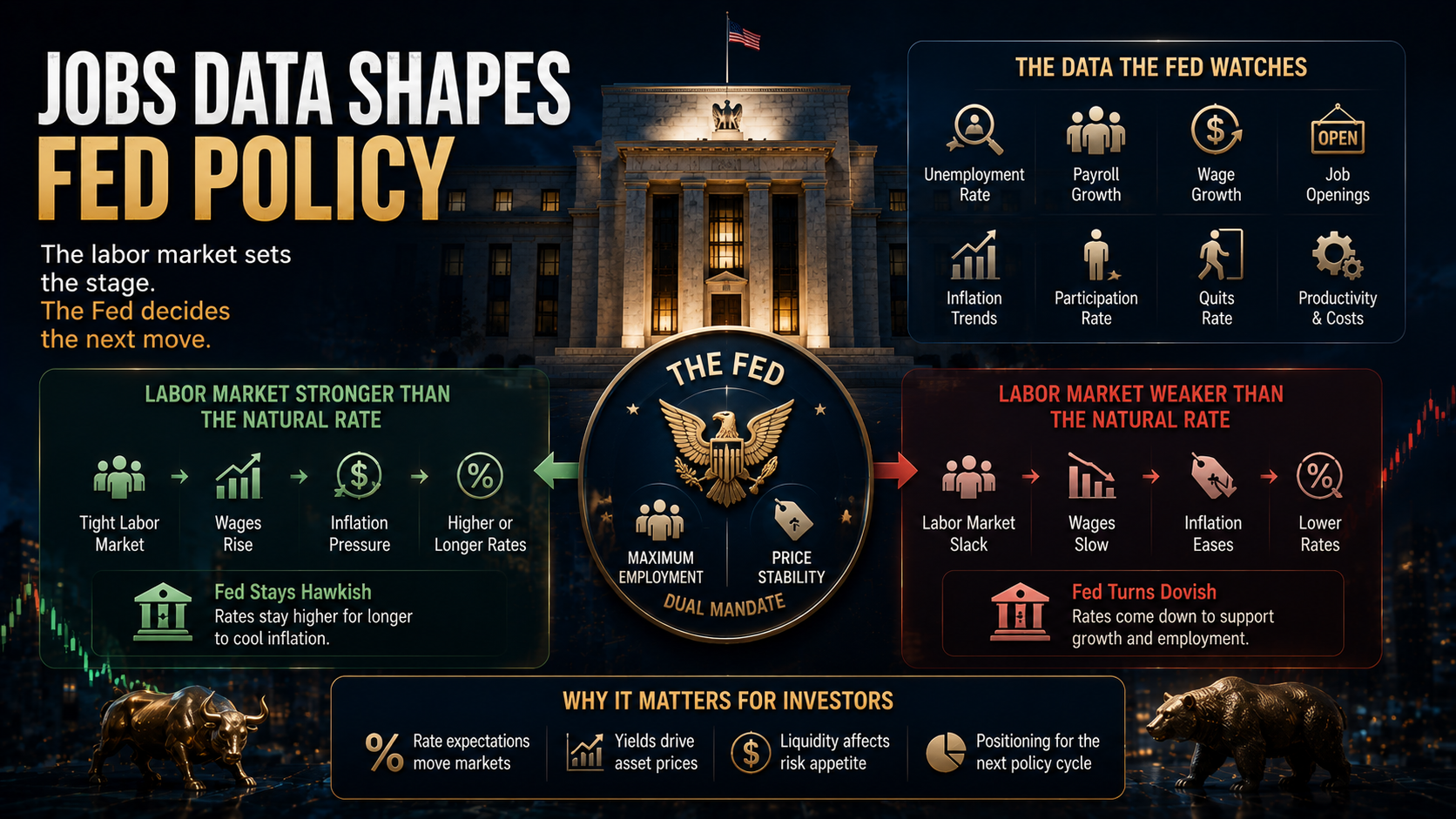
The Federal Reserve has a dual mandate
- maximum employment
- stable prices
These goals can sometimes conflict.
If unemployment is too high, the Fed may lower interest rates to support demand, hiring, and investment.
If unemployment is extremely low and inflation is rising, the Fed may keep rates high to prevent the economy from overheating.
The natural rate of unemployment provides a reference point for judging whether labor demand is stronger or weaker than the economy can sustainably support.
However, the Fed does not respond mechanically to a single unemployment number.
Policymakers also consider
- inflation trends
- wage growth
- financial conditions
- productivity
- consumer spending
- business investment
- credit conditions
- global risks
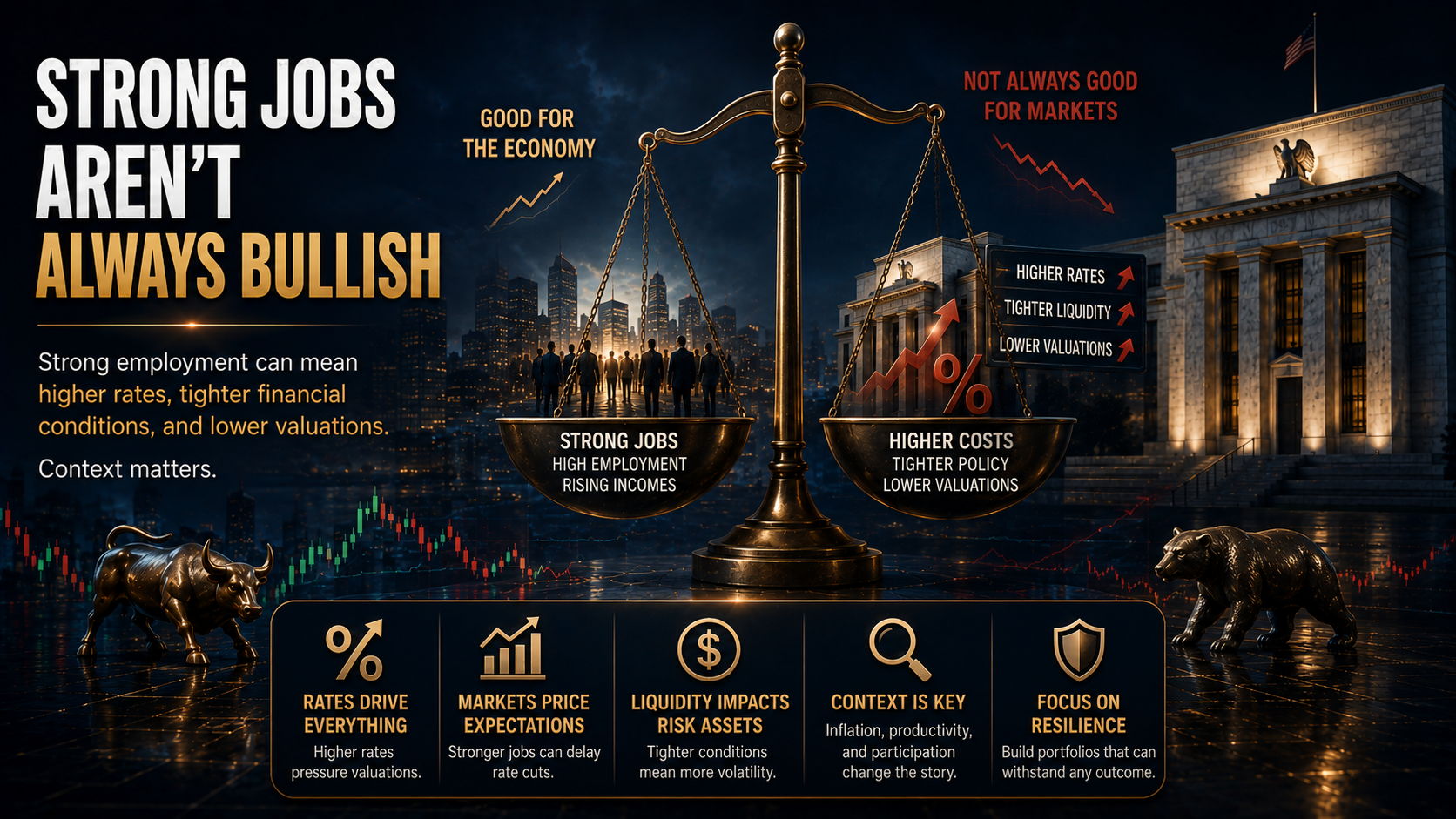
The key point for investors is that a very strong labor report can produce a negative market reaction.
Why?
Because the market may interpret strong employment as a reason for the Fed to delay rate cuts.
This is an example of why good economic news is not always good news for asset prices.
Why Investors Should Care
Interest rates are one of the most important inputs in asset valuation.
The natural rate of unemployment matters because the relationship between actual unemployment and sustainable employment can influence the future path of Fed policy.
If the labor market is much tighter than expected, investors may anticipate
- higher Treasury yields
- fewer rate cuts
- tighter financial conditions
- a stronger U.S. dollar
- lower valuation multiples
- increased pressure on highly leveraged companies
If the labor market weakens sharply, investors may anticipate rate cuts.
But weaker employment is not automatically bullish.
A modest slowdown may support bonds and growth stocks by reducing inflation pressure.
A severe slowdown may instead signal falling earnings, rising defaults, weaker consumer demand, and recession risk.
Markets therefore care about the speed and scale of labor-market change, not just the direction.
Market Impact by Asset Class
The natural rate of unemployment does not move markets by itself.
Markets respond to how employment conditions change expectations for inflation, growth, interest rates, and liquidity.
| Asset Class | Unemployment Below the Natural Rate | Unemployment Above the Natural Rate |
| U.S. Treasuries | Inflation and tightening concerns may push yields higher and prices lower | Rate-cut expectations may push yields lower and prices higher |
| U.S. Stocks | Strong demand may initially support earnings, but higher rates can pressure valuations | Slower growth may hurt earnings, though rate-cut expectations can support valuations |
| Nasdaq and Growth Stocks | More sensitive to rising discount rates and higher long-term yields | May benefit from falling yields unless the slowdown becomes a deep recession |
| U.S. Dollar | Higher relative interest rates can support dollar strength | Rate cuts may weaken the dollar, depending on global conditions |
| Gold | Higher real yields can create pressure, while inflation fears may provide support | Lower real yields and easier policy can be favorable |
| Bitcoin and Other Risk Assets | Tight liquidity and rising real yields can increase volatility | Easing expectations may improve liquidity, though recession risk can create short-term pressure |
| Corporate Credit | High rates may raise refinancing costs despite strong employment | Spreads may widen if defaults and recession fears increase |
The most important takeaway is that the same employment number can have different effects depending on the economic backdrop.
Strong job growth during falling inflation may be viewed positively.
Strong job growth during persistent inflation may be interpreted as a reason for tighter policy.
Weak job growth during an orderly slowdown may support rate-cut expectations.
Weak job growth during a credit shock may trigger recession fears.
Context matters more than the headline number.
How the Natural Rate Affects Treasury Yields
The Treasury market often reacts quickly to labor-market data because bond yields reflect expectations for
- future Fed policy
- inflation
- economic growth
- term premiums
If employment remains stronger than expected and wage growth stays elevated, investors may conclude that the Fed has less reason to cut rates.
Short-term Treasury yields may rise because they are closely tied to expected policy rates.
Long-term yields may also rise if investors expect inflation to remain persistent or government borrowing demand to stay high.
When labor data weakens, yields may fall as markets price in rate cuts.
However, the reason yields are falling matters.
A gradual decline caused by lower inflation may support stocks.
A rapid decline caused by recession fear may coincide with falling equity prices and widening credit spreads.
How the Natural Rate Affects the S&P 500 and Nasdaq
A tight labor market can help corporate revenue because employed consumers generally spend more.
But it can also hurt margins through higher wages.
The balance varies across industries.
Labor-intensive sectors may face greater cost pressure, while companies with strong pricing power, high productivity, or scalable digital business models may be better positioned.
The Nasdaq is especially sensitive to interest rates because many technology companies are valued on profits expected far into the future.
When long-term yields rise, those future profits are discounted at a higher rate, which can reduce present valuations.
This means strong labor data can pressure technology stocks even when the broader economy appears healthy.
The market is not only asking whether companies will grow.
It is also asking what interest rate should be used to value that growth.
How the Natural Rate Affects the U.S. Dollar
A tighter-than-expected labor market can support the dollar if it causes investors to expect higher U.S. interest rates relative to other economies.
Higher yields may attract global capital into dollar-denominated assets.
However, the dollar’s direction also depends on
- foreign central-bank policy
- global risk appetite
- trade flows
- geopolitical uncertainty
- U.S. fiscal conditions
A weakening labor market may reduce the dollar’s interest-rate advantage if investors expect the Fed to cut rates aggressively.
Yet during a global crisis, the dollar may still strengthen because it remains a major reserve and funding currency.
How the Natural Rate Affects Gold and Bitcoin
Gold and Bitcoin do not respond directly to unemployment.
They respond to the monetary and liquidity consequences of labor-market conditions.
For gold, important variables include
- real interest rates
- inflation expectations
- dollar strength
- central-bank demand
- financial stress
A very tight labor market may support higher real yields, which can pressure gold.
However, if investors fear that inflation will remain persistent, gold may still attract demand as a store of value.
Bitcoin is often highly sensitive to global liquidity and risk appetite.
If weak employment data leads markets to expect easier monetary policy, Bitcoin may benefit from improving liquidity expectations.
But if unemployment rises because the economy is entering a severe recession, investors may initially reduce risk across multiple asset classes.
Liquidity is important, but so is investor confidence.
Key Points Investors Should Understand
The Natural Rate Is an Estimate
There is no single number that can be measured in real time with certainty.
Investors should avoid treating any estimate as an exact boundary.
The Gap Matters More Than the Headline
A 4% unemployment rate may represent a tight labor market in one period and a balanced labor market in another.
The important question is whether unemployment is above or below the sustainable level implied by inflation, wages, productivity, and labor supply.
Wage Growth Matters
Unemployment may remain low without causing inflation if productivity is improving and labor supply is expanding.
Investors should study wage growth together with productivity and unit labor costs.
Labor-Force Participation Matters
A falling unemployment rate caused by more people finding jobs is different from a falling unemployment rate caused by people leaving the labor force.
Employment Is a Lagging Indicator
Businesses do not always begin layoffs immediately when growth weakens.
By the time unemployment rises significantly, economic conditions may already have deteriorated.
Revisions Matter
Payroll figures are often revised after the initial release.
One report should not be treated as a complete economic signal.
The Fed Watches a Dashboard, Not One Number
The Fed evaluates labor demand, wage pressure, inflation, productivity, and financial conditions together.
What Should Investors Monitor?
A better labor-market framework includes several indicators.
Unemployment Rate
Shows the percentage of the labor force actively seeking work but unable to find it.
Nonfarm Payrolls
Measures monthly job creation across most U.S. industries.
Average Hourly Earnings
Provides information about wage growth and potential labor-cost pressure.
Labor-Force Participation Rate
Shows how much of the working-age population is employed or actively looking for work.
Job Openings
Helps measure labor demand and the degree of competition for workers.
Quits Rate
A high quits rate may signal worker confidence and wage bargaining power.
Initial Jobless Claims
Can provide a relatively timely indication of layoffs.
Employment Cost Index
Offers a broader view of wage and benefit costs.
Productivity and Unit Labor Costs
Help determine whether wage growth is inflationary.
If productivity rises alongside wages, companies may absorb higher compensation without increasing prices as aggressively.
What Do Wealthy Investors Watch in This Cycle?
Experienced investors do not focus only on whether the unemployment rate is low.
They focus on what labor-market conditions imply for capital flows, cash flow durability, balance-sheet strength, and the next stage of the economic cycle.
Capital Flows
When employment remains strong and inflation pressure persists, markets may expect interest rates to stay high.
Capital may move toward
- short-term Treasuries
- money-market funds
- high-quality bonds
- cash-generating companies
When labor conditions weaken and the Fed begins easing, capital may rotate toward longer-duration bonds and selected growth assets.
However, the transition is rarely immediate or smooth.
Rate cuts caused by falling inflation are different from rate cuts caused by financial stress.
Cash Flow
In a high-wage and high-rate environment, investors may favor companies with
- strong free cash flow
- recurring revenue
- pricing power
- low refinancing needs
- disciplined capital spending
Revenue growth alone may not be enough if labor expenses and interest costs are rising faster.
Asset Survival
The strongest assets are not always those with the highest expected growth.
They are often those capable of surviving multiple economic environments.
Investors may examine
- debt maturity schedules
- interest coverage
- operating margins
- customer concentration
- liquidity reserves
- sensitivity to consumer spending
Long-Term Perspective
The labor market can remain tight longer than expected, and monetary policy can stay restrictive longer than markets initially price in.
Long-term investors therefore avoid building a portfolio around one employment report or one anticipated Fed decision.
They focus on resilience.
The most important question is not whether one can perfectly predict the next unemployment number.
It is whether the portfolio can survive if the labor market, inflation, and interest rates evolve differently from expectations.
Questions Investors Should Ask Themselves
- Is the current unemployment rate low because labor demand is strong, or because labor-force participation is weak?
- Are wages rising faster than productivity?
- Is the labor market cooling gradually or deteriorating rapidly?
- Are Treasury yields rising because of stronger growth, persistent inflation, or fiscal concerns?
- Which companies can protect margins if labor costs remain elevated?
- Which assets depend heavily on rapid rate cuts?
- Does my portfolio rely on a single economic scenario?
- Can the companies I own refinance debt if interest rates remain high?
- Am I reacting to one headline, or analyzing a broader trend?
These questions are more useful than simply deciding whether a jobs report is “good” or “bad.”
The Deeper Market Lesson
The natural rate of unemployment reveals an important truth about financial markets
An economy can be strong enough to become a problem for asset prices.
When employment is extremely strong, inflation may remain persistent. That can delay rate cuts, keep bond yields elevated, and compress equity valuations.
When employment becomes too weak, inflation may fall, but corporate earnings and credit quality may also deteriorate.
Markets are constantly searching for a narrow path between overheating and recession.
This is why investors often refer to a soft landing.
A soft landing is not simply low unemployment.
It is a situation in which labor demand cools enough to reduce inflation without triggering a severe collapse in employment, income, spending, and corporate profits.
That balance is difficult to achieve.
Conclusion
The natural rate of unemployment is the level of unemployment that exists when the economy is near full employment and cyclical unemployment has largely disappeared.
It reflects the normal friction and structural mismatch that occur in a changing labor market.
For investors, its importance comes from the connection between employment, wages, inflation, Federal Reserve policy, Treasury yields, and financial-market liquidity.
When unemployment falls below a sustainable level, wage and inflation pressure may increase, encouraging the Fed to maintain tighter policy.
When unemployment rises above that level, inflation may cool, but recession and earnings risks may grow.
The key is not to react to the unemployment rate in isolation.
Investors should evaluate the entire chain
Labor demand → wage growth → inflation → Federal Reserve policy → interest rates → capital flows → asset prices
Markets are not driven only by whether economic data is strong or weak.
They are driven by how the data changes expectations.
The long-term investor’s advantage does not come from predicting every monthly jobs report. It comes from understanding the structure behind the numbers and owning assets that can survive when the economic path differs from the market’s expectations.
This was MasterMind.
'[Global] Success Blueprints' 카테고리의 다른 글