Why Didn’t My Mortgage Rate Drop After the Fed Cut Rates? How Loan Rates Really Work


Hello, this is MasterMind.
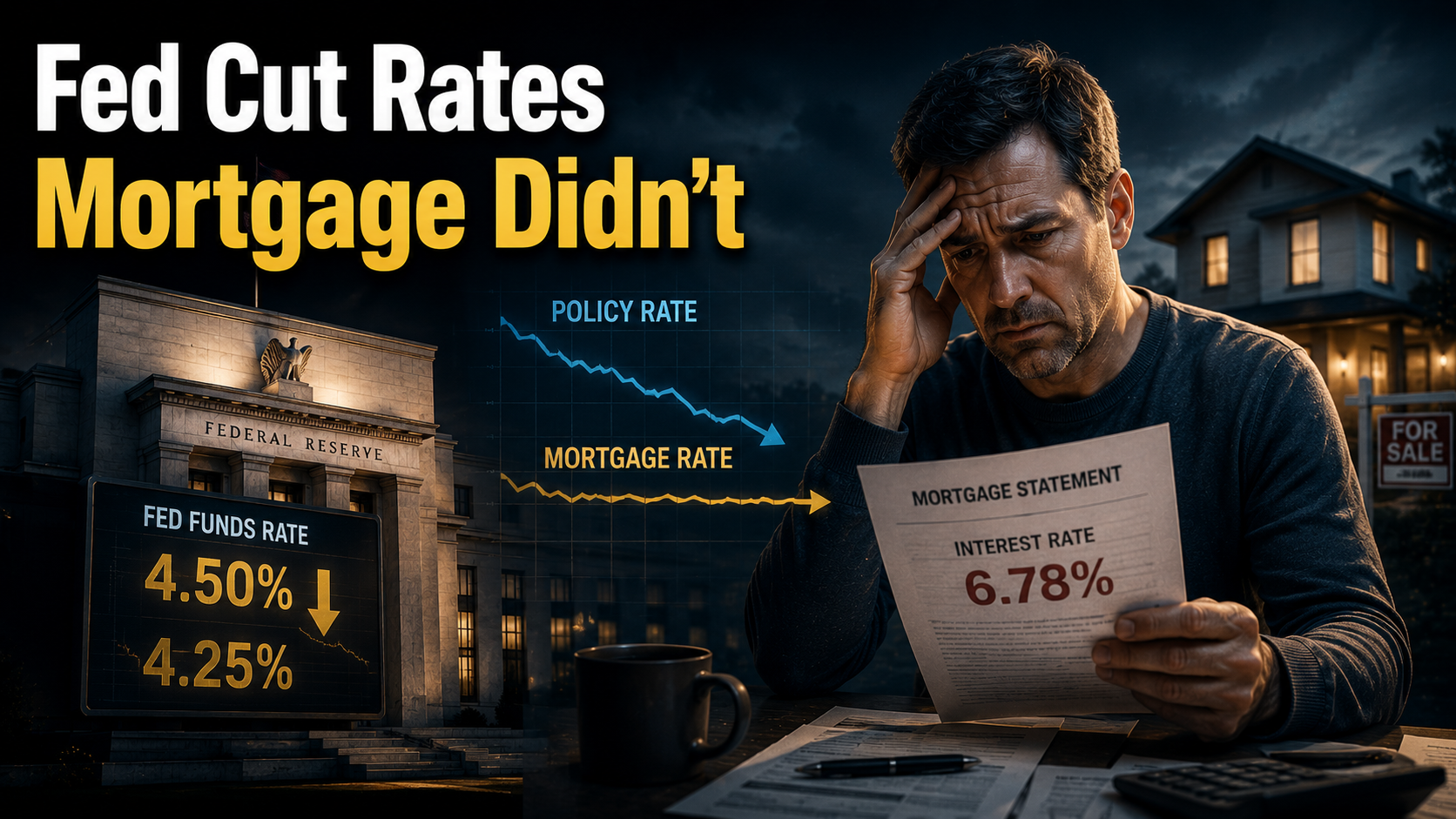
"The Federal Reserve just cut interest rates. So why hasn't my mortgage payment gone down?"
It's a question many Americans ask whenever the Fed announces a rate cut. Headlines often suggest that lower interest rates should immediately make borrowing cheaper. Yet many homeowners discover that their mortgage rate barely changes—or in some cases, new loans become even more expensive.
The reason is surprisingly simple.
The Federal Reserve controls policy rates, but it does not directly control the interest rate on your mortgage, auto loan, or business loan.
To understand why, we need to look beyond headlines and examine how money actually moves through the financial system.
Key Takeaway
Your loan rate is determined not just by the Fed, but by Treasury yields, bank funding costs, credit risk, and lending conditions across the financial system.
What Is the Difference Between the Fed Funds Rate and Your Loan Rate?
Many investors assume all interest rates move together.
In reality, they serve different purposes.
The Federal Funds Rate
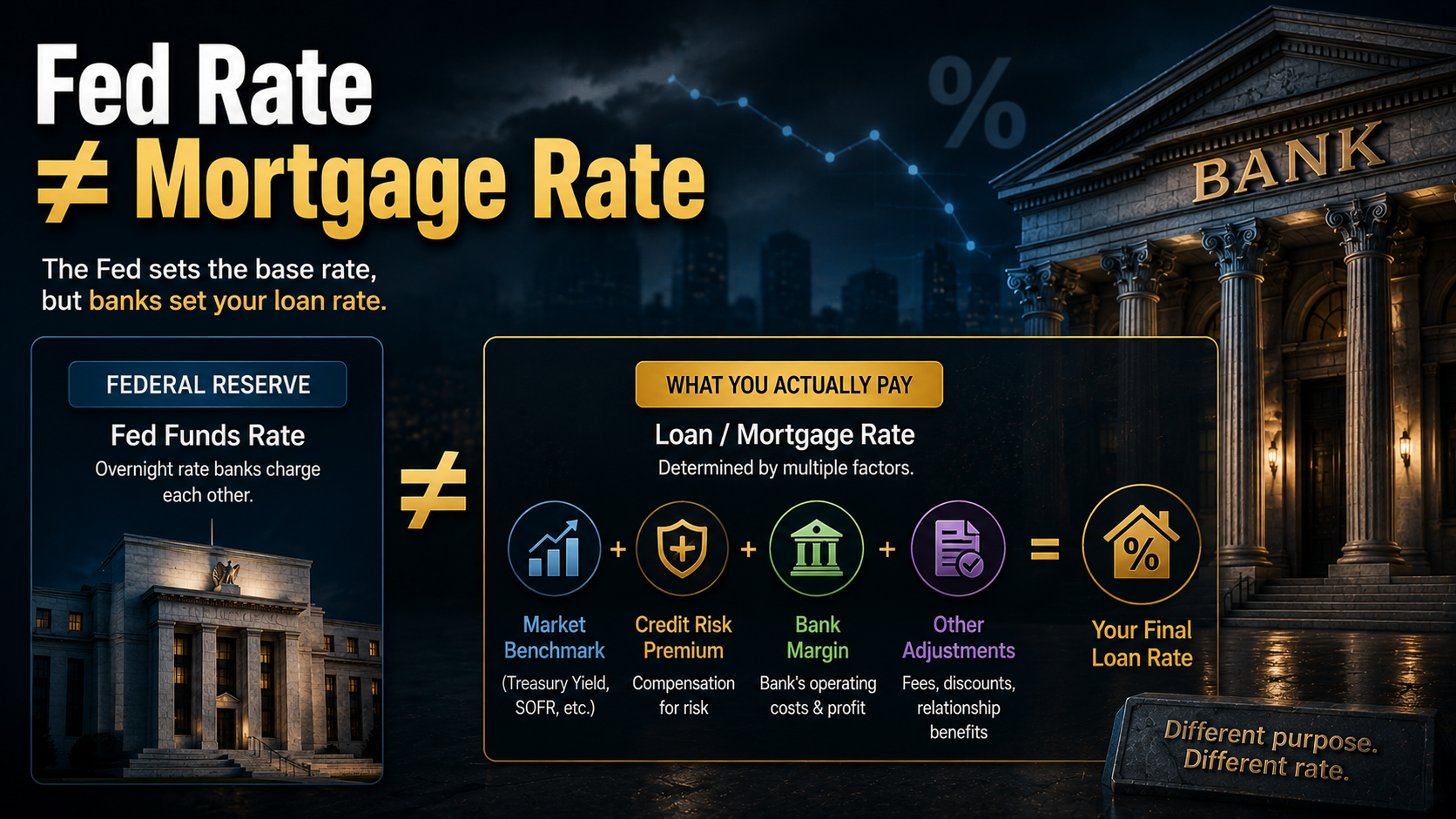
The Federal Funds Rate is the overnight interest rate banks charge each other for short-term borrowing.
It is the Federal Reserve's primary monetary policy tool and acts as the starting point for the entire interest-rate system.
Think of it as the base signal that influences financial markets.
Consumer Loan Rates
Mortgage rates, auto loans, credit lines, and business loans are determined differently.
Banks typically calculate lending rates using a formula similar to this
Loan Rate = Market Benchmark + Credit Spread + Bank Margin − Discounts
Unlike the Fed Funds Rate, these benchmarks often include Treasury yields, SOFR, or other market-based funding costs.
This explains why a Fed rate cut does not automatically reduce borrowing costs.
How Loan Rates Are Actually Determined
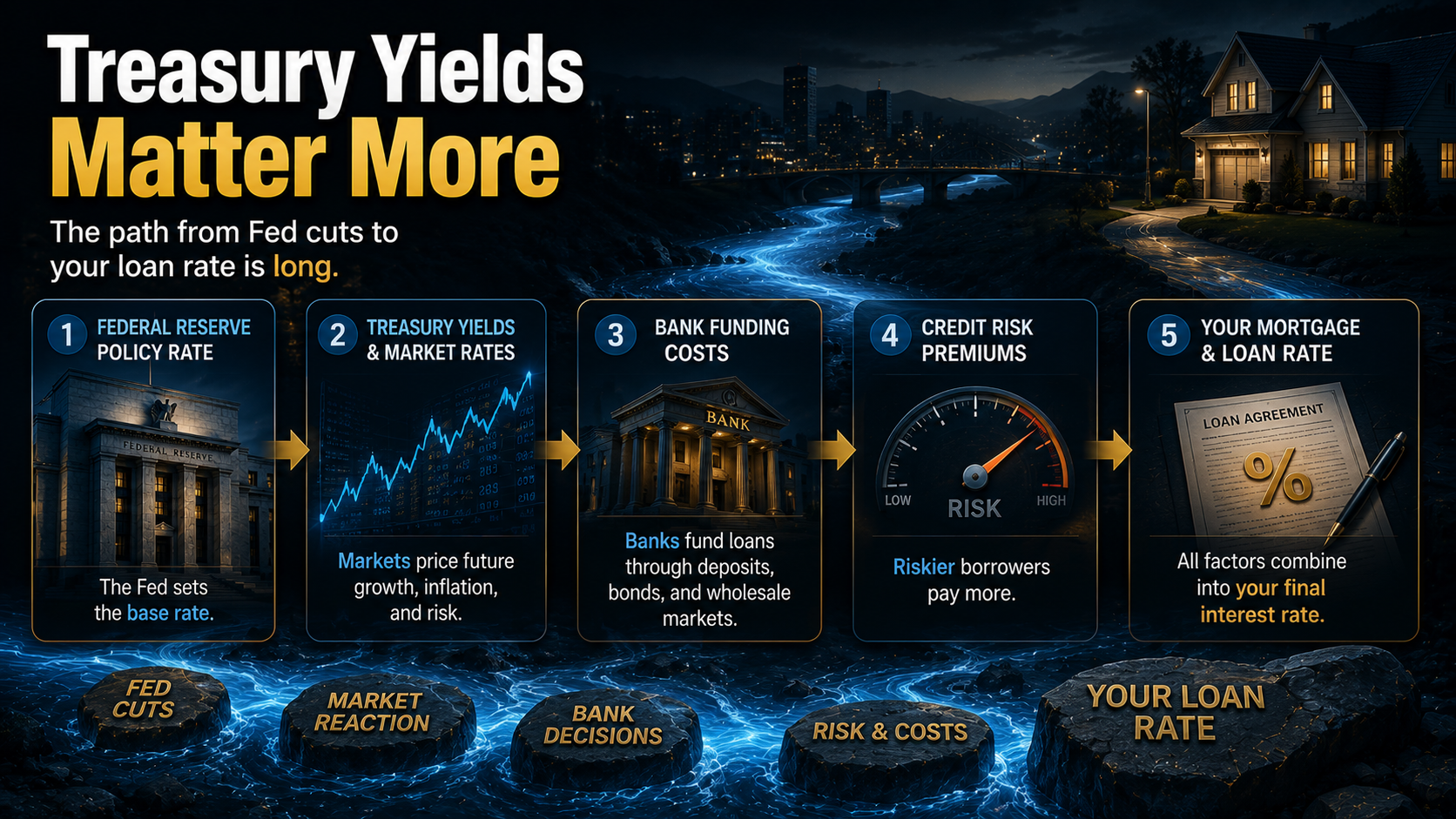
Imagine the financial system as a river.
The Federal Reserve controls the source of the river.
But before that water reaches households and businesses, it flows through multiple channels.
Those channels determine how much actually arrives.
Federal Reserve Policy Rate
          ↓
Treasury Yields & Market Rates
          ↓
Bank Funding Costs
          ↓
Credit Risk Premiums
          ↓
Final Mortgage & Loan Rates
The Fed can influence the direction of the river.
It cannot completely control every section downstream.
Why Your Mortgage Rate May Stay High
1. Markets Move Before the Fed
Financial markets are forward-looking.
If investors already expect multiple rate cuts, Treasury yields often fall months before the Fed actually acts.
By the time the announcement arrives, much of the expected decline has already been priced into the market.
Sometimes long-term yields even rise afterward because investors shift their attention to inflation or government borrowing.
The market trades expectations—not headlines.
2. Mortgage Rates Follow Treasury Yields
In the United States, the 30-year fixed mortgage is heavily influenced by the 10-year U.S. Treasury yield, not directly by the Fed Funds Rate.
If Treasury yields remain elevated because investors expect stronger growth, persistent inflation, or larger government deficits, mortgage rates can remain high despite Fed easing.
This is one of the biggest misconceptions among new investors.
3. Banks Price Risk
Banks are businesses.
They evaluate credit risk every day.
If unemployment rises, defaults increase, or economic uncertainty grows, lenders demand higher compensation for taking that risk.
That additional compensation becomes the credit spread built into your loan.
As a result, policy rates may fall while borrowing costs remain relatively unchanged.
4. Funding Costs Don't Change Overnight
Banks finance loans using deposits, wholesale funding, and bond issuance.
Those funding costs adjust gradually.
Even after the Fed cuts rates, banks may continue paying relatively high funding costs for months.
That delay slows the transmission of lower rates to consumers.

Why This Matters for Investors
Many people believe the Federal Reserve determines the price of money.
In reality, financial markets determine the market price of money, while the Fed influences the direction.
Several forces shape interest rates simultaneously
- Treasury supply and demand
- Inflation expectations
- Economic growth
- Credit conditions
- Banking-sector risk
- Investor sentiment
The Fed is an important player.
It is not the only player.
This distinction helps explain why markets sometimes rally before a rate cut—or decline after one.
How Different Asset Classes React
| Asset | Typical Impact |
| U.S. Treasuries | Usually move ahead of Fed decisions as markets price future expectations. |
| Mortgage Rates | Closely tied to the 10-year Treasury yield rather than the Fed Funds Rate. |
| Stocks | Lower rates can support valuations, but higher long-term yields may offset the benefit. |
| U.S. Dollar | May weaken if investors expect continued monetary easing. |
| Gold | Often benefits when real interest rates decline. |
| Bitcoin | Can gain from improving liquidity, although risk sentiment remains the key driver. |
| Real Estate | Activity typically improves only after mortgage rates meaningfully decline. |
What Investors Should Watch
1. Watch Treasury Yields, Not Just the Fed
The 10-year Treasury yield often tells you more about future mortgage costs than the latest Fed announcement.
2. Credit Spreads Matter
Even if Treasury yields fall, widening credit spreads can keep borrowing expensive.
3. Liquidity Is More Important Than Headlines
A rate cut does not guarantee that credit becomes easier.
Banks must also be willing to lend.
4. Markets Care About the Future
Financial markets continuously price future expectations.
The next six months often matter more than today's announcement.
What Wealthy Investors See That Others Often Miss
Experienced investors rarely focus only on the Fed's latest press conference.
Instead, they ask a different question
"Where is capital actually flowing?"
If borrowing conditions remain tight, liquidity may stay concentrated in safer assets such as Treasury securities or cash.
As financial conditions gradually ease, capital often rotates toward equities, real estate, private investments, and other growth-oriented assets.
Wealthy investors also prioritize resilience.
Rather than assuming lower rates will solve every problem, they build portfolios capable of withstanding prolonged periods of higher borrowing costs.
Ask yourself
- Are long-term Treasury yields actually falling?
- Is credit becoming easier to access?
- Are banks expanding lending?
- Could your portfolio withstand another year of elevated borrowing costs?
Investing isn't about predicting every Fed meeting.
It's about understanding where capital is moving and positioning yourself accordingly.

Conclusion
A Federal Reserve rate cut is an important signal—but it is only the first step in a much larger financial process.
Mortgage rates and consumer borrowing costs depend on Treasury yields, bank funding costs, credit spreads, and the overall flow of capital throughout the economy.
Understanding this distinction helps investors move beyond sensational headlines and focus on the forces that truly drive financial markets.
In the end, successful investing isn't about correctly predicting the Fed's next move.
It's about understanding how money flows through the financial system—and building a portfolio that can survive regardless of where interest rates go next.
MasterMind.
'[Global] Success Blueprints' 카테고리의 다른 글