What Is the Taylor Rule? How It Shapes Interest Rates and Financial Markets


Hello, this is MasterMind.
Why does the Federal Reserve decide to raise interest rates at one meeting but leave them unchanged at the next? Is it simply reacting to inflation headlines, or is there a structured framework behind those decisions?
Whenever the Federal Reserve announces an interest rate decision, financial markets react within seconds. Stocks surge or tumble, Treasury yields move sharply, and the U.S. dollar often strengthens or weakens almost immediately.
While investors closely watch every word from the Fed Chair, there is a well-known economic framework that often helps explain how policymakers think about interest rates. That framework is called the Taylor Rule.
The Taylor Rule is not a law that the Federal Reserve must follow. Instead, it is one of the most influential policy guidelines ever developed for determining what the federal funds rate should be based on current economic conditions.
Understanding this concept gives investors something far more valuable than predicting the next Fed meeting—it helps explain why monetary policy changes over time.

Key Takeaway
The Taylor Rule is a monetary policy guideline that estimates an appropriate policy interest rate based on inflation and overall economic conditions, helping investors understand the likely direction of future monetary policy.
What Is the Taylor Rule?
The Taylor Rule was introduced in 1993 by Stanford economist John B. Taylor.
Its purpose was straightforward
Instead of relying solely on judgment, central banks could use measurable economic data to estimate where interest rates should be.
At its core, the Taylor Rule attempts to answer one simple question
Given today's economy, what would be an appropriate policy interest rate?
Rather than focusing on politics or market sentiment, the rule uses objective economic indicators to estimate a neutral policy stance.
Over the past three decades, the Taylor Rule has become one of the most widely discussed frameworks in monetary economics. Even though the Federal Reserve does not mechanically follow it, economists, analysts, and institutional investors frequently compare actual interest rates with the level suggested by the Taylor Rule.
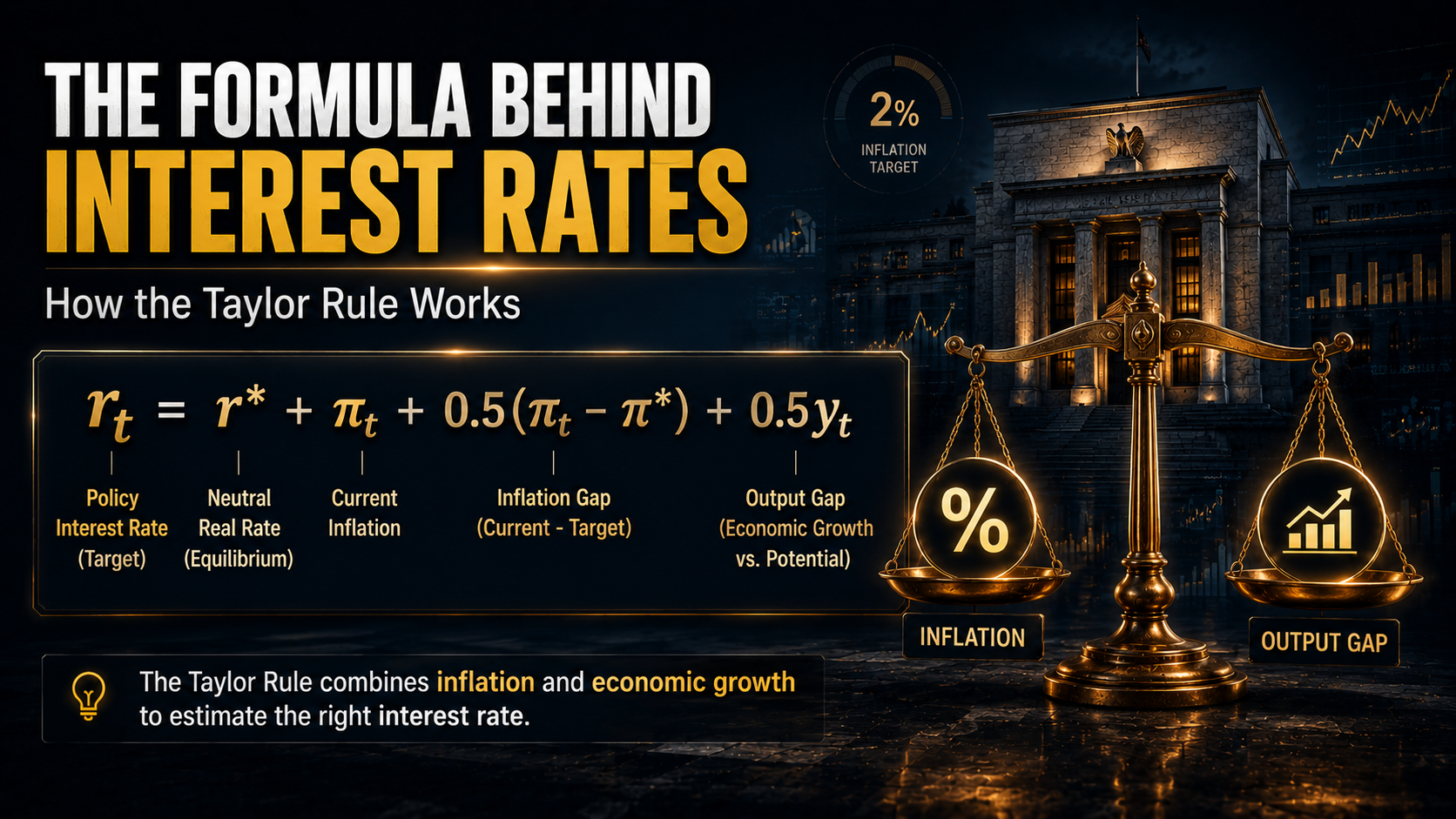
How Does the Taylor Rule Work?
The Taylor Rule primarily evaluates two economic conditions.
1. Inflation Gap
The first variable measures how far inflation is from the Federal Reserve's target.
For example
- Inflation target: 2%
- Current inflation: 4%
The inflation gap is +2%.
Higher inflation generally suggests that interest rates should be higher to cool demand and reduce inflationary pressure.
2. Output Gap
The second variable measures whether the economy is operating above or below its long-term productive capacity.
If economic activity is stronger than its sustainable level, the economy may overheat, increasing inflation risks.
If output falls below potential, lower interest rates may help stimulate borrowing, investment, and employment.

Think of It Like Cruise Control
Imagine the economy as a car traveling down the highway.
- Inflation is the engine temperature.
- Economic growth is the vehicle's speed.
- Interest rates are the accelerator and brake.
If the engine begins overheating, the system applies the brakes by raising interest rates.
If the vehicle slows too much and risks stalling, it presses the accelerator by lowering rates.
The Taylor Rule simply provides a systematic way to adjust the speed instead of relying on guesswork.
Why Does the Taylor Rule Matter?
Financial markets dislike uncertainty.
One reason the Taylor Rule receives so much attention is that it provides a benchmark for evaluating whether monetary policy appears loose or restrictive.
Investors constantly ask
Is the current policy rate above or below what economic conditions would normally justify?
If actual interest rates remain well below the Taylor Rule estimate, markets may begin pricing in additional rate hikes.
Conversely, if rates appear significantly higher than the model suggests, expectations for future rate cuts often increase.
The market isn't reacting to today's interest rate alone—it is reacting to where monetary policy is likely headed next.
The Real Driver of Markets Is Expectations
One of the biggest lessons in investing is that markets rarely wait for events to happen.
They move based on expectations.
A higher-than-expected inflation report does not automatically cause stocks to fall because inflation itself increased.
Stocks move because investors begin adjusting their expectations for future Federal Reserve decisions.
In other words
Markets trade tomorrow's expectations, not today's headlines.
How the Taylor Rule Can Influence Financial Markets
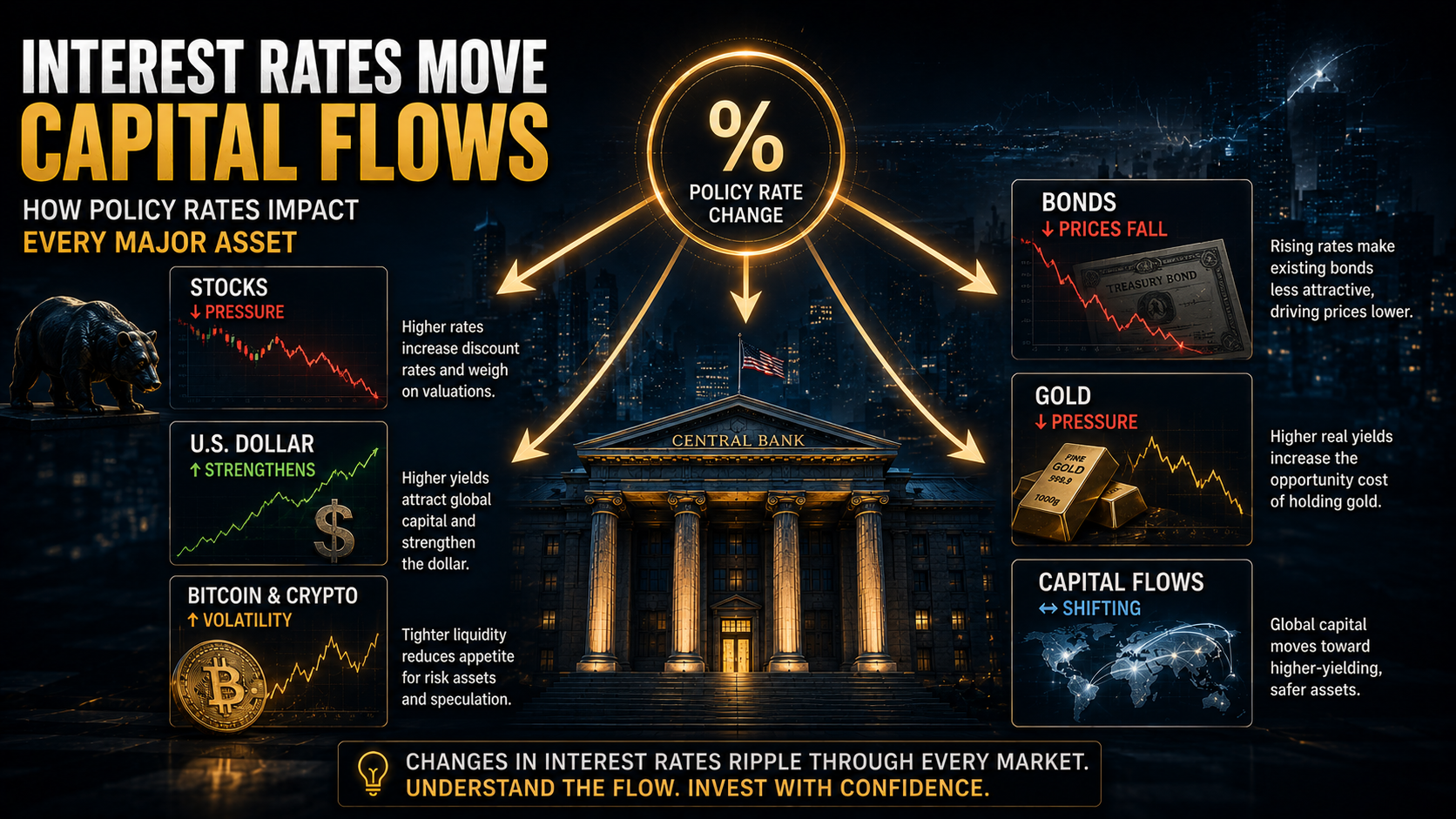
Changes in expected interest rates affect nearly every major asset class.
| Asset | Typical Market Impact | Why |
| Stocks | Downward pressure | Higher discount rates reduce equity valuations, especially for growth companies. |
| Treasury Bonds | Prices fall | Rising interest rates make existing lower-yield bonds less attractive. |
| U.S. Dollar | Often strengthens | Higher interest rates attract global capital seeking better yields. |
| Gold | Often weakens | Gold does not generate income, making it less attractive when real yields rise. |
| Bitcoin & Crypto | Higher volatility | Tighter liquidity generally reduces demand for speculative assets. |
Of course, markets are influenced by many variables beyond interest rates, including corporate earnings, fiscal policy, geopolitical events, and investor sentiment.
The Taylor Rule should therefore be viewed as one important framework—not a complete explanation of market behavior.
What Investors Should Know
The Taylor Rule Is Not a Crystal Ball
A common misconception is that the Taylor Rule predicts exactly what the Federal Reserve will do.
It does not.
Instead, it estimates what policy rates might look like under a rules-based framework.
The Fed also considers labor market conditions, financial stability, global risks, banking stress, and unexpected economic shocks.
Focus on Trends, Not Individual Data Releases
One CPI report rarely changes monetary policy by itself.
Instead of reacting to every economic release, investors should ask
- Is inflation consistently moving higher or lower?
- Is economic activity accelerating or slowing?
- Is the overall trend pushing the Taylor Rule estimate higher or lower?
Long-term trends matter far more than short-term noise.
Expectations Move Markets First
Financial markets usually adjust before central banks act.
By the time the Fed officially changes interest rates, investors have often been pricing that decision into asset prices for months.
Understanding expectations is often more valuable than simply knowing today's policy rate.
What Do Professional Investors Watch?
Experienced investors rarely obsess over the Taylor Rule itself.
Instead, they use it to understand broader capital flows.
Where Is Capital Moving?
Changes in expected interest rates influence how money moves across markets.
Higher rates often encourage flows toward cash, Treasury securities, and defensive sectors.
Lower rates typically support growth stocks, technology companies, and other long-duration assets.
The direction of capital often matters more than the level of interest rates.
Which Businesses Generate Strong Cash Flow?
During periods of higher interest rates, companies with consistent free cash flow tend to outperform businesses that rely heavily on cheap financing.
Institutional investors often prioritize financial resilience over rapid growth when borrowing costs rise.
Can Your Portfolio Survive Different Rate Cycles?
Rather than trying to perfectly predict every Federal Reserve decision, long-term investors should ask themselves
- Can my portfolio withstand both rising and falling interest rate environments?
- Am I overly dependent on one macroeconomic outcome?
- Do the businesses I own generate durable cash flow through different economic cycles?
- Am I investing based on long-term fundamentals rather than short-term headlines?
Successful investing is rarely about making perfect forecasts.
It is about building a portfolio capable of surviving uncertainty.

Final Thoughts
The Taylor Rule remains one of the most influential frameworks for understanding how central banks think about interest rates.
Although the Federal Reserve does not strictly follow the model, it provides investors with a valuable benchmark for interpreting inflation, economic growth, and the likely direction of monetary policy.
More importantly, the Taylor Rule reminds us that markets are driven by changing expectations, not just current economic data.
Understanding how policymakers think allows investors to better understand how capital moves, and understanding capital flows is often more valuable than trying to predict the next market headline.
The most successful long-term investors are not those who consistently predict every interest rate decision.
They are the ones who build portfolios resilient enough to navigate changing economic cycles.
MasterMind.
'[Global] Success Blueprints' 카테고리의 다른 글