Why Investors Obsess Over Their Cost Basis: Anchoring Bias


Hello, this is MasterMind.
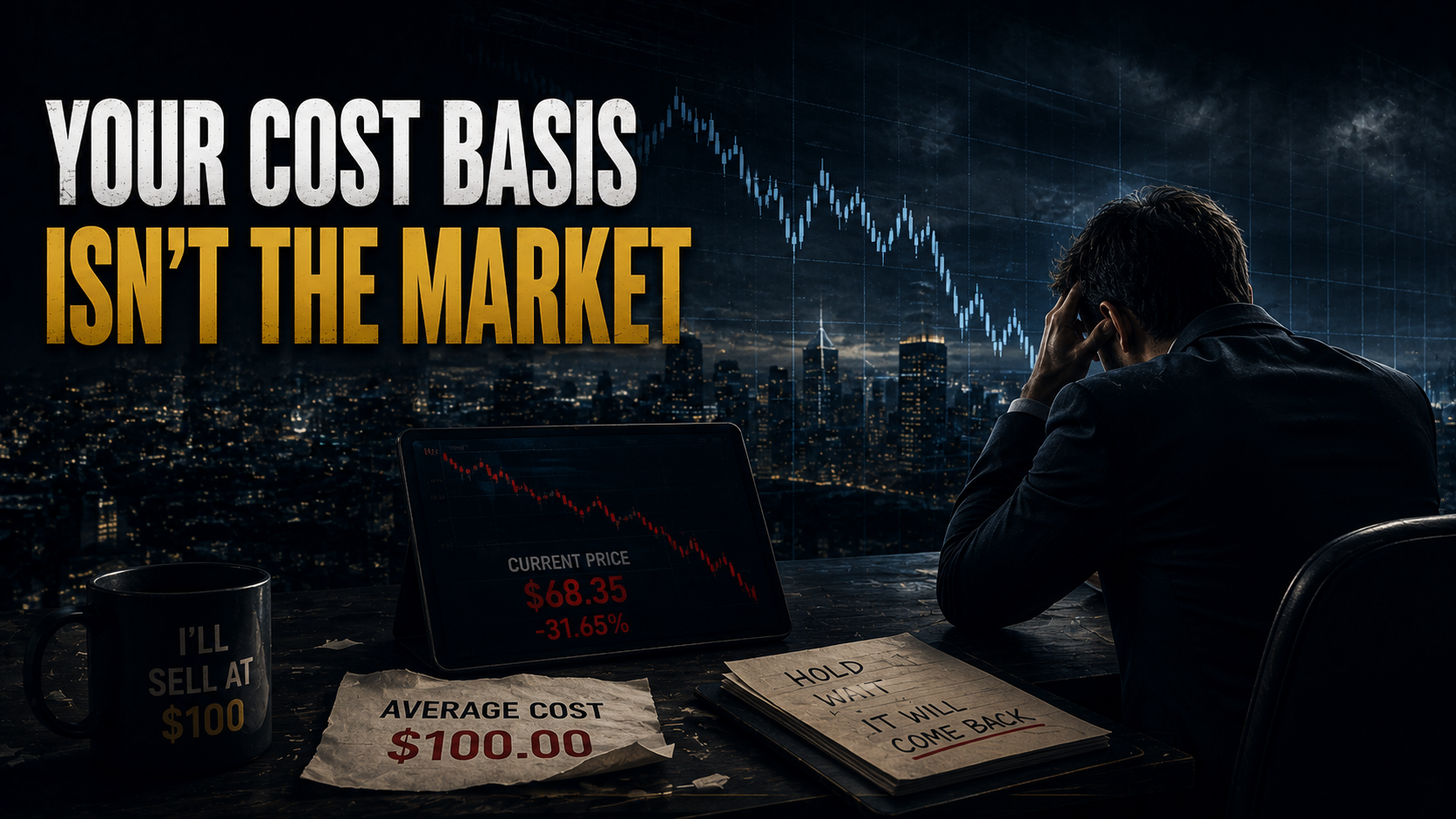
Have you ever told yourself, "I'll sell as soon as the stock gets back to my purchase price"?
Or maybe you've looked at a stock that has fallen 50% from its all-time high and thought, "It has to be cheap now."
Most investors believe they make rational decisions based on financial statements, earnings, and market conditions. In reality, many investment decisions are driven by a single number that has little to do with a company's actual value.
That number is often your cost basis.
Why do investors become emotionally attached to the price they paid? And why does that simple number influence decisions long after market conditions have changed?
The answer lies in one of the most powerful cognitive biases in behavioral finance: Anchoring Bias.
Key Takeaway
Anchoring Bias causes investors to rely on an initial reference point—such as their purchase price or a previous market high—instead of evaluating what an investment is worth today.
What Is Anchoring Bias?
Anchoring Bias is a psychological tendency in which people rely too heavily on the first piece of information they receive when making future decisions.
In investing, that anchor often becomes
- Your purchase price
- The stock's all-time high
- A previous market low
- A price target from an analyst
- A number repeatedly discussed in financial media
The problem is simple.
None of these numbers necessarily reflects the company's current value.
Markets constantly adjust to new information.
Businesses evolve.
Interest rates change.
Industries transform.
But investors often continue making decisions based on numbers from the past.
MasterMind Insight
The market has no memory of your purchase price. Stock prices move according to future cash flows, changing expectations, and the continuous flow of capital—not your brokerage statement.

Why Investors Become Attached to Their Cost Basis
The moment you buy a stock, your brain quietly creates a psychological benchmark.
Imagine buying shares of a company at $100.
Months later, the stock trades at $80.
Revenue is slowing.
Margins are shrinking.
The competitive landscape has changed.
Objectively, you might not buy this company today.
Yet many investors think
"I'll sell once it gets back to $100."
Notice what happened.
The investment decision is no longer based on future prospects.
It is based on recovering a past loss.
That is Anchoring Bias in action.
How Anchoring Bias Works
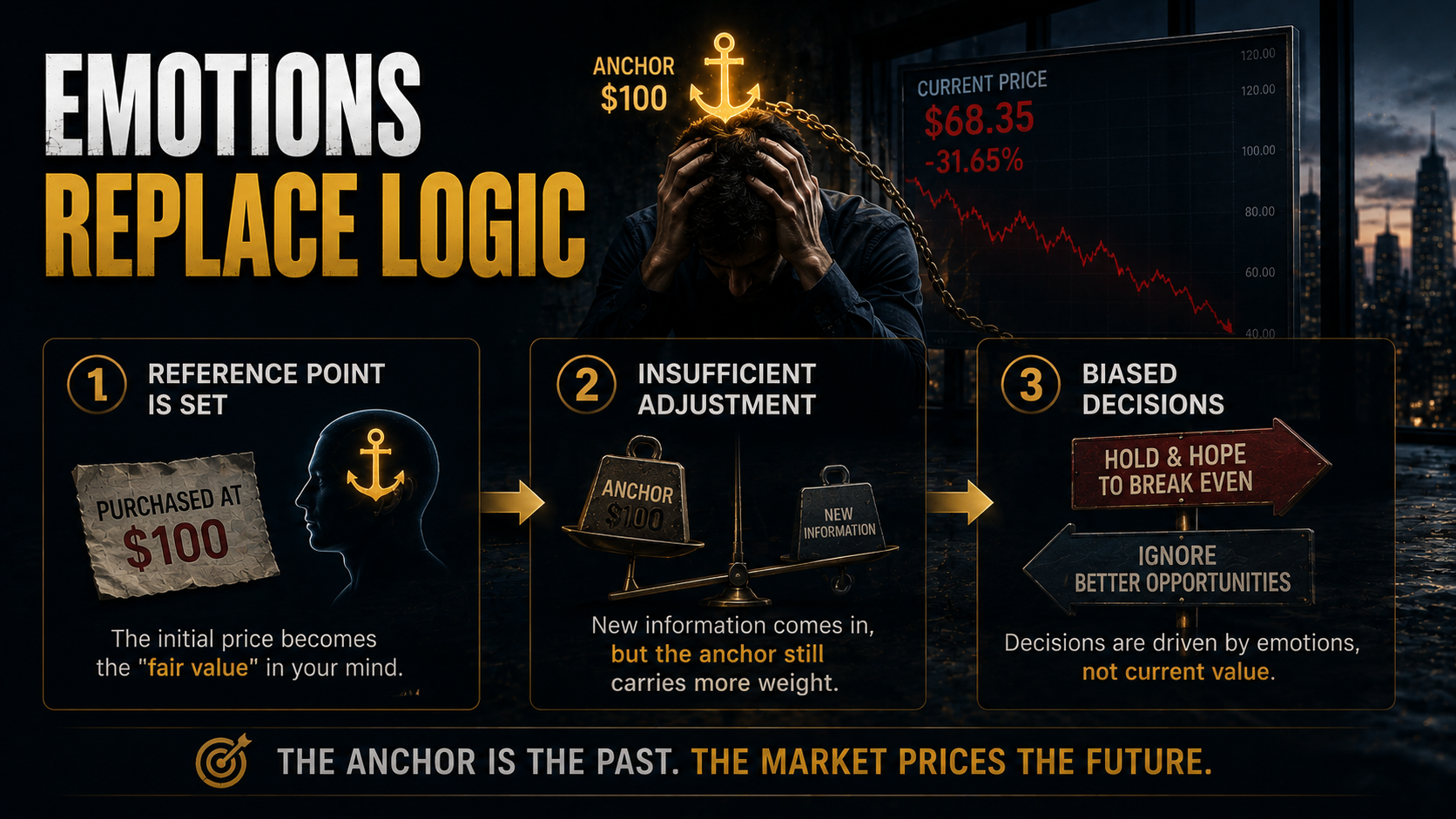
Anchoring Bias generally follows three stages.
1. A Reference Point Is Created
The purchase price becomes the mental definition of "fair value."
Some investors anchor to the stock's previous all-time high instead.
2. New Information Receives Too Little Weight
Even when earnings deteriorate, economic conditions shift, or an industry's outlook changes, investors make only small adjustments to their original belief.
Behavioral economists call this anchoring and insufficient adjustment.
The original number continues to dominate decision-making.
3. Investment Decisions Become Distorted
Eventually, investors begin making choices that no longer reflect reality.
Common examples include
- Holding losing positions indefinitely.
- Averaging down simply because prices look "cheap."
- Selling winners too early because gains look large relative to the purchase price.
- Ignoring improving or worsening fundamentals.
The anchor quietly replaces objective analysis.
Why Anchoring Bias Matters
The most important question an investor can ask is surprisingly simple.
If I didn't own this stock today, would I buy it at the current price?
Anchoring Bias prevents many people from asking that question.
Instead, they ask
- How far am I from breaking even?
- How much has it fallen from its peak?
- What did I originally pay?
Those questions focus on history.
Successful investing depends on the future.
Markets do not reward the past. They continuously price future expectations.
Common Investment Mistakes Caused by Anchoring Bias
Holding Losing Stocks Too Long
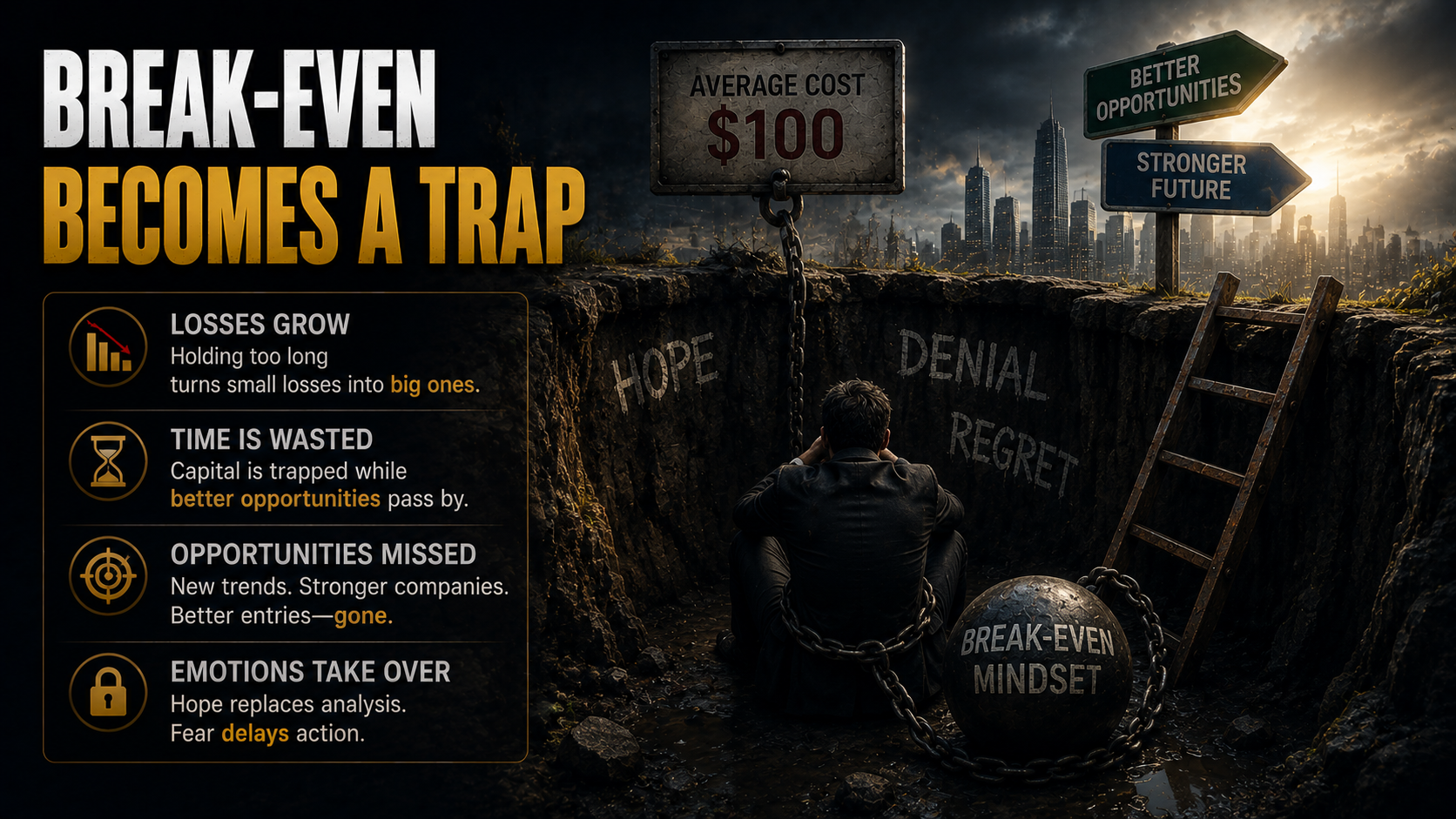
Many investors refuse to realize a loss because they want to recover their original investment.
Unfortunately, markets do not move simply because an investor wants to break even.
Mistaking Lower Prices for Better Value
A stock trading 70% below its previous high is not automatically undervalued.
Sometimes the business itself has permanently changed.
Price declines alone do not create opportunity.
Selling Winners Too Early
Anchoring works both ways.
Investors often compare current gains to their purchase price instead of evaluating future potential.
As a result, high-quality companies are sold long before their strongest growth phase.
Ignoring Better Opportunities
Capital trapped in weak investments cannot be deployed into stronger businesses.
This hidden cost is known as opportunity cost, and it is often larger than the original loss itself.
How Anchoring Bias Affects Financial Markets
Anchoring Bias influences more than individual portfolios.
When millions of investors behave similarly, entire markets can be affected.
| Asset | Typical Anchoring Behavior | Market Impact |
| Stocks | Cost basis, previous highs | Resistance levels, delayed selling, emotional trading |
| Real Estate | Peak selling prices | Slow price adjustments, declining transaction volume |
| Bitcoin & Crypto | Previous bull market highs | Extreme optimism and panic cycles |
| Bonds | Historical interest-rate expectations | Slow adaptation to changing monetary policy |
| Gold | Previous record prices | Misjudging value based on historical benchmarks |
Markets evolve.
Human psychology often does not.
Practical Ways to Overcome Anchoring Bias
Stop Thinking About Your Cost Basis
Your purchase price matters for taxes.
It should not determine whether an investment deserves a place in your portfolio.
Separate Price From Value
Price reflects what the market is paying today.
Value reflects what a business may generate tomorrow.
Those are not the same thing.
Reevaluate Every Position Objectively
Ask yourself
If I had cash instead of this stock today, would I still buy it?
If the answer is no, your portfolio deserves another look.
Define Exit Rules Before You Invest
Waiting until emotions appear almost guarantees biased decisions.
Risk management should be planned before entering a position—not after losses occur.
A Simple Anchoring Bias Checklist
Before making any investment decision, ask yourself
- Would I buy this investment today if I didn't already own it?
- Has the company's intrinsic value changed, or only its stock price?
- Am I evaluating today's risks instead of yesterday's purchase price?
- Is my capital trapped because I'm emotionally waiting to break even?
These four questions can eliminate many costly investment mistakes.
What Wealthy Investors See Differently
Long-term wealth builders rarely focus on where they bought an asset.
Instead, they focus on where capital is moving next.
They study
- Future cash flow potential
- Competitive advantages
- Industry transformation
- Capital allocation
- Long-term business durability
If better opportunities emerge elsewhere, they are willing to reallocate capital without emotional attachment.
Their objective is not to recover losses on a single investment.
Their objective is to grow total wealth over decades.
Ask yourself one final question.
Am I holding this investment because I believe in its future—or because I want my money back?
That single question often reveals whether logic or emotion is driving your decision.

Final Thoughts
Anchoring Bias is one of the most common psychological traps in investing.
Every investor experiences it.
The difference is that successful investors recognize it before it controls their decisions.
Markets do not care what price you paid.
They care only about future earnings, future cash flows, and future expectations.
The sooner you stop anchoring your decisions to yesterday's prices, the sooner you can begin investing based on tomorrow's opportunities.
The market never remembers your cost basis. It only prices the future.
Thank you for reading.
This was MasterMind.
'[Global] Success Blueprints' 카테고리의 다른 글