Why Does a Strong U.S. Dollar Hurt the Nasdaq? DXY, Interest Rates, and Big Tech Explained


Hello, this is MasterMind.
“If the U.S. dollar is getting stronger, shouldn’t that be good news for American companies?”
At first glance, that assumption seems reasonable. A stronger dollar reflects confidence in the U.S. economy, attracts global capital, and increases the purchasing power of American consumers and businesses.
Yet financial markets often tell a different story.
When the U.S. Dollar Index rises sharply, the Nasdaq frequently comes under pressure. Technology stocks weaken, growth-stock valuations contract, and investors begin moving capital toward cash and short-term Treasury securities.
Why does a stronger U.S. dollar often hurt the Nasdaq?
The answer is not simply that the dollar rises and technology stocks fall. The deeper explanation lies in the economic conditions that strengthen the dollar in the first place: higher interest rates, tighter liquidity, risk aversion, and pressure on the foreign earnings of multinational companies.
Understanding this relationship helps investors interpret one of the most important signals in global financial markets.

Key Takeaway
A strong U.S. dollar does not automatically cause the Nasdaq to decline. Instead, the same forces that strengthen the dollar—higher interest rates, tighter financial conditions, and rising demand for safe assets—often reduce growth-stock valuations and weaken the reported overseas earnings of major technology companies.
What Is a Strong U.S. Dollar?
A strong dollar means that the U.S. dollar is gaining value relative to other currencies.
The most widely followed measure is the U.S. Dollar Index, commonly known as the DXY.
The DXY measures the value of the dollar against a basket of six major currencies, including
- The euro
- Japanese yen
- British pound
- Canadian dollar
- Swedish krona
- Swiss franc
When the DXY rises, the dollar is strengthening against this currency basket. When it declines, the dollar is weakening.
For investors, however, the dollar is more than a currency.
Because the dollar is the world’s dominant reserve and funding currency, it also functions as a gauge of
- Global liquidity
- U.S. monetary policy expectations
- Demand for safe assets
- Cross-border capital flows
- Financial stress
A rising dollar can therefore reveal that money is becoming more expensive, less abundant, or more defensive.
What Does the Nasdaq Represent?
The Nasdaq Composite and Nasdaq-100 are heavily influenced by large technology and growth companies.
These include businesses in areas such as
- Artificial intelligence
- Semiconductors
- Cloud computing
- Enterprise software
- E-commerce
- Digital advertising
- Consumer electronics
Many of these companies receive high valuations because investors expect them to generate substantial profits in the future.
That future-oriented structure makes the Nasdaq especially sensitive to interest rates and liquidity.
A traditional, mature company may be valued largely on the cash it earns today. A high-growth technology company, by contrast, may derive much of its valuation from profits expected five, ten, or even twenty years into the future.
This difference is critical when interest rates rise.
Why Does a Strong Dollar Often Hurt the Nasdaq?
The relationship can be understood through five main channels.
[Stronger U.S. Dollar]
          │
          ├── Higher interest rates
          │       └── Lower growth-stock valuations
          │
          ├── Tighter global liquidity
          │       └── Less capital available for risk assets
          │
          ├── Foreign-exchange translation effects
          │       └── Lower reported overseas revenue
          │
          ├── Reduced foreign purchasing power
          │       └── Weaker demand for U.S. products and services
          │
          └── Risk-off capital flows
                  └── Money moves toward cash and Treasuries
1. Higher Interest Rates Strengthen the Dollar
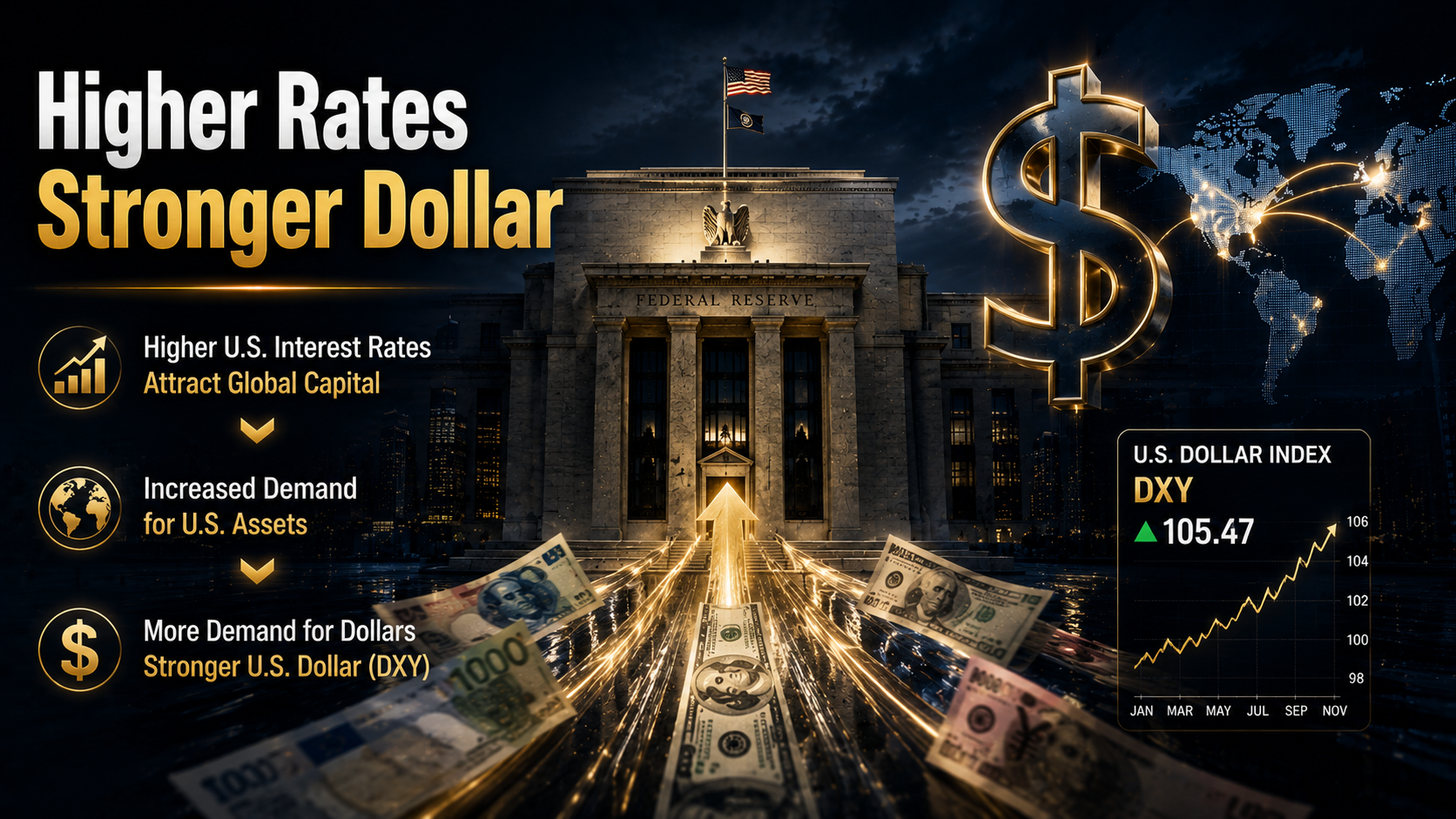
One of the most common reasons for dollar strength is relatively high U.S. interest rates.
When Treasury yields rise above yields available in other developed markets, global investors have a greater incentive to move capital into dollar-denominated assets.
To purchase U.S. Treasury securities, money-market instruments, or other American assets, foreign investors first need dollars.
That creates a simple capital-flow mechanism
Higher U.S. interest rates
↓
Increased demand for U.S. assets
↓
Increased demand for dollars
↓
Stronger U.S. dollar
This is why the dollar often rises when the Federal Reserve signals that interest rates may remain high for longer.
However, the same higher-rate environment that supports the dollar can create serious valuation pressure for the Nasdaq.
2. Higher Discount Rates Reduce Growth-Stock Valuations
The value of a stock is ultimately connected to the cash flows investors expect the business to generate.
Future cash flows must be converted into today’s value through a process known as discounting.
When interest rates rise, the discount rate used in valuation models also tends to rise.
That means a dollar of profit expected many years from now becomes worth less in present-value terms.
For example, suppose a technology company is expected to generate substantial profits ten years in the future.
When rates are low, investors may be willing to assign a high present value to those distant profits.
When rates rise, the same future earnings are discounted more aggressively.
Nothing about the company’s product, revenue, or market share may have changed. Yet its stock can still decline because the market is now applying a lower valuation multiple to its future cash flows.
This is why long-duration growth stocks tend to be more rate-sensitive than companies whose profits are concentrated in the present.
Market Insight
Growth stocks are often treated like long-duration financial assets. The farther their expected profits lie in the future, the more sensitive their valuations become to changes in interest rates.

3. A Strong Dollar Reduces Reported Foreign Revenue
Large U.S. technology companies operate globally.
They sell software, cloud services, advertising, semiconductors, devices, and subscriptions in dozens of currencies.
However, U.S. public companies report their financial results in dollars.
This creates a foreign-exchange translation effect.
Imagine that a U.S. company generates €100 in European revenue.
- At an exchange rate of €1 = $1.20, that revenue becomes $120.
- At an exchange rate of €1 = $1.00, the same €100 becomes only $100.
The company sold the same amount and received the same number of euros. Yet reported dollar revenue declined by approximately 17%.
This is often called
- A foreign-exchange headwind
- Currency translation pressure
- FX impact
- Translation loss
The stronger the dollar becomes, the fewer dollars a company reports when overseas sales are converted back into its home currency.
This matters because major Nasdaq companies often generate a significant share of their revenue outside the United States.
As a result, dollar strength can reduce
- Reported revenue growth
- Operating income
- Earnings per share
- Forward guidance
Even when the underlying business remains healthy, the headline financial statements may appear weaker.

4. A Strong Dollar Can Reduce Overseas Demand
Currency translation is only an accounting effect. But a strong dollar can also have a real economic impact.
When the dollar rises, foreign currencies weaken relative to it.
That makes American products and services more expensive for customers outside the United States.
Consider products such as
- Smartphones
- Cloud infrastructure
- Software subscriptions
- Semiconductor equipment
- Digital advertising services
- Enterprise technology contracts
If a European, Japanese, or emerging-market customer pays in local currency, a stronger dollar may increase the effective local cost of purchasing a U.S. product.
Companies then face several choices
- Raise local prices and risk weaker demand.
- Keep local prices stable and accept lower dollar revenue.
- Hedge part of the currency exposure.
- Absorb the impact through lower margins.
None of these options is ideal.
This is why prolonged dollar strength can eventually affect not only reported revenue but also actual unit demand and profitability.
5. Dollar Strength Often Signals Tighter Global Liquidity
The most important part of the relationship is liquidity.
A strong dollar frequently appears when global financial conditions are tightening.
Many international loans, commodities, corporate debts, and trade contracts are denominated in dollars.
When the dollar rises, borrowers outside the United States may need more local currency to repay the same amount of dollar debt.
This can create pressure on
- Emerging-market governments
- Global corporations
- Financial institutions
- Commodity-importing countries
- Highly leveraged investors
As dollar funding becomes more expensive, investors and institutions often reduce exposure to riskier assets.
Capital may move from
- Growth stocks
- Small-cap equities
- Emerging markets
- Cryptocurrency
- Speculative investments
Toward
- U.S. dollars
- Treasury bills
- Money-market funds
- Short-duration bonds
- High-quality defensive assets
The Nasdaq is particularly vulnerable because many of its companies carry high valuation multiples and depend heavily on favorable liquidity conditions.
The market’s true language is not price alone. It is the movement of capital.
When the dollar becomes scarce and expensive, investors usually become less willing to pay premium valuations for distant and uncertain growth.
Does the Dollar Always Move Opposite the Nasdaq?
No.
The dollar and the Nasdaq do not have a permanent inverse relationship.
Both can rise at the same time.
This can happen when
- The U.S. economy is outperforming other regions
- American corporate earnings are accelerating
- Technology innovation is attracting global capital
- U.S. productivity expectations are improving
- Foreign investors are buying both dollars and U.S. stocks
For example, a major technology cycle can create powerful demand for U.S. equities even while the dollar remains strong.
In that environment, global investors may buy dollars specifically to invest in U.S. technology companies.
The key principle is that markets are driven by several forces simultaneously.
A stronger dollar may create a headwind, but that headwind can be overwhelmed by
- Earnings growth
- Artificial intelligence investment
- Semiconductor demand
- Expanding margins
- Strong corporate guidance
- Improving productivity
Therefore, investors should never treat the DXY as a standalone market-timing signal.
The more useful question is not
“Is the dollar rising?”
It is
“Why is the dollar rising, and which force is dominant?”
Three Different Types of Dollar Strength
Not all dollar rallies have the same market impact.
1. Rate-Driven Dollar Strength
The dollar may rise because the Federal Reserve is expected to keep interest rates high.
Typical market effects include
- Rising Treasury yields
- Lower growth-stock valuations
- Tighter financial conditions
- Pressure on the Nasdaq
This is generally the most difficult type of dollar strength for technology stocks.
2. Risk-Off Dollar Strength
The dollar may rise during financial stress, geopolitical uncertainty, or recession fears.
Investors seek safety and liquidity, increasing demand for dollars and Treasury securities.
Typical effects include
- Equity-market weakness
- Higher volatility
- Pressure on cryptocurrencies
- Capital outflows from emerging markets
In this case, both the dollar and safe-haven bonds may strengthen.
3. Growth-Driven Dollar Strength
The dollar may also rise because the U.S. economy and corporate sector are stronger than those of other regions.
Typical effects can include
- Foreign capital entering U.S. markets
- Stronger U.S. equities
- Improving earnings expectations
- Dollar and Nasdaq gains at the same time
This is why the cause of dollar strength matters more than the direction alone.
How a Strong Dollar Affects Major Asset Classes
| Asset Class | Typical Effect of Dollar Strength | Main Reason |
| Nasdaq and Big Tech | Downward valuation pressure | Higher discount rates, FX headwinds, tighter liquidity |
| S&P 500 | Mixed to negative | Multinational earnings pressure, partly offset by domestic sectors |
| U.S. Treasuries | Depends on the cause | Rate-driven dollar strength can hurt bond prices; risk-off flows can support them |
| Small-Cap Stocks | Mixed | Lower overseas exposure but greater sensitivity to borrowing costs |
| Emerging-Market Stocks | Often negative | Capital outflows and higher dollar-debt burdens |
| Gold | Often faces pressure | Gold is dollar-denominated and provides no yield |
| Oil and Commodities | Often face demand pressure | Stronger dollar reduces non-U.S. purchasing power |
| Bitcoin and Crypto | Often negative in tightening cycles | Sensitive to liquidity and risk appetite |
| Cash and Treasury Bills | Relatively attractive | Higher short-term yields and capital preservation |
These are tendencies rather than fixed laws. The economic reason behind the dollar’s move must always be considered.
Why Treasury Yields Matter as Much as the DXY
The DXY alone does not tell investors whether dollar strength is being driven by rates, growth, or fear.
Treasury yields provide critical context.
Rising Dollar + Rising Treasury Yields
This often suggests
- Hawkish Federal Reserve expectations
- Strong economic data
- Persistent inflation
- Higher real yields
This combination is usually challenging for high-valuation technology stocks.
Rising Dollar + Falling Treasury Yields
This may suggest
- Risk aversion
- Recession concerns
- Flight-to-safety demand
- Global financial stress
Technology stocks may still decline, but the mechanism is different. The problem is not necessarily higher discount rates. It may instead be falling risk appetite and weaker growth expectations.
Falling Dollar + Falling Yields
This combination may support growth stocks when investors expect
- Easier monetary policy
- Slower inflation
- Lower discount rates
- Improving liquidity
However, if yields are falling because the economy is deteriorating rapidly, earnings risks can offset the valuation benefit.
Investors must therefore interpret the complete macro picture rather than relying on one signal.
What Investors Should Look for in Big Tech Earnings
During a strong-dollar period, headline revenue growth can be misleading.
Investors should review several additional metrics.
Constant-Currency Revenue Growth
Companies often report growth on a constant-currency basis.
This calculation removes the effect of exchange-rate movements and shows how the underlying business performed as though currency rates had remained unchanged.
For example
- Reported revenue growth: 5%
- Constant-currency revenue growth: 9%
This suggests that the business itself grew more strongly than the headline figure indicates, but the strong dollar reduced reported results.
Foreign-Exchange Headwind
Management may quantify how much currency movements reduced
- Revenue
- Operating profit
- Earnings per share
This helps investors distinguish between operational weakness and accounting translation effects.
Geographic Revenue Mix
A company with substantial revenue from Europe, Asia, or emerging markets may be more exposed to dollar strength than a domestically focused business.
Pricing Power
Companies with strong pricing power may raise local prices to offset currency pressure.
However, frequent price increases can eventually weaken demand.
Hedging Strategy
Some companies use currency derivatives to reduce near-term volatility.
Hedging can soften the impact, but it rarely eliminates long-term economic exposure.
Are Domestic U.S. Companies Better During a Strong Dollar?
Sometimes, but not always.
Companies that generate most of their revenue inside the United States may face less foreign-exchange translation pressure.
This can make certain domestic businesses appear relatively defensive compared with global multinationals.
However, domestic companies may still be exposed to
- Higher borrowing costs
- Slower consumer spending
- Tight bank lending
- Lower business investment
- Economic weakness
Small-cap companies, for example, often have less foreign revenue than mega-cap technology firms. Yet they may rely more heavily on debt financing and therefore suffer more from high interest rates.
A strong dollar does not automatically make domestic companies safer. Investors must compare currency exposure with balance-sheet strength and interest-rate sensitivity.
Is a Dollar Peak Bullish for the Nasdaq?
A peak in the dollar can become supportive for technology stocks, but the timing is complicated.
When the dollar stops rising or begins to weaken, several positive effects may appear
- Overseas revenue converts into more dollars
- Financial conditions become less restrictive
- Global liquidity improves
- Risk appetite recovers
- Foreign capital returns to equities and emerging markets
This can create a favorable environment for growth stocks.
However, the dollar may weaken for different reasons.
A gradual decline caused by lower inflation and easier monetary policy may be constructive.
A rapid decline caused by a severe U.S. recession may not be bullish because earnings expectations could collapse.
Once again, the reason matters more than the direction.
Key Points for Investors
1. Ask Why the Dollar Is Rising
Do not treat every DXY rally as the same signal.
Determine whether it is driven by
- Interest-rate expectations
- U.S. economic strength
- Global risk aversion
- Weakness in Europe or Asia
- Financial stress
Each cause has different implications for equities.
2. Watch Real Yields
Technology valuations are particularly sensitive to real interest rates, which are nominal Treasury yields adjusted for expected inflation.
Rising real yields increase the opportunity cost of holding long-duration growth assets.
3. Compare Reported and Constant-Currency Results
A company may appear to be slowing even when underlying customer demand remains healthy.
Constant-currency growth helps separate currency effects from business performance.
4. Examine Free Cash Flow
During periods of tight liquidity, free cash flow becomes more important than distant growth promises.
Companies that can internally fund investment are less dependent on expensive external financing.
5. Avoid Using the DXY as a Standalone Trading Signal
Dollar strength is one part of a broader financial system.
It should be analyzed alongside
- Treasury yields
- Credit spreads
- Federal Reserve policy
- Earnings revisions
- Market breadth
- Volatility
- Liquidity conditions
What Do Wealthy Investors Look for in This Environment?

Experienced investors do not view a stronger dollar only as a reason to sell technology stocks.
They study how capital is being repriced and where long-term opportunities may be developing.
The Movement of Money
They ask where capital is leaving and where it is going.
Is money moving from speculative growth stocks into Treasury bills?
Are institutional investors increasing cash holdings?
Are emerging markets experiencing capital outflows?
The direction of capital often reveals more than the daily movement of an index.
Cash-Flow Quality
During an easy-money cycle, investors may reward revenue growth even when profits are limited.
During a strong-dollar and high-rate cycle, the market becomes more selective.
Businesses with strong free cash flow, recurring revenue, and low refinancing risk tend to have greater resilience.
Asset Survivability
A company must survive unfavorable conditions before it can benefit from the next expansion.
Investors should examine
- Net cash
- Debt maturity schedules
- Interest expenses
- Operating margins
- Customer retention
- Competitive position
A weak balance sheet can turn a temporary macroeconomic headwind into a permanent loss of shareholder value.
Long-Term Business Strength
Currency cycles change.
A strong dollar may reduce reported revenue temporarily, but it does not automatically destroy a company’s competitive advantage.
Long-term investors distinguish between
- Temporary foreign-exchange pressure
- Cyclical demand weakness
- Permanent deterioration in the business
That distinction is essential.
Questions Investors Should Ask
- Is the stock falling because of currency translation, or because demand is weakening?
- Can the company continue investing without raising expensive capital?
- Does it have enough pricing power to protect margins?
- Is the valuation already reflecting the macroeconomic risk?
- Would the company remain competitive if interest rates stayed high for several years?
- Is the current decline damaging the business, or only changing the price investors are willing to pay?
The purpose of macroeconomic analysis is not to predict every short-term market move.
It is to understand which assets can survive when liquidity becomes scarce.
Final Thoughts
A stronger U.S. dollar and a weaker Nasdaq often appear together, but the relationship is not a simple mechanical rule.
Dollar strength can pressure technology stocks through several channels
- Higher interest rates reduce the present value of future earnings.
- Tighter liquidity lowers investor appetite for expensive growth assets.
- Foreign revenue converts into fewer dollars.
- Overseas customers face higher effective prices.
- Capital shifts toward cash and safer assets.
Yet the Nasdaq can still rise during a strong-dollar environment if earnings growth, innovation, and productivity gains are powerful enough to overcome those headwinds.
The most important lesson is not that investors should automatically sell technology stocks when the DXY rises.
The real lesson is to understand why the dollar is rising, how financial conditions are changing, and whether a company’s cash flow and competitive position can withstand the pressure.
Markets are driven not only by economic growth, but also by the price and availability of money.
When liquidity becomes scarce, valuation matters more. When capital becomes abundant, growth receives a higher premium.
Today’s key message is this
The U.S. dollar is more than a currency. It is a signal of global liquidity, monetary conditions, and capital movement. The Nasdaq is usually influenced less by the dollar itself than by the financial environment that caused the dollar to strengthen.
This was MasterMind.
'[Global] Success Blueprints' 카테고리의 다른 글