What Is the GDP Deflator? How It Measures Inflation and Real Economic Growth


Hello, this is MasterMind.
Have you ever seen headlines saying the economy grew strongly, yet businesses and consumers still felt under pressure? Or wondered why GDP can rise even when living standards seem unchanged?
The answer often lies in a metric that receives far less attention than the Consumer Price Index (CPI): the GDP Deflator.
While CPI measures the prices consumers pay for everyday goods and services, the GDP Deflator measures price changes across the entire domestic economy. It helps investors separate genuine economic expansion from growth that exists only because prices have increased.
For long-term investors, understanding this distinction is essential.

Key Takeaway
The GDP Deflator is the broadest measure of inflation within an economy, allowing investors to distinguish between nominal growth driven by higher prices and real growth driven by increased production.
What Is the GDP Deflator?
The GDP Deflator measures the average price change of all final goods and services produced within a country.
Unlike consumer-focused inflation indicators, it reflects the overall price level across the entire economy, including
- Consumer spending
- Business investment
- Government spending
- Exports
In other words, it answers an important question
Is the economy producing more, or are prices simply higher?
To understand this, investors first need to distinguish between two versions of GDP.
Nominal GDP
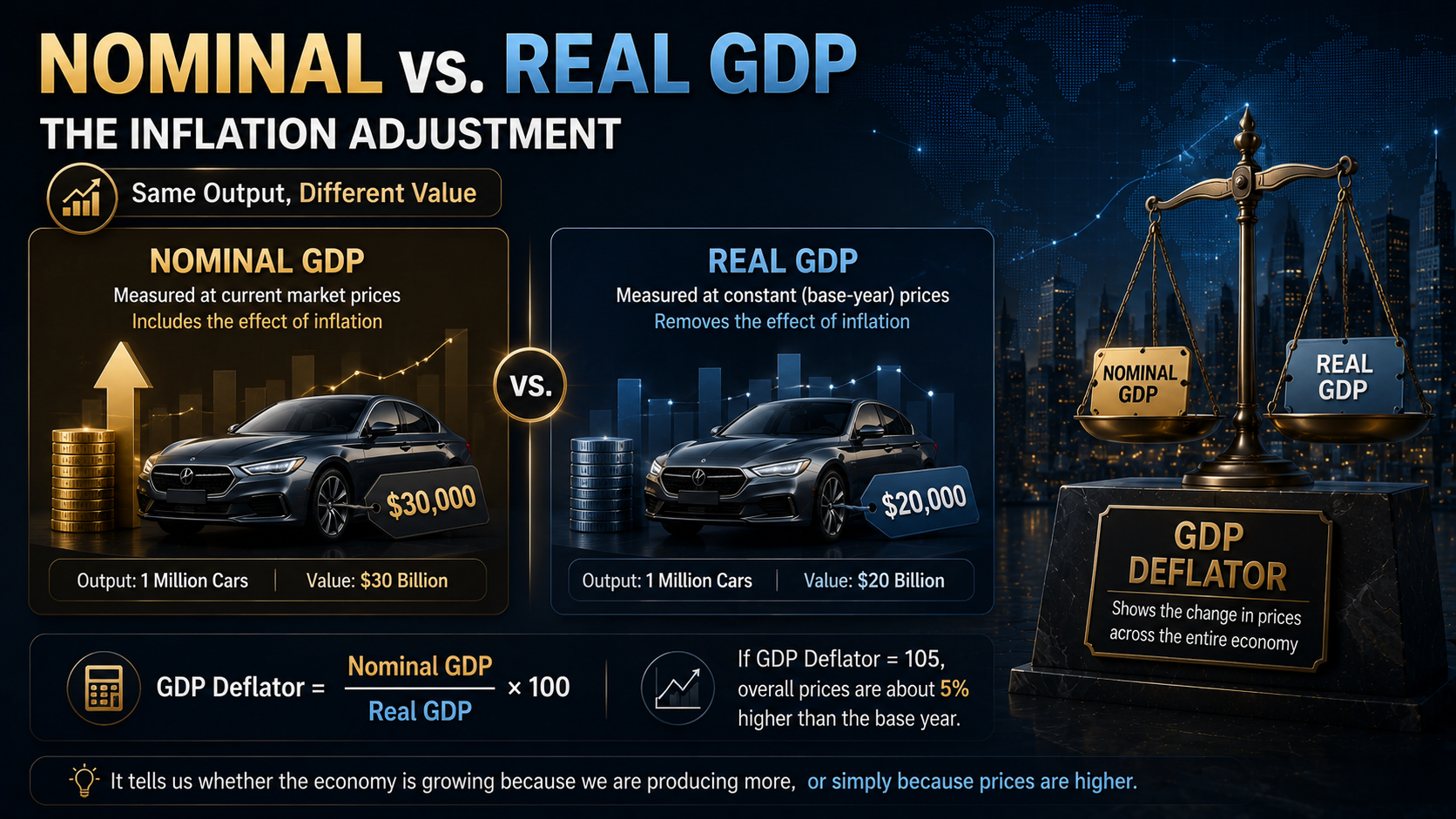
Nominal GDP measures total economic output using current market prices.
If prices rise while production stays unchanged, nominal GDP increases.
Real GDP
Real GDP removes inflation by measuring output using base-year prices.
It reflects changes in actual production rather than price movements.
The GDP Deflator connects these two measures.
GDP Deflator = (Nominal GDP ÷ Real GDP) × 100
If the GDP Deflator equals 105, overall domestic prices have risen approximately 5% compared with the base year.
Rather than measuring inflation from a consumer's perspective, it measures inflation from the perspective of the entire economy.
Why Nominal GDP and Real GDP Tell Different Stories
Imagine an economy that produces exactly one million automobiles this year and next year.
Production remains unchanged.
However, automobile prices increase by 15%.
Nominal GDP rises because the value of production is higher.
Real GDP barely changes because actual production did not increase.
This distinction matters because investors ultimately care about real economic expansion, not simply larger dollar figures created by inflation.
Economic growth driven by higher productivity is fundamentally different from growth driven only by rising prices.
GDP Deflator vs. CPI: What's the Difference?

Although both measure inflation, they answer different questions.
| GDP Deflator | Consumer Price Index (CPI) |
| Measures all domestically produced final goods and services | Measures goods and services purchased by households |
| Excludes imports | Includes imported consumer products |
| Includes business investment | Excludes investment spending |
| Includes government services | Excludes most government output |
| Weights change automatically with production | Uses a relatively fixed consumer basket |
For example, if oil prices surge because of global supply disruptions, gasoline prices immediately affect CPI.
The GDP Deflator, however, focuses on domestic production and reflects those higher costs only as they influence prices of domestically produced goods and services.
As a result, CPI and the GDP Deflator often move together—but not always.
When Is the GDP Deflator Released?
The GDP Deflator is published alongside quarterly GDP reports.
In the United States, it is released by the Bureau of Economic Analysis (BEA) as part of each GDP estimate.
Professional investors rarely examine GDP growth alone.
Instead, they compare
- Nominal GDP
- Real GDP
- GDP Deflator
Together, these numbers reveal whether economic growth reflects stronger production or simply higher prices.
Why Does the GDP Deflator Matter?
One of the biggest mistakes investors make is confusing higher prices with stronger growth.
Imagine a company reports revenue growth of 12%.
At first glance, that sounds impressive.
But if prices increased by 12% while unit sales remained flat, the business has not actually expanded.
The same logic applies to national economies.
A country can report strong nominal GDP growth while real economic activity changes very little.
This is why economists, policymakers, and institutional investors closely monitor the GDP Deflator.
It removes the illusion created by inflation.
Ultimately, markets reward productivity far more than price increases.
Is a Higher GDP Deflator Always Bad?
Not necessarily.
Its interpretation depends on the broader economic environment.
Moderate increases
Often indicate healthy demand alongside sustainable economic expansion.
Rapid increases
May signal excessive inflation, declining purchasing power, and tighter monetary policy.
Persistent declines
Can suggest slowing demand, weak pricing power, or even deflationary pressure.
The number itself is only part of the story.
What matters most is why it is changing.
How the GDP Deflator Influences Financial Markets
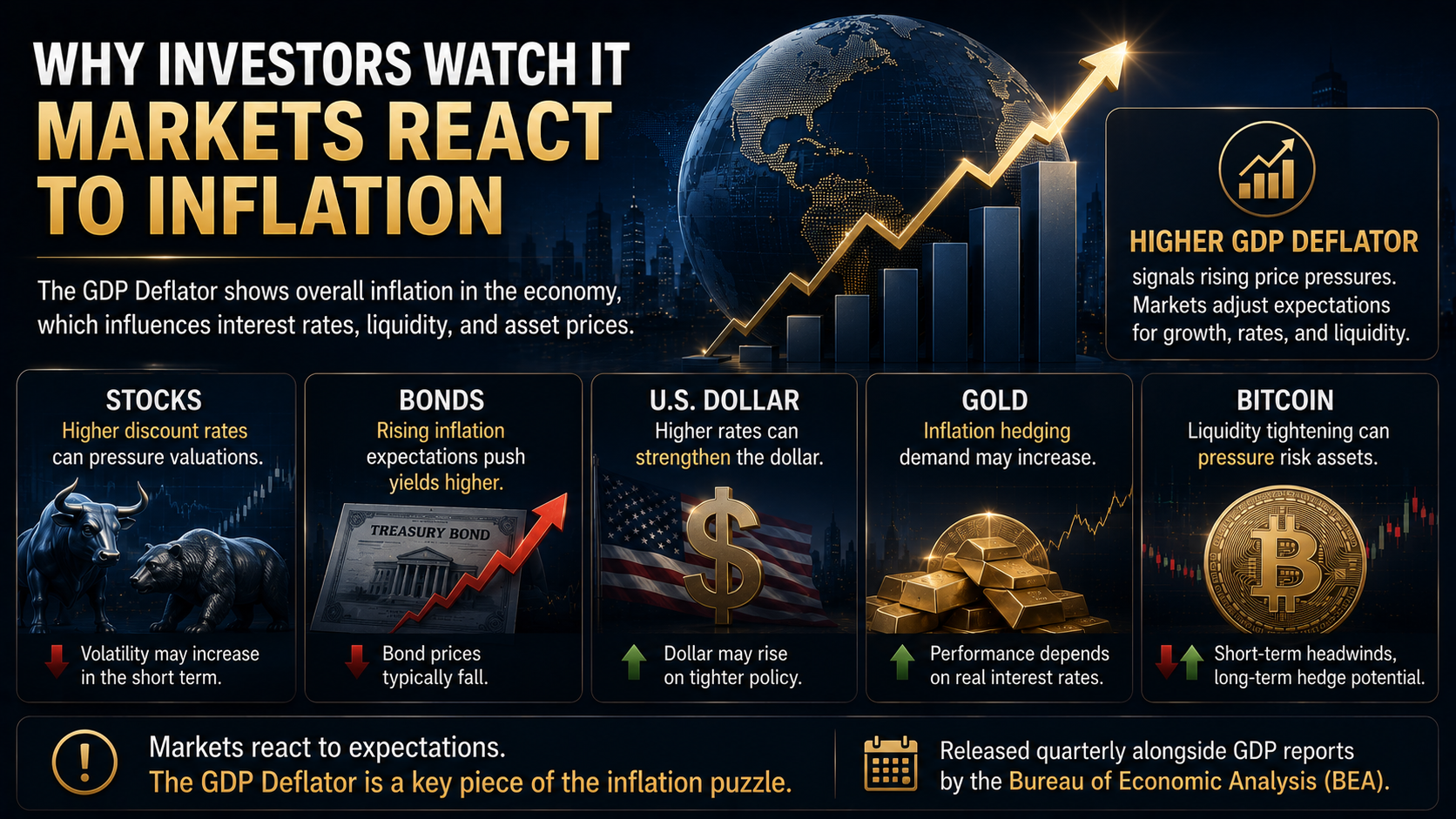
Because inflation expectations influence interest rates and liquidity, the GDP Deflator can affect virtually every major asset class.
| Asset | Higher GDP Deflator | Lower GDP Deflator |
| Stocks | Higher discount rates may pressure valuations | Growth concerns may dominate, with sector rotation |
| Bonds | Rising inflation expectations often push yields higher and bond prices lower | Falling inflation supports bond prices |
| U.S. Dollar | Hawkish monetary policy can strengthen the dollar | Easier policy expectations may weaken the dollar |
| Gold | Inflation hedging demand may increase | Performance depends on real interest rates |
| Bitcoin | Liquidity tightening can create short-term pressure, while long-term inflation narratives may remain supportive | Easier liquidity conditions may improve risk appetite |
Markets never react to one indicator alone.
Investors should interpret the GDP Deflator alongside employment, consumer spending, corporate earnings, productivity, and Federal Reserve policy.
Key Takeaways for Investors
- Compare nominal GDP with real GDP rather than focusing on one number.
- Strong nominal growth does not always mean strong economic fundamentals.
- Use both CPI and the GDP Deflator to understand different types of inflation.
- Evaluate whether corporate revenue growth comes from higher prices or greater demand.
- Focus on real returns rather than nominal returns over long investment horizons.
What Do Experienced Investors See?
Professional investors rarely focus only on inflation.
Instead, they ask a deeper question
How is purchasing power changing?
Capital Flows
When inflation steadily erodes cash, capital tends to migrate toward productive businesses, real assets, and companies with durable pricing power.
Cash Flow
Businesses capable of increasing cash flow faster than inflation often maintain stronger long-term valuations.
Asset Resilience
The best investments are not necessarily those with the highest nominal returns.
They are the assets that preserve and expand purchasing power through multiple economic cycles.
Long-Term Thinking
Markets constantly fluctuate, but wealth compounds through ownership of productive assets that generate sustainable cash flow.
The world's most successful investors understand that protecting purchasing power is just as important as increasing portfolio value.
Ask yourself
- Is my portfolio growing in real terms, or only in nominal dollars?
- Which companies can continue creating value even if inflation remains elevated?
- Am I investing in assets that benefit from productivity, or simply hoping prices continue rising?
Long-term investing is less about predicting the next quarter and more about owning assets that remain valuable regardless of changing economic conditions.

Final Thoughts
The GDP Deflator is far more than another government statistic.
It helps investors distinguish between economic growth created by greater production and growth created merely by higher prices.
While CPI tells us how inflation affects consumers, the GDP Deflator reveals how inflation influences the entire economy.
That perspective is especially valuable for long-term investors.
Markets may celebrate impressive headline numbers, but sustainable wealth is built by understanding what lies beneath those numbers.
Remember one key idea
The GDP Deflator strips away inflation's illusion, revealing the true pace of economic growth and the real purchasing power behind the world's largest economies.
Thank you for reading.
This was MasterMind.
'[Global] Success Blueprints' 카테고리의 다른 글