The Most Important Metrics for Understanding EPS and Guidance During Earnings Season


Hello, this is MasterMind.
Every earnings season, investors hear the same phrases repeated across financial media
“Earnings beat.”
“EPS surprise.”
“Guidance cut.”
“Revenue miss.”
Yet many investors still ask the same question
Why does a stock sometimes fall even after reporting great earnings?
And why can a company with mediocre results rally sharply after an earnings release?
The answer lies in understanding what the market is actually pricing.
Earnings reports are not simply scorecards of the past. They are one of the most important tools investors use to evaluate the future.
Key Takeaway
The market often reacts less to what a company earned last quarter and more to what management expects to earn next quarter.
That is why guidance frequently matters more than EPS.
What Are EPS and Guidance?
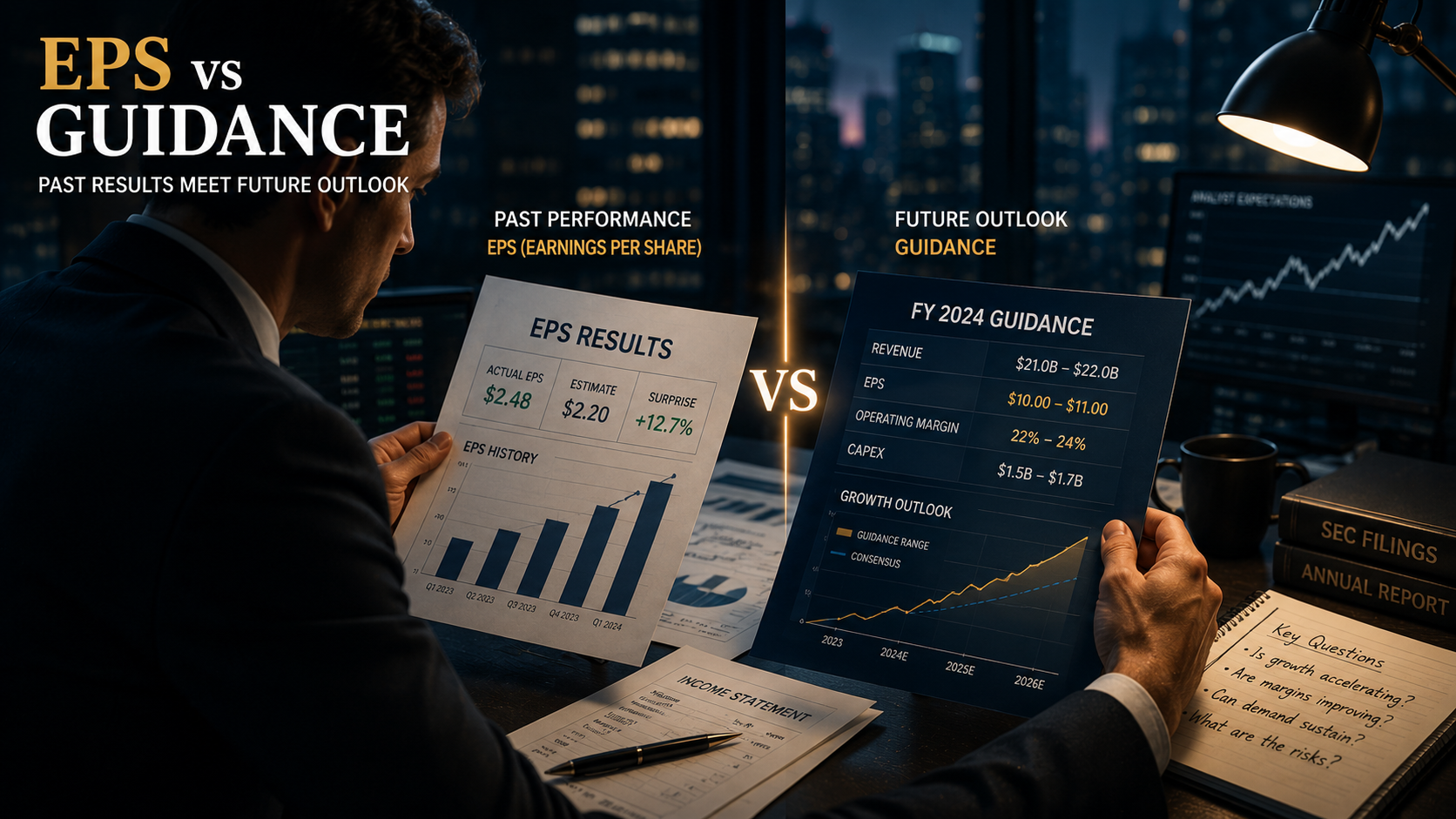
When investors analyze an earnings report, two metrics immediately receive the most attention
EPS (Earnings Per Share) and Guidance.
What Is EPS?
EPS measures how much profit a company generated for each outstanding share.
The formula is simple
EPS = Net Income ÷ Shares Outstanding
For investors, EPS is one of the clearest indicators of profitability.
It answers a simple question
How much money did the company actually earn for shareholders?
Because EPS is widely followed by analysts, even small differences between expected and actual EPS can move stock prices significantly.
What Is Guidance?
Guidance is management's forecast for future performance.
Companies may provide estimates for
- Revenue
- EPS
- Operating margins
- Capital expenditures
- Market demand
- Business outlook
While EPS reflects the past, guidance reflects management's expectations for the future.
And markets are forward-looking.
That distinction is critical.
Which Metrics Matter Most During Earnings Season?

An earnings report can contain dozens of financial metrics.
Revenue.
Operating income.
Margins.
Free cash flow.
Capital expenditures.
Share buybacks.
Debt levels.
But investors do not treat all metrics equally.
In most cases, the market prioritizes earnings data in the following order
| Importance | Metric | Why Investors Watch It |
| ⭐⭐⭐⭐⭐ | Guidance | Future growth expectations |
| ⭐⭐⭐⭐ | EPS | Current profitability |
| ⭐⭐⭐ | Revenue | Business growth |
| ⭐⭐⭐ | Earnings Call Commentary | Management outlook |
| ⭐⭐ | Operating Margin | Efficiency and profitability |
| ⭐⭐ | Free Cash Flow | Cash generation strength |
| ⭐ | Capital Expenditures | Future investment plans |
While all of these metrics matter, the majority of immediate stock reactions are usually driven by EPS and guidance.
Why Do Stocks Fall After Strong Earnings?
Many investors assume that beating earnings estimates should automatically push a stock higher.
In reality, markets compare results against expectations.
There are two important benchmarks
Consensus Estimates
These are the average forecasts published by Wall Street analysts.
Market Expectations
These are the expectations already embedded in the stock price.
Sometimes those expectations are even higher than official analyst estimates.
For example
| Metric | Result |
| Expected EPS | $5.00 |
| Actual EPS | $6.00 |
| Market Expectation | $7.00 |
Although the company beat analyst estimates, investors were expecting even stronger results.
As a result, the stock may decline.
The market does not reward companies for being good.
It rewards companies for being better than expected.
Why Guidance Often Matters More Than EPS
Stock prices represent the discounted value of future earnings.
Because of that, investors care deeply about what comes next.
A company may report outstanding earnings today.
However, if management signals slowing growth tomorrow, investors may immediately adjust their expectations.
This is especially true for
- Technology companies
- AI-related businesses
- Semiconductor manufacturers
- High-growth stocks
In these sectors, future demand matters far more than past performance.
Investors constantly ask
- Is demand accelerating?
- Are customers increasing spending?
- Are margins improving?
- Can earnings continue growing next year?
Guidance helps answer those questions.
How Earnings Reports Impact Financial Markets

Earnings reports do not only affect individual stocks.
They can influence broader asset classes as well.
| Asset Class | Strong Guidance | Weak Guidance |
| Stocks | Bullish sentiment | Selling pressure |
| Bonds | Higher yields possible | Lower yields possible |
| U.S. Dollar | Potential strength | Potential weakness |
| Gold | Reduced safe-haven demand | Increased safe-haven demand |
| Bitcoin | Higher risk appetite | Reduced liquidity appetite |
Large-cap earnings often influence overall market sentiment because they shape expectations for economic growth, corporate spending, and future liquidity.
What Investors Should Focus On
When reviewing an earnings report, start with these questions
1. Did guidance improve?
Future expectations matter most.
2. Did EPS beat estimates?
Profitability remains important.
3. Did revenue grow?
Strong demand should support long-term growth.
4. What did management say during the earnings call?
Often the most valuable information is not in the financial statements.
5. Is cash flow improving?
Long-term winners typically generate strong and sustainable cash flow.
The goal is not simply to find companies with strong earnings.
The goal is to understand whether expectations are rising or falling.
What Wealthy Investors Look For

Professional investors rarely focus on a single quarter.
Instead, they focus on capital flows.
Where is money moving?
Which industries are attracting investment?
Which companies continue generating cash regardless of economic conditions?
The strongest investors understand that markets are driven by expectations in the short term but by cash flow in the long term.
That is why they often ask
- Is this company becoming stronger or weaker?
- Are expectations realistic?
- Is future growth already priced into the stock?
- Can this business still thrive five years from now?
Investing is not about predicting every market move.
It is about surviving long enough to benefit from the right opportunities.
Final Thoughts
An earnings report is far more than a collection of financial numbers.
It is a real-time reassessment of a company's future value.
EPS tells investors how the company performed.
Guidance tells investors where the company may be heading.
And markets consistently place greater value on the future than on the past.
The next time earnings season arrives, remember this
The most important number is not always what a company earned.
It is what investors expect the company to earn next.
This is MasterMind
designing success through insight.
'[Global] Success Blueprints' 카테고리의 다른 글