What Is the NASDAQ-100 and Why Does It Matter to Investors?


Hello, this is MasterMind.
If you've spent any time investing in U.S. stocks, you've probably heard statements like these
"Just buy QQQ and hold it for the long term."
"The biggest winners of the AI era will be found in the NASDAQ-100."
"The NASDAQ-100 has outperformed almost every major stock index over time."
But what exactly is the NASDAQ-100?
Is it simply a collection of technology stocks?
Or is it something much bigger—a reflection of where global capital believes the future is heading?
Understanding the NASDAQ-100 is about more than understanding technology companies. It is about understanding how money flows through the global economy and why investors consistently pay a premium for future growth.
Key Takeaway
The NASDAQ-100 is a market-cap-weighted index of the 100 largest non-financial companies listed on the Nasdaq exchange, and it serves as one of the clearest indicators of innovation, growth, and global capital flows.
What Is the NASDAQ-100?
The NASDAQ-100 is a stock market index composed of the largest non-financial companies listed on the Nasdaq Stock Market.
Many investors confuse it with the Nasdaq Composite, but they are not the same.
| Index | Description |
| Nasdaq Composite | Includes thousands of companies listed on Nasdaq |
| NASDAQ-100 | Includes the 100 largest non-financial companies |
In simple terms, the Nasdaq Composite represents the entire ecosystem, while the NASDAQ-100 represents the industry's most influential leaders.
Because the index is weighted by market capitalization, the largest companies have the greatest influence on performance.
Which Companies Are in the NASDAQ-100?
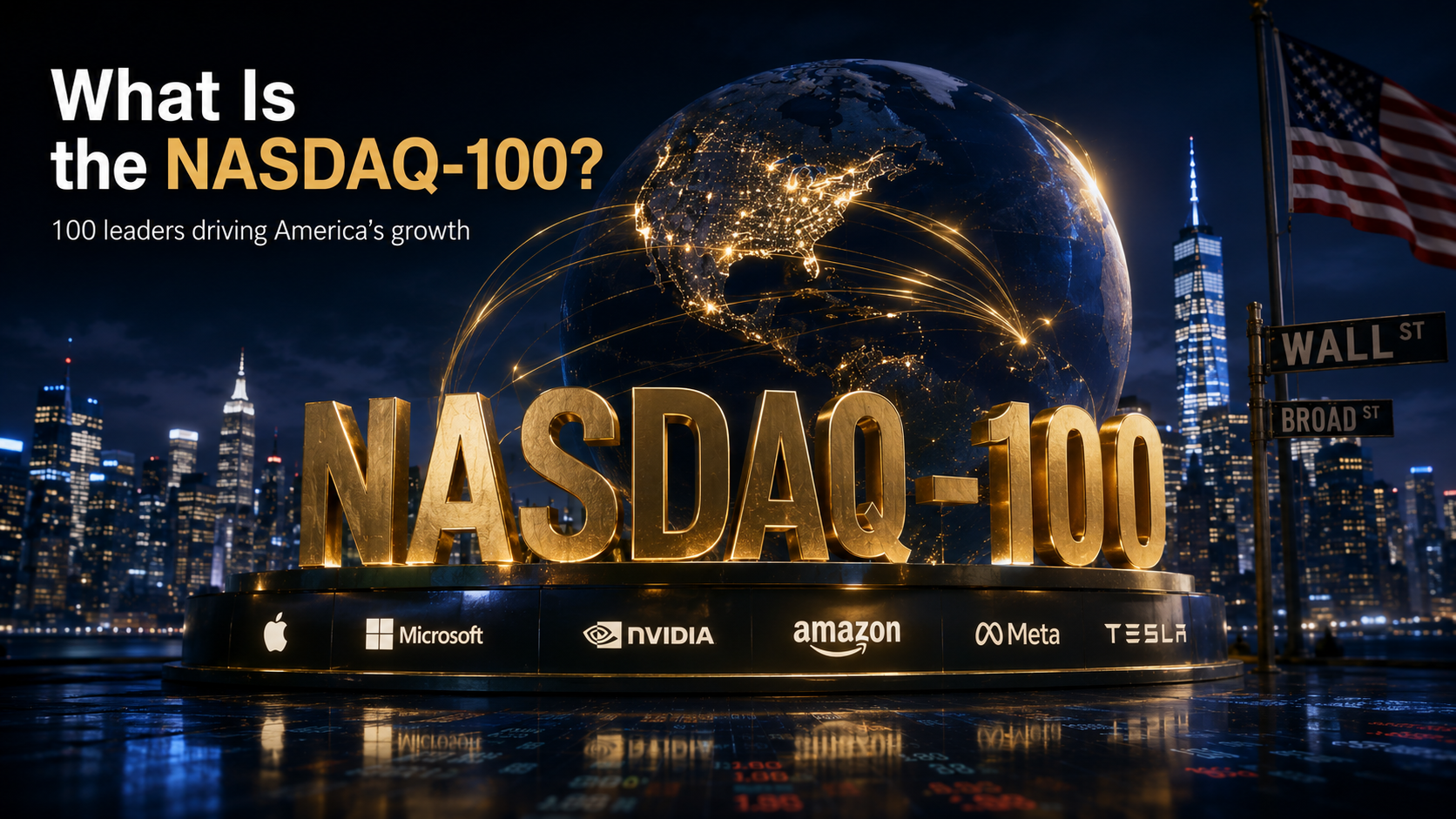
The NASDAQ-100 contains many of the most valuable and influential companies in the world.
Examples include
- Apple
- Microsoft
- NVIDIA
- Amazon
- Meta Platforms
- Broadcom
- Tesla
These companies operate at the center of major economic trends such as
- Artificial Intelligence
- Semiconductors
- Cloud Computing
- E-Commerce
- Digital Advertising
- Software Infrastructure
Unlike many broad-market indexes, financial institutions are excluded.
As a result, the NASDAQ-100 has become a concentrated bet on innovation, productivity, and technological advancement.
How Does the NASDAQ-100 Work?

One of the biggest misconceptions among new investors is that stock prices only reflect current earnings.
In reality, markets spend most of their time pricing the future.
When investors believe AI adoption will accelerate, semiconductor companies often rise before the revenue fully arrives.
When businesses increase spending on cloud infrastructure, technology stocks may appreciate long before those investments appear in quarterly profits.
This is why the NASDAQ-100 often reacts more strongly to changes in interest rates than other indexes.
Growth stocks derive much of their value from expected future cash flows.
Higher interest rates reduce the present value of those future earnings.
Lower interest rates tend to have the opposite effect.
In many ways, the NASDAQ-100 is not a measure of today's economy.
It is a measure of what investors believe tomorrow's economy will look like.
Why Is the NASDAQ-100 So Important?

Global Capital Naturally Flows Toward Growth
Large pension funds, sovereign wealth funds, institutions, and individual investors constantly seek opportunities for long-term growth.
Over the last several decades, the NASDAQ-100 has become one of the primary destinations for that capital.
When investors want exposure to innovation, they often start with the companies found inside this index.
The Index Evolves With the Economy
Unlike an individual stock, the NASDAQ-100 continuously adapts.
Companies that lose relevance eventually leave.
New leaders enter.
This creates a powerful self-renewing mechanism.
Investors are not simply buying today's technology leaders.
They are buying exposure to the next generation of leaders as well.
It Reflects Major Technological Trends
Artificial intelligence.
Cloud computing.
Digital infrastructure.
Automation.
Semiconductors.
These trends are reshaping productivity across the global economy.
The NASDAQ-100 sits at the center of many of them.
The Relationship Between the NASDAQ-100 and QQQ
For many investors, exposure to the NASDAQ-100 comes through the Invesco QQQ ETF.
QQQ is designed to track the performance of the NASDAQ-100.
Instead of purchasing dozens of individual companies, investors can gain exposure through a single ETF.
This simplicity is one reason QQQ has become one of the most popular growth-oriented investment vehicles in the world.
Understanding the NASDAQ-100 means understanding what drives QQQ.
And understanding QQQ means understanding how investors position themselves for future economic growth.
How the NASDAQ-100 Impacts Financial Markets

The influence of the NASDAQ-100 extends far beyond technology stocks.
| Asset Class | Typical Impact When NASDAQ-100 Strengthens |
| U.S. Stocks | Growth sectors outperform |
| Global Equities | Risk appetite improves |
| Bonds | Demand may shift away from fixed income |
| U.S. Dollar | Capital inflows can support dollar demand |
| Gold | May face competition from growth assets |
| Bitcoin | Often benefits from abundant liquidity |
These relationships are not perfect.
However, the NASDAQ-100 remains one of the most useful gauges of investor confidence and global liquidity conditions.
Key Things Investors Should Know
The NASDAQ-100 Is Not Just a Technology Index
Many investors describe it as a tech index.
That description is incomplete.
The NASDAQ-100 is better understood as a collection of companies positioned to benefit from long-term economic transformation.
It reflects expectations about
- Innovation
- Productivity growth
- Capital investment
- Consumer behavior
- Future earnings potential
Volatility Is the Price of Growth
The NASDAQ-100 has generated exceptional long-term returns.
It has also experienced significant drawdowns.
The Dot-Com Crash.
The Global Financial Crisis.
The 2022 interest-rate shock.
Periods of extreme volatility are part of the journey.
Investors who focus only on returns often underestimate the importance of surviving those periods.
In investing, survival usually matters more than prediction.
What Do Wealthy Investors See in This Trend?

Successful long-term investors rarely focus on daily price movements.
Instead, they focus on where capital is flowing.
They ask questions such as
- Which industries are attracting the most investment?
- Which companies generate the strongest cash flows?
- Which businesses can maintain competitive advantages for the next decade?
- Where is global liquidity moving?
Markets appear to move because of headlines.
In reality, headlines often follow money.
Price is usually the result.
Capital flow is often the cause.
This is why many experienced investors view the NASDAQ-100 not simply as an index, but as a real-time map of innovation and capital allocation.
A Question Worth Asking
Are you trying to predict the NASDAQ-100's next move?
Or are you trying to own a piece of the economic systems that may continue creating value for decades?
The answer often determines whether an investor thinks like a trader or like an owner.
Final Thoughts
The NASDAQ-100 is much more than a collection of technology stocks.
It represents some of the world's most innovative businesses, the flow of global capital, and the market's expectations for future economic growth.
Understanding the NASDAQ-100 means understanding where investors believe productivity, innovation, and value creation are headed.
The most important lesson is this
The NASDAQ-100 is not merely a stock index. It is one of the clearest reflections of how markets price the future.
This is MasterMind
designing success through insight.
'[Global] Success Blueprints' 카테고리의 다른 글