What Is the NASDAQ? Why It Matters to Investors


Hello, this is MasterMind.
Every day, millions of investors check the NASDAQ before making investment decisions.
Financial news headlines constantly report that the NASDAQ is up, down, rallying, or correcting. Yet many investors still don't fully understand what the NASDAQ actually represents—or why it has such a powerful influence on stocks, bonds, cryptocurrencies, and even the broader economy.
Is the NASDAQ simply a stock market index?
Or is it something much bigger?
To understand modern investing, you need to understand the role the NASDAQ plays in global capital markets.
Key Takeaway
The NASDAQ is more than a stock index. It is one of the clearest indicators of where global capital is flowing and how investors are pricing future innovation and economic growth.
What Is the NASDAQ?
NASDAQ stands for National Association of Securities Dealers Automated Quotations.
Founded in 1971, it became the world's first fully electronic stock exchange, helping transform how securities are traded.
Today, when investors refer to "the NASDAQ," they are usually talking about the NASDAQ Composite Index, which tracks thousands of companies listed on the exchange.
Unlike the New York Stock Exchange (NYSE), which historically attracted industrial and financial companies, the NASDAQ became the home of technology and innovation-focused businesses.
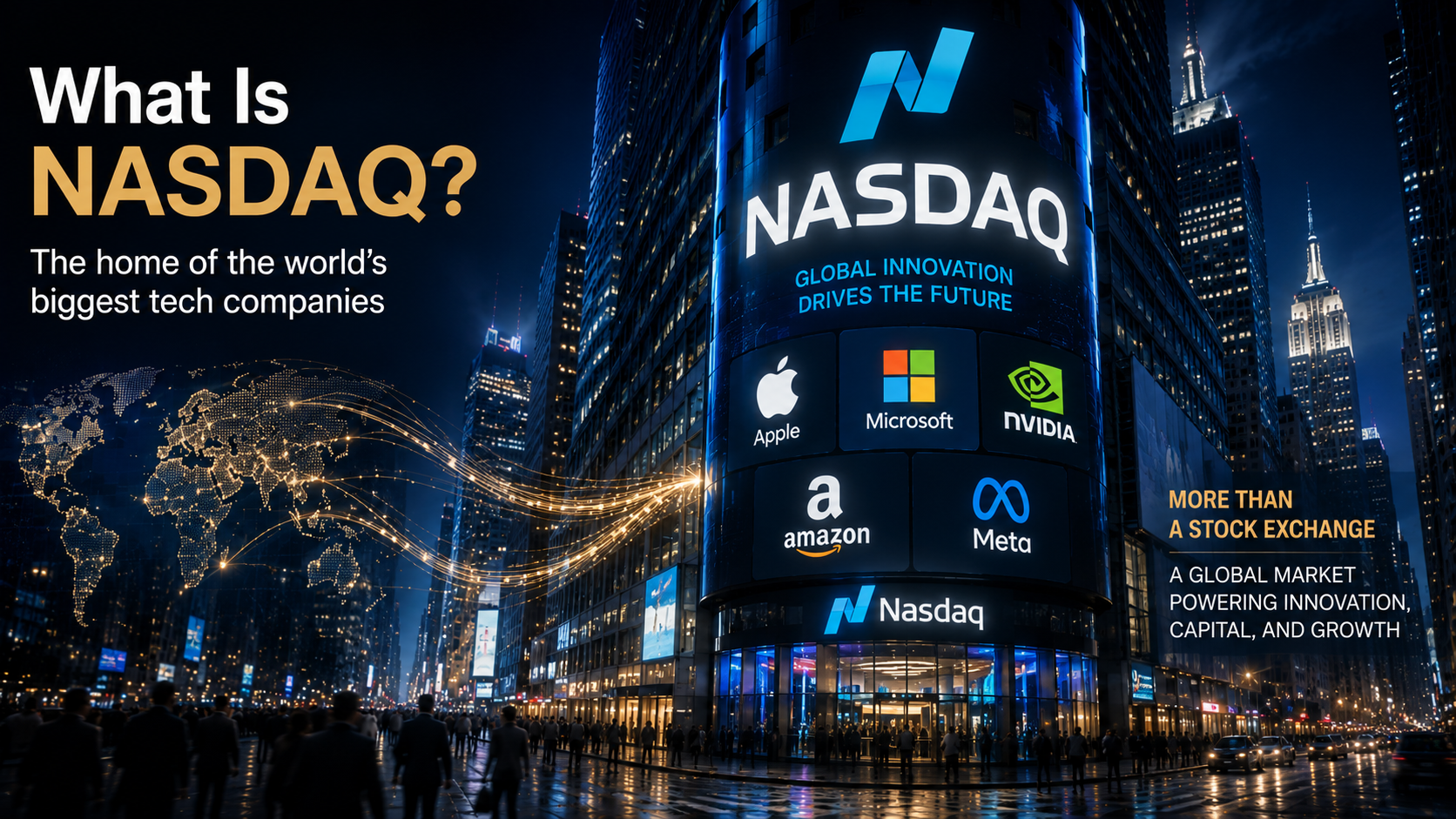
Many of the world's most influential companies trade on the NASDAQ, including
- Apple
- Microsoft
- NVIDIA
- Amazon
- Alphabet (Google)
- Meta Platforms
Because of this concentration of innovative companies, the NASDAQ has become the primary benchmark for technology-driven economic growth.
NASDAQ Composite vs. NASDAQ-100
Many investors confuse these two indexes.
| Index | Description |
| NASDAQ Composite | Includes thousands of companies listed on the NASDAQ exchange |
| NASDAQ-100 | Includes the 100 largest non-financial companies listed on the NASDAQ |
The NASDAQ Composite provides a broad picture of the exchange.
The NASDAQ-100, however, is often considered the more important benchmark because it contains many of the world's largest technology companies and is widely followed through ETFs such as QQQ.
How Does the NASDAQ Work?

The NASDAQ uses a market-capitalization-weighted methodology.
In simple terms, larger companies have a greater impact on the index.
For example, a 3% move in Microsoft or Apple affects the NASDAQ far more than a 3% move in a smaller company.
This structure reflects how capital actually moves through financial markets.
When investors pour money into artificial intelligence, cloud computing, semiconductors, or software companies, the largest beneficiaries often dominate index performance.
As a result, the NASDAQ frequently acts as a real-time measure of investor confidence in future growth industries.
Why Is the NASDAQ So Important?

It Reflects Expectations About the Future
Traditional businesses are often valued based on current earnings.
Technology companies, on the other hand, are largely valued based on expected future growth.
Investors buying shares of AI leaders, semiconductor manufacturers, or cloud infrastructure companies are often paying for future earnings rather than current profits.
That makes the NASDAQ highly sensitive to expectations.
When optimism rises, the index tends to outperform.
When expectations fall, even strong companies can experience significant declines.
It Represents the Direction of Global Capital
The NASDAQ is not simply a collection of stocks.
It is one of the primary destinations for global investment capital.
Institutional investors, pension funds, sovereign wealth funds, hedge funds, and retail investors all allocate capital to companies that they believe will shape the future economy.
Because of this, the NASDAQ often serves as a barometer for risk appetite.
Strong NASDAQ performance typically signals confidence in economic growth and innovation.
Weak performance often reflects concerns about slowing growth, tighter financial conditions, or declining investor confidence.
The Relationship Between the NASDAQ and Interest Rates
One of the most important concepts investors should understand is the relationship between technology stocks and interest rates.
Technology companies derive much of their value from future cash flows.
When interest rates are low, those future cash flows become more valuable in today's dollars.
When rates rise, future earnings are discounted more heavily, reducing their present value.
This is why Federal Reserve policy has such a significant impact on the NASDAQ.
In many cases, changes in interest rate expectations can move the NASDAQ more than quarterly earnings reports.
How the NASDAQ Affects Other Asset Classes

The influence of the NASDAQ extends far beyond technology stocks.
| Asset Class | Typical Impact When NASDAQ Rises | Typical Impact When NASDAQ Falls |
| U.S. Stocks | Increased risk appetite | Increased risk aversion |
| International Equities | Stronger demand for growth-oriented markets | Potential capital outflows |
| U.S. Treasury Bonds | Lower demand for safe assets | Higher demand for safety |
| U.S. Dollar | Can weaken as risk appetite increases | Often strengthens during uncertainty |
| Gold | May face reduced demand | Often benefits from defensive positioning |
| Bitcoin | Frequently benefits from risk-on sentiment | Often experiences higher volatility |
The NASDAQ has become deeply interconnected with nearly every major asset class in the global financial system.
What Investors Should Watch
Liquidity Matters
The NASDAQ performs best when liquidity is abundant.
Federal Reserve policy, credit conditions, and financial system liquidity often play a larger role than many investors realize.
Innovation Drives Long-Term Growth
Artificial intelligence, semiconductors, cloud computing, cybersecurity, and software continue to attract significant investment capital.
Understanding where innovation is occurring can help investors understand why money is moving.
Expectations Matter More Than Headlines
Markets do not simply react to current events.
They react to expectations about the future.
The NASDAQ is one of the clearest examples of this principle in action.
What Do Wealthy Investors See in This Trend?

Wealthy investors rarely focus on daily market fluctuations.
Instead, they focus on capital flows.
They ask questions such as
- Where is money moving?
- Which industries are attracting long-term investment?
- Which businesses generate durable cash flow?
- Which assets can survive economic downturns?
- Which companies are building lasting competitive advantages?
The most successful investors understand that markets are ultimately driven by capital allocation.
Prices may fluctuate daily, but long-term wealth is often created by identifying where capital is flowing before the crowd fully recognizes the trend.
In investing, survival matters more than prediction.
Those who preserve capital during difficult periods are often best positioned to benefit from future opportunities.
Final Thoughts
The NASDAQ is far more than a technology stock index.
It represents the intersection of innovation, capital flows, investor psychology, and economic growth.
Whether you invest directly in technology companies or simply want to understand the broader financial markets, the NASDAQ offers valuable insight into where the global economy may be heading.
The most important lesson is not whether the NASDAQ will rise or fall tomorrow.
The real lesson is learning to follow the flow of capital.
Because in financial markets, prices often tell you what happened.
Capital flows tell you what may happen next.
This is MasterMind
designing success through insight.
'[Global] Success Blueprints' 카테고리의 다른 글