What Is Consumer Sentiment? How Consumer Confidence Predicts the Economy and Stock Market



Hello, this is MasterMind.
What happens when consumers suddenly decide to spend less money?
Most investors focus on earnings reports, inflation data, or Federal Reserve meetings. Yet one of the earliest signals of economic change often comes from something much less tangible: consumer confidence.
Before retail sales slow down, before corporate profits weaken, and before a recession officially begins, consumer sentiment often starts to shift.
That is why economists, policymakers, and professional investors closely watch consumer sentiment indicators.
Understanding consumer sentiment is not just about understanding consumer behavior. It is about understanding where money may flow next.
Key Takeaway
Consumer sentiment measures how optimistic or pessimistic households feel about the economy, and it often serves as an early indicator of future spending, economic growth, and market performance.
What Is Consumer Sentiment?

Consumer sentiment is a measure of how consumers feel about current economic conditions and their expectations for the future.
In the United States, the most widely followed measures include
- University of Michigan Consumer Sentiment Index
- Consumer Confidence Index (CCI) published by The Conference Board
These surveys ask households about
- Current financial conditions
- Job prospects
- Income expectations
- Business conditions
- Future spending plans
The goal is simple.
If consumers feel confident about their finances and the economy, they are more likely to spend money. If they feel uncertain, they tend to reduce spending and increase savings.
Since consumer spending accounts for roughly 70% of U.S. GDP, these attitudes matter enormously.
How Consumer Sentiment Works

The economy is driven by more than numbers.
It is also driven by expectations.
When consumers feel optimistic about the future, they are more willing to
- Buy homes
- Purchase vehicles
- Travel
- Invest
- Make large discretionary purchases
This increased spending supports corporate revenues, employment growth, and economic expansion.
The process often looks like this
Consumer Confidence Rises
→ Consumer Spending Increases
→ Corporate Revenue Grows
→ Hiring and Investment Expand
→ Economic Growth Accelerates
The opposite is also true.
When consumers become concerned about inflation, unemployment, or economic uncertainty, spending often slows before economic data reflects the change.
This is why consumer sentiment is considered a leading indicator.
Why Investors Pay Attention to Consumer Sentiment
Many economic reports describe what has already happened.
Consumer sentiment provides insight into what may happen next.
Investors are constantly trying to anticipate future economic conditions rather than react to past events.
For example
A decline in consumer sentiment may signal
- Slower retail sales
- Weaker corporate earnings
- Reduced economic growth
A recovery in consumer sentiment may suggest
- Improving consumption
- Stronger business activity
- Expanding economic momentum
Markets often react to changes in expectations long before those expectations become reality.
Consumer Sentiment and Financial Markets

Consumer sentiment affects nearly every major asset class.
| Asset Class | Rising Sentiment | Falling Sentiment |
| Stocks | Positive for growth and consumer-driven sectors | Negative for earnings expectations |
| Bonds | Yields may rise as growth expectations improve | Bond demand may increase as investors seek safety |
| U.S. Dollar | Often supported by stronger economic outlook | Safe-haven demand may also influence direction |
| Gold | May lose appeal during risk-on environments | Often benefits from uncertainty |
| Bitcoin and Risk Assets | Can benefit from stronger risk appetite | May experience increased volatility and outflows |
Of course, consumer sentiment is only one piece of the puzzle.
Inflation, interest rates, labor markets, and corporate earnings remain critical factors.
However, sentiment often provides an early glimpse into how these variables may evolve.
What Matters More Than the Headline Number?
Many investors focus on whether sentiment is high or low.
Professional investors often focus on something else
The direction of change.
A sentiment reading below historical averages may still be bullish if it has been improving consistently.
Likewise, a high reading can become concerning if momentum is weakening.
Markets frequently respond more to changes in expectations than to absolute levels.
That is why trend analysis often matters more than a single monthly report.
What Smart Investors Look For
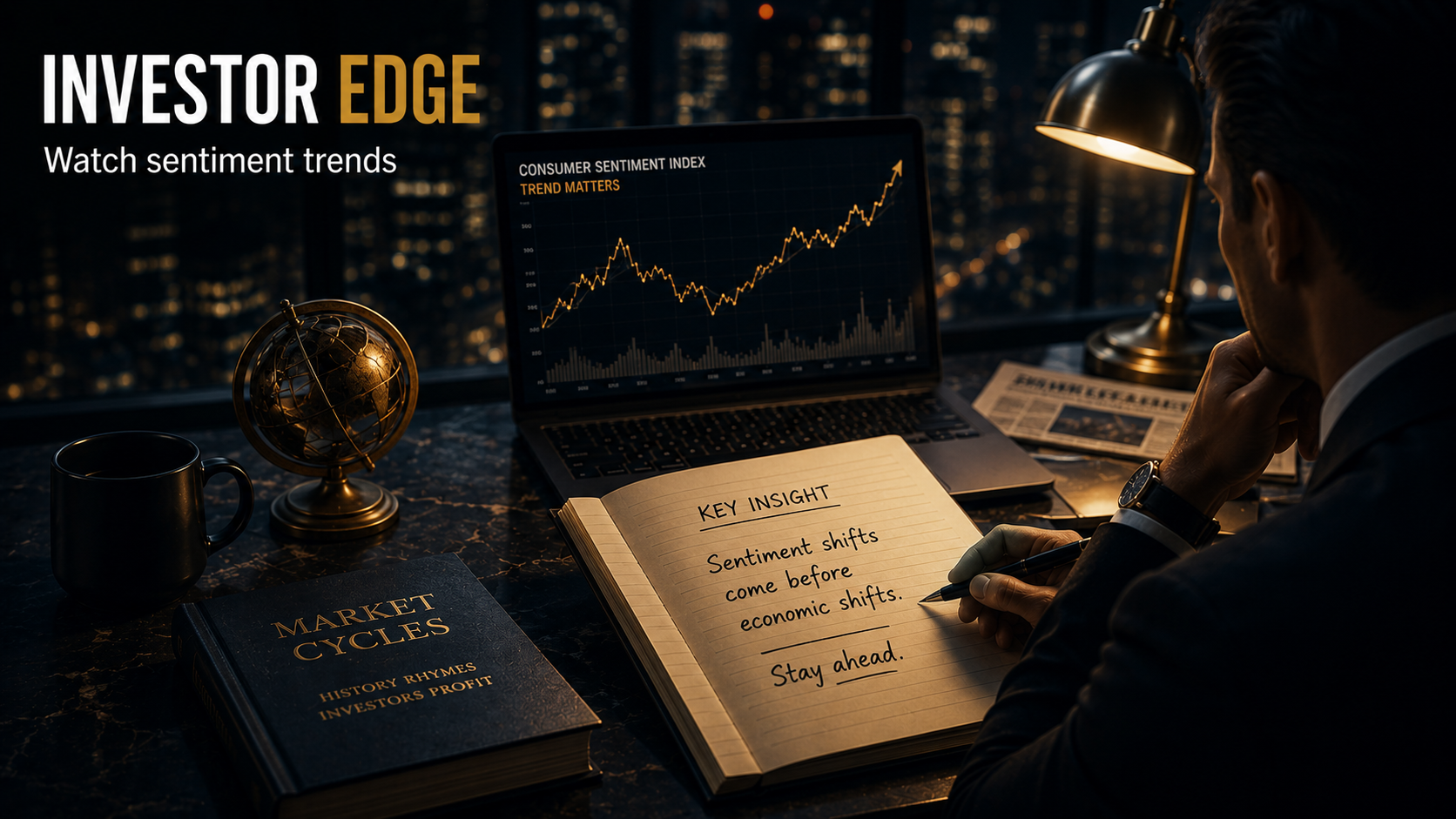
The most successful investors rarely focus on sentiment alone.
Instead, they use sentiment to identify potential shifts in capital flows.
When confidence weakens, they ask
- Which industries can maintain strong cash flow?
- Which companies have pricing power?
- Which assets can survive an economic slowdown?
When confidence improves, they ask
- Where will consumer spending return first?
- Which sectors benefit most from renewed optimism?
- Where is new capital likely to flow?
Markets ultimately follow money.
And money often follows confidence.
Understanding sentiment is therefore not about predicting the future with certainty.
It is about recognizing potential changes before they appear in traditional economic data.
Final Thoughts
Consumer sentiment is often described as a measure of how people feel about the economy.
But for investors, it is much more than that.
It provides an early look into future spending behavior, business activity, and economic momentum.
Consumer sentiment does not move markets by itself.
However, it influences the decisions that eventually shape corporate earnings, employment, investment activity, and asset prices.
The market is driven not only by economic reality but also by expectations.
And expectations begin with confidence.
Understanding consumer sentiment is ultimately about understanding where economic momentum may emerge next.
This is MasterMind
designing success through insight.
'[Global] Success Blueprints' 카테고리의 다른 글