What Is a Fund? How Your Money Gets Invested and Why It Matters



Hello, this is MasterMind.
Most people know they should invest, but few have the time to analyze companies, track economic data, and build a diversified portfolio on their own.
That is why investment funds have become one of the most important tools in modern finance.
But what actually happens when you put money into a fund?
Where does that money go, who makes the decisions, and why do pension funds, endowments, and wealthy investors rely on funds to manage billions of dollars?
Understanding how funds work is not just about choosing an investment product. It is about understanding how capital moves through financial markets.
Today, we'll break down what a fund is, how it works, why it matters, and what long-term investors should pay attention to.
Key Takeaway
A fund pools money from many investors, invests it according to a specific strategy, and distributes the resulting gains or losses among participants.
What Is a Fund?
A fund is a pooled investment vehicle that combines money from multiple investors into a single portfolio managed according to a defined investment strategy.
Rather than purchasing individual stocks or bonds themselves, investors buy shares of the fund and gain exposure to a diversified collection of assets.
For example, if thousands of investors contribute capital to a fund, that pooled money can be invested across hundreds of companies, government bonds, real estate assets, commodities, or international markets.
In simple terms, a fund allows investors to access professional portfolio management and diversification without having to build and manage an entire portfolio themselves.
How Do Investment Funds Work?

The structure of a fund is relatively straightforward.
Investors Contribute Capital
Individuals, institutions, pension funds, and retirement accounts invest money into the fund.
As money enters the fund, ownership shares are issued based on the fund's net asset value (NAV).
Portfolio Managers Allocate Capital
Professional fund managers then invest that capital according to the fund's stated objective.
Some funds focus on growth stocks.
Others emphasize dividend income, bonds, international markets, or specific sectors such as technology or healthcare.
Returns Are Shared Among Investors
As the underlying assets rise or fall in value, the fund's value changes accordingly.
After management fees and operating expenses are deducted, gains and losses are reflected in each investor's ownership share.
Types of Investment Funds

Not all funds are designed for the same purpose.
| Fund Type | Primary Investment | Typical Objective |
| Mutual Fund | Stocks, Bonds, Mixed Assets | Professional active management |
| Index Fund | Market Indexes | Low-cost market exposure |
| ETF | Publicly Traded Securities | Flexibility and diversification |
| Bond Fund | Government and Corporate Bonds | Income and stability |
| Real Estate Fund | Property Assets | Income and asset appreciation |
| Sector Fund | Specific Industries | Targeted growth opportunities |
In recent years, index funds and ETFs have gained significant popularity because of their lower costs and broad diversification.
Why Are Funds Important?
Funds are not merely investment products.
They are one of the primary mechanisms through which capital is allocated across the global economy.
Diversification
One of the greatest advantages of funds is risk reduction through diversification.
Instead of depending on a single company or asset, investors gain exposure to many investments simultaneously.
Professional Management
Most investors do not have the time, resources, or expertise to analyze markets full-time.
Funds provide access to professional investment management.
Access to Broader Markets
Funds make it easier to invest in areas that might otherwise be difficult to access, including international equities, fixed income markets, emerging economies, and alternative assets.
How Funds Impact Financial Markets
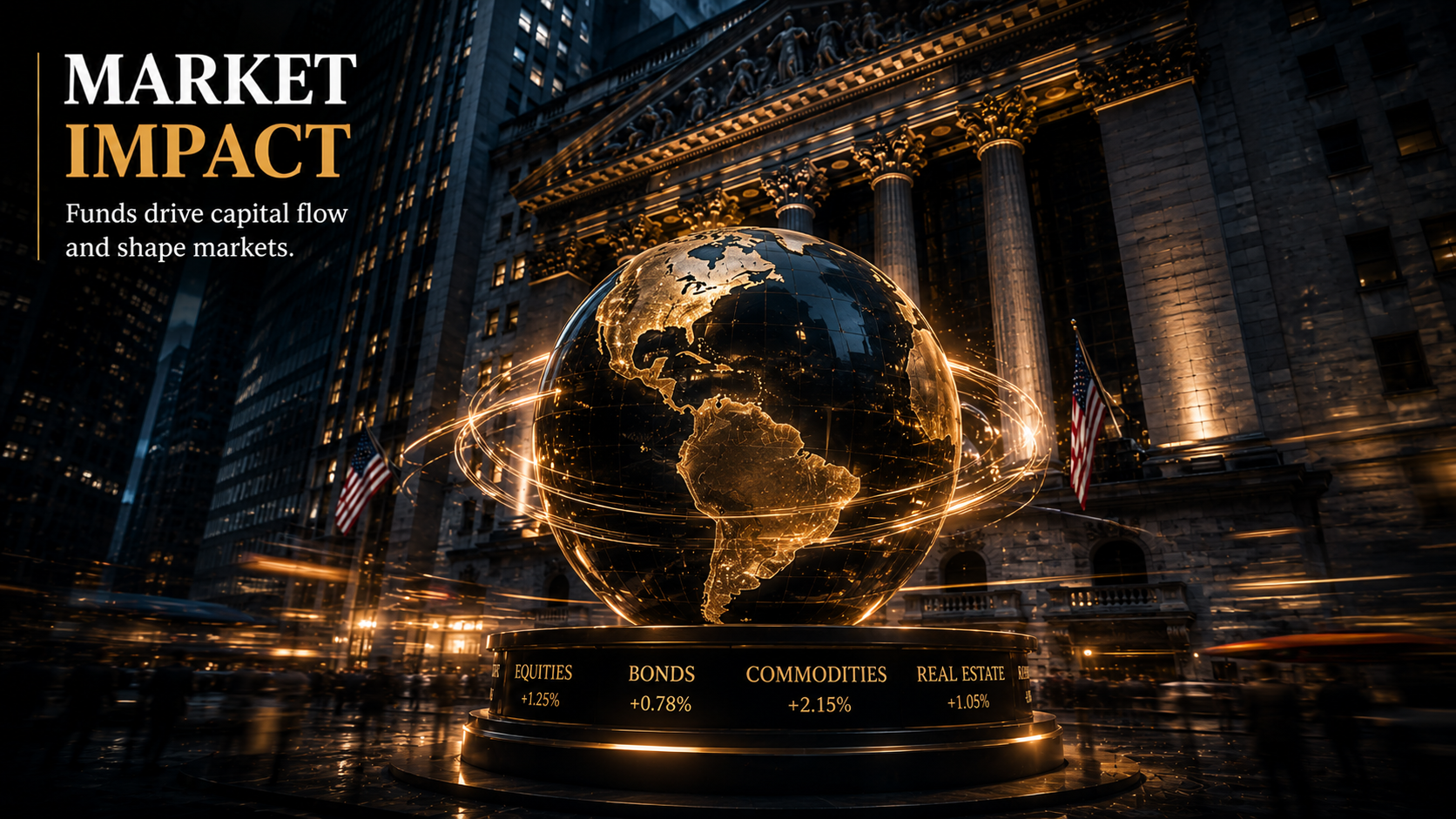
Funds play a major role in determining where capital flows
throughout the financial system.
When investors pour money into stock funds, fund managers must purchase additional shares, increasing demand.
When investors withdraw money, managers may need to sell assets, creating downward pressure.
| Asset Class | Fund Inflows | Fund Outflows |
| Stocks | Increased buying demand | Increased selling pressure |
| Bonds | Higher bond prices | Lower bond prices |
| Real Estate | Greater investment activity | Reduced capital allocation |
| Commodities | Rising demand potential | Reduced speculative flows |
| Cash | Lower cash balances | Higher cash reserves |
This is why market movements are often driven by capital flows as much as by news headlines.
A strong company can decline if investors are pulling money out of the sector.
Likewise, average companies may rise when large amounts of capital flow into their industry.
Markets do not move solely because of information.
They move because money moves.
Key Things Investors Should Know
Understand Fund Costs
Management fees may seem small, but over decades they can significantly reduce investment returns.
Lower-cost funds often have an advantage in long-term investing.
Know the Investment Strategy
Investors should understand whether a fund is actively managed or designed to track an index.
The strategy should align with their goals and risk tolerance.
Consider Liquidity
Some funds allow daily withdrawals, while others may have restrictions or delays.
Liquidity matters when planning future financial needs.
Funds Are Not Risk-Free
Professional management does not eliminate risk.
Funds remain exposed to market volatility and economic cycles.
What Do Wealthy Investors Watch?

Successful investors rarely focus only on a fund's recent performance.
Instead, they pay attention to where capital is moving and why.
Capital Flows
Which sectors are attracting new money?
Which asset classes are experiencing withdrawals?
The answers often reveal changing investor expectations before headlines do.
Cash Flow
Many investors use funds to generate consistent income through dividends, interest payments, or real estate cash flows.
Portfolio Resilience
Long-term wealth is not built solely through maximizing returns.
It is built by surviving market downturns and staying invested through multiple economic cycles.
Ask yourself
- What assets does this fund actually own?
- Why does this strategy exist?
- Could I continue holding this investment during a major market decline?
- Where is capital flowing today, and why?
The most successful investors understand that investing is not about predicting every market move.
It is about building a portfolio that can survive regardless of what happens next.
Final Thoughts
Investment funds have become one of the foundations of modern investing.
They allow individuals to access professional management, broad diversification, and opportunities across global financial markets.
However, not all funds are created equal.
Understanding costs, strategy, asset allocation, and risk exposure is essential before investing.
In the end, markets are driven by capital flows.
And funds are among the most important vehicles through which that capital moves.
The most valuable lesson is this
A fund is not simply a financial product. It is a system that channels money through the economy and shapes the direction of financial markets.
This is MasterMind
designing success through insight.
'[Global] Success Blueprints' 카테고리의 다른 글